

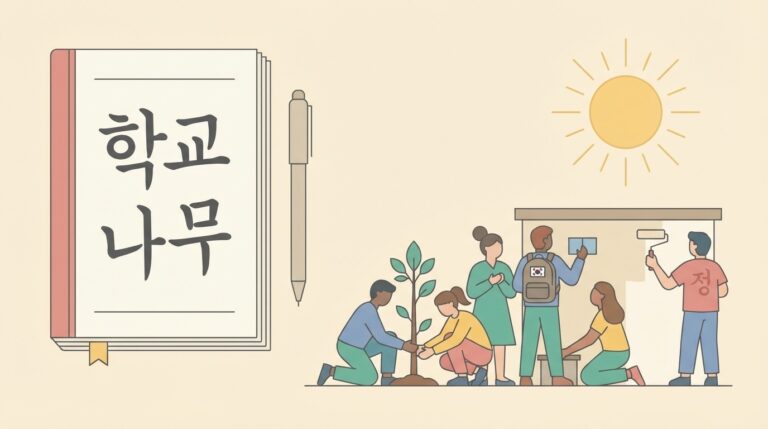
How to Talk About Overseas Volunteering in Korean (Without Sounding Arrogant!) 🌍
Hello! Daily Hangul Editor here. 👋
If you’ve watched K-dramas, you’ve probably seen this trope: the arrogant, wealthy protagonist gets sent on a medical volunteer trip to a remote village abroad. They complain at first, but eventually, they learn the meaning of true happiness, share heartwarming moments over local food, and return home completely transformed. Or maybe you’re a K-Pop fan and you’ve seen your favorite idol’s fandom quietly raise funds to build a school or dig a water well in Southeast Asia under the idol’s name.
Volunteering and giving back are huge parts of modern Korean culture, often summarized by a trendy phrase: 선한 영향력 (Good influence).
But here’s the catch for Korean learners: When you talk about your own overseas volunteer experiences (해외 봉사 활동), the vocabulary you learned in your textbook might actually make you sound… well, a bit arrogant. At the C1 level, it’s no longer just about saying “I helped them” or “It was good.” It’s about expressing deep emotion, reflection, and most importantly, Korean humility.
Let’s dive into how to share your stories like a true, empathetic local!
Phase 2: Core Expressions Deep Dive 🤿
1. 가슴이 벅차올랐어요 (My heart was overwhelmed)
- Pronunciation: [ga-seu-mi beok-cha-ol-la-sseo-yo]
- Meaning: Literal: My chest boiled up. Real: I was overwhelmed with emotion / My heart was incredibly full.
- K-Culture Moment: Picture a K-Pop idol holding their very first music show trophy, tears streaming down their face. They almost always say, “가슴이 벅차네요…” (My heart is so full…). It’s the ultimate expression of positive emotional overload.
- Editor’s Insight: Use this when you want to describe the moment you saw the completed school you helped build, or when the local children hugged you goodbye. It sounds much more poetic and sincere than just saying “너무 기뻤어요” (I was very happy).
- Situation Spectrum:
[🚫 Never] ———— [⚠️ Careful] ———— [✅ Freely]- Close Friends (Casual): ✅ (Use “가슴이 벅차올랐어”)
- Colleagues (Semi-formal): ✅
- Boss/Elders (Formal): ✅
- 🤔 Think About It: Why do Koreans associate strong, overwhelming emotions with the physical sensation of the chest (가슴)? In your native language, where do you “feel” your strongest emotions—your heart, your stomach, or your head?
2. 오히려 제가 더 많이 배우고 왔어요 (Actually, I came back having learned more)
- Pronunciation: [o-hi-ryeo je-ga deo ma-ni bae-u-go wa-sseo-yo]
- Meaning: Literal: On the contrary, I learned more and came back. Real: I went to help, but I ended up learning so much more from them.
- K-Culture Moment: Whenever Korean actors or celebrities return from UNICEF volunteer trips and give interviews, this is their go-to phrase. It is the gold standard of Korean humility.
- Editor’s Insight: If you say “제가 그들을 많이 도와줬어요” (I helped them a lot), Koreans might secretly think you lack Nunchi (social awareness) and are bragging. Emphasizing what you received emotionally from the people you helped shows deep maturity and respect.
- Situation Spectrum:
[🚫 Never] ———— [⚠️ Careful] ———— [✅ Freely]- Close Friends (Casual): ✅
- Colleagues (Semi-formal): ✅
- Boss/Elders (Formal): ✅ (Perfect for job interviews!)
- 🤔 Think About It: Humility is a cornerstone of East Asian communication. Do you think downplaying your own good deeds makes the story more powerful, or should people proudly claim the credit for the help they provided?
3. 제가 우물 안 개구리였다는 걸 깨달았어요 (I realized I was a frog in a well)
- Pronunciation: [je-ga u-mul an gae-gu-ri-yeot-da-neun geol kkae-da-ra-sseo-yo]
- Meaning: Literal: I realized I was a frog in a well. Real: I realized how narrow my perspective/worldview was.
- K-Culture Moment: This is a famous Korean idiom (proverb). It’s used in dramas when a character finally steps out of their privileged bubble and faces the harsh realities of the world.
- Editor’s Insight: C1 learners, this is how you flex your advanced Korean! Using a proverb naturally in conversation instantly makes you sound highly educated and culturally fluent. It’s the perfect way to describe the culture shock and subsequent growth you experienced abroad.
- Situation Spectrum:
[🚫 Never] ———— [⚠️ Careful] ———— [✅ Freely]- Close Friends (Casual): ✅
- Colleagues (Semi-formal): ✅
- Boss/Elders (Formal): ✅
- 🤔 Think About It: What is the equivalent idiom for “a frog in a well” in your language? Does your language use animals to describe ignorance or narrow-mindedness?
Phase 3: Textbook vs. Real Korean 📖🗣️
| Situation | 📖 Textbook Korean | 🗣️ Real Korean (C1 Level) | 💡 Why the difference? |
|---|---|---|---|
| Expressing difficulty | 너무 힘들었습니다. (It was very hard.) | 몸은 고됐지만 마음은 가벼웠어요. (My body was exhausted, but my heart was light.) | Koreans love poetic contrasts. Acknowledging the physical toll while highlighting the spiritual reward shows deep resilience. |
| Describing the impact | 좋은 경험이었습니다. (It was a good experience.) | 제 인생의 터닝포인트가 됐어요. (It became a turning point in my life.) | Incorporating English loanwords (Konglish) like “터닝포인트” sounds much more modern and natural in daily conversation. |
| Talking about the locals | 불쌍한 사람들을 도왔어요. (I helped poor/pitiful people.) | 그분들과 따뜻한 정을 나눴어요. (I shared warm ‘Jeong’ with them.) | Calling someone “불쌍하다” (pitiful) is highly condescending. Focusing on “정” (shared human connection) is respectful and culturally resonant. |
Phase 4: Cultural Deep Dive 🇰🇷
4-1. Non-verbal Communication: The Art of Deflection
When sharing your volunteer story, someone will inevitably praise you: “와, 진짜 대단하시네요! 천사 같아요!” (Wow, you’re amazing! You’re like an angel!).
Do NOT say “Thank you” and nod proudly! In Korea, the correct non-verbal response is to lightly wave one or both hands in front of your chest (like you’re fanning yourself or erasing something in the air), look slightly down, and smile awkwardly while saying, “아유, 아니에요~ 누구나 다 하는 건데요, 뭐” (Oh no~ It’s something anyone would do). This physical act of “pushing away” the compliment is crucial for the humble vibe.
4-2. K-Culture Connection: Fandoms and ‘Good Influence’
In the past, K-Pop fans used to send incredibly expensive luxury gifts to their idols (called 조공 – tribute). Today, the culture has evolved beautifully into 기부 서포트 (Donation Support).
When it’s an idol’s birthday, fans pool their money to build libraries in Vietnam, donate winter briquettes to low-income neighborhoods in Seoul, or adopt endangered animals. Agencies and idols actively encourage this, calling it 선한 영향력 (Good influence). If you ever want to bond with a Korean K-Pop fan, tell them, “I loved how your fandom donated to that overseas charity.” You’ll be best friends instantly.
Phase 5: Immersive Roleplay 🎭
Scenario A: The Networking Cafe
Setting: A cozy, minimalist cafe in Seongsu-dong. You just returned from a 2-week educational volunteer trip in Cambodia. You’re catching up with your Korean colleague, Min-su (32, friendly, always impressed by you).
민수: 출장인 줄 알았는데, 캄보디아로 교육 봉사를 다녀오셨다고요? 와, 진짜 멋지다. 휴가 내고 가신 거예요? ☕
(chuljangin jul aranneunde, kambodiaro gyoyuk bongsareul danyeoosyeotdagoyo? wa, jinjja meotjida. hyuga naego gasin geoyeyo?)
(I thought it was a business trip, but you went to Cambodia for educational volunteering? Wow, that’s so cool. Did you use your vacation days for that?)
YOU: 네, 맞아요. 예전부터 꼭 한 번 해보고 싶었거든요.
(ne, majayo. yejeonbuteo kkok han beon haebogo sipeotgeodeunyo.)
(Yes, that’s right. I’ve always really wanted to try it.)
민수: 와… 보통 휴가 때는 쉬고 싶어 하잖아요. 덥고 환경도 열악했을 텐데, 너무 고생 많으셨어요. 진짜 천사 아니에요? 👼
(wa… botong hyuga ttaeneun swigo sipeo hajanayo. deopgo hwangyeongdo yeorakhaesseul tende, neomu gosaeng maneusyeosseoyo. jinjja cheonsa anieyo?)
(Wow… usually people just want to rest during their vacation. It must have been hot and the conditions were probably harsh, you worked so hard. Aren’t you truly an angel?)
🔀 YOUR TURN! How do you respond?
– A) “네, 날씨가 더워서 정말 고생했어요. 제가 많은 도움을 줬죠!” (Yes, the weather was hot so I suffered a lot. I gave them a lot of help!)
– B) “아유, 아니에요. 봉사하러 갔다가 오히려 제가 더 많이 배우고 왔는걸요.”
– C) “당연한 일을 했을 뿐입니다. 감사합니다.”✅ Best Choice: B — This perfectly deflects the compliment while showing deep reflection.
⚠️ Choice A Analysis: This sounds incredibly arrogant and lacks Nunchi.
⚠️ Choice C Analysis: A bit too stiff and textbook-like. It sounds like a politician giving a press conference!
(Assuming you chose B)
민수: 크… 마인드 진짜 존경스럽다. 가서 제일 기억에 남는 게 뭐였어요?
(keu… maindeu jinjja jongyeongseureopda. gaseo jeil gieoge namneun ge mwoyeosseoyo?)
(Wow… I truly respect your mindset. What was the most memorable thing there?)
YOU: 마지막 날 아이들이 손편지를 써줬는데, 그때 정말 가슴이 벅차올랐어요. 제가 우물 안 개구리였다는 걸 깨달았죠.
(majimak nal aideuri sonpyeonjireul sseojwonneunde, geuttae jeongmal gaseumi beokchaollasseoyo. jega umul an gaeguriyeotdaneun geol kkaedarasseojyo.)
(On the last day, the kids wrote me handwritten letters, and my heart was so overwhelmed then. I realized I had been a frog in a well.)
민수: (감동받은 표정) 아… 무슨 느낌인지 알 것 같아요. 저도 나중에 꼭 한번 참여해보고 싶네요.
Scenario B: K-Culture Bonus (Fandom Donation)
Setting: You are on X (Twitter), trying to join your fandom’s global donation project for your idol’s anniversary.
Korean Fanbase Admin: 여러분의 작은 정성이 모여 큰 기적이 됩니다! 이번 해외 우물 파기 프로젝트에 동참해주세요! 💧
YOU: 저도 작지만 힘을 보태고 싶습니다. 입금했습니다!
Korean Fanbase Admin: 참여해주셔서 감사합니다! 오빠의 이름으로 선한 영향력을 널리 퍼뜨려요! ✨
Phase 6: 10-Second Shadowing Drill ⏱️
Practice this aloud! Pay attention to the pauses (/) and the emotion.
🥺 아유, 아니에요~ / 봉사하러 갔다가 / 오히려 제가 / 더 많은 걸 배우고 왔습니다.
(a-yu, a-ni-e-yo~ / bong-sa-ha-reo gat-da-ga / o-hi-ryeo je-ga / deo ma-neun geol bae-u-go wat-seum-ni-da.)
Tone: Smile modestly, lower your eyes slightly, and speak with a soft, warm tone.
Phase 7: K-Culture Glossary 📚
| Korean | Romanization | English | Contextual Meaning |
|---|---|---|---|
| 선한 영향력 | seonhan yeonghyangnyeok | Good influence | The concept of public figures or groups using their platform to spread positivity and charity. |
| 재능기부 | jaeneunggibu | Talent donation | Volunteering your professional skills (e.g., a photographer taking free portraits for the elderly). |
| 정(情) | jeong | Deep affection/bond | The invisible, warm emotional connection between people. The core of Korean relationships. |
| 조공 | jogong | Tribute/Gifting | Originally meant sending gifts to idols, now often replaced by charitable donations in their name. |
| 십시일반 | sipsiilban | Making a united effort | A proverb meaning “ten spoons make one bowl of rice.” Small efforts combined make a big difference. |
Phase 8: Traveler’s Survival Kit 🧳
Even if you’re volunteering in another country (like India, Vietnam, or Peru), you will often run into Korean volunteer groups or backpackers! Here are survival phrases to connect with them.
🆘 Survival Phrases for Meeting Koreans Abroad
– 🇰🇷 “혹시 한국 분이세요? 반가워요!” (hoksi hanguk buniseyo? bangawoyo!) – Are you Korean by any chance? Nice to meet you!
– 🇰🇷 “좋은 일 하시네요. 응원합니다!” (joeun il hasineyo. eungwonhamnida!) – You’re doing a great thing. I support you!
– 🇰🇷 “저희 사진 좀 같이 찍어주시겠어요?” (jeoheui sajin jom gachi jjigeojusigesseoyo?) – Could you take a picture of us together?📌 Editor’s Travel Note
If you join a Korean volunteer group, KakaoTalk (카카오톡) is mandatory. They will instantly create a “단톡방” (Group Chat) to share schedules, photos, and announcements. Also, Koreans love to share snacks (like instant coffee sticks or jellies) during breaks—accept them with two hands to show appreciation!
Phase 9: Think Deeper — “One Step Further” 🧠
Language & Power: The Eradication of the “White Savior” Complex in Korean
Notice how we completely avoided the word “불쌍하다” (pitiful) or “도와주다” (to help/save) when talking about volunteering. Modern Korean society is increasingly sensitive to the power dynamics embedded in language. The phrase “선한 영향력” (Good influence) shifts the focus away from the ego of the “giver” and focuses purely on the positive ripple effect in the community. By saying “I learned from them,” the Korean language artificially levels the power hierarchy, ensuring dignity for those receiving assistance.
💬 Your Turn: Does your native language have specific words for volunteering that might unintentionally sound condescending? How do you express “giving back” with humility in your culture? Share in the comments!
Phase 10: FAQ & Troubleshooting 🛠️
Q: Can I post photos of my volunteer trip on Instagram, or is that considered bragging in Korea?
Yes, you absolutely can! But the caption matters. Instead of writing “I am so proud of myself for helping these people,” use hashtags like #해외봉사 (Overseas volunteering), #재능기부 (Talent donation), and #선한영향력. Keep the caption focused on how beautiful the local people were and how much you learned.
Q: What if I want to say I felt sorry for the people living in poverty?
❌ Common Mistake: “사람들이 너무 불쌍했어요.” (The people were so pitiful.)
✅ Do This Instead: “마음이 아팠어요.” (My heart hurt.) or “마음이 많이 쓰였어요.” (I was very concerned/My heart went out to them.) This shows empathy without condescension.
Q: Can I use “수고하셨습니다” to the local people I helped?
No! “수고하셨습니다” is for colleagues or people who worked with you. To the locals you interacted with, just say “함께해서 행복했습니다” (I was happy to be with you) or simply “건강하세요” (Stay healthy).
Phase 11: Wrap-up & Action Items 🎬
🎯 One-Liner Summary: Talking about volunteering in Korean isn’t about listing your good deeds; it’s about showcasing your humility, shared Jeong, and personal growth.
Your Action Missions:
– 🥉 Bronze (Solo): Stand in front of a mirror, wave your hand humbly, and say “오히려 제가 더 많이 배우고 왔습니다” 3 times.
– 🥈 Silver (Online): Leave a comment on a Korean celebrity’s or idol’s post about their charity work, saying “선한 영향력 너무 멋져요!” (Your good influence is so cool!).
– 🥇 Gold (Real Life): Next time you talk to a Korean friend or teacher about a time you helped someone, use the phrase “가슴이 벅차올랐어요.”
🎟️ K-Culture Mission: Go to X (Twitter) or Naver and search [Your favorite Idol's name] + 기부 (Donation). Read the articles or posts and see how many times you can spot the words “선한 영향력” or “따뜻한 정”!
Phase 12: Interactive Quiz 📝
1. Situational Judgment: You are being interviewed by a Korean company. The interviewer sees your overseas volunteer experience in Africa and praises you. What is your best response?
– A) 네, 저는 그 불쌍한 아이들을 위해 우물을 파주었습니다.
– B) 감사합니다. 봉사를 통해 오히려 제가 더 넓은 세상을 배우고 왔습니다.
– C) 너무 힘들었지만 좋은 경험이었습니다.
2. Fill in the Blank:
“제가 그동안 ___ __ ___였다는 걸 깨달았습니다. 세상은 정말 넓더라고요.”
(I realized I was a ______ in a _______. The world is truly wide.)
3. True or False – K-Culture Edition:
In Korean fandom culture, “조공(Jogong/Tribute)” is nowadays often replaced by donating to charities or building forests in the idol’s name. (T/F)
(Answers: 1. B, 2. 우물 안 개구리, 3. True)
See you in the next lesson! 화이팅! 💪
Frequently Asked Questions (FAQ)
Q: What does "가슴이 벅차올랐어요 (My heart was overwhelmed)" mean in Korean and how do you pronounce it?
A: In Korean, "가슴이 벅차올랐어요 (My heart was overwhelmed)" is pronounced [ga-seu-mi beok-cha-ol-la-sseo-yo] and means: Literal: My chest boiled up. Real: I was overwhelmed with emotion / My heart was incredibly full.
Q: What does "오히려 제가 더 많이 배우고 왔어요 (Actually, I came back having learned more)" mean in Korean and how do you pronounce it?
A: In Korean, "오히려 제가 더 많이 배우고 왔어요 (Actually, I came back having learned more)" is pronounced [o-hi-ryeo je-ga deo ma-ni bae-u-go wa-sseo-yo] and means: Literal: On the contrary, I learned more and came back. Real: I went to help, but I ended up learning so much more from them.
Q: What does "제가 우물 안 개구리였다는 걸 깨달았어요 (I realized I was a frog in a well)" mean in Korean and how do you pronounce it?
A: In Korean, "제가 우물 안 개구리였다는 걸 깨달았어요 (I realized I was a frog in a well)" is pronounced [je-ga u-mul an gae-gu-ri-yeot-da-neun geol kkae-da-ra-sseo-yo] and means: Literal: I realized I was a frog in a well. Real: I realized how narrow my perspective/worldview was.







