

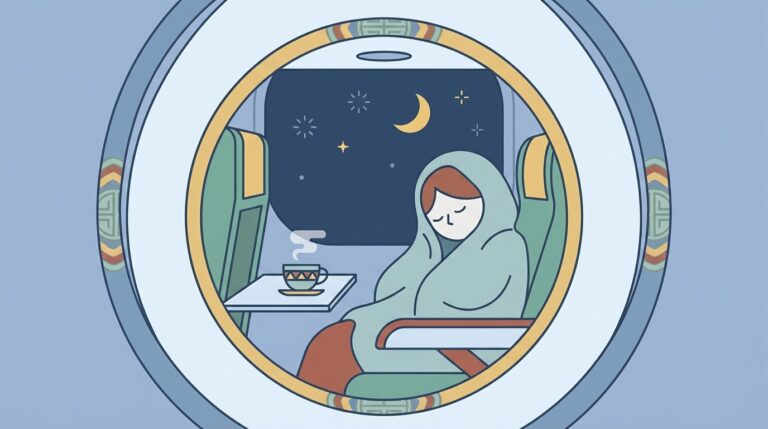
Phase 1: Immersive Hook
Hello, fellow travelers! Lead Editor of Daily Hangul here.
Let’s set the scene: You’re watching a K-Drama. The chaebol heir steps out of the arrivals gate at Incheon International Airport after a 14-hour flight from New York. Their hair is flawless, their skin is glowing, and they immediately jump into a high-stakes board meeting.
Cut to reality.
You’ve just survived a 14-hour flight. Your back aches, your biological clock thinks it’s 3 AM, and you’re desperately trying to decipher whether the flight attendant just asked if you want beef or bibimbap.
If you’re flying to Korea—especially on renowned carriers like Korean Air or Asiana—you’ll encounter a level of customer service that is famously hyper-polite. At the C2 level, simply saying “물 주세요” (Water, please) doesn’t cut it anymore. You want to match their grace, make sophisticated requests, and later, accurately complain about your jet lag to your Korean friends or colleagues just like a local would.
This guide is built from the real experiences of advanced learners who wanted to navigate the skies—and the first 48 hours in Seoul—with absolute linguistic finesse. Buckle up!
Phase 2: Deep Dive into Core Expressions
Let’s upgrade your in-flight and arrival vocabulary from textbook basics to native-level sophistication.
1. 번거로우시겠지만, [요청] 부탁드려도 될까요?
- Pronunciation: beongeorousigetjiman, […] butakdeuryeodo doelkkayo?
- Sound-alike guide: bun-guh-row-she-get-jee-man…
- Meaning: Literal: “Although it will be cumbersome for you, may I ask a favor of…” / Real nuance: “I know it’s a hassle, but could I trouble you for…”
- K-Culture Moment: Picture a business class cabin. Instead of barking orders, a seasoned Korean businessperson gently stops a passing flight attendant with a soft smile and uses this exact phrase to ask for an extra blanket or a glass of warm water. It’s the peak of polite consideration.
- Editor’s Insight: At the C2 level, mastering the “preemptive apology” is crucial. By acknowledging that you are causing an inconvenience (번거로우시겠지만), you instantly win the respect of Korean service workers.
- Situation Spectrum:
[🚫 절대 금지] ———— [⚠️ 주의] ———— [✅ 자유롭게]
- Close Friends (Casual): 🚫 (Too formal, sounds sarcastic!)
- Flight Attendants / Service Staff: ✅ (Perfect)
- Boss / Elders: ✅ (Excellent for making polite requests)
- 🤔 Think About It: Why does Korean have so many expressions that apologize before even making a request? How does this reflect the cultural emphasis on nunchi and group harmony over individual demands?
2. 시차 때문에 비몽사몽이에요.
- Pronunciation: sicha ttaemune bimongsangmong-ieyo.
- Sound-alike guide: shee-cha ddae-moo-ne bee-mong-sa-mong-ee-eh-yo.
- Meaning: Literal: “Because of the time difference, I am in a state of half-dream, half-wakefulness.” / Real nuance: “I’m completely out of it/delirious because of jet lag.”
- K-Culture Moment: You’ll see K-Pop idols use this constantly on their hotel room V-Lives after arriving in LA or Paris for a world tour. They rub their eyes, look at the camera, and mumble, “여러분… 저 지금 완전 비몽사몽이에요…” (Guys… I’m completely out of it right now…)
- Editor’s Insight: Bimongsangmong is a Saja-seongeo (four-character idiom derived from Hanja). Using these idioms elevates your Korean from “fluent” to “educated native.” It perfectly captures that specific brain-fogged state of severe jet lag.
- Situation Spectrum:
[🚫 절대 금지] ———— [⚠️ 주의] ———— [✅ 자유롭게]
- Close Friends (Casual): ✅ (Say “비몽사몽이야”)
- Colleagues (Semi-formal): ✅ (Great for small talk before a meeting)
- Formal Presentations: ⚠️ (A bit too personal/casual for a speech)
- 🤔 Think About It: Saja-seongeo often compress complex human experiences into just four syllables. Does your language have a similarly compact way to express the exact feeling of jet lag?
3. 눈 좀 붙이려고 하는데…
- Pronunciation: nun jom buchiryeogo haneunde…
- Sound-alike guide: noon johm boo-chee-ryuh-go ha-neun-deh…
- Meaning: Literal: “I am trying to attach my eyes…” / Real nuance: “I’m trying to get some shut-eye / catch some Zs…”
- K-Culture Moment: You’re in the middle seat, trying to sleep, but the passenger next to you has their reading light glaring. You softly say this to the flight attendant as a preamble to asking them to help mediate the lighting situation.
- Editor’s Insight: “Attaching the eyes” is such a vivid, physical way to describe sleeping. It sounds infinitely more natural and native-like than simply saying “자려고 하는데요” (I am trying to sleep).
- Situation Spectrum:
[🚫 절대 금지] ———— [⚠️ 주의] ———— [✅ 자유롭게]
- Close Friends (Casual): ✅
- Flight Attendant (Soft request context): ✅
- Boss / Elders: ⚠️ (Use with caution; better to say “잠시 휴식을 취하려고 합니다”)
- 🤔 Think About It: Korean idioms frequently use body parts (eyes, ears, hands) to describe actions and emotions. Why is the language so deeply rooted in physical sensation?
Phase 3: Textbook vs. Real Life
| Situation | 📖 Textbook Korean | 🗣️ Real Korean | 💡 Why the difference? |
|---|---|---|---|
| Asking for water on a flight | 물 주시겠어요? (Could you give me water?) | 번거로우시겠지만, 따뜻한 물 한 잔 부탁드려도 될까요? | Service culture requires higher levels of indirect politeness. |
| Explaining you’re jet-lagged | 시차 때문에 피곤합니다. (I am tired due to the time difference.) | 밤낮이 완전 바뀌어서 비몽사몽이에요. (Day and night are totally flipped, I’m out of it.) | C2 speakers use idiomatic expressions (비몽사몽) to convey the exact physical sensation. |
| Complaining about failing to adjust | 시차 적응이 어렵습니다. (Jet lag adjustment is difficult.) | 시차 적응 폭망했어요. (I completely bombed adjusting to the time zone.) | Slang like ‘폭망’ (complete failure) is widely used by younger generations and idols for comedic effect. |
Phase 4: Cultural Deep Dive
4-1. Non-verbal Communication: The “Two-Handed” Cabin Rule
When a Korean flight attendant hands you your meal tray or a cup of water, notice how they do it: often with two hands, or with one hand supporting the forearm of the other. As an advanced learner, mirroring this gesture—receiving your cup with two hands, or giving a slight nod of the head (목례)—shows that you don’t just speak Korean; you breathe the culture. Also, maintain soft, not piercing, eye contact when making a request.
4-2. K-Culture Connection: Airport Fashion & The Arrival Myth
In K-Culture, airports aren’t just transit hubs; they are runways. K-Pop idols’ “공항패션” (Airport Fashion) is a massive industry. Brands pay thousands for an idol to wear their trench coat while holding a passport.
But here’s the critical contrast: while the media portrays this flawless travel experience, the idols themselves will log onto Weverse or bubble from their hotel rooms a few hours later, looking exhausted, saying: “한국 도착! 근데 시차 적응 대실패… 지금 새벽 3신데 눈이 말똥말똥해요.” (Arrived in Korea! But totally failed jet lag adjustment… It’s 3 AM and my eyes are wide awake.) Understanding this dual reality—the public perfection vs. the private exhaustion—gives you the perfect icebreaker when you meet your Korean colleagues the next day.
Phase 5: Immersive Roleplay
Scenario A: The In-Flight Diplomacy
- Setting: 35,000 feet above the Pacific. Cabin lights are dimmed. You are flying Korean Air to Seoul. You woke up feeling incredibly dehydrated, but the meal service is over, and the flight attendants are busy in the galley.
- Characters:
- YOU: A seasoned business traveler heading to Seoul for a major conference.
- 지윤 (Ji-yoon): A highly professional flight attendant.
YOU: (Pressing the call button gently. Ji-yoon approaches quietly.)
지윤: 손님, 무엇을 도와드릴까요?
(Sonnim, mueoseul dowadeurilkkayo?)
[Passenger, how may I help you?]
YOU: 저기요, 물 좀 주세요.
(Jeogiyo, mul jom juseyo.)
[Excuse me, give me some water.]
(Wait, no! You’re a C2 learner! Let’s rewind.)
YOU: 승무원님, 번거로우시겠지만 따뜻한 물 한 잔 부탁드려도 될까요?
(Seungmuwon-nim, beongeorousigetjiman ttatteuthan mul han jan butakdeuryeodo doelkkayo?)
[Flight attendant, I know it’s a hassle, but could I trouble you for a glass of warm water?]
지윤: (Smiling warmly) 네, 그럼요. 금방 준비해 드리겠습니다. 혹시 다른 필요하신 건 없으십니까?
(Ne, geureomyo. Geumbang junbihae deurigetseumnida. Hoksi dareun piryohasin geon eopseusimnikka?)
[Yes, of course. I will prepare it for you right away. Do you need anything else by any chance?]
🔀 Your Turn! How do you ask for an extra blanket because it’s chilly?
– A) 담요도 하나 주세요. (Give me a blanket too.)
– B) 아, 눈 좀 붙이려고 하는데 혹시 여분 담요가 있을까요?
– C) 여기 너무 추워요. (It’s too cold here.)✅ Best Choice: B — “Ah, I’m trying to get some shut-eye, do you have any extra blankets by any chance?” This uses the soft ‘혹시’ (by any chance), gives a reason (‘눈 좀 붙이려고 하는데’), and asks if there are ‘여분’ (extras), showing maximum consideration for the cabin’s limited supplies.
Scenario B: The Morning After in Seoul
- Setting: Your company’s Seoul office, 9:00 AM. You are clutching an iced Americano for dear life.
- Character: 민수 (Min-su, 34, your energetic Korean colleague).
민수: 오, 어서 오세요! 비행은 괜찮으셨어요? 피곤해 보이시는데.
(O, eoseo oseyo! Bihaengeun gwaenchaneusyeosseoyo? Pigonhae boisineunde.)
[Oh, welcome! Was the flight okay? You look tired.]
YOU: 네, 무사히 도착했어요. 그런데 시차 적응에 실패해서 지금 완전 비몽사몽이에요.
(Ne, musahi dochakaesseoyo. Geureonde sicha jeogeunge silpaehaeseo jigeum wanjeon bimongsangmong-ieyo.)
[Yes, I arrived safely. But I failed to adjust to the jet lag, so I’m completely out of it right now.]
민수: 하하, 첫날은 원래 다 그래요. 이따 점심에 얼큰한 김치찌개 먹으면서 땀 좀 빼면 시차 적응 확 될 겁니다!
[Haha, the first day is always like that. Later at lunch, if we eat some spicy Kimchi stew and sweat a bit, you’ll adjust immediately!]
Phase 6: 10-Second Shadowing Drill
Practice this advanced request until it rolls off the tongue. Pay attention to the pauses (/) and the polite, gentle intonation.
🥺 부드럽고 공손하게 (Soft and polite):
승무원님, / 번거로우시겠지만 / 따뜻한 물 한 잔 / 부탁드려도 될까요?
(seungmuwon-nim, / beongeorousigetjiman / ttatteuthan mul han jan / butakdeuryeodo doelkkayo?)
“Flight attendant, I know it’s a hassle, but could I trouble you for a glass of warm water?”
Phase 7: K-Culture Glossary (Travel Edition)
| Korean | Romanization | English | Context |
|---|---|---|---|
| 시차 적응 | sicha jeogeung | Jet lag adjustment | The physical and mental battle of overcoming the time difference. Often paired with ‘성공'(success) or ‘실패/폭망'(failure). |
| 비몽사몽 | bimongsangmong | Half-asleep, delirious | A 4-character idiom describing the dazed state of extreme fatigue or waking up. |
| 공항패션 | gonghang paesyeon | Airport fashion | The K-Pop/K-Drama phenomenon where celebrities treat the airport departure hall like a runway. |
| 눈(을) 붙이다 | nun(eul) buchida | To get some shut-eye | An idiom literally meaning “to attach the eyes,” used for taking brief naps or sleeping on flights. |
| 기내식 | ginaesik | In-flight meal | A highly anticipated part of Korean airlines (Bibimbap is the classic!). |
Phase 8: Traveler’s Survival Kit
🆘 Top 3 Advanced Airport/Flight Survival Phrases
- 🇰🇷 “입국 신고서는 어디서 작성하나요?” (ipguk singoseoneun eodiseo jakseonghanayo?)
- Meaning: “Where do I fill out the arrival card?”
- Pro Tip: Use ‘작성하다’ (to fill out/write up) instead of the basic ‘쓰다’ to sound like a seasoned traveler.
- 🇰🇷 “혹시 수하물 찾는 곳이 몇 번 레일인지 알 수 있을까요?” (hoksi suhamul channeun gosi myeot beon reirinji al su isseulkkayo?)
- Meaning: “Could I possibly find out which baggage claim carousel it is?”
- 🇰🇷 “시내로 나가는 공항버스 매표소는 어디에 있나요?” (sinaero naganeun gonghangbeoseu maepyosoneun eodie innayo?)
- Meaning: “Where is the ticket booth for the airport limousine buses heading downtown?”
📌 Editor’s Travel Note
– Navigating from ICN: Download KakaoMetro or Naver Map before you board. Google Maps does not provide walking/driving directions effectively in Korea due to security laws.
– The K-ETA / Q-Code: Make sure your documents are sorted before landing to breeze through immigration while you’re still 비몽사몽!
– Tipping FAs? ABSOLUTELY NOT. Tipping is not a part of Korean culture. Trying to tip a flight attendant for good service will only confuse them and might even be perceived as inappropriate. A sincere “수고 많으셨습니다” (Thank you for your hard work) upon disembarking is the highest praise.
Phase 9: Think Deeper — “One Step Further”
🧠 Think Deeper: Language, Power, and Hyper-Politeness (Gapjil Culture)
When you fly a Korean airline, you’ll notice the flight attendants use an extreme level of honorifics, sometimes even applying honorifics to objects (e.g., “커피 나오셨습니다” – literally “The coffee has honorably arrived”). From a C2 perspective, this “hyper-correction” stems from Korea’s highly competitive service industry and the societal issue of Gapjil (갑질) — the abuse of power by customers over service workers. As an advanced speaker, your goal shouldn’t be to demand this level of subservience, but to break the hierarchy gracefully. By using phrases like “번거로우시겠지만” (I know it’s a hassle) and ending your interactions with “수고하셨습니다” (Thank you for your hard work), you signal that you respect them as equals. You aren’t just speaking Korean; you are healing a societal pain point.
💬 Your Turn: Have you ever experienced a culture shock regarding customer service in Korea compared to your home country? How do you handle overly polite service? Share your thoughts in the comments!
Phase 10: FAQ & Troubleshooting
Q: Can I use “~요” (informal polite) with flight attendants, or must I use “~습니다/까” (formal polite)?
Editor’s Answer: At a C2 level, you want to use a mix. For simple, quick confirmations, “~요” is fine (“네, 좋아요”). But when making requests or asking questions, using “~습니다/까” or the highly polite “~으시겠어요?” elevates your sophistication and matches their professional tone.
Q: Why do Koreans say “수고하세요” to workers? Doesn’t it mean “work hard”?
Editor’s Answer: Literally, yes (“Keep suffering/working hard”). But culturally, it means “I acknowledge your hard work.” Use “수고 많으십니다” (You are working very hard) when making a request, or “수고하셨습니다” when leaving the plane.
❌ Common Mistake #1: Being too direct with “주세요” (Give me).
While grammatically correct, “담요 주세요” sounds like a command from a child or a demanding boss to a service worker.
✅ Do This Instead: Always soften the blow with “부탁드립니다” (I request) or “~있을까요?” (Would you happen to have…).
Phase 11: Wrap-up & Action Items
One-Liner Summary: Surviving a long-haul flight and jet lag in Korean requires swapping blunt requests for preemptive apologies and using vivid idioms like Bimongsangmong.
Action Mission 3 Steps:
– 🥉 Bronze (Solo): Stand in front of a mirror and practice saying “시차 때문에 비몽사몽이에요” 3 times with the most exhausted face you can make.
– 🥈 Silver (Online): Go to a K-Pop group’s YouTube or Weverse where they post a tour vlog. Leave a comment: “오빠/언니들, 비행하느라 수고 많았어요! 시차 적응 화이팅!”
– 🥇 Gold (Real Life): On your next flight to Korea, or the next time you visit a high-end Korean restaurant, use “번거로우시겠지만…” to ask for something extra. Watch the staff’s eyes light up with respect.
Phase 12: Interactive Quiz — K-Culture Challenge
1. Situational Judgment: You dropped your fork on a Korean Air flight and need a new one. What is the most C2-appropriate way to ask?
– A) 저기요, 포크 떨어졌어요. 새 거 주세요.
– B) 승무원님, 죄송한데 포크 하나만 갖다주실래요?
– C) 번거로우시겠지만, 포크 하나만 새로 부탁드려도 될까요?
2. Fill in the Blank: “It’s 2 PM in Seoul, but my body thinks it’s 1 AM. I completely failed my jet lag adjustment. 저는 시차 적응에 실패해서 완전 ______________이에요.”
3. True or False – K-Culture Edition: “It is customary to leave a $5-$10 tip for the Korean flight attendants if they brought you extra snacks during the long-haul flight.” (T/F)
Click here for Answers!
- C (A is too demanding. B is okay but slightly casual for high-end service. C is perfect C2-level consideration.)
- 비몽사몽 (bimongsangmong)
- False. Korea is strictly a no-tip culture. Offering cash to a flight attendant will likely cause immense awkwardness. Express your gratitude with “정말 친절하게 도와주셔서 감사합니다” (Thank you for helping me so kindly) instead.
Frequently Asked Questions (FAQ)
Q: What does "번거로우시겠지만, [요청] 부탁드려도 될까요?" mean in Korean and how do you pronounce it?
A: In Korean, "번거로우시겠지만, [요청] 부탁드려도 될까요?" is pronounced [beongeorousigetjiman, [...] and means: Literal: "Although it will be cumbersome for you, may I ask a favor of..." / Real nuance: "I know it's a hassle, but could I trouble you for..."
Q: What does "시차 때문에 비몽사몽이에요." mean in Korean and how do you pronounce it?
A: In Korean, "시차 때문에 비몽사몽이에요." is pronounced [sicha ttaemune bimongsangmong-ieyo.] and means: Literal: "Because of the time difference, I am in a state of half-dream, half-wakefulness." / Real nuance: "I'm completely out of it/delirious because of jet lag."
Q: What does "눈 좀 붙이려고 하는데..." mean in Korean and how do you pronounce it?
A: In Korean, "눈 좀 붙이려고 하는데..." is pronounced [nun jom buchiryeogo haneunde...] and means: Literal: "I am trying to attach my eyes..." / Real nuance: "I'm trying to get some shut-eye / catch some Zs..."







