

Phase 1: 공감 — 몰입형 오프닝 (Immersive Hook)
Hello there! This is your editor from Daily Hangul.
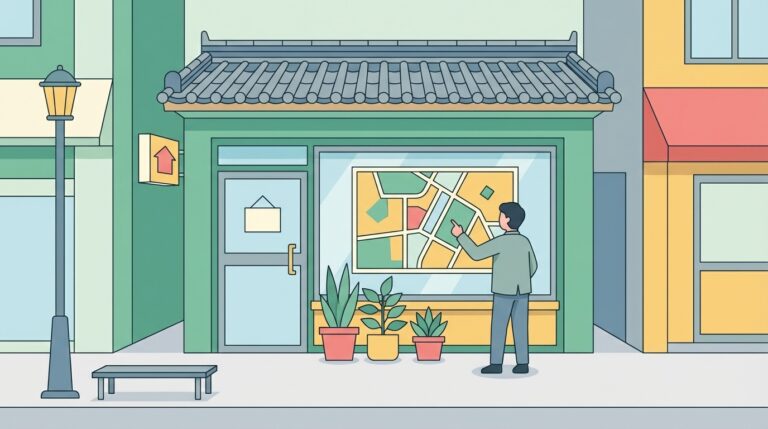
Picture this: You’re watching a classic K-Drama. The main character, having just moved to Seoul to chase their dreams, walks into an office with windows plastered in colorful papers and maps. A friendly middle-aged woman—the Ajumma—hands them a sweet, steaming paper cup of Maxim instant coffee. They sit down, sigh, and say, “I need a room.”
If you’re planning to live in Korea, transition from a traveler to an expat, or just want to understand the reality behind those K-Drama scenes, you are going to encounter the 부동산 (Budongsan – Real Estate Agency).
Walking into a Budongsan can be intimidating. The vocabulary is highly specific, and there’s a unique culture of negotiation and neighborhood networking. But don’t worry! As your veteran tutor and local Seoulite friend, I’m here to guide you. By the end of this post, you won’t just survive your visit to the Korean real estate office—you’ll walk in like a confident local.
Let’s dive into the exact phrases you need to make an appointment and secure that dream apartment!
Phase 2: 핵심 표현 심층 분석 (Deep Dive)
Let’s break down the 3 essential phrases you need when approaching a real estate agent.
1. 방 좀 보러 왔는데요. (I came to look at some rooms.)
- Pronunciation: bang jom boreo wanneundeyo. [bahng johm boh-ruh wahn-neun-deh-yo]
- Meaning: Literal: “I came to see a room a little.” / Real nuance: “Hi, I’m looking for an apartment/room.”
- K-Culture Moment: This is the ultimate icebreaker. You open the sliding door of the Budongsan, the agent looks up from their desk, and you drop this line. It immediately tells them your purpose without sounding too demanding.
- Editor’s Insight: The word ‘좀’ (jom – literally ‘a little’) is the magic dust of Korean politeness. We use it to soften requests. Without it, “방 보러 왔어요” sounds a bit blunt, almost like a military report.
- Situation Spectrum:
[🚫 절대 금지] ———— [⚠️ 주의] ———— [✅ 자유롭게]
- Casual (To a friend): 🚫 (Friends don’t show you houses!)
- Semi-formal (To a Budongsan agent): ✅
- Formal (To a much older/strict agent): ✅ (It ends in ‘요’, making it polite enough for customer interactions)
- 🤔 Think About It: Why do Koreans use “좀 (a little)” even when they want to see many rooms? How does your culture soften requests?
2. 혹시 오늘 집 볼 수 있을까요? (By any chance, can I view houses today?)
- Pronunciation: hoksi oneul jip bol su isseulkkayo? [hohk-shee oh-neul jeep bohl soo ees-seul-kka-yo?]
- Meaning: Literal: “By any chance, today house see can we?” / Real nuance: “Is it possible to do some viewings today?”
- K-Culture Moment: Unlike some countries where you must book days in advance, Korean Budongsans often operate on a “let’s go right now” basis. If the current tenant is home or the agent has the passcode, you could be touring a place 5 minutes after saying this!
- Editor’s Insight: ‘혹시’ (hoksi – by any chance) is your best friend when making requests. It shows you are considerate of the other person’s schedule.
- Situation Spectrum:
[🚫 절대 금지] ———— [⚠️ 주의] ———— [✅ 자유롭게]
- Texting the agent (Semi-formal): ✅
- Walking into the office (Semi-formal): ✅
- 🤔 Think About It: The concept of “Ppalli-ppalli” (Hurry, hurry) culture applies heavily to real estate. Houses go off the market in a matter of hours! Would you feel comfortable signing a lease on the same day you saw the house?
3. 보증금 OO에 월세 OO 정도 생각하고 있어요. (I’m thinking around a deposit of XX and monthly rent of XX.)
- Pronunciation: bojeunggeum [Amount]-e wolse [Amount] jeongdo saenggakago isseoyo.
(Tip: ‘으’ sounds like the disgusted sound you make when stepping in gum: “eu”)- Meaning: Literal: “To deposit XX, monthly rent XX around, I am thinking.” / Real nuance: “My budget is XX for the deposit and XX for the rent.”
- K-Culture Moment: The moment you say this, the agent’s brain starts calculating like a supercomputer. They might click their tongue and say, “Aigoo, that’s a bit tough in this neighborhood…” (Don’t panic, this is part of the dance!)
- Editor’s Insight: Koreans rarely say “I want to pay exactly this.” Using “~정도 생각하고 있어요” (~jeongdo saenggakago isseoyo / I am thinking around…) leaves room for negotiation and sounds much more natural and polite.
- Situation Spectrum:
[🚫 절대 금지] ———— [⚠️ 주의] ———— [✅ 자유롭게]
- Consulting with the agent: ✅
Phase 3: 교과서 vs 진짜 한국어 (Textbook vs Real Life)
| 상황 | 📖 교과서 한국어 | 🗣️ 진짜 한국어 | 💡 왜 다를까? |
|---|---|---|---|
| Entering the agency | 부동산 중개인님, 안녕하십니까. (Hello, Mr. Real Estate Agent.) | 안녕하세요~ 방 좀 알아보려고요. (Hello~ I’m looking to check out some rooms.) | “중개인님” sounds too formal and distant. Koreans treat local agents almost like neighborhood aunts/uncles. |
| Asking for budget | 제 예산은 천만 원입니다. (My budget is 10 million won.) | 천에 오십 정도 생각해요. (I’m thinking 10 over 50.) | Efficiency! Koreans drop the “million won” (만원) and just say the numbers (Deposit 1000 / Rent 50). |
| Making an appointment | 화요일 오후 2시에 예약하고 싶습니다. (I want to reserve 2 PM on Tuesday.) | 혹시 화요일 두 시쯤 방문해도 될까요? (Can I visit around 2 PM on Tuesday by any chance?) | Direct demands feel rude. Asking “Is it okay if I visit around…” shows Nunchi (social tact). |
Phase 4: 문화적 맥락 — K-Culture 딥다이브 (Cultural Deep Dive)
4-1. 비언어적 요소 (Non-verbal Communication)
In Korea, making the appointment is just the first step. When the agent actually takes you to see the house, you must take off your shoes at the Hyungwan (현관 – entrance). Even if the house is empty and dusty, stepping on the floor with outdoor shoes is a massive cultural faux pas. Also, when you hand over your ID or sign documents later, always use two hands—it’s a sign of respect!
4-2. K-Culture 연결 고리 (K-Culture Connection)
The K-Drama “Neighborhood Hub” Trope:
Have you noticed in K-Dramas like Reply 1988 or Hometown Cha-Cha-Cha how the real estate agent knows everyone’s business? It’s not just TV fiction! In Korea, the Budongsan is the information hub of the neighborhood. The agents usually live in the area, know which building owner is grumpy, and which street gets too noisy on weekends. Building a good rapport with your agent (being polite, accepting that mixed coffee) often means they will fight for you to get a better deal or lower your maintenance fee!
Phase 5: 실전 롤플레이 시나리오 (Immersive Roleplay)
시나리오 A: 메인 롤플레이 (Main Scenario)
- Setting: A sunny Tuesday afternoon. You walk into “Seoul Metro Real Estate.” The walls are covered in complex neighborhood maps. An agent in her 50s is sipping coffee and watching a trot music show on TV.
- Characters:
- YOU: An expat whose Korean B1 skills are ready to shine.
- Agent (소장님 – Sojangnim): Friendly, talks a bit fast, but genuinely wants to help.
Agent: 어서 오세요~ 방 찾으세요? ☕
(eoseo oseyo~ bang chajeuseyo?)
[Welcome~ Are you looking for a room?]
(🎭 Stage Direction: She mutes the TV and smiles warmly)
YOU: 네, 안녕하세요. 원룸 좀 보러 왔는데요.
(ne, annyeonghaseyo. wollum jom boreo wanneundeyo.)
[Yes, hello. I came to look for a one-room.]
Agent: 아유, 잘 오셨네! 이사는 언제쯤 하려고요?
(ayu, jal osyeonne! isaneun eonjejjeum haryeogoyo?)
[Oh, you came to the right place! Around when are you planning to move?]
YOU: 다음 달 초에 이사해야 해요.
(daeum dal cho-e isahaeya haeyo.)
[I need to move early next month.]
Agent: 그렇구나. 혹시 예산은 어느 정도 생각하고 있어요?
(geureokuna. hoksi yesaneun eoneu jeongdo saenggakago isseoyo?)
[I see. By any chance, what budget are you thinking of?]
YOU: 보증금 천만 원에 월세 60만 원 정도 생각하고 있어요.
(bojeunggeum cheonman won-e wolse yuksipman won jeongdo saenggakago isseoyo.)
[I’m thinking of a deposit of 10 million won and rent of 600,000 won.]
Agent: 쓰읍… 요새 그 가격대 방이 많이 빠졌는데… 잠깐만요. (Clicks mouse rapidly) 아! 딱 하나 좋은 거 있다.
(sseueup… yosae geu gagyeokdae bang-i mani ppajyeonneunde… jamkkanmanyo. a! ttak hana joeun geo itda.)
[Inhales sharply… Rooms in that price range have mostly been taken lately… Wait a minute. Ah! There’s one really good one.]
🔀 당신의 차례! 어떻게 대답할까요? (Your Turn! How will you respond?)
– A) 당장 내놓으세요! (Give it to me right now!)
– B) 혹시 오늘 집 볼 수 있을까요? (By any chance, can I see the house today?)
– C) 너무 비싸요. 깎아주세요. (It’s too expensive. Give me a discount.)✅ Best Choice: B — Korean real estate moves fast. If a good room pops up, you should see it immediately.
⚠️ Choice A & C 분석: Choice A is incredibly aggressive and rude. Choice C makes no sense because you haven’t even seen the house or heard the exact price yet!
YOU (Choosing B): 오, 진짜요? 혹시 오늘 집 볼 수 있을까요?
(o, jinjjayo? hoksi oneul jip bol su isseulkkayo?)
[Oh, really? Can I see the house today?]
Agent: 지금 비밀번호 아니까 바로 보러 갑시다! 따라와요.
(jigeum bimilbeonho anikka baro boreo gapsida! ttarawayo.)
[I know the passcode right now, so let’s go see it immediately! Follow me.]
YOU: 네, 감사합니다!
(ne, gamsahamnida!)
[Yes, thank you!]
시나리오 B: K-Culture 보너스 롤플레이 (Getting Lost!)
You made an appointment by phone, but Naver Maps is acting up. You’re standing in an alleyway. You ask a passing student.
– YOU: 저기요, 혹시 ‘대박 부동산’ 어딘지 아세요? (Excuse me, do you know where ‘Daebak Real Estate’ is?)
– Student: 아, 저기 편의점 보이시죠? 그 골목으로 들어가시면 바로 있어요. (Ah, you see that convenience store? Go into that alley and it’s right there.)
– YOU: 아, 편의점 골목이요! 감사합니다! (Ah, the convenience store alley! Thank you!)
Phase 6: 10초 섀도잉 드릴 (Shadowing Drill)
Practice making your request naturally. Follow the slashes for pacing!
😊 안녕하세/요! / 방 좀 / 보러 / 왔는데/요.
(annyeonghase/yo! / bang jom / boreo / wanneunde/yo.)
🥺 보증금 / 천만 원/에 / 월세 / 오십 정도 / 생각/해요.
(bojeunggeum / cheonman won/e / wolse / osip jeongdo / saenggak/haeyo.)
✨ 혹시 / 오늘 / 집 / 볼 수 / 있을까/요?
(hoksi / oneul / jip / bol su / isseulkka/yo?)
Phase 7: K-Culture 미니 사전 (K-Culture Glossary)
| 한국어 | Romanization | English | Context |
|---|---|---|---|
| 부동산 | budongsan | Real estate agency | Short for ‘Real Estate Agent Office’. Look for this sign on streets! |
| 원룸 | wollum | One-room (Studio) | Konglish for a studio apartment. Very common for singles. |
| 보증금 | bojeunggeum | Key money / Deposit | In Korea, rent deposits are extremely high (often $5,000 – $10,000+). |
| 월세 | wolse | Monthly rent | You pay this every month, usually along with a maintenance fee. |
| 전세 | jeonse | Jeonse (Huge lump-sum deposit) | A unique Korean system where you pay a massive deposit (like 70% of house value) but NO monthly rent! |
| 관리비 | gwallibi | Maintenance fee | Covers building cleaning, sometimes internet/water. Always ask how much this is! |
Phase 8: 여행자 서바이벌 키트 (Traveler’s Survival Kit)
Whether you are hunting for an apartment or trying to find a specific K-Pop pop-up store, navigating the labyrinth of Korean streets requires some survival skills!
🆘 서바이벌 표현 (Navigation Edition)
– 🇰🇷 “길을 잃었어요. 여기가 어디예요?” (gireul ireosseoyo. yeogiga eodiyeyo?)
– I’m lost. Where is this place?
– 🇰🇷 “~로 가려면 어떻게 가야 해요?” (~ro garyeomyeon eotteoke gaya haeyo?)
– How do I go to ~?
– 🇰🇷 “가장 가까운 지하철역이 어디예요?” (gajang gakkaun jihacheollyeogi eodiyeyo?)
– Where is the nearest subway station?📌 Editor’s Travel Note
– The Ultimate App: Do NOT rely on Google Maps for walking directions in Korea. Download Naver Map or KakaoMap. They are the lifelines of Korean navigation!
– Street Logic: Korean addresses are based on street names (도로명) and building numbers, but many locals still refer to places by landmarks (e.g., “Behind the Starbucks”).
Phase 9: 비판적 사고 코너 — “한 발 더 깊이” (Think Deeper)
🧠 Think Deeper: Media vs Reality (미디어와 현실의 차이)
In countless K-Dramas, the struggling protagonist lives in a charming “Oktapbang” (옥탑방 – Rooftop room). They drink beer under the city lights, looking incredibly romantic. However, the reality of Korean real estate is quite different! Rooftop rooms are notorious for being freezing in the winter and boiling like an oven in the summer due to lack of insulation. The media romanticizes poverty and struggle, painting it with a pastel K-Drama filter. Real-life Korean house hunting is highly competitive and practical.💬 Your Turn: Does your country’s TV shows romanticize certain types of housing (like NYC loft apartments in Friends) that are actually terrible or impossible to afford in real life? Share in the comments!
Phase 10: FAQ & 오해 방지 (Troubleshooting)
Q: Do I need to pay the agent to just look at houses?
No! Viewing houses is completely free. You only pay a brokerage fee (복비 – bokbi) after you successfully sign a lease contract.
Q: Can I negotiate the rent price?
Sometimes! But in Korea, you usually negotiate the deposit to lower the rent. For example, adding an extra 10 million won to your deposit might lower your monthly rent by 50,000 won.
❌ 흔한 실수 #1: Forgetting the Maintenance Fee (관리비)
Many foreigners find a room with cheap rent, sign the contract, and are shocked to find out there is an extra 150,000 won monthly maintenance fee!
✅ 이렇게 하세요: Always ask: “관리비는 얼마예요? 그리고 뭐가 포함돼 있어요?” (How much is the maintenance fee, and what is included?)
Phase 11: 요약 및 액션 아이템 (Wrap-up)
- One-Liner Summary: Soften your requests with “방 좀 보러 왔는데요” and state your budget using “~정도 생각하고 있어요” to sound like a natural Korean resident!
Action Mission 3단계:
– 🥉 Bronze (Solo): Stand in front of a mirror and practice saying your budget in Korean out loud! “보증금 OOO에 월세 OOO…”
– 🥈 Silver (Online): Find a Korean real estate app (like ‘Zigbang’ 직방 or ‘Dabang’ 다방) and look up the average rent in a Seoul neighborhood you’d love to live in.
– 🥇 Gold (Real Life): If you’re in Korea, walk past a Budongsan today and try to read the numbers posted on their windows (Deposit/Rent).
🎬 K-Culture Mission:
Next time you watch a K-Drama and someone moves into a new house, watch how they interact with the Budongsan agent or the building owner. Do they bow? Do they bring a small gift? Notice the Nunchi!
Have you ever stayed in an interesting place in Korea, like a Goshiwon, Hanok, or an Airbnb? Tell me about your experience below!👇
Phase 12: 퀴즈 — 인터랙티브 챌린지 (Interactive Quiz)
1. Situational Judgment: You want to ask if it’s possible to view a house today. Which is the most polite and natural way?
– A) 오늘 집 보세요. (Look at the house today.)
– B) 당장 집 보여주세요. (Show me the house right now.)
– C) 혹시 오늘 집 볼 수 있을까요? (By any chance, can I see the house today?)
2. Fill in the Blank:
“보증금 1000에 월세 50 (______).” (I am thinking of a deposit of 1000 and rent of 50.)
(Hint: Think about it…)
3. True or False — K-Culture Edition:
“It is culturally acceptable to wear your sneakers while touring an empty apartment in Korea with an agent.” (T/F)
👀 정답 보기 (Click for Answers)
1. C. “혹시” (by any chance) softens the request beautifully. (A means you’re commanding them to look, B is rude).
2. 정도 생각해요 (or 정도 생각하고 있어요). This gives flexibility to the budget!
3. False. Never wear outdoor shoes inside a Korean living space, even if it’s currently empty or under light renovation!
Frequently Asked Questions (FAQ)
Q: What does "방 좀 보러 왔는데요. (I came to look at some rooms.)" mean in Korean and how do you pronounce it?
A: In Korean, "방 좀 보러 왔는데요. (I came to look at some rooms.)" is pronounced [bang jom boreo wanneundeyo. [bahng johm boh-ruh wahn-neun-deh-yo] and means: Literal: "I came to see a room a little." / Real nuance: "Hi, I'm looking for an apartment/room."
Q: What does "혹시 오늘 집 볼 수 있을까요? (By any chance, can I view houses today?)" mean in Korean and how do you pronounce it?
A: In Korean, "혹시 오늘 집 볼 수 있을까요? (By any chance, can I view houses today?)" is pronounced [hoksi oneul jip bol su isseulkkayo? [hohk-shee oh-neul jeep bohl soo ees-seul-kka-yo?] and means: Literal: "By any chance, today house see can we?" / Real nuance: "Is it possible to do some viewings today?"
Q: What does "보증금 OO에 월세 OO 정도 생각하고 있어요. (I'm thinking around a deposit of XX and monthly rent of XX.)" mean in Korean and how do you pronounce it?
A: In Korean, "보증금 OO에 월세 OO 정도 생각하고 있어요. (I'm thinking around a deposit of XX and monthly rent of XX.)" is pronounced [bojeunggeum [Amount] and means: Literal: "To deposit XX, monthly rent XX around, I am thinking." / Real nuance: "My budget is XX for the deposit and XX for the rent."







