

Phase 1: Immersive Hook
Hello there! It’s your Daily Hangul Editor.
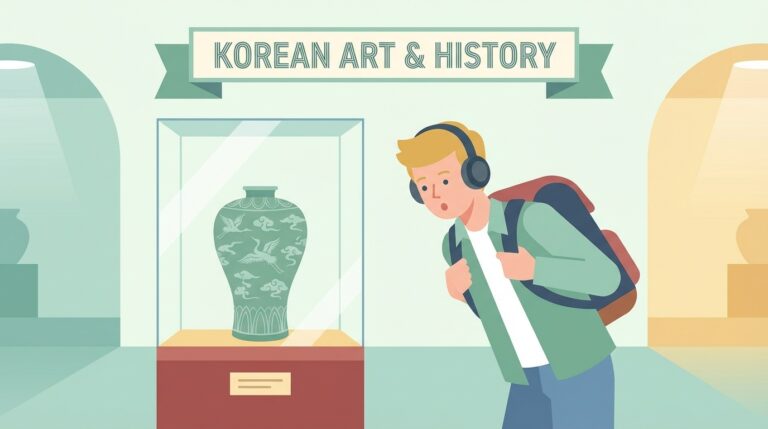
Picture this: You are standing in the grand, quiet halls of the National Museum of Korea in Seoul. Right in front of you is a breathtakingly beautiful Goryeo celadon vase. It looks exactly like the one you saw in that historical K-Drama you binged last weekend. You lean in to read the placard, but the English description is just one short sentence.
You remember hearing that your favorite K-Pop idol (maybe RM from BTS?) recently recorded a special voice guide for this exact exhibition. It’s the ultimate K-Culture experience, often called ‘Namjooning’ among fans! But… how do you get that audio guide? You approach the information desk, the staff smiles warmly at you, and suddenly your mind goes blank. You don’t want to just point and say ‘Audio? English?’
Renting an audio guide isn’t just about getting a device; it’s your golden key to unlocking the hidden, fascinating stories of Korea’s past. Today, we are going to learn exactly how to navigate this situation like a seasoned traveler. Let’s dive into the real Korean phrases you need to sound polite, natural, and confident!
Phase 2: Deep Dive into Core Expressions
Let’s look at the 3 essential expressions you need at the museum desk.
1. 오디오 가이드 빌릴 수 있나요?
- Pronunciation: o-di-o ga-i-deu bil-lil ssu in-na-yo? (Sound guide: ‘bil-lil’ sounds a bit like ‘bill’ + ‘ill’)
- Meaning: Can I rent an audio guide? (Literal: Is it possible to borrow an audio guide?)
- K-Culture Moment: You’ll use this at museum info desks, palace ticket booths, or even art galleries. It’s the perfect ice-breaker to start your cultural journey.
- Editor’s Insight: The verb ‘빌리다’ (to borrow/rent) is incredibly versatile in Korean. You use it for books, rental cars, umbrellas, and audio guides. Instead of saying ‘Give me,’ Koreans soften the request by asking ‘Is it possible to…?’ (수 있나요?).
- Situation Spectrum:
[🚫 절대 금지] ———— [⚠️ 주의] ———— [✅ 자유롭게]
- Casual with friends: ⚠️ (Use ‘빌릴 수 있어?’ instead)
- Semi-formal/Staff: ✅
- Formal/Elders: ✅
- 🤔 Think About It: Why do Koreans prefer asking ‘Is it possible to do X?’ rather than ‘I want X’? How does this reflect the Korean value of avoiding direct demands to maintain harmony?
2. 신분증 맡겨야 하나요?
- Pronunciation: sin-bun-jeung mat-gyeo-ya ha-na-yo?
- Meaning: Do I need to leave my ID? (Literal: Must I entrust my ID card?)
- K-Culture Moment: In Korea, when you rent something valuable (like a locker key at a Jimjilbang or an audio guide), leaving an ID as a deposit is standard practice.
- Editor’s Insight: ‘신분증’ means ID card, and ‘맡기다’ means to entrust or leave something in someone’s care. It sounds much more polite than saying ‘take my card.’
- Situation Spectrum:
[🚫 절대 금지] ———— [⚠️ 주의] ———— [✅ 자유롭게]
- Casual with friends: 🚫 (You don’t leave IDs with friends!)
- Semi-formal/Staff: ✅
- Formal/Elders: ✅
- 🤔 Think About It: Does your home country require leaving a physical ID card to rent museum equipment?
3. 어디로 반납하면 되나요?
- Pronunciation: eo-di-ro ban-na-pa-myeon doe-na-yo?
- Meaning: Where should I return it?
- K-Culture Moment: You’ve finished the tour, your brain is full of Joseon Dynasty history, and now you need to give the device back to get your passport.
- Editor’s Insight: ‘반납하다’ is a specific formal verb meaning ‘to return a borrowed item.’ You wouldn’t use this to say ‘I’m returning home,’ but only for returning things like books, guides, or rental cars.
- Situation Spectrum:
[🚫 절대 금지] ———— [⚠️ 주의] ———— [✅ 자유롭게]
- Casual with friends: ⚠️ (Too formal, just use ‘어디에 줄까?’)
- Semi-formal/Staff: ✅
- Formal/Elders: ✅
Phase 3: Textbook vs Real Life
| Situation | 📖 Textbook Korean | 🗣️ Real Korean | 💡 Why the difference? |
|---|---|---|---|
| Asking to rent | 오디오 가이드를 대여하고 싶습니다. (I want to rent an audio guide.) | 오디오 가이드 하나 빌릴게요. (I’ll borrow one audio guide.) | ‘대여하다’ is formal/written. ‘빌리다’ is softer and more common in speech. |
| Asking about language | 영어 버전이 있습니까? (Is there an English version?) | 영어 지원 되나요? (Is English supported?) | Tech devices use the term ‘지원 되다’ (to be supported) heavily in modern Korea. |
| Returning | 이것을 반납하겠습니다. (I will return this.) | 여기 반납할게요. (I’ll return it here.) | Adding ‘여기’ (here) while handing it over makes it sound completely natural and local. |
Phase 4: Cultural Deep Dive
4-1. Non-verbal Communication: The Art of Handing Things Over
When the museum staff asks for your ID (신분증), do not slide it across the counter with one hand. In Korea, handing over an important item (like an ID or a credit card) is done with two hands, or with your right hand while your left hand lightly touches your right elbow or forearm. It’s a physical sign of respect! Also, apply a bit of Nunchi (눈치): museums are quiet zones. Lower your voice volume to about 30% when speaking at the desk.
4-2. K-Culture Connection: The ‘Idol Docent’ Trend
If you are a K-Pop fan, you might know that visiting museums has become a massive trend. Idols like RM of BTS are famous for their love of art (often tagged as #Namjooning on social media). To attract younger audiences and tourists, many Korean museums and art galleries now hire famous actors or idols to record the Korean or English audio guides! When you rent one, you might just get a private historical tour guided by your favorite celebrity’s voice. It perfectly blends ancient history with modern pop culture.
Phase 5: Immersive Roleplay
Main Scenario: At the Museum Desk
Setting: It’s a Tuesday morning at the National Museum of Korea. The lobby is vast and echoes slightly. You walk up to the sleek wooden information desk.
Characters:
– YOU: An excited tourist wanting to learn about the Silla Dynasty.
– Staff (지훈, 28): A polite and smiling museum employee.
지훈: 안녕하세요. 무엇을 도와드릴까요? 😊
(an-nyeong-ha-se-yo. mu-eo-seul do-wa-deu-ril-kka-yo?)
(English) Hello. How may I help you?
(🎭 Stage Direction: Ji-hoon stands up slightly and bows)
YOU: 안녕하세요! 오디오 가이드 빌릴 수 있나요?
(an-nyeong-ha-se-yo! o-di-o ga-i-deu bil-lil ssu in-na-yo?)
(English) Hello! Can I rent an audio guide?
지훈: 네, 가능합니다. 어느 언어로 설정해 드릴까요?
(ne, ga-neung-ham-ni-da. eo-neu eo-neo-ro seol-jeong-hae deu-ril-kka-yo?)
(English) Yes, it’s possible. Which language should I set it to?
YOU: 영어 지원 되나요?
(yeong-eo ji-won doe-na-yo?)
(English) Is English supported?
지훈: 네, 영어 지원됩니다. 대여를 위해 신분증 하나 맡겨주셔야 합니다.
(ne, yeong-eo ji-won-doem-ni-da. dae-yeo-reul wi-hae sin-bun-jeung ha-na mat-gyeo-ju-syeo-ya ham-ni-da.)
(English) Yes, English is supported. You need to leave one ID for the rental.
🔀 Your Turn! How do you respond?
– A) “여권도 괜찮나요? 여기 있습니다.” (Is a passport okay? Here it is.)
– B) “신용카드 드릴게요.” (I’ll give you my credit card.)
– C) “없어요. 그냥 주세요.” (I don’t have it. Just give it to me.)✅ Best Choice: A — Passports or Alien Registration Cards (ARC) are the standard accepted IDs for foreigners.
⚠️ Choice B & C Analysis: Credit cards are almost never accepted as a valid ID deposit in Korea. And choice C is both rude and will result in you not getting the guide!
(Assuming you chose A)
지훈: 네, 확인했습니다. 다 보시고 나중에 이쪽으로 반납해 주시면 여권을 돌려드립니다. 즐거운 관람 되세요!
(ne, hwa-gin-haet-seum-ni-da. da bo-si-go na-jung-e i-jjog-eu-ro ban-na-pae ju-si-myeon yeo-gwon-eul dol-lyeo-deu-rim-ni-da. jeul-geo-un gwal-lam doe-se-yo!)
(English) Yes, checked. After viewing, please return it here and I will give your passport back. Enjoy the exhibition!
Bonus Scenario: Getting Lost Inside
You are inside, but you can’t find the famous Gold Crown exhibit. You spot a Docent (volunteer guide).
YOU: 실례합니다. 신라 금관은 어디에 있나요?
(sil-lye-ham-ni-da. sil-la geum-gwan-eun eo-di-e in-na-yo?)
(English) Excuse me. Where is the Silla Gold Crown?
Docent: 아, 금관은 2층 특별 전시실에 있습니다. 엘리베이터 타시고 오른쪽으로 가세요.
(a, geum-gwan-eun i-cheung teuk-byeol jeon-si-si-re it-seum-ni-da. el-ri-be-i-teo ta-si-go o-reun-jjog-eu-ro ga-se-yo.)
(English) Ah, the gold crown is in the 2nd-floor special exhibition room. Take the elevator and go right.
Phase 6: 10-Second Shadowing Drill
Practice these sentences out loud to nail the rhythm and intonation!
- 🗣️ 🥺 Politely asking:
오디오 가이드 / 빌릴 수 / 있나요?
(o-di-o ga-i-deu / bil-lil ssu / in-na-yo?) - 🗣️ 🧐 Confirming details:
영어 지원 / 되나요?
(yeong-eo ji-won / doe-na-yo?) - 🗣️ 😊 Wrapping up:
나중에 / 어디로 / 반납하면 되나요?
(na-jung-e / eo-di-ro / ban-na-pa-myeon doe-na-yo?)
Phase 7: K-Culture Glossary
| Korean | Romanization | English | Cultural Context |
|---|---|---|---|
| 신분증 | sin-bun-jeung | ID card | Crucial for renting items or proving age. For foreigners, passport or ARC. |
| 반납 | ban-nap | Return (an item) | Used for returning borrowed things like library books, guides, or public bikes (Ttareungi). |
| 도슨트 | do-seun-teu | Docent/Guide | Often volunteers at museums who give guided tours. Highly respected. |
| 무료 관람 | mu-ryo gwal-lam | Free admission | Many national museums in Korea are free! Palace entries are also free if you wear a Hanbok. |
| 문화가 있는 날 | mun-hwa-ga in-neun nal | Culture Day | The last Wednesday of every month. Many paid exhibitions and movies offer heavy discounts or free entry. |
Phase 8: Traveler’s Survival Kit
Museums and historical sites are massive. Here are the top survival phrases you need when navigating these cultural treasures.
🆘 Survival Phrases at the Museum
– 🇰🇷 “사진 찍어도 되나요?” (sa-jin jji-geo-do doe-na-yo?) – Can I take pictures?
– 🇰🇷 “화장실은 어디예요?” (hwa-jang-si-reun eo-di-ye-yo?) – Where is the restroom?
– 🇰🇷 “기념품 숍은 몇 층인가요?” (gi-nyeom-pum syo-beun myeot cheung-in-ga-yo?) – Which floor is the souvenir shop?📌 Editor’s Travel Note
– Photos: Look for the camera icon with a red slash. If it’s there, no photos! Also, NEVER use flash photography in ancient artifact rooms; it damages the colors.
– Free Entry: Gyeongbokgung Palace is closed on Tuesdays, and Changdeokgung is closed on Mondays. Always check the off-days before visiting!
– Apps: Use ‘Naver Map’ or ‘KakaoMap’. Google Maps doesn’t provide walking directions inside Korea due to security laws.
Phase 9: Think Deeper — “One Step Further”
🧠 Think Deeper: Korean in the Global Era
When you visit a Korean museum, you are looking at artifacts that are thousands of years old. Yet, the vocabulary you use to navigate the space is surprisingly Western: ‘오디오 가이드’ (Audio Guide), ‘도슨트’ (Docent), ‘팸플릿’ (Pamphlet). Why didn’t Korea create pure Korean words for these?
As Korea rapidly modernized and opened up to global tourism, it adopted international museum systems and the English terminology that came with them. While some language purists argue we should use native Korean words, others believe these ‘Konglish’ or loanwords make Korea more accessible to international travelers.💬 Your Turn: Does your language use English loanwords for modern technology and tourism, or do you invent new native words? Share in the comments!
Phase 10: FAQ & Troubleshooting
Q: Do I have to pay for the audio guide?
Yes, usually it costs around 3,000 KRW to 5,000 KRW. You pay with a card or cash, AND leave your ID as collateral.
Q: Can I use “저기요” (Excuse me) to call the museum staff?
At a quiet museum desk, you don’t need to shout “저기요” like you would in a BBQ restaurant! Just walk up, make eye contact, and start with “안녕하세요” (Hello).
Q: Can I keep the audio guide if I accidentally leave the museum?
Absolutely not! You left your ID behind, remember?
❌ Common Mistake #1: Forgetting to pick up your passport when you return the guide!
✅ Do this instead: Set a reminder on your phone, and always double-check your bag before leaving the building.
Phase 11: Wrap-up & Action Items
One-Liner Summary: To rent an audio guide like a pro, ask “오디오 가이드 빌릴 수 있나요?” and remember to prepare your passport!
Your Action Missions:
– 🥉 Bronze: Stand in front of a mirror and ask your reflection, “영어 지원 되나요?” 3 times.
– 🥈 Silver: Write down your favorite Korean historical era or artifact in the comments below using Korean!
– 🥇 Gold: Visit a museum or palace in Korea (or a local museum near you) and imagine going through this exact Korean dialogue at the desk.
Special K-Culture Mission: Search YouTube for “National Museum of Korea Virtual Tour” or look up which K-Pop idol recently recorded a museum docent track. Listen to a few minutes of it!
Phase 12: Interactive Quiz
Let’s test what you’ve learned!
1. You are at the palace ticket booth. How do you naturally ask to borrow an audio guide?
A) 오디오 가이드를 줘. (Give me an audio guide.)
B) 오디오 가이드 빌릴 수 있나요? (Can I rent an audio guide?)
C) 오디오 가이드 반납할게요. (I will return the audio guide.)
2. True or False: It is completely fine to leave your credit card as a ‘신분증’ (ID deposit) at a Korean museum.
– True / False
3. Fill in the blank:
Staff: 어느 언어로 설정해 드릴까요? (Which language should I set?)
You: 영어 ________ 되나요? (Is English supported?)
(Scroll down for answers!)
Answers:
1. B (A is too demanding and casual. C is for returning, not renting.)
2. False (You must leave a Passport or Alien Registration Card. Credit cards are generally not accepted as ID.)
3. 지원 (ji-won, meaning support.)
Frequently Asked Questions (FAQ)
Q: What does "오디오 가이드 빌릴 수 있나요?" mean in Korean and how do you pronounce it?
A: In Korean, "오디오 가이드 빌릴 수 있나요?" is pronounced [o-di-o ga-i-deu bil-lil ssu in-na-yo? (Sound guide: 'bil-lil' sounds a bit like 'bill' + 'ill'] and means: Can I rent an audio guide? (Literal: Is it possible to borrow an audio guide?)
Q: What does "신분증 맡겨야 하나요?" mean in Korean and how do you pronounce it?
A: In Korean, "신분증 맡겨야 하나요?" is pronounced [sin-bun-jeung mat-gyeo-ya ha-na-yo?] and means: Do I need to leave my ID? (Literal: Must I entrust my ID card?)
Q: What does "어디로 반납하면 되나요?" mean in Korean and how do you pronounce it?
A: In Korean, "어디로 반납하면 되나요?" is pronounced [eo-di-ro ban-na-pa-myeon doe-na-yo?] and means: Where should I return it?







