

Phase 1: Immersive Hook
Hello there! This is your Daily Hangul Editor. 👋
Let’s set the scene: You’ve seen this in at least a dozen K-Dramas. The male lead and the female lead are awkwardly standing in an elevator. Suddenly, the lights flicker, the elevator jolts, and everything goes dark. They are trapped. Sparks fly, deep secrets are revealed, and romance blossoms in the confined space.
But what if it happens to you, entirely alone, in a hip but aging building in Euljiro? There’s no handsome K-Drama CEO to save you. It’s just you, a glowing emergency call button, and a crackling voice on the intercom asking questions in rapid-fire Korean.
Panic? Absolutely not. While being stuck in an elevator (엘리베이터 갇힘 사고) is a scary emergency situation, Korea’s rescue system is famously fast—thanks to the ‘Pali-Pali’ (hurry up) culture. But to get that fast help, you need to communicate effectively. If you only know textbook greetings, you might freeze. Today, we are going to learn the precise, B2-level expressions you need to confidently report your situation and get rescued like a true local.
Phase 2: Deep Dive into Core Expressions
Let’s master the most critical phrases you need when you press that emergency button.
1. 엘리베이터에 갇혔어요.
- Pronunciation: [ellibeiteo-e gacheosseoyo.] + [el-lee-bay-ee-tuh-eh gah-chyuh-sso-yo]
- Meaning: Literal: I am trapped in the elevator. / Real nuance: Help, I’m stuck in the elevator!
- K-Culture Moment: This is the universal phrase you hear in thrillers or dramas when someone is calling 119 (the Korean equivalent of 911). It’s direct, urgent, and immediately conveys the severity of the situation.
- Editor’s Insight: The verb ‘갇히다’ (to be trapped/locked in) is passive. You don’t need to explain how you got stuck; just state the fact. It’s concise, which is exactly what emergency responders need.
- Situation Spectrum:
[🚫 절대 금지] ———— [⚠️ 주의] ———— [✅ 자유롭게]- Casual to 119/Security (Formal & Urgent): ✅
- 🤔 Think About It: Why do Koreans use the passive voice ‘갇혔어요’ instead of ‘I cannot get out’? Passive structures in Korean often emphasize the situation rather than the person’s inability, taking the blame off the speaker.
2. 승강기 번호가 OOO번이에요.
- Pronunciation: [seungganggi beonhoga OOO-beonieyo.] + [seung-gahng-ghee bun-ho-gah OOO-bun-ee-eh-yo]
- Meaning: Literal: The elevator number is OOO. / Real nuance: My exact GPS location via the elevator ID is OOO.
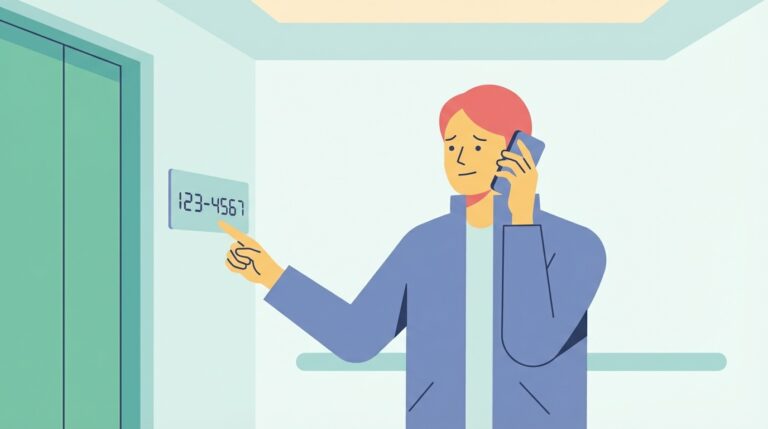
- K-Culture Moment: If you look closely inside any Korean elevator, you will see a sticker with a unique 7-digit number (usually near the buttons). This is the ‘승강기 고유번호’ (Elevator Unique ID). Even if you don’t know the building’s address, giving 119 this number tells them your exact location instantly.
- Editor’s Insight: This is the ultimate insider tip. Tourists try to describe the street outside; locals just read the 7-digit number. It’s a lifesaver!
- Situation Spectrum:
[🚫 절대 금지] ———— [⚠️ 주의] ———— [✅ 자유롭게]- Giving location to authorities: ✅
- 🤔 Think About It: Korea has a highly centralized and digitized infrastructure. How does this 7-digit elevator ID system reflect Korea’s obsession with efficiency and technology?
3. 숨쉬기가 좀 답답해요.
- Pronunciation: [sumswigiga jom dapdapaeyo.] + [soom-shee-ghee-gah johm dahp-dahp-hay-yo]
- Meaning: Literal: Breathing is a bit stuffy. / Real nuance: I’m feeling claustrophobic / It’s hard to breathe.
- K-Culture Moment: ‘답답하다’ is one of the most uniquely Korean adjectives. It means feeling stifled, either physically (lack of air) or emotionally (frustration). In K-Dramas, characters often hit their chest when they feel ‘답답하다’.
- Editor’s Insight: If you’re panicking or the air is getting thin, use this. Adding ‘좀’ (a little) softens the sentence, making it sound more natural and native-like, even in emergencies.
- Situation Spectrum:
[🚫 절대 금지] ———— [⚠️ 주의] ———— [✅ 자유롭게]- Explaining physical symptoms: ✅
Phase 3: Textbook vs Real Life
When adrenaline is pumping, nobody speaks like a textbook. Here is how real Koreans handle it.
| Situation | 📖 Textbook Korean | 🗣️ Real Korean | 💡 Why the difference? |
|---|---|---|---|
| Reporting the situation | 현재 엘리베이터가 고장 나서 정지되었습니다. | 저기요! 엘리베이터에 갇혔어요! | In emergencies, formal grammar is dropped for raw urgency and direct facts. |
| Asking for location | 이 건물의 주소가 어떻게 됩니까? | 여기 무슨 건물이에요? / 승강기 번호 부를게요. | Addresses are hard to remember; building names or ID numbers are faster. |
| Expressing fear | 저는 지금 매우 무섭습니다. | 아, 어떻게 해… 너무 무서워요. / 빨리 와주세요. | Real fear is expressed with exclamations (‘아’, ‘어떻게 해’) rather than clinical statements. |
Bottom Note: As B2 learners, you should aim for the ‘Real Korean’ expressions. They show you understand the emotional context of the language.
Phase 4: Cultural Deep Dive
4-1. Non-verbal Communication in Emergencies
In Korea, action speaks louder than words. When trapped, the very first thing you do before speaking is locate the 비상벨 (Emergency Bell). It usually has a phone icon. Press and hold it for about 3-5 seconds until it rings. Also, use your phone’s flashlight to locate the 승강기 번호 (Elevator ID) immediately so you have it ready before the operator even answers.
4-2. K-Culture Connection: The ‘Pali-Pali’ Rescue & Drama Tropes
K-Drama Trope Alert! We mentioned the classic elevator scene earlier. But notice how they act in dramas? They often sit on the floor, talk about their childhood trauma, and wait.
The Reality: In Korea, the 119 rescue teams are driven by the famous ‘빨리빨리 (Pali-Pali / Hurry up)’ culture. If you give them the 7-digit Elevator ID, they will often arrive within 5 to 10 minutes in urban areas like Seoul. There’s no time for childhood trauma stories! The operator will likely be very direct, speaking quickly to dispatch the team. Don’t be offended if they sound blunt; they aren’t angry, they are just trying to save you efficiently.
Phase 5: Immersive Roleplay
Scenario A: The Euljiro Incident
Setting: A Friday night, 8 PM. You just left a trendy hidden café on the 4th floor of an old, retro building in Euljiro. You step into the tiny, creaky elevator. Suddenly—CLUNK. The lights go out. You press the emergency call button.
Characters:
– YOU: A B2 Korean learner, slightly panicked but trying to keep it together.
– Operator (경비원/119): An older Korean man, speaking through a static-filled intercom.
Dialogue:
Operator: 네, 관리실입니다. 무슨 일이시죠?
(Ne, gwallisil-imnida. Museun irisijyo?)
[Yes, this is the management office. What’s the matter?]
YOU: 저기요! 엘리베이터가 멈췄어요. 안에 갇혔어요!
(Jeogiyo! Ellibeiteoga meomchwosseoyo. Ane gacheosseoyo!)
[Excuse me! The elevator stopped. I’m trapped inside!]
Operator: 아유, 많이 놀라셨겠네요. 다치신 데는 없고요?
(Ayu, mani nollasyeotgenneyo. Dachisin deneun eopgoyo?)
[Oh my, you must be startled. Are you hurt anywhere?]
YOU: 네, 다친 데는 없는데 너무 어두워서 무서워요.
(Ne, dachin deneun eomneunde neomu eoduwoseo museowoyo.)
[Yes, I’m not hurt, but it’s too dark so I’m scared.]
Operator: 지금 바로 기사님 부를게요. 거기가 몇 층이에요?
(Jigeum baro gisanim bureulgeyo. Geogiga myeot cheung-ieyo?)
[I’ll call the technician right now. What floor is it?]
YOU: 4층에서 내려가고 있었으니까… 아마 3층쯤인 것 같아요.
(4-cheung-eseo naeryeogago isseosseunikka… ama 3-cheung-jjumin geot gatayo.)
[I was going down from the 4th floor, so… I think it’s around the 3rd floor.]
Operator: 알겠습니다. 금방 가니까 문 강제로 열지 마시고 조금만 기다려주세요!
(Algetseumnida. Geumbang ganikka mun gangjero yeolji masigo jogeumman gidaryeojuseyo!)
[Understood. We’ll be there soon, so please don’t force the door open and wait a little bit!]
🔀 Your Turn! How should you reply to ensure they find you faster?
– A) “감사합니다. 빨리 오세요.” (Thank you. Come quickly.)
– B) “저기, 승강기 번호가 1234-567이에요!” (Excuse me, the elevator number is 1234-567!)
– C) “진짜요? 대박!” (Really? Awesome!)✅ Best Choice: B — Reason: Giving the elevator ID is the absolute best thing you can do. It confirms the exact shaft you are in.
⚠️ Choice A Analysis: Safe and polite, but lacks crucial information.
🚫 Choice C Analysis: Highly inappropriate for an emergency situation.
Scenario B: Bonus K-Culture Scenario (The Shared Emergency)
Imagine you are stuck with a Korean local (maybe a neighbor). The tension is high.
Neighbor: 하아… 진짜 답답하네요. 괜찮으세요?
(Haa… jinjja dapdaphaneyo. Gwaenchaneuseyo?)
[Sigh… It’s really frustrating. Are you okay?]
YOU: 네, 괜찮아요. 휴대폰 배터리는 있으세요?
(Ne, gwaenchanayo. Hyudaepon baeteorineun isseuseyo?)
[Yes, I’m fine. Do you have phone battery?]
Neighbor: 아, 네! 제가 바로 119에 신고할게요.
(A, ne! Jega baro 119-e singohalgeyo.)
[Ah, yes! I’ll report it to 119 right away.]
Notice how sharing the burden (checking on their phone battery) builds immediate solidarity. This is a great way to use your B2 skills to manage a crisis together!
Phase 6: 10-Second Shadowing Drill
Practice this sentence until it becomes muscle memory.
😤 저기요! / 엘리베이터가 멈췄어요! / 승강기 번호는 / 1234-567이에요!
(Jeogiyo! / ellibeiteoga meomchwosseoyo! / seungganggi beonhoneun / il-i-sam-sa o-ryuk-chil-ieyo!)
Coach’s Tip: Put some urgency into your voice! The / indicates a micro-pause. Don’t sing it; state it clearly and firmly.
Phase 7: K-Culture Glossary (Emergency Edition)
| Korean | Romanization | English | Contextual Meaning |
|---|---|---|---|
| 갇히다 | gachida | to be trapped | Used for elevators, locked rooms, or even being stuck in traffic. |
| 승강기 | seungganggi | elevator (formal) | The official term for elevator. ‘엘리베이터’ is more common in speech, but signs use ‘승강기’. |
| 119 | il-il-gu | Fire & Rescue | Korea’s emergency number for fire, rescue, and medical emergencies. (112 is for Police). |
| 답답하다 | dapdaphada | stifling/stuffy | A uniquely Korean word for feeling physically suffocated or emotionally frustrated. |
| 안심하다 | ansimhada | to feel relieved | What the operator will tell you to do: “안심하세요” (Please be reassured/calm down). |
Phase 8: Traveler’s Survival Kit
Are you traveling in Korea? Print this out or screenshot it!
🆘 Survival Phrases for Elevator Emergencies
– 🇰🇷 “여기 승강기 번호 OOO번이에요.” (yeogi seungganggi beonho OOO-beonieyo)
– 🗣️ English Guide: [yuh-ghee seung-gahng-ghee bun-ho OOO-bun-ee-eh-yo]
– 📍 Where to use: Anytime you are stuck and need to tell 119 where you are.
– 💡 Pro Tip: The Elevator ID is ALWAYS formatted as a 7-digit number (e.g., 0123-456). Look for a silver or yellow plate near the buttons or above the door.📌 Editor’s Travel Note
– Emergency Numbers: Dial 119 for rescue (fire, ambulance, trapped in an elevator). Dial 112 for police. If you don’t speak Korean, the 119 dispatchers can connect you to an English interpreter! Just say “English please.”
– Cell Service: Korean elevators usually have excellent cell reception. Your phone will likely work perfectly inside the shaft, allowing you to use Naver Maps or call for help directly if the emergency bell is broken.
Phase 9: Think Deeper — Language & Society
🧠 Think Deeper: Media vs Reality in Emergency Responses
In K-Dramas, being trapped in an elevator is often used as a romantic plot device to force two characters into close physical proximity. They might spend hours in the dark, sharing deep secrets. However, the reality of Korean society is built on hyper-efficiency. The implementation of the National Elevator Information Center and the 7-digit ID system means that emergency services can pinpoint your location and rescue you incredibly fast. The drama trope relies on an isolation that is actually quite hard to achieve in modern Seoul! This highlights how media often suspends the reality of Korea’s advanced, ‘pali-pali’ infrastructure for the sake of storytelling.
💬 Your Turn: Do movies or TV shows in your country romanticize certain emergencies? Share your thoughts in the comments!
Phase 10: FAQ & Troubleshooting
Q: Should I use formal language (존댓말) even if I’m panicking?
A: Yes! Even in emergencies, it is best to use standard polite language (요 form). It ensures clear communication and maintains respect with the rescue workers. Yelling in informal language (반말) might cause confusion or be perceived as rude, though they will still rescue you!
Q: What if I can’t read the Korean numbers out loud fast enough?
A: You can read the numbers individually just like in English. For example, 1234 can be read as “일, 이, 삼, 사” (il, i, sam, sa). You don’t need to say “천이백삼십사” (one thousand two hundred thirty-four).
❌ Common Mistake #1: Calling 112 (Police) instead of 119 (Fire/Rescue).
✅ Do this instead: For physical entrapment, fires, or medical issues, ALWAYS call 119.❌ Common Mistake #2: Trying to describe the neighborhood instead of giving the building name or Elevator ID.
✅ Do this instead: Look for the 7-digit 승강기 번호 (Elevator Number) immediately. It is the fastest way to be found.
Phase 11: Wrap-up & Action Items
One-Liner Summary: When stuck in a Korean elevator, stay calm, find the 7-digit Elevator ID, and say “엘리베이터에 갇혔어요!”
Your Action Missions for Today:
– 🥉 Bronze (Solo): Stand in your room and say “저기요! 엘리베이터에 갇혔어요!” out loud three times with a sense of urgency.
– 🥈 Silver (Online): Write down the 7-digit elevator ID of the building you live or work in (or make one up) and write a practice sentence in the comments.
– 🥇 Gold (Real-world): Next time you enter an elevator in Korea, find the ‘승강기 번호’ sticker. Take a mental note (or a picture) of it before the doors close!
K-Culture Mission: Watch a K-Drama this week. If there is an elevator scene, look closely at the walls—can you spot the silver Elevator ID plate?
Have you ever experienced a minor emergency while traveling? How did you handle it? Let us know in the comments below!
Phase 12: Interactive Quiz
1. Situation Judgment: You are stuck in an elevator and press the emergency bell. The operator answers. What is your BEST first sentence?
– A) “안녕하세요. 제 이름은 데이비드입니다.”
– B) “엘리베이터에 갇혔어요! 승강기 번호는 0123-456입니다.”
– C) “문 좀 열어주실 수 있나요?”
2. True or False – K-Culture Edition:
– In Korea, if you are trapped in an elevator, you should call 112 for the fastest response. (T/F)
3. Fill in the Blank:
– I feel claustrophobic and it’s hard to breathe. -> “숨쉬기가 좀 ( ______ )해요.”
(Scroll down for answers)
Answers:
1. B (You don’t need to introduce yourself [A], and asking to open the door [C] doesn’t explain the urgency. B gives the problem and location instantly.)
2. False (You should call 119 for rescue. 112 is for the police.)
3. 답답 (dapdap)
Frequently Asked Questions (FAQ)
Q: What does "엘리베이터에 갇혔어요." mean in Korean and how do you pronounce it?
A: In Korean, "엘리베이터에 갇혔어요." is pronounced [ellibeiteo-e gacheosseoyo.] and means: Literal: I am trapped in the elevator. / Real nuance: Help, I'm stuck in the elevator!
Q: What does "승강기 번호가 OOO번이에요." mean in Korean and how do you pronounce it?
A: In Korean, "승강기 번호가 OOO번이에요." is pronounced [seungganggi beonhoga OOO-beonieyo.] and means: Literal: The elevator number is OOO. / Real nuance: My exact GPS location via the elevator ID is OOO.
Q: What does "숨쉬기가 좀 답답해요." mean in Korean and how do you pronounce it?
A: In Korean, "숨쉬기가 좀 답답해요." is pronounced [sumswigiga jom dapdapaeyo.] and means: Literal: Breathing is a bit stuffy. / Real nuance: I'm feeling claustrophobic / It's hard to breathe.







