

Phase 1: 공감 — Immersive Hook
Hello! I’m your Lead Editor at Daily Hangul.
Picture this: You’re watching a trendy slice-of-life K-Drama. The young, stylish protagonist—who clearly doesn’t own real estate in Seoul—is carefully wiping the split, white-and-green leaf of a Monstera Albo in their studio apartment. Suddenly, their phone pings with a notification: “Karrot!” (당근!). They carefully pack the single leaf into a takeaway coffee cup, rush to the subway station, and hand it over to a stranger for… $500?
Wait, what just happened? Did they just sell a leaf to pay rent?
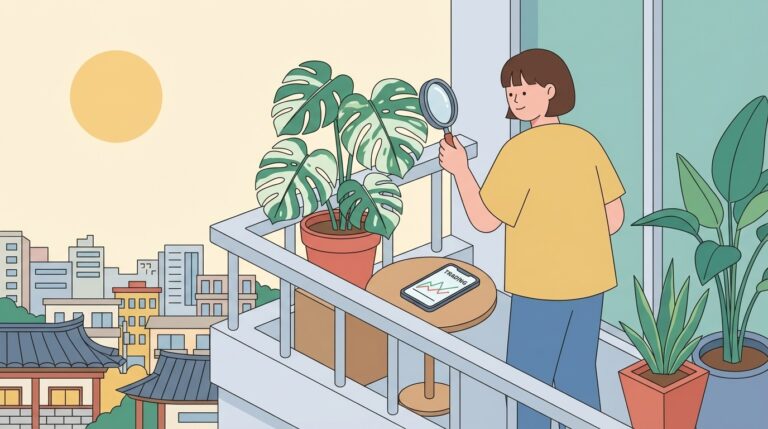
Welcome to the fascinating world of 식테크 (Sik-tech) and Korea’s 플랜테리어 (Planterior) boom. For Korea’s MZ generation, plants are no longer just living decor; they are “green gold,” beloved pets, and micro-investments all rolled into one. If you want to mingle with trendy Seoulites, understand their economic realities, or simply buy a cute fern for your desk in Itaewon, you need to know this subculture.
Today, we aren’t just learning botanical terms. We are diving into the nuanced vocabulary of Korea’s hyper-local secondhand market, the emotional bond Koreans form with their plants, and the slang that will make you sound like a true Insider (인싸).
Phase 2: Core Expressions Deep Dive
Let’s explore the essential vocabulary of the Korean rare plant investment scene.
1. 식테크 (Sik-tech) / 잎테크 (Ip-tech)
- Pronunciation: [Sik-te-keu] / [Ip-te-keu]
- Meaning: Plant (식물) + Investment Tech (재테크). / Leaf (잎) + Investment Tech.
- K-Culture Moment: You open a Korean news app, and the headline reads: “Better than stocks? The MZ generation’s Sik-tech craze.” It refers to the trend of buying rare plants (like variegated Monsteras), propagating them, and selling the cuttings for a profit.
- Editor’s Insight: The word ‘재테크’ (financial technology/investment) is everywhere in Korea (e.g., Syu-tech for sneakers, Jjantech for extreme penny-pinching). Adding ‘식’ (plant) creates a word that perfectly captures the modern Korean hustle culture mixed with aesthetic hobbies.
- Situation Spectrum:
[🚫 Never] ———— [⚠️ Be Careful] ———— [✅ Freely]
- Close friends (Casual): ✅
- Coworkers (Semi-formal): ✅ (Great small-talk topic)
- Boss/Elders (Formal): ✅ (Safe, but they might find the trend amusing)
- 🤔 Think About It: Why do you think Korean youth combine the word “technology/investment” (테크) with almost every hobby? What does this say about the economic pressure in modern Korean society?
2. 식집사 (Sik-jipsa)
- Pronunciation: [Sik-jip-sa]
- Meaning: Plant Butler (식물 + 집사).
- K-Culture Moment: On a weekend vlog, a Korean YouTuber says, “주말엔 밀린 식집사 모드를 켭니다” (On weekends, I turn on my backlogged plant-butler mode) while meticulously misting their indoor jungle.
- Editor’s Insight: In Korea, cat owners lovingly call themselves “butlers” (집사) to imply the cat is the true master. Plant owners have adopted this term! It shows a shift from viewing plants as “objects” to “living companions” that demand servitude.
- Situation Spectrum:
[🚫 Never] ———— [⚠️ Be Careful] ———— [✅ Freely]
- Close friends (Casual): ✅
- Online Forums/Social Media: ✅✅ (Highly used)
- Formal Business: 🚫
- 🤔 Think About It: Does your native language have a word that elevates a pet or a plant to the status of “master”?
3. 분양하다 (Bunyang-hada)
- Pronunciation: [Bun-yang-ha-da]
- Meaning: Literal: To parcel out / to sell real estate. Real nuance: To adopt out (a pet or plant).
- K-Culture Moment: On Karrot Market (당근마켓 – Korea’s #1 neighborhood trading app), a post reads: “알보 몬스테라 삽수 분양합니다” (Adopting out a Monstera Albo cutting).
- Editor’s Insight: You almost never see plant lovers use the word “팔다” (to sell) for their rare plants. They use “분양하다” or “입양 보내다” (to send for adoption). It reflects a deep emotional attachment—you aren’t just selling a commodity; you are finding a good home for a piece of your “child.”
- Situation Spectrum:
[🚫 Never] ———— [⚠️ Be Careful] ———— [✅ Freely]
- Trading apps & Hobbyist groups: ✅
- General commerce: ⚠️ (Sounds too emotional for a standard flower shop)
4. 무늬천재 (Munui-cheonjae)
- Pronunciation: [Mu-nui-cheon-jae]
- Meaning: Literal: Pattern Genius. Real nuance: A spectacularly variegated plant.
- K-Culture Moment: An Instagram post of a half-moon Monstera leaf is flooded with comments like, “와, 완전 무늬천재네요!” (Wow, total pattern genius!).
- Editor’s Insight: Koreans love adding “천재” (genius) to things that excel in a specific trait (e.g., 얼굴천재 = face genius/extremely handsome). In Sik-tech, the “pattern” (white/pink spots) dictates the price. A “pattern genius” is the jackpot.
Phase 3: Textbook vs Real Life
| Situation | 📖 Textbook Korean | 🗣️ Real Korean Slang | 💡 Why the Difference? |
|---|---|---|---|
| Selling a plant | 식물을 팝니다. (I am selling a plant.) | 식물 분양합니다. | Emotional anthropomorphism; treating plants like pets. |
| Asking for a discount | 가격을 깎아 주실 수 있나요? (Can you lower the price?) | 네고 되나요? / 차비 정도 빼주실 수 있나요? | “Nego” (Negotiation). Asking to deduct “bus fare” (차비) is a culturally polite, cute way to ask for a small $2-$3 discount. |
| It sprouted roots! | 뿌리가 났어요. (Roots have grown.) | 순화 완료됐어요. (Acclimatization complete.) | Professional jargon adopted by hobbyists to prove the cutting’s survival rate. |
| A beautiful plant | 아주 아름다운 식물이네요. (It’s a very beautiful plant.) | 와, 무늬천재 / 잎자루 대박! | Focusing on the specific traits (variegation/petiole) that determine investment value. |
Bottom Note for C1 Learners: You don’t need to use all this slang, but dropping “분양합니다” instead of “팔아요” on Karrot Market will instantly raise your “Manner Temperature” (매너온도 – the app’s user rating system) because you sound like a true plant lover!
Phase 4: Cultural Deep Dive
4-1. Non-verbal Communication: The “Karrot” Hand-off
When doing a direct trade (직거래) for a rare plant, Koreans don’t just shove a plant into a plastic bag. Cuttings are often delicately placed inside a clear takeaway coffee cup (like a Starbucks venti cup) with damp sphagnum moss. When handing it over, use both hands slightly, bow your head, and always say “예쁘게 키우세요~” (Please raise it beautifully~). The Nunchi here is to inspect the plant quickly but gently, ensuring you don’t damage the “investment.”
4-2. K-Culture Connection: The Karrot Market (당근마켓) Phenomenon
To understand Sik-tech, you must understand Karrot (Danggeun Market). It’s a hyper-local app where you can only trade with people within your GPS-verified neighborhood.
* The Trope: In K-Dramas and real life, strangers meet awkwardly at subway exits holding random items in shopping bags.
* The Code: The universal greeting isn’t “Hello.” It’s making eye contact with a confused person and cautiously whispering, “혹시… 당근이세요?” (By any chance… are you Karrot?).
* The Connection: Rare plant trading thrives here because shipping live plants by courier is risky. Buyers want to see the 무늬 (variegation) in person before handing over 300,000 KRW for a single leaf!
Phase 5: Immersive Roleplay
Scenario A: The Karrot Trade
Setting: Friday evening, 7:00 PM. Exit 3 of Gangnam Station. The sun has set, and commuters are rushing past. You are holding a paper shopping bag, nervously looking at your phone. You agreed to buy a highly sought-after Monstera Albo cutting for 150,000 KRW from a user named “GreenFingers.”
Characters:
* YOU: An expat who recently got into planterior to spice up your Seoul apartment.
* GreenFingers (Jiwon): A 20-something Korean office worker who funds her cafe-hopping through Sik-tech.
Dialogue:
(You see a woman holding a transparent Starbucks cup with a green-and-white leaf inside. She is looking around.)
You: 저기… 혹시 당근이세요? 🥕
(Jeogi… hoksi danggeun-iseyo?)
[Excuse me… by any chance, are you Karrot?]
Jiwon: 아! 네네, 알보 몬스테라 분양받으시는 분 맞으시죠?
(Ah! Nene, albo monseutera bunyang-badeusineun bun majeuseyo?)
[Ah! Yes, you’re the one adopting the Monstera Albo, right?]
You: 네, 맞아요. 와, 사진보다 무늬가 훨씬 예쁘네요! 무늬천재예요.
(Ne, majayo. Wa, sajin-boda munui-ga hwolssin yeppeuneyo! Munui-cheonjae-yeyo.)
[Yes, that’s me. Wow, the variegation is much prettier than the photos! It’s a pattern genius.]
(🎭 Stage Direction: Jiwon’s face lights up at the compliment. In Korea, praising someone’s plant is like praising their pet.)
Jiwon: 그렇죠? 제가 진짜 애지중지 순화시킨 아이예요. 뿌리도 튼튼하게 잘 났어요. 한번 확인해 보시겠어요?
(Geureochyo? Jega jinjja aeji-jungji sunhwa-sikin ai-yeyo. Ppuri-do teunteunhage jal nasseoyo. Hanbeon hwagin-hae bosigesseoyo?)
[Right? I really acclimatized this child with utmost care. The roots grew out strong too. Would you like to check?]
🔀 Your Turn! How do you respond and finalize the deal?
– A) “완벽하네요. 여기 15만 원 현금입니다. 안녕히 계세요!” (Strictly business)
– B) “너무 마음에 들어요. 혹시… 제가 멀리서 왔는데 차비 정도 네고 가능할까요? 🥺” (The “Bus Fare” Nego technique)
– C) “진짜 대박! 이거 나중에 비싸게 팔게요!” (Revealing your pure capitalist intentions)✅ Best Choice: B — If their profile didn’t say “No Nego” (네고 불가), asking to deduct “bus fare” (usually 2,000-5,000 KRW) is a culturally accepted, cute way to haggle. Even if she says no, she won’t be offended. Choice A is fine but a bit cold. Choice C is a major faux pas—remember, they see themselves as “adopting out” a living thing!
Jiwon (If you chose B): 아유, 외국 분이 차비 네고도 아시네요! 그럼 5천 원 빼드릴게요. 계좌이체 해 주시겠어요?
(Ayu, oeguk bun-i chabi nego-do asineyo! Geureom o-cheon won ppae-deurilgeyo. Gyejwa-iche hae jusigesseoyo?)
[Oh my, a foreigner knows the bus fare nego! Then I’ll deduct 5,000 won. Could you do a bank transfer?]
You: 감사합니다! 방금 카카오페이로 보냈습니다. 예쁘게 잘 키울게요!
(Gamsahamnida! Banggeum Kakao-pay-ro bonaetseumnida. Yeppeuge jal kiulgeyo!)
[Thank you! I just sent it via Kakao Pay. I’ll raise it beautifully!]
Phase 6: 10-Second Shadowing Drill
Practice your tone! When complementing a Korean’s plant, you must sound genuinely impressed, slightly exaggerating the vowels.
😲 와! / 사진보다 / 무늬가 / 훨~~~씬 예쁘네요! / 완전 / 무늬천재예요!
(Wa! / sajin-boda / munui-ga / hwol~~~ssin yeppeuneyo! / wanjeon / munui-cheonjae-yeyo!)
- Intonation Guide: Start high on “와!” Pitch goes up on “훨~~~씬” (much more) and drag the ‘ㄹ’ slightly for emphasis.
Phase 7: K-Culture Glossary (Sik-tech Edition)
| Korean | Romanization | English | Contextual Explanation |
|---|---|---|---|
| 당근마켓 | Danggeun Market | Karrot | Korea’s premier hyperlocal neighborhood trading app. Literal meaning is “Carrot,” but it’s a pun on “당신 근처” (Near You). |
| 소확행 | So-hwak-haeng | Small but certain happiness | A philosophy popular among MZ generation. Finding joy in small things (like a new plant leaf) rather than unattainable goals. |
| 잎꽂이 / 삽수 | Ip-kko-ji / Sap-su | Leaf cutting / Cutting | Methods of propagating plants. The foundation of Sik-tech. |
| 순화하다 | Sun-hwa-ha-da | To acclimatize | Getting a propagated cutting to root and adapt to soil/water. A “순화 완료” (fully acclimatized) plant sells for much more. |
| 매너온도 | Mae-neo on-do | Manner Temperature | Karrot app’s rating system. Starts at 36.5°C. A high temperature means a highly trusted, polite trader. |
Phase 8: Traveler’s Survival Kit
Are you visiting Seoul and want to explore the massive Yangjae Flower Market (양재꽃시장) to see the Planterior boom yourself? Here’s your kit:
🆘 Survival Expressions for the Plant Market
– 🇰🇷 “이거 키우기 까다로운 편인가요?” (Igeo ki-u-gi kka-da-ro-un pyeon-in-ga-yo?)
– 🗣️ English: Is this on the difficult side to raise?
– 📍 Use case: Asking the vendor if you’re about to buy a diva plant that will die in 3 days.
- 🇰🇷 “빛이 많이 안 드는 방인데 괜찮을까요?” (Bich-i mani an deuneun bang-inde gwaen-chaneulkkayo?)
- 🗣️ English: My room doesn’t get much light, will this be okay?
📌 Editor’s Travel Note
– Bringing plants home: Remember, bringing live plants with soil across international borders usually requires strict phytosanitary certificates. If you’re a tourist, stick to buying cute, uniquely Korean gardening tools, modern ceramic pots, or Planterior magazines!
– Payment: The Yangjae Flower Market is one of the few places in Korea where paying in cash or via bank transfer (계좌이체) might get you a “Service” (서비스 – freebies like a small extra plant or fertilizer).
Phase 9: Think Deeper — “One Step Further”
Korean in the Global Era & Economic Realities: Why Plants?
Why did Sik-tech explode in Korea specifically? It’s deeply tied to the Korean economy and the psychology of the MZ generation. In the past, the ultimate Korean dream was buying an apartment in Seoul (부동산 재테크 – real estate investment). However, with skyrocketing housing prices, this dream has become nearly impossible for many young people.
Instead of giving up on the concept of “investment” entirely, young Koreans pivoted to micro-investments that offer immediate psychological comfort. You can’t buy a house, but you can control the environment of your small rented room with Planterior. You can’t flip real estate, but you can buy a rare plant for $100, grow it meticulously, and “flip” a cutting for $50. The language of Sik-tech—words like “분양” (historically used for parceling out apartments)—is a fascinating, somewhat melancholic linguistic shift where the terminology of grand wealth is applied to a single, beautiful leaf.
💬 Your Turn:
How does your generation deal with the high cost of living? Are there similar micro-investment trends in your country? Let us know in the comments!
Phase 10: FAQ & Troubleshooting
Q: “Can I use ‘분양하다’ when giving my friend a random cheap plant I bought at the supermarket?”
Editor’s Answer: Yes, but it might sound a bit dramatic and cute! “분양하다” is usually reserved for pets or plants that require high care or have high value. For a cheap succulent, you can just playfully say, “이거 너 가질래?” (Do you want to have this?).
Q: “Is it rude to ask for ‘네고’ (negotiation) on Karrot?”
Editor’s Answer: It depends! ALWAYS check the seller’s tags. If they checked “가격 제안 불가” (Price offers not allowed), do not ask. If it’s open, politely using the “차비 빼주세요” (Please deduct bus fare) tactic is perfectly fine.
❌ Common Mistake #1: Calling the seller “당신” (You) on the Karrot app.
✅ Do this instead: Never use “당신.” It sounds confrontational in Korean! Instead, refer to them as “판매자님” (Seller-nim) or simply omit the subject: “언제 시간 되세요?” (When are [you] free?).
Phase 11: Wrap-up & Action Items
🌿 One-Liner Summary:
In Korea, plants aren’t just decor; they are “adopted” companions and micro-investments that reflect the modern MZ generation’s pursuit of small happiness and smart hustling.
Action Mission:
* 🥉 Bronze (Solo): Look at a plant in your house and confidently declare to it: “너는 무늬천재야!” (You are a pattern genius!).
* 🥈 Silver (Online): Browse Instagram using the hashtag #식집사 or #플랜테리어 and leave a comment with emojis on a pretty plant.
* 🥇 Gold (Real Life): Next time you buy something secondhand (or at a market), try the “차비 정도 네고 가능할까요?” technique with a big smile!
K-Culture Mission:
Download the Karrot (당근마켓) app if you are in Korea (or browse the web version). Search for “알보 몬스테라” (Albo Monstera) and look at how sellers describe their “children.” Spot the words 순화 (acclimatized) and 분양 (adoption)!
Phase 12: Interactive Quiz 🧠
1. You are meeting a Karrot seller to buy a rare plant. How do you identify them at the subway exit?
A) “저기요! 식물 파는 분이시죠?” (Excuse me! Are you the plant seller?)
B) “당신이 당근마켓입니까?” (Are you Karrot Market? – Robot voice)
C) “혹시… 당근이세요?” (By any chance… are you Karrot?)
2. Fill in the blank:
“주말이라 밀린 [ _____ ] 모드를 켜고 식물들에 물을 줬어요.”
(It’s the weekend so I turned on my backlogged [ ______ ] mode and watered the plants.)
3. True or False: When selling a rare plant on Korean apps, it’s considered polite to use the word “팔다” (to sell) rather than “분양하다” (to adopt out) to show professionalism.
4. Situational Judgment: You want a discount on a beautiful plant cutting. The seller’s profile says “네고 불가” (No negotiation). What should you do?
A) Ask for just a “bus fare” discount anyway because you are a foreigner.
B) Respect the tag and pay the full price.
C) Tell them the plant is ugly to lower the price.
(Answers: 1: C, 2: 식집사, 3: False – 분양하다 is preferred!, 4: B – Respect the Nego Bulga!)
Frequently Asked Questions (FAQ)
Q: What does "식테크 (Sik-tech) / 잎테크 (Ip-tech)" mean in Korean and how do you pronounce it?
A: In Korean, "식테크 (Sik-tech) / 잎테크 (Ip-tech)" is pronounced [Sik-te-keu] and means: Plant (식물) + Investment Tech (재테크). / Leaf (잎) + Investment Tech.
Q: What does "식집사 (Sik-jipsa)" mean in Korean and how do you pronounce it?
A: In Korean, "식집사 (Sik-jipsa)" is pronounced [Sik-jip-sa] and means: Plant Butler (식물 + 집사).
Q: What does "분양하다 (Bunyang-hada)" mean in Korean and how do you pronounce it?
A: In Korean, "분양하다 (Bunyang-hada)" is pronounced [Bun-yang-ha-da] and means: Literal: To parcel out / to sell real estate. Real nuance: To adopt out (a pet or plant).
Q: What does "무늬천재 (Munui-cheonjae)" mean in Korean and how do you pronounce it?
A: In Korean, "무늬천재 (Munui-cheonjae)" is pronounced [Mu-nui-cheon-jae] and means: Literal: Pattern Genius. Real nuance: A spectacularly variegated plant.







