

Mastering Korean Business Negotiations: How to Push Back Like a K-Drama CEO
Phase 1: Immersive Hook (The Tense Boardroom)
Hello! This is your Lead Editor at Daily Hangul, your veteran tutor and local cultural navigator in Seoul.
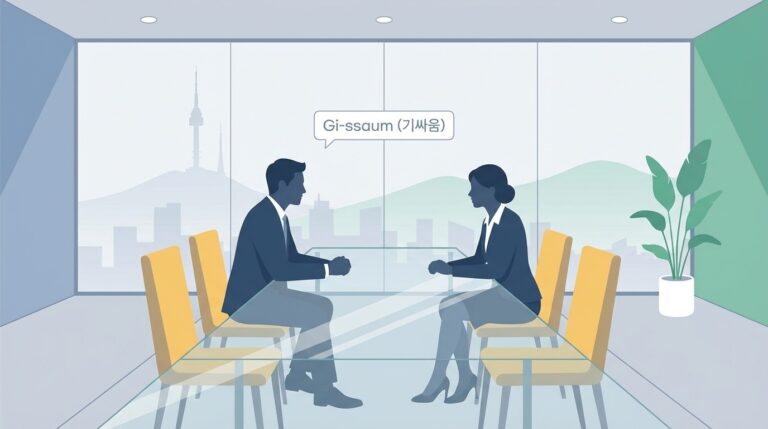
Picture this: You are sitting in a sleek, glass-walled conference room in Yeouido, the financial hub of Seoul. The air is heavy, reminiscent of a high-stakes corporate scene in K-Dramas like Misaeng or Queen of Tears. Across the table, a seasoned Korean executive pushes a hardline demand: “We need a 20% price cut, or we walk.”
In English, you might simply say, “No, that’s impossible.” But in Korean business culture, an outright “No” is a grenade. It damages the counterpart’s 체면 (Chemyon, face/dignity) and shatters the relationship. Yet, if you just smile and nod, you lose the deal.
How do you push back elegantly but with an iron will? How do you win the 기싸움 (Gi-ssaum, battle of nerves) without burning bridges? Today, we are diving deep into C1-level advanced negotiation tactics. By the end of this guide, you won’t just know the language; you’ll command the room like a true insider.
Phase 2: Deep Dive into Core Expressions
Let’s upgrade your vocabulary from textbook basic to boardroom elite.
1. 말씀하신 취지는 충분히 이해합니다만…
- Pronunciation: Mal-sseum-ha-sin chwi-ji-neun chung-bun-hi i-hae-ham-ni-da-man… [Sounds like: Mal-ssoom-ha-shin chee-jee-noon choong-boon-hee ee-hae-ham-nee-da-man…]
- Meaning: (Literal) I fully understand the intention of what you said, but… / (Real nuance) “I hear you, but absolutely not.”
- K-Culture Moment: This is the ultimate “buffer” phrase. In Korean corporate dramas, the protagonist will calmly adjust their glasses, make steady eye contact, and drop this line before launching a counterattack.
- Editor’s Insight: The word ‘취지’ (purpose/intention) elevates the conversation. You aren’t just rejecting their idea; you are acknowledging their strategic intent. It shows profound respect while holding your ground.
- Situation Spectrum:
[🚫 절대 금지] ———— [⚠️ 주의] ———— [✅ 자유롭게]
- Casual Friends: 🚫 (Way too stiff, sounds like a robot)
- Colleagues (Semi-formal): ⚠️ (A bit heavy, but okay for serious debates)
- Formal Negotiation/Superiors: ✅ (Absolute perfection)
- 🤔 Think About It: Why does Korean business language require such a long preamble before a disagreement? How does this reflect the cultural priority of “harmony” (화합) over “efficiency”?
2. 그 부분은 저희로서도 양보하기 벅찹니다.
- Pronunciation: Geu bu-bun-eun jeo-hui-ro-seo-do yang-bo-ha-gi beok-cham-ni-da. [Sounds like: Goo boo-boon-oon juh-hee-ro-suh-doh yang-bo-ha-ghee buk-cham-nee-da.]
- Meaning: (Literal) That part is too overwhelming for us to concede. / (Real nuance) “We have reached our absolute limit. Push further, and it breaks.”
- K-Culture Moment: Use this when the counterpart acts like a 갑 (Gab, the powerful party). It subtly signals that they are squeezing you too hard, appealing to their sense of fairness.
- Editor’s Insight: Instead of saying “We can’t do it” (할 수 없습니다), you use ‘벅차다’ (to be beyond one’s power/overwhelming). It frames the rejection not as stubbornness, but as a genuine structural inability.
- Situation Spectrum:
[🚫 절대 금지] ———— [⚠️ 주의] ———— [✅ 자유롭게]
- Casual Friends: 🚫
- Colleagues (Semi-formal): ✅ (Good for team negotiations)
- Formal Negotiation/Superiors: ✅
- 🤔 Think About It: Compare this to the English “That’s a dealbreaker.” Which feels more defensive, and which feels more aggressive?
3. 자칫하면 원점에서 재검토해야 할 상황입니다.
- Pronunciation: Ja-chit-ha-myeon won-jeom-e-seo jae-geom-to-hae-ya hal sang-hwang-im-ni-da. [Sounds like: Jah-chit-ha-myun won-jum-eh-suh jae-gum-toh-hae-ya hal sang-hwang-im-nee-da.]
- Meaning: (Literal) If we are not careful, it is a situation where we must re-examine this from square one. / (Real nuance) “Drop this demand, or the whole deal is off.”
- K-Culture Moment: This is the polite ultimatum. It’s the moment the music stops in the drama, and everyone holds their breath.
- Editor’s Insight: Notice the indirectness: “It is a situation where…” (상황입니다) instead of “I will cancel it.” By blaming the “situation,” you remove personal hostility while maintaining a lethal threat.
- Situation Spectrum:
[🚫 절대 금지] ———— [⚠️ 주의] ———— [✅ 자유롭게]
- Casual Friends: 🚫
- Colleagues (Semi-formal): ⚠️ (Use only in extreme crises)
- Formal Negotiation: ✅ (The final card to play)
- 🤔 Think About It: How does phrasing a threat as an “unfortunate situation” change the dynamic of the room?
Phase 3: Textbook vs Real Life
Even at the C1 level, textbooks often teach overly direct translations. Let’s look at how actual professionals talk.
| Situation | 📖 Textbook Korean | 🗣️ Real Corporate Korean | 💡 Why the difference? |
|---|---|---|---|
| Rejecting an offer | 안 됩니다. (No/It doesn’t work.) | 곤란합니다. (It is difficult/troublesome.) | Direct “No” destroys ‘face’. ‘곤란하다’ implies “I want to, but external factors prevent it.” |
| Asking them to rethink | 다시 생각하세요. (Think again.) | 재고해 주시면 감사하겠습니다. (I’d appreciate it if you reconsider.) | Softening a command into a request for a favor shows high-level professionalism. |
| Disagreeing with a claim | 틀렸습니다. (You are wrong.) | 저희 측 데이터와는 다소 차이가 있습니다. (There is a slight difference from our data.) | Avoiding the word “wrong” prevents the counterpart from becoming instantly defensive. |
Bottom Note: In advanced business Korean, the key is using Sino-Korean words (Hanja-based vocabulary like 재고, 수용, 검토) rather than native Korean words. It instantly boosts your credibility.
Phase 4: Cultural Deep Dive — The Art of Gi-ssaum
4-1. Non-verbal Communication: The Power of Silence
When delivering a firm pushback, do not over-explain. In Western cultures, silence can feel awkward, prompting people to fill the void with concessions. In Korea, silence during a 기싸움 (battle of nerves) is a weapon. Deliver your line (“원점에서 재검토해야 할 상황입니다”), maintain calm eye contact, and wait. Do not fidget. Let them feel the weight of your boundary.
4-2. K-Culture Connection: The “Gab and Eul” (갑과 을) Dynamic
If you’ve watched K-Dramas like Itaewon Class or Misaeng, you’ve seen the absolute power disparity between 갑 (Gab – the buyer, the contractor, the boss) and 을 (Eul – the supplier, the subcontractor, the employee).
If your counterpart is the ‘Gab’, they might expect you to fold simply because of their position. Using elegant, high-level vocabulary to push back gracefully disrupts this expectation. It forces them to see you not as a submissive ‘Eul’, but as an equal, global partner.
Critical View: While dramas often portray ‘Eul’ dramatically turning the tables by shouting or causing a scene, in reality, corporate warriors win through meticulously polite, unyielding logic.
Phase 5: Immersive Roleplay
Scenario A: The Gangnam Boardroom
- Setting: Wednesday, 3:00 PM. A pristine conference room in Gangnam. You’ve been negotiating a software licensing deal for three hours. The coffee is cold.
- Characters:
- YOU: The lead foreign negotiator for an international tech firm.
- Director Park (박 이사): 50s, a seasoned, tough-as-nails Korean executive who wants to slash your margins.
Director Park: (Tapping his pen on the table) “솔직히 말씀드리면, 이 단가로는 계약하기 힘듭니다. 최소 15%는 더 낮춰주셔야 저희도 결재를 올릴 수 있어요.”
(Sol-jik-hi mal-sseum-deu-ri-myeon, i dan-ga-ro-neun gye-yak-ha-gi him-deum-ni-da. Choe-so 15%neun deo nat-chwo-ju-syeo-ya jeo-hui-do gyeol-jae-reul ol-ril su is-seo-yo.)
[To be honest, it’s hard to sign at this unit price. You need to lower it by at least 15% for us to get approval.]
🔀 Your Turn! How do you respond?
– A) “15%는 절대 안 됩니다. 저희도 남는 게 없어요.”
– B) “이사님 말씀하신 취지는 충분히 이해합니다만, 그 조건은 저희로서도 수용하기 벅찹니다.”
– C) “그럼 원점에서 다시 검토합시다.”✅ Best Choice: B — It acknowledges his position (getting internal approval) while firmly setting a boundary using advanced vocabulary.
⚠️ Choice A Analysis: Too direct and emotional (“절대 안 됩니다”). It sounds amateurish.
⚠️ Choice C Analysis: Dropping the “square one” ultimatum too early can completely kill the deal. Reserve it for a true deadlock.
YOU: (Delivering Option B with a calm tone)
Director Park: (Sighs, realizing you won’t fold easily) “허허, 참 깐깐하시네. 그럼 10%로 타협점(compromise)을 찾아볼까요?”
Scenario B: Bonus K-Culture Roleplay — The Post-Negotiation Hoesik
- Setting: 7:30 PM. A premium Korean BBQ restaurant. The deal is signed (at a 5% cut, a win for you). The tension from the boardroom has melted into the smoke of grilling Hanwoo beef.
- Director Park: (Pouring you a shot of Soju) “아까 회의실에서는 제가 좀 밀어붙였죠? 기분 상하지 않으셨으면 좋겠습니다. 자, 한잔 받으시죠!”
[I pushed a bit hard in the meeting room earlier, didn’t I? I hope you weren’t offended. Here, take a glass!] - YOU: “아닙니다. 이사님 덕분에 저도 많이 배웠습니다. 앞으로 잘 부탁드립니다!”
[Not at all. I learned a lot thanks to you, Director. I look forward to our continued partnership!]
(Pro-tip: Receive the glass with two hands, turn your head slightly away to drink. The ‘Gi-ssaum’ is over; it’s time for ‘Jeong’ (정 – connection).)
Phase 6: 10-Second Shadowing Drill
Practice out loud! Pay attention to the pauses (/) and the emotional tone.
😤 Firmly but politely:
이사님, / 말씀하신 취지는 / 충분히 이해합니다만… / 그 조건은 / 수용하기 벅찹니다.
(i-sa-nim, / mal-sseum-ha-sin chwi-ji-neun / chung-bun-hi i-hae-ham-ni-da-man… / geu jo-geon-eun / su-yong-ha-gi beok-cham-ni-da.)
😠 Serious & Final:
자칫하면 / 이 프로젝트 자체를 / 원점에서 / 재검토해야 할 / 상황입니다.
(ja-chit-ha-myeon / i peo-ro-jek-teu ja-che-reul / won-jeom-e-seo / jae-geom-to-hae-ya hal / sang-hwang-im-ni-da.)
Phase 7: K-Culture Glossary (Business Edition)
| Korean | Romanization | English Meaning | Cultural Context |
|---|---|---|---|
| 기싸움 | gi-ssaum | Battle of nerves | The silent psychological warfare to establish dominance in a relationship or negotiation. |
| 갑을관계 | gab-eul gwan-gye | Gab-Eul dynamic | The power dynamic between the contractor (Gab) and subcontractor (Eul). |
| 타협점 | ta-hyeop-jeom | Point of compromise | The sweet spot where both parties save face and find mutual benefit. |
| 체면 | che-myeon | Face / Dignity | Maintaining one’s social standing and pride. Crucial in Asian business. |
| 결재 | gyeol-jae | Internal approval | The hierarchical stamp of approval needed from higher-ups to finalize anything. |
Phase 8: Traveler’s/Business Survival Kit
Even a high-level negotiator needs to survive the logistics of a business trip in Seoul!
🆘 Survival Expressions for Business Travelers
– 🇰🇷 “가장 빠른 길로 가주세요. 회의가 있어서요.” (ga-jang bba-reun gil-lo ga-ju-se-yo. hoe-ui-ga is-seo-seo-yo.)
– 🗣️ Meaning: Please take the fastest route. I have a meeting.
– 📍 Where to use: In a taxi, running late to a corporate HQ.
– 💡 Pro Tip: Korean taxi drivers appreciate knowing if you’re in a rush. They will channel their inner F1 racer for you.📌 Editor’s Travel Note
– Navigating Corporate Buildings: Large tech hubs (Pangyo, Yeouido) have strict security. Have your passport or ID ready to exchange for a visitor badge.
– Business Cards (명함): Always receive and present business cards with two hands. Read it for a few seconds before putting it on the table. Never shove it into your back pocket!
Phase 9: Think Deeper — “Language & Power”
🧠 Think Deeper:
Have you noticed that the more formal Korean becomes, the longer and more indirect the sentences are? In Western business, “clarity and brevity” are the ultimate virtues. We are taught to be concise. But in Korean, linguistic “padding” (like “It is a situation where…” or “I fully understand your intention, but…”) is a mechanism of power and respect. By softening the blow of a rejection, you are protecting the counterpart’s 체면 (Face). The true power in a Korean boardroom doesn’t belong to the loudest person who says “No,” but to the one who can dismantle an opponent’s argument while making them feel respected.💬 Your Turn: In your home country’s business culture, is it better to be brutally honest or diplomatically indirect during a tense negotiation? Share your thoughts in the comments!
Phase 10: FAQ & Troubleshooting
Q: Can I just use “안 돼요” (No, you can’t) or “싫어요” (I don’t want to) in a negotiation?
Absolutely not. 🚫 Those expressions are strictly for personal, casual relationships or when scolding a child. Using them in a B2B negotiation makes you sound unprofessional and highly emotional.
Q: If they keep pushing, what is the ultimate polite way to end the meeting?
Say: “오늘은 이쯤에서 정리하고, 내부적으로 다시 논의해 보겠습니다.” (Let’s wrap up here for today, and we will discuss it internally again.) It gracefully pauses the negotiation without breaking it.
❌ Common Mistake #1: Pointing your finger at the counterpart or the document while disagreeing.
✅ Do This Instead: Use your whole hand, palm facing up, to gesture toward the document. Pointing with an index finger is considered rude.
Phase 11: Wrap-up & Action Items
One-Liner Summary: To push back effectively in Korean business, replace blunt rejections with structural limitations (‘벅찹니다’) and diplomatic buffers.
Your 3-Step Action Mission:
– 🥉 Bronze (Solo): Stand in front of a mirror, channel your inner K-Drama CEO, and confidently say: “말씀하신 취지는 충분히 이해합니다만…”
– 🥈 Silver (Online): Post a comment below answering the ‘Think Deeper’ question about your country’s negotiation style!
– 🥇 Gold (Real Life): Next time you watch a corporate K-Drama, listen for the words ‘수용’ (acceptance) or ‘검토’ (review) during tense boardroom scenes.
Phase 12: Interactive Quiz
1. Fill in the Blank (Situational Judgment)
The supplier wants to increase the price by 30%. You need to reject it firmly but professionally.
“그 조건은 저희로서도 수용하기 ( _________ ).”
A) 안 됩니다 (Impossible)
B) 싫습니다 (I hate it)
C) 벅찹니다 (Overwhelming/Beyond our power)
2. True or False: K-Culture Edition
In a Korean business negotiation, if the other party is silent for 10 seconds after your proposal, you should immediately offer a discount to fill the silence. (T / F)
👉 Click to reveal answers
1. Correct Answer: C.
‘벅찹니다’ elevates your professionalism. ‘안 됩니다’ is too blunt, and ‘싫습니다’ sounds like a child throwing a tantrum.
2. Answer: False.
Silence is a key part of 기싸움 (Gi-ssaum). Let them think. Don’t negotiate against yourself just because the quiet makes you nervous!
Frequently Asked Questions (FAQ)
Q: What does "말씀하신 취지는 충분히 이해합니다만..." mean in Korean and how do you pronounce it?
A: In Korean, "말씀하신 취지는 충분히 이해합니다만..." is pronounced [Mal-sseum-ha-sin chwi-ji-neun chung-bun-hi i-hae-ham-ni-da-man... [Sounds like: Mal-ssoom-ha-shin chee-jee-noon choong-boon-hee ee-hae-ham-nee-da-man...] and means: (Literal) I fully understand the intention of what you said, but... / (Real nuance) "I hear you, but absolutely not."
Q: What does "그 부분은 저희로서도 양보하기 벅찹니다." mean in Korean and how do you pronounce it?
A: In Korean, "그 부분은 저희로서도 양보하기 벅찹니다." is pronounced [Geu bu-bun-eun jeo-hui-ro-seo-do yang-bo-ha-gi beok-cham-ni-da. [Sounds like: Goo boo-boon-oon juh-hee-ro-suh-doh yang-bo-ha-ghee buk-cham-nee-da.] and means: (Literal) That part is too overwhelming for us to concede. / (Real nuance) "We have reached our absolute limit. Push further, and it breaks."
Q: What does "자칫하면 원점에서 재검토해야 할 상황입니다." mean in Korean and how do you pronounce it?
A: In Korean, "자칫하면 원점에서 재검토해야 할 상황입니다." is pronounced [Ja-chit-ha-myeon won-jeom-e-seo jae-geom-to-hae-ya hal sang-hwang-im-ni-da. [Sounds like: Jah-chit-ha-myun won-jum-eh-suh jae-gum-toh-hae-ya hal sang-hwang-im-nee-da.] and means: (Literal) If we are not careful, it is a situation where we must re-examine this from square one. / (Real nuance) "Drop this demand, or the whole deal is off."







