

Hello there! Daily Hangul Editor here. As a veteran tutor and your personal local culture navigator in Seoul, I’ve seen countless foreign students join Korean language exchanges, hiking clubs, or K-Pop dance covers. They join to make friends, but they often hit a wall.
Picture this: You just finished a fantastic meetup with your new Korean photography club. Everyone decides to go to a dwit-puri (뒷풀이, after-party) at a local pub. You’re sitting there, clinking glasses of beer, but the conversation feels a bit… stiff. In K-Dramas, you always see that magical moment where characters suddenly become best friends over a bottle of soju, dropping the polite language and laughing. But in real life, you’re stuck exchanging awkward “Hello, how are you?” textbook phrases.
If you don’t know the right phrases to break the ice, you might remain forever stuck in the “polite acquaintance” zone. But don’t worry! Today, I’m going to share the exact survival phrases you need to go from a club newcomer to a true Inssa (인싸, insider).
Let’s dive into the real, living Korean used for socializing!
Phase 2: Deep Dive into Key Expressions
1. 우리 말 놓을까요? (Shall we speak casually?)
- Pronunciation: u-ri mal noeulkkayo? [Sound-alike: “u-ri” (oo-ree) + “mal” (mall) + “no-eul-kka-yo” (no-ul-ka-yo)]
- Meaning: Literal: “Shall we drop the language?” / Real nuance: “Shall we stop using polite forms and be close friends?”
- K-Culture Moment: In almost every romantic comedy or youth K-Drama, there is a pivotal scene where two characters are drinking or walking home, and one nervously asks, “우리 말 놓을까요?”. It’s the ultimate green light for friendship or romance.
- Editor’s Insight: Think of polite Korean (존댓말, Jondaetmal) as a protective wall. It shows respect, but it also creates distance. Asking to “drop” the words means you want to tear down that wall.
- Situation Spectrum:
[🚫 절대 금지] ———— [⚠️ 주의] ———— [✅ 자유롭게]- Club members of the exact same age: ✅
- Club members older than you: ⚠️ (Wait for them to suggest it first!)
- Club president/Instructors: 🚫
- 🤔 Think About It: Why does the Korean language equate grammar with social distance? Do you have a similar concept in your native language where the way you speak changes based on how close you are?
2. 다음에 밥 한 번 같이 먹어요. (Let’s grab a meal together sometime.)
- Pronunciation: da-eu-me bap han beon ga-chi meo-geo-yo. [Sound-alike: “da-eu-me” (da-oo-meh) + “bap” (bop) + “han bun” + “ga-chi” (gah-chee) + “muh-guh-yo”]
- Meaning: Literal: “Let’s eat rice together one time next time.” / Real nuance: “Let’s hang out again / Nice meeting you!”
- K-Culture Moment: You’re leaving the language exchange, saying your goodbyes at the subway station. A Korean member says this to you. You wait for them to pull out their calendar… but they just wave and walk away.
- Editor’s Insight: This is often the Korean equivalent of “See you around!” It’s a warm expression of goodwill. If they really mean it, they will follow up with a specific date.
- Situation Spectrum:
[🚫 절대 금지] ———— [⚠️ 주의] ———— [✅ 자유롭게]- New club friends: ✅
- Casual acquaintances: ✅
- Formal business setting: ⚠️
- 🤔 Think About It: Why is “eating rice” (밥) synonymous with friendship in Korea?
3. 인스타 하세요? (Do you have Instagram?)
- Pronunciation: in-seu-ta ha-se-yo? [Sound-alike: “in-suh-tah” + “ha-se-yo”]
- Meaning: Literal: “Do you do Insta?” / Real nuance: “Can I follow you on Instagram?”
- K-Culture Moment: During a break at your dance cover practice, everyone is sitting on the floor drinking water. Asking for a phone number can feel a bit too serious or romantic. Asking for Instagram is the perfect, low-pressure way to stay connected!
- Editor’s Insight: Notice we use the verb 하다 (to do) instead of 있다 (to have). We don’t say “Do you have Instagram?”, we say “Do you do Instagram?”.
- Situation Spectrum:
[🚫 절대 금지] ———— [⚠️ 주의] ———— [✅ 자유롭게]- Young club members (20s-30s): ✅
- Older club members (50s+): ⚠️ (They might prefer KakaoTalk: 카톡 하세요?)
Phase 3: Textbook vs Real Life
| Situation | 📖 Textbook Korean | 🗣️ Real Korean | 💡 Why is it different? |
|---|---|---|---|
| Asking about hobbies | 취미가 무엇입니까? (What is your hobby?) | 주말에 보통 뭐 하세요? (What do you usually do on weekends?) | “Hobby” sounds like an interview question. Asking about weekend plans is more natural. |
| Exchanging contacts | 전화번호가 어떻게 됩니까? (What is your phone number?) | 인스타 하세요? / 카톡 친추할까요? (Do you use Insta? / Shall we add each other on Kakao?) | Phone numbers are private. Social media/Kakao is casual and safe. |
| Suggesting to be close | 우리 친하게 지냅시다. (Let’s get along well.) | 우리 말 놓을까요? (Shall we drop the honorifics?) | True closeness in Korea begins by changing the speech level. |
Phase 4: Cultural Deep Dive
4-1. Non-verbal Communication: The Art of Pouring
In club after-parties (hoesik or dwit-puri), drinks are often shared. Here is a golden rule of non-verbal communication: Never pour your own drink! It’s a cultural bonding ritual to pour for each other. When an older member pours a drink for you, hold your cup with two hands. It’s a small gesture, but Koreans will secretly think, “Wow, they really know our culture!”
4-2. K-Culture Connection: The Mighty ‘Dwit-puri’ (뒷풀이)
Whether you are in a university club, an amateur football team, or a fan club meeting up before a K-Pop concert, the main event is only half of the experience. The real bonding happens at the Dwit-puri (the after-party).
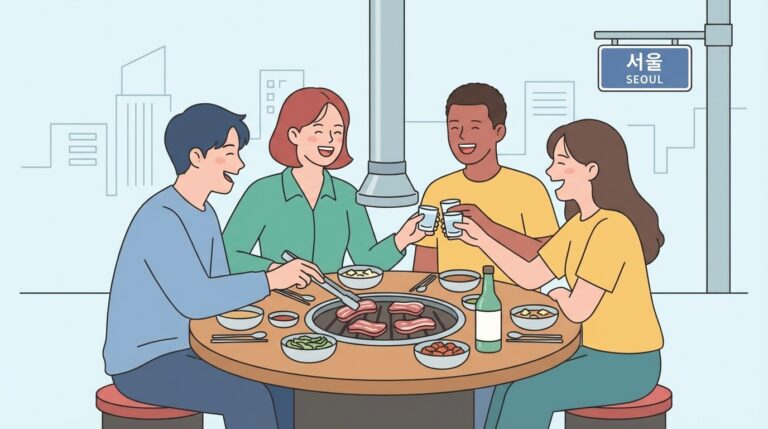
If you watch K-Dramas, you’ll notice that characters rarely resolve their conflicts or confess their feelings in broad daylight at the office. It always happens at a BBQ restaurant or a cozy pub. Sharing a steaming pot of stew and cooking meat for each other breaks down social barriers. If you want to make Korean friends, never skip the Dwit-puri!
Phase 5: Immersive Roleplay Scenario
Main Scenario: The Post-Hike BBQ
Setting: Saturday afternoon, 2 PM. A bustling Dakgalbi (Spicy Stir-fried Chicken) restaurant near Bukhansan Mountain. You just finished your first hike with a Korean hiking club. You are sitting next to Minji, a friendly Korean member of the same age.
Characters:
– YOU: A foreigner living in Korea, eager to make local friends.
– Minji (28): A cheerful Korean club member who helped you during the hike.
Dialogue:
Minji: 산 타는 거 안 힘들었어요? 오늘 진짜 더웠죠!
(san taneun geo an himdeureosseoyo? oneul jinjja deowotjyo!)
(English) Wasn’t it hard hiking? It was really hot today, right!
YOU: 네, 조금 힘들었는데 너무 재밌었어요!
(ne, jogeum himdeureonneunde neomu jaemisseosseoyo!)
(English) Yes, it was a bit hard, but really fun!
Minji: 다행이네요. 아, 근데 우리 나이도 같은데…
(dahaengineyo. a, geunde uri naido gateunde…)
(English) That’s a relief. Oh, by the way, since we are the same age…
Minji: 우리 이제 말 편하게 할까요?
(uri ije mal pyeonhage halkkayo?)
(English) Shall we speak casually now?
(🎭 Stage Direction: Minji smiles and hands you a lettuce wrap she just made.)
🔀 Your Turn! How should you answer?
– A) 아니요, 저는 존댓말이 좋아요. (No, I like polite language.)
– B) 그래! 너도 많이 먹어! (Yeah! You eat a lot too! – Instant Banmal)
– C) 아, 네! 그럼 그럴까요? (Ah, yes! Shall we do that then?)✅ Best Choice: C — Why? Even though she suggested speaking casually, jumping straight into hard Banmal (Option B) right that second can feel a tiny bit abrupt. Option C warmly accepts the offer while keeping a soft tone, smoothly transitioning into casual speech.
⚠️ Choice A Analysis: This will put up an instant wall. Minji might feel rejected or embarrassed.
YOU: 아, 네! 그럼 그럴까요?
(a, ne! geureom geureolkkayo?)
(English) Ah, yes! Shall we do that then?
Minji: 좋아요! 민지라고 불러주세요.
(joayo! minjirago bulleojuseyo.)
(English) Great! Please call me Minji.
YOU: 고마워, 민지야. 넌 등산 자주 해?
(gomawo, minjiya. neon deungsan jaju hae?)
(English) Thanks, Minji. Do you hike often?
(Notice the drop of ‘yo’!)
Minji: 응, 한 달에 두 번 정도? 우리 다음에 또 같이 오자!
(eung, han dare du beon jeongdo? uri daeume tto gachi oja!)
(English) Yeah, about twice a month? Let’s come together again next time!
YOU: 좋아! 인스타 해? 사진 보내줄게.
(joa! inseuta hae? sajin bonaejulge.)
(English) Sounds good! Do you use Insta? I’ll send you the photos.
Bonus Scenario: The Empty Promise?
Later, you are saying goodbye to another member, a 40-year-old club leader.
Leader: 오늘 고생 많았어요. 다음에 밥 한 번 같이 먹어요!
(oneul gosaeng manasseoyo. daeume bap han beon gachi meogeoyo!)
(English) Great job today. Let’s eat together sometime!
YOU: 네, 감사합니다! 조심히 가세요~
(ne, gamsahamnida! josimhi gaseyo~)
(English) Yes, thank you! Get home safely~
(Pro tip: Don’t pull out your planner. Just smile and politely say thank you!)
Phase 6: 10-Second Shadowing Drill
Speak out loud! Follow the pauses (/) and the emotion tags.
😊 Friendly & Casual:
우/리 / 이/제 / 말 편/하/게 할/까/요?
(u/ri / i/je / mal pyeon/ha/ge hal/kka/yo?)
😊 Brightly asking:
혹/시 / 인/스/타 / 하/세/요?
(hok/si / in/seu/ta / ha/se/yo?)
Phase 7: K-Culture Glossary
| Korean | Romanization | English | Cultural Context |
|---|---|---|---|
| 뒷풀이 | dwit-puri | After-party | The gathering after an event where people drink, eat, and bond. |
| 인싸 | inssa | Insider | Someone who is very sociable, popular, and gets along well in groups. |
| 존댓말 | jondaetmal | Polite language | Used for older people, strangers, and in formal situations. |
| 반말 | banmal | Casual language | Used for close friends and people younger than you. |
| 눈치 | nunchi | Social sense | The ability to “read the room” and understand others’ feelings. |
Phase 8: Traveler’s Survival Kit
Even if you aren’t living in Korea, you might join a one-day K-Pop dance class or a language cafe in Hongdae during your travels. Here is your survival kit for finding your spot!
🆘 Survival Phrase #1: Finding Your Group
– 🇰🇷 “여기 언어교환 모임 맞나요?” (yeogi eoneogyohwan moim mannayo?)
– 🗣️ English Guide: Is this the language exchange meetup?
– 📍 Where to use: Cafes, pubs, rented studios.
– 💡 Pro Tip: Meetups in Korea often happen in large cafes. Look for small table signs or just ask the staff.🆘 Survival Phrase #2: Joining a Table
– 🇰🇷 “저도 껴도 돼요? / 빈자리 있나요?” (jeodo kkyeodo dwaeyo? / binjari innayo?)
– 🗣️ English Guide: Can I join you? / Is there an empty seat?
📌 Editor’s Travel Note
– Map Apps: Google Maps doesn’t work well for walking directions in Korea. To find the obscure pub for your club’s dwit-puri, you MUST download KakaoMap or Naver Map.
– Splitting the Bill (Dutch Pay): In clubs, the bill for the after-party is usually split equally. This is called “엔빵” (N-bbang) in slang. Usually, one person pays with their card, and everyone transfers the money to their bank account, or hands them cash.
Phase 9: Think Deeper — Language & Power
🧠 Think Deeper: The Hierarchy of Language
When you join a Korean club, the very first question people ask you isn’t “What do you do for a living?” but rather, “How old are you?” (나이가 어떻게 되세요?). To a foreigner, this can feel incredibly invasive! But in Korean culture, age dictates the grammar. Koreans need to know your age to figure out whether to use Jondaetmal (polite) or Banmal (casual). It’s not about being nosy; it’s about establishing social order and showing proper respect. Without knowing your age, a Korean person feels grammatically paralyzed!
💬 Your Turn:
In your culture, what is the first question people ask to break the ice and figure out social dynamics? Share it in the comments below!
Phase 10: FAQ & Troubleshooting
Q: Can I suggest “우리 말 놓을까요?” to someone older than me?
A: NO! 🚫 In Korean culture, the privilege of dropping the honorifics belongs to the older person. If you are younger, you must wait for them to say, “말 편하게 해” (Speak comfortably to me). If you say it first, it sounds disrespectful.
Q: If a 50-year-old club leader tells me to speak comfortably, can I use Banmal?
A: Maybe, but be careful! ⚠️ When elders say “말 편하게 하세요,” they usually mean they will use Banmal to you, and you don’t have to be overly stiff. But you should still use the polite “~요” form.
❌ Common Mistake #1: Using “너” (You) in Korean.
✅ Do this instead: Even if you start speaking casually (Banmal) with a same-age friend, do not translate the English word “You” to “너 (neo)”. It can sound aggressive. Instead, use their name: “민지는 주말에 뭐 해?” (What is Minji doing on the weekend? = What are you doing on the weekend?).
Phase 11: Wrap-up & Action Items
One-Liner Summary: To level up your friendships in Korean clubs, master the art of the after-party and know when to transition from polite to casual speech!
Your Action Missions:
– 🥉 Bronze (Solo): Stand in front of a mirror and practice saying “우리 말 놓을까요?” with a friendly smile 3 times.
– 🥈 Silver (Online): Leave a comment in our community saying “다음에 밥 한 번 같이 먹어요!” to another learner.
– 🥇 Gold (Real Life): Next time you meet a Korean friend of the same age, ask them for their Instagram using today’s phrase!
🎬 K-Culture Mission:
Watch an episode of a slice-of-life K-Drama (like Hospital Playlist or Reply 1988). Keep your ears open! Can you catch the moment they switch from ending sentences in “~요” to just ending them abruptly (Banmal)?
What kind of club would you want to join in Korea? Let me know in the comments!
Phase 12: Interactive Quiz
1. You are at a K-Pop dance club gathering. You want to stay in touch with a 22-year-old member you just met. What is the most natural thing to say?
A) 전화번호가 어떻게 됩니까?
B) 인스타 하세요?
C) 우리 말 놓을까요?
2. Fill in the blank:
Korean friend: “오늘 만나서 반가웠어요. 다음에 ___ 한 번 같이 먹어요!”
A) 밥 (rice/meal)
B) 돈 (money)
C) 잠 (sleep)
3. True or False – K-Culture Edition:
“If an older person in your club tells you to ‘speak comfortably’, you should immediately drop all honorifics and speak to them like a childhood friend.”
(Answers: 1: B (Social media is less pressure than a phone number), 2: A (Sharing a meal is sharing a bond), 3: False! You should still maintain a polite boundary and use ‘~요’ unless explicitly told otherwise!)
Frequently Asked Questions (FAQ)
Q: What does "우리 말 놓을까요? (Shall we speak casually?)" mean in Korean and how do you pronounce it?
A: In Korean, "우리 말 놓을까요? (Shall we speak casually?)" is pronounced [u-ri mal noeulkkayo? [Sound-alike: "u-ri" (oo-ree] and means: Literal: "Shall we drop the language?" / Real nuance: "Shall we stop using polite forms and be close friends?"
Q: What does "다음에 밥 한 번 같이 먹어요. (Let's grab a meal together sometime.)" mean in Korean and how do you pronounce it?
A: In Korean, "다음에 밥 한 번 같이 먹어요. (Let's grab a meal together sometime.)" is pronounced [da-eu-me bap han beon ga-chi meo-geo-yo. [Sound-alike: "da-eu-me" (da-oo-meh] and means: Literal: "Let's eat rice together one time next time." / Real nuance: "Let's hang out again / Nice meeting you!"
Q: What does "인스타 하세요? (Do you have Instagram?)" mean in Korean and how do you pronounce it?
A: In Korean, "인스타 하세요? (Do you have Instagram?)" is pronounced [in-seu-ta ha-se-yo? [Sound-alike: "in-suh-tah" + "ha-se-yo"] and means: Literal: "Do you do Insta?" / Real nuance: "Can I follow you on Instagram?"







