

Phase 1: Immersive Hook
Hello, everyone! It’s your Daily Hangul Editor here.
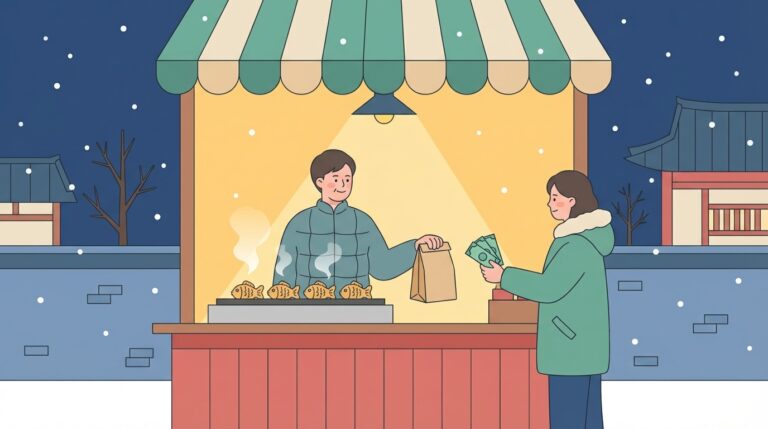
Picture this: You are walking down the streets of Seoul in mid-December. The freezing wind is biting at your cheeks. Suddenly, a sweet, warm, toasty scent wafts through the air. You look ahead and see steam rising from a small, glowing food cart. It’s a Bungeoppang (fish-shaped pastry) stall! Just like in those classic K-Dramas where the male lead buys a warm bag of pastries to warm up the female lead’s hands.
You rush over, mouth watering, ready to order. You confidently pull out your sleek credit card… and the vendor gives you a sorry look. Cash only.
Panic sets in. You walk away empty-handed, heartbroken by a pastry.
This is why every Korean lives by a strict winter rule: “Always carry 3,000 won in your chest pocket” (가슴속에 현금 3천 원은 품고 다녀야 한다). While Korea is one of the most cashless societies in the world, the magical winter street food stalls are the ultimate exception. Today, we are going to learn exactly what to say to secure your street food, save your pride, and sound like a true local. Let’s dive in!
Phase 2: Deep Dive (Key Expressions)
Let’s look at the absolute must-know B1-level expressions for conquering Korean street food carts.
1. 계좌이체 되나요?
- Pronunciation: [Gyejwa-iche doenayo?] / Gye-jwa-ee-che doe-na-yo? (The ‘oe’ sounds like ‘weh’.)
- Meaning: (Literal) Is bank transfer possible? / (Real nuance) Can I wire you the money since I don’t have cash?
- K-Culture Moment: If you forget your 3,000 won, this phrase is your lifeline. Vendors usually have their bank account numbers taped to the cart on a piece of cardboard. Just pull up your Korean banking app!
- Editor’s Insight: This phrase sounds very polite and practical. You are asking for permission softly. It’s much better than just saying “No cash” and staring awkwardly.
- Situation Spectrum:
[🚫 절대 금지] ———— [⚠️ 주의] ———— [✅ 자유롭게]
- Close Friends (Casual): ✅ (You can just say ‘계좌이체 해줄게’ to friends)
- Street Vendors/Shop Owners: ✅
- Formal Business: 🚫 (Too casual for official corporate payments)
- 🤔 Think About It: Korea is incredibly digital. Why do you think vendors prefer bank transfers over credit cards? (Hint: It avoids credit card processing fees for small 1,000-won purchases!)
2. 붕어빵 삼천 원어치 주세요.
- Pronunciation: [Bungeoppang samcheon won-eochi juseyo.] / Bung-uh-ppang sam-chun won-uh-chee joo-seh-yo.
- Meaning: (Literal) Please give me 3,000 won’s worth of Bungeoppang.
- K-Culture Moment: At a street stall, the prices are usually “3 for 2,000 won” or “2 for 1,000 won.” Instead of doing the math to figure out how many pastries you get, Koreans just order by the price.
- Editor’s Insight: The grammar point
~어치(worth of) is incredibly native. Textbooks teach you “Please give me three items,” but ordering by “X won’s worth” proves you really know the culture.- Situation Spectrum:
[🚫 절대 금지] ———— [⚠️ 주의] ———— [✅ 자유롭게]
- Casual Stores/Markets: ✅
- High-end Restaurants: 🚫 (Don’t say “Give me 50,000 won’s worth of steak!”)
- 🤔 Think About It: Do you order food by “money value” or by “quantity” in your home country? How does this change the dynamic between the buyer and seller?
3. 섞어서 주세요.
- Pronunciation: [Seokkeoseo juseyo.] / Suck-uh-suh joo-seh-yo. (The ‘eo’ sounds like the ‘u’ in ‘up’.)
- Meaning: (Literal) Please mix them and give them. / (Real nuance) I’ll take a mix of different flavors, please.
- K-Culture Moment: Bungeoppang comes in two main flavors: Red Bean (팥 – Pat) and Chou Cream/Custard (슈크림 – Shu-cream). When you can’t decide between the two, this is your magic phrase!
- Editor’s Insight: This isn’t just for pastries! You can use this at traditional markets when buying fried snacks (튀김) or dumplings (만두).
- Situation Spectrum:
[🚫 절대 금지] ———— [⚠️ 주의] ———— [✅ 자유롭게]
- Any informal food setting with options: ✅
Phase 3: Textbook vs. Real Life
Let’s see how textbooks differ from the lively streets of Seoul.
| Situation | 📖 Textbook Korean | 🗣️ Real Life Korean | 💡 Why different? |
|---|---|---|---|
| Asking the price | 이거 얼마입니까? | 이거 얼마예요? | The ‘~입니다’ form is too stiff for a cozy street stall. ‘~예요/이에요’ is friendly. |
| Handing over cash | 현금으로 내겠습니다. | 여기요~ (Holding out cash) | Speed is key in Korea (Palli-palli). A simple “Here you go” is enough. |
| Expressing a lack of cash | 현금이 없습니다. | 아, 현금이 없는데… | Trailing off with ‘~은/는데…’ is a polite, indirect way to show hesitation without a harsh “No.” |
| Choosing flavors | 팥 2개, 크림 1개 주세요. | 팥붕 두 개, 슈붕 하나요! | Koreans LOVE shortening words. Pat-bung (Red bean) and Shu-bung (Cream) are modern slang! |
Phase 4: Cultural Deep Dive
4-1. Non-verbal Communication (The ‘Manner Hands’)
When handing your precious 3,000 won to the Ajumma (auntie/vendor), do not just toss it on the counter! In Korea, handing things over with two hands is a sign of respect.
Pro Tip: If you are holding bags in one hand, use your right hand to give the cash, and place your left hand lightly under your right elbow. It’s a classic Korean polite gesture that will immediately win you extra smiles (and maybe an extra pastry)!
4-2. K-Culture Connection: The Great Idol Debate
If you follow K-Pop, you have definitely seen this. During winter, idols on V-Live or Weverse will always ask their fans: “Are you Team Pat-bung (Red Bean) or Team Shu-bung (Chou Cream)?”
It is a highly debated topic in Korea, similar to “pineapple on pizza.” Red bean is the traditional, nostalgic flavor, while Chou cream is the sweet, modern favorite. Knowing whether your favorite idol is a Pat-bung or Shu-bung lover is essential fan knowledge. Next time you go to a K-Pop concert in winter, use your 3,000 won to buy the flavor your bias loves!
Phase 5: Immersive Roleplay
Setting: It’s 8 PM on a Friday outside Hongdae Station. The temperature is -5°C. You are shivering with your Korean friend, Minho. You spot a Bungeoppang cart.
Characters:
– YOU: An expat who loves Korean winter snacks but forgot their wallet.
– Minho: (28, your Korean friend, loves teasing you).
– Ajumma: (Friendly cart owner in a thick winter jacket).
Dialogue:
Minho: 야, 너무 춥다. 어? 저기 붕어빵 있다! 먹을래?
(Ya, neomu chupda. Eo? jeogi bungeoppang itda! meogeullae?)
[Hey, it’s so cold. Oh? There’s Bungeoppang! Wanna eat?]
YOU: 완전 좋지! 나 진짜 먹고 싶었어.
(Wanjeon jochi! Na jinjja meokgo sipeosseo.)
[Absolutely! I really wanted to eat some.]
Minho: 그럼 네가 사! 나 현금 없어.
(Geureom nega sa! Na hyeongeum eopseo.)
[Then you buy it! I don’t have cash.]
(🎭 Stage Direction: You pat your pockets and freeze in horror)
YOU: 헐… 나도 현금 없는데. 카드만 있어.
(Heol… nado hyeongeum eomneunde. Kadeuman isseo.)
[OMG… I don’t have cash either. Only a card.]
Ajumma: 어서 오세요~ 몇 개 줘요?
(Eoseo oseyo~ myeot gae jwoyo?)
[Welcome~ How many should I give you?]
🔀 Your Turn! How do you respond to the Ajumma?
– A) “안 사요. 안녕히 계세요.” (I won’t buy. Goodbye.)
– B) “혹시… 계좌이체 되나요?” (By any chance… is bank transfer possible?)
– C) “카드 받으세요!!” (Take my card!!)✅ Best Choice: B — This is the perfect survival skill! Most vendors will point to a sign with their bank details.
⚠️ Choice A & C Analysis: ‘A’ is way too direct and a missed opportunity for food! ‘C’ is a bit aggressive and demanding; street stalls rarely have card machines.
(Assuming you chose B)
Ajumma: 그럼~ 저기 번호로 이체해 줘요. 팥으로 줄까, 슈크림으로 줄까?
(Geureom~ jeogi beonhoro ichehae jwoyo. Pateuro julkka, syukeurimeuro julkka?)
[Of course~ Transfer to the number over there. Should I give you red bean or chou cream?]
YOU: 음… 섞어서 삼천 원어치 주세요!
(Eum… seokkeoseo samcheon won-eochi juseyo!)
[Hmm… Please give me 3,000 won’s worth mixed!]
Minho: 오~ 한국 사람 다 됐네!
(O~ hanguk saram da dwaenne!)
[Oh~ You’ve become totally Korean!]
Phase 6: 10-Second Shadowing Drill
Practice these lines out loud. Pay attention to the pauses (/) and the emotions!
- 🥺 (With desperate, polite puppy eyes)
사장님, / 혹시 / 계좌이체 / 되나요?
(sajangnim, / hoksi / gyejwa-iche / doenayo?) -
😊 (Brightly and confidently)
팥이랑 슈크림 / 섞어서 / 삼천 원어치 / 주세요!
(pat-irang syukeurim / seokkeoseo / samcheon won-eochi / juseyo!)
Phase 7: K-Culture Glossary
| Korean | Romanization | English | Cultural Context |
|---|---|---|---|
| 가슴속 3천 원 | gaseumsok samcheon won | 3,000 won in the chest | A famous meme/phrase meaning you must always carry emergency cash in winter for street food. It’s even the name of a popular app! |
| 붕세권 | bung-segwon | Bungeoppang zone | A slang portmanteau of Bungeoppang + Yeoksegwon (Station area). It means living in an area close to a Bungeoppang stall. A huge flex! |
| 팥붕 / 슈붕 | pat-bung / syu-bung | Red bean / Cream pastry | Shortened slang for the two dominant Bungeoppang flavors. |
| 서비스 | seobiseu | “Service” (Freebie) | When a vendor gives you an extra pastry for free out of the kindness of their heart (Jeong). |
Phase 8: Traveler’s Survival Kit
If you are traveling to Korea this winter, you absolutely need these phrases!
🆘 Survival Phrases for Street Stalls
– 🇰🇷 “이거 하나에 얼마예요?” (igeo hana-e eolmayeyo?)
– 🗣️ Meaning: How much is it for one of these?
– 📍 Use it: When the price isn’t written anywhere.
– 🇰🇷 “봉투 하나만 주세요.” (bongtu hanaman juseyo.)
– 🗣️ Meaning: Please give me a bag.
– 📍 Use it: When you need a bag to hold your hot snacks.📌 Editor’s Travel Note
– The Ultimate App: Did you know there is a community-driven app in Korea literally called “가슴속 3천원” (3,000 won in your chest)? Koreans use it to track and map out where street vendors are located on any given day. Download it to find the best spots!
– Cash is King: While 99% of Korea uses cards, street stalls, traditional markets (like Gwangjang Market), and T-Money card reloads often require cash. Keep a crisp 10,000 won bill broken into smaller 1,000 bills!
– No Tipping: Never tip the vendor. The best ‘tip’ is bowing and saying “잘 먹겠습니다!” (I will eat it well!).
Phase 9: Think Deeper — Language & Reality
🧠 Think Deeper: The Irony of a Cashless Society
Korea is famously a high-tech, cashless society. You can pay for a $1 coffee with Samsung Pay or a credit card without anyone blinking an eye. Yet, the romanticized rule of “carrying 3,000 won in cash” strictly survives for winter street food. This highlights a beautiful contrast in Korean culture: the hyper-fast, digital modern world versus the slow, analog nostalgia of Jeong (정 – human warmth). Handing over physical cash for a paper bag of hot pastries connects Koreans to a simpler time. The street stall is one of the last remaining spaces where digital transactions feel almost too cold for the warm interaction taking place.💬 Your Turn: In your culture, is there a specific place or situation where people still strictly use cash despite modern technology? Share it in the comments!
Phase 10: FAQ & Troubleshooting
Q: Can I bargain with street vendors in Korea?
No. Unlike some other countries, bargaining at food stalls is not common in Korea. The prices are already very low (usually 1,000 to 3,000 won). Just pay the asking price with a smile!
Q: What if I don’t have a Korean bank account for ‘계좌이체’ (bank transfer)?
If you are a tourist without a Korean bank app, bank transfers are virtually impossible. Therefore, the “carry cash” rule is doubly important for you!
❌ Common Mistake #1: Trying to use Apple Pay at a street stall.
✅ Do this instead: Look for a piece of cardboard with an account number, or just hand them physical cash.❌ Common Mistake #2: Saying “슈크림 붕어빵 세 개 주세요” (Give me 3 Chou cream Bungeoppang) when the sign says ‘2 for 1,000 won’.
✅ Do this instead: Order by price using~어치. “이천 원어치 주세요” (Give me 2,000 won’s worth). The vendor will do the math!
Phase 11: Wrap-up & Action Items
🔥 One-Liner Summary: To survive Korean winter and eat the best street food, always carry 3,000 won in cash and know how to order by price (~어치)!
Action Mission:
– 🥉 Bronze: Stand in front of a mirror and ask your reflection, “계좌이체 되나요?” 3 times.
– 🥈 Silver: Ask a Korean friend or language partner if they are Team Pat-bung (Red Bean) or Team Shu-bung (Cream).
– 🥇 Gold: Go to an actual Korean street vendor, order “삼천 원어치 주세요,” and pay with physical cash!
✨ K-Culture Mission:
Search “가슴속 3천원” on your app store, or look up a vlog of someone eating Bungeoppang in Korea. Notice how they interact with the vendor!
Phase 12: Interactive Quiz
Test your street-smart Korean!
1. (Situational Judgment) You found a Bungeoppang cart but only have your credit card. You do have a Korean bank app. What should you say?
A) “카드 긁어주세요.” (Please swipe my card.)
B) “혹시 계좌이체 되나요?” (Is bank transfer possible?)
C) “다음에 올게요.” (I’ll come next time.)
2. (Fill in the Blank) The vendor sells pastries 3 for 2,000 won. You want to buy exactly 2,000 won worth. You say: “____ 원어치 주세요.”
3. (True/False – K-Culture Edition) It is considered polite to leave a tip for the street food vendor if the food is delicious. (T/F)
4. (Roleplay Logic) If your friend says “나는 무조건 슈붕이지!” (I am unconditionally Team Shu-bung!), what flavor do they want?
(Answers: 1. B, 2. 이천(2,000), 3. False (No tipping in Korea!), 4. Chou Cream / Custard)
Frequently Asked Questions (FAQ)
Q: What does "계좌이체 되나요?" mean in Korean and how do you pronounce it?
A: In Korean, "계좌이체 되나요?" is pronounced [Gyejwa-iche doenayo?] and means: (Literal) Is bank transfer possible? / (Real nuance) Can I wire you the money since I don't have cash?
Q: What does "붕어빵 삼천 원어치 주세요." mean in Korean and how do you pronounce it?
A: In Korean, "붕어빵 삼천 원어치 주세요." is pronounced [Bungeoppang samcheon won-eochi juseyo.] and means: (Literal) Please give me 3,000 won's worth of Bungeoppang.
Q: What does "섞어서 주세요." mean in Korean and how do you pronounce it?
A: In Korean, "섞어서 주세요." is pronounced [Seokkeoseo juseyo.] and means: (Literal) Please mix them and give them. / (Real nuance) I'll take a mix of different flavors, please.







