

Phase 1: Immersive Hook
Hello! I’m your Daily Hangul Editor.
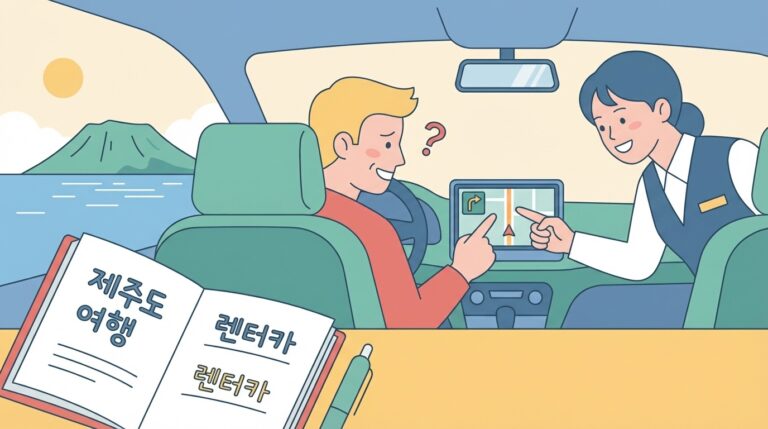
Picture this: You’ve just arrived in Jeju Island. The ocean breeze is blowing, and you are ready for that ultimate K-Drama coastal road trip. You get the keys to your rental car, slide into the driver’s seat, and turn on the engine. Suddenly, the car’s navigation system (GPS) starts speaking to you in rapid-fire Korean: “전방에 과속 방지턱이 있습니다!” (Speed bump ahead!)
You stare at the screen. It’s all in Hangul. You need to get to your hotel, but you have no idea how to make this machine understand you. “Wait… how do I even change this to English?”
If you don’t know how to ask this simple question, your relaxing K-Travel experience might turn into a stressful puzzle. But don’t worry! I’ve seen countless students panic over this exact situation. Today, I’m going to teach you the ultimate “Insider” survival phrases for dealing with Korean rental car navigation systems. By the end of this post, you’ll be hitting the road like a true local!
Phase 2: Deep Dive into Core Expressions
Let’s look at the absolute must-know phrases to ask a rental car staff member for help.
1. 이거 영어로 어떻게 바꿔요?
- Pronunciation: [igeo yeong-eoro eotteoke bakkwoyo?] / [ee-guh yung-uh-ro uh-ddoh-keh bah-kwoh-yo?] (The ‘uh’ sounds like the sound you make when you say ‘uh-oh’)
- Meaning: (Literal) This to-English how to change? -> (Real nuance) How do I change this to English?
- K-Culture Moment: You’ll use this the moment the rental car ajusshi (older gentleman) hands you the keys. Often, they set the GPS to Korean by default. Asking this politely will make them lean into the car and press the magical settings button for you.
- Editor’s Insight: The word “바꿔요” comes from “바꾸다” (to change/swap). Koreans use this for everything—changing languages, exchanging items at a store, or even changing a bad habit!
- Situation Spectrum:
[🚫 절대 금지] ———— [⚠️ 주의] ———— [✅ 자유롭게]
- Casual with friends: ✅
- Semi-formal (Rental staff): ✅ (Add “저기요” – Excuse me – at the beginning!)
- Highly formal (Business meeting): ⚠️ (Use “바꿀 수 있을까요?” instead)
- 🤔 Think About It: Notice how the subject (“I” or “You”) is completely dropped? Korean is a “high-context” language. If you’re holding the GPS and looking confused, everyone already knows who wants to change what!
2. 목적지 어떻게 찍어요?
- Pronunciation: [mokjeokji eotteoke jjigeoyo?] / [mok-juk-jee uh-ddoh-keh jji-guh-yo?] (Make a strong, tense ‘jj’ sound!)
- Meaning: (Literal) Destination how to stamp/poke? -> (Real nuance) How do I input the destination?
- K-Culture Moment: This is purely a local slang turned everyday phrase! We don’t say “type” or “input” for a GPS. We say “찍다” (to stamp or poke) because early touch screens required you to physically poke them.
- Editor’s Insight: If you use the word “찍다” instead of the dictionary word for ‘input’ (입력하다), the local staff will widen their eyes and think, “Wow, this foreigner knows real Korean!”
- Situation Spectrum:
[🚫 절대 금지] ———— [⚠️ 주의] ———— [✅ 자유롭게]
- Casual with friends: ✅
- Semi-formal (Rental staff): ✅
- Highly formal/Written: 🚫 (Use 입력하다 in writing)
- 🤔 Think About It: Languages evolve with technology. Can you think of a word in English that changed its meaning because of smartphones? (Hint: “Scroll” or “Swipe”!)
3. 소리 좀 줄여주세요.
- Pronunciation: [sori jom juryeojuseyo] / [so-ree johm joo-ryuh-joo-seh-yo]
- Meaning: Please turn down the volume a bit.
- K-Culture Moment: Korean navigation systems are incredibly chatty. They warn you about speed cameras, school zones, rest stops, and sharp curves. Sometimes, it ruins the vibe of your K-Pop road trip playlist. You’ll need this to ask the staff to lower the system’s voice!
- Editor’s Insight: The magic word here is “좀” (a little). Even if you want the volume down by 90%, saying “좀” softens your request and makes you sound much more polite and native.
- Situation Spectrum:
[🚫 절대 금지] ———— [⚠️ 주의] ———— [✅ 자유롭게]
- Casual with friends: ✅ (Just say “소리 좀 줄여!”)
- Semi-formal (Rental staff): ✅
Phase 3: Textbook vs Real Life
How does textbook Korean compare to what you’ll actually hear in the rental car parking lot?
| 상황 | 📖 교과서 한국어 | 🗣️ 진짜 한국어 | 💡 왜 다를까? |
|---|---|---|---|
| Calling the device | 내비게이션 (Naebigeisyeon) | 네비 (Nebi) | Koreans love abbreviating 4+ syllable words for efficiency! |
| Asking to type an address | 주소를 입력해 주세요. (Please input the address.) | 여기 주소 좀 찍어주세요. (Please poke/stamp the address here.) | “찍다” refers to the physical tapping action, making it more intuitive. |
| Asking how to use it | 사용 방법을 알려주시겠습니까? (Could you please inform me of the usage method?) | 이거 어떻게 써요? (How do I use this?) | Real spoken Korean prefers short, direct verbs over formal nouns. |
Bottom Note: For A2 learners, sticking to “어떻게 써요?” (How do I use it?) is your golden ticket. It’s polite, short, and universally understood!
Phase 4: Cultural Deep Dive
4-1. Non-verbal Communication (The Nunchi Check)
When asking for help in Korea, especially from older staff members, body language matters. Don’t just point at the screen with one index finger from afar.
Instead, get slightly closer, point with your whole hand (or a slightly open palm), and look at the staff with a slight bow of your head. This shows respect. In Korean culture, reading the room (Nunchi) means realizing the staff is busy, so having your question ready with a polite smile goes a long way!
4-2. K-Travel Connection: The “Phone Number” Hack
If you’ve watched K-Dramas like Welcome to Samdal-ri or Our Blues, you know the magic of driving in Jeju. But here is the ultimate real-life Korean travel secret:
Korean addresses are incredibly long and hard to type. Even Koreans hate typing them into the car’s GPS!
So, what do we do? We search by phone number. Every official business, restaurant, and hotel in Korea has its phone number registered to its exact GPS coordinates. If you want to go to a famous Black Pork restaurant, you just type “064-123-4567” into the GPS, and boom! It finds it instantly. Knowing this will save your life on a Korean road trip.
Phase 5: Immersive Roleplay
Scenario A: The Jeju Airport Rental Car House
Setting: A sunny Tuesday morning at the Jeju Airport Rental Car parking lot. The air smells like the ocean. You are standing next to your shiny rented Hyundai Avante.
Characters:
– YOU: An excited traveler ready to eat some black pork.
– Staff Ajusshi (50s): Wearing a high-vis vest, checking off a clipboard. Friendly but speaking very quickly.
Dialogue:
Staff: 고객님, 예약하신 차량 여깄습니다. (gogaengnim, yeyakasin charyang yeogitseumnida.)
(English) Customer, here is the car you reserved.
YOU: 아, 감사합니다! (a, gamsahamnida!)
(English) Ah, thank you!
(🎭 Stage Direction: You sit in the driver’s seat and look at the GPS screen. It’s fully in Korean.)
YOU: 저기요… 질문 있어요. (jeogiyo… jilmun isseoyo.)
(English) Excuse me… I have a question.
Staff: 네, 말씀하세요. (ne, malsseumhaseyo.)
(English) Yes, please speak.
YOU: 이거 영어로 어떻게 바꿔요? (igeo yeong-eoro eotteoke bakkwoyo?)
(English) How do I change this to English?
Staff: 아하! 잠시만요. (aha! jamsimanyo.)
(English) Aha! Just a moment.
(🎭 Stage Direction: The Ajusshi leans in and taps the screen a few times. The menu turns to English.)
Staff: 다 됐습니다. (da dwaetseumnida.)
(English) All done.
YOU: 우와! 그럼, 목적지 어떻게 찍어요? (uwa! geureom, mokjeokji eotteoke jjigeoyo?)
(English) Wow! Then, how do I input the destination?
Staff: 여기 누르시면 돼요. 주소 아세요? (yeogi nureusimyeon dwaeyo. juso aseyo?)
(English) You just press here. Do you know the address?
🔀 당신의 차례! 어떻게 대답할까요? (Decision Point)
– A) “네, 제주도 제주시 한림읍…” (Trying to read the 20-syllable Korean address)
– B) “전화번호로 찍을게요!” (I’ll input it by phone number!)
– C) “몰라요. 알아서 가주세요.” (I don’t know. Just take me there.)✅ Best Choice: B — As we learned in the Cultural Dive, using the phone number is the smartest and fastest way!
⚠️ Choice A & C 분석: Choice A will take you 10 minutes to type. Choice C sounds like you are talking to a taxi driver, not a rental car!
Scenario B: The Talkative GPS
Setting: You are driving happily, but the GPS keeps beeping loudly every 10 seconds to warn you about speed cameras.
YOU: 아… 소리 너무 커. (Ah… sori neomu keo. / Ah… the sound is too loud.)
Friend: 네비 소리 좀 줄여봐. (Nebi sori jom juryeobwa. / Turn down the navi volume a bit.)
YOU: 어떻게 줄여? (Eotteoke juryeo? / How do I turn it down?)
Friend: 화면 왼쪽 버튼! (Hwamyeon oenjjok beoteun! / The button on the left of the screen!)
Phase 6: 10-Second Shadowing Drill
Let’s practice the most important phrase. Pay attention to the pauses (/) and the emotion!
🥺 저기요, / 이거 / 영어로 어떻게 / 바꿔요?
(jeogiyo, / igeo / yeong-eoro eotteoke / bakkwoyo?)
Emotion: Slightly helpless but polite, asking for a favor!
Phase 7: K-Culture Glossary
| 한국어 | Romanization | English | 맥락 설명 (Context) |
|---|---|---|---|
| 네비 | nebi | GPS / Navigation | The shortened, everyday word for navigation system. |
| 렌터카 | renteoka | Rental car | Notice how it’s borrowed directly from English! |
| 초보운전 | chobounjeon | Beginner driver | You will see cute stickers saying this on cars. It means “Novice driving.” |
| 방지턱 | bangjiteok | Speed bump | Korean residential and school areas have hundreds of these! |
| 과속카메라 | gwasokkamera | Speed camera | The reason the Korean GPS beeps so much. Korea has many speed cameras! |
Phase 8: Traveler’s Survival Kit
🆘 Survival Expressions for the Road
– 🇰🇷 “전화번호로 검색할게요.” (jeonhwabeonhoro geomsaekalgeyo.)
– 🗣️ English: I will search by phone number.
– 📍 Where to use: In the rental car when setting your destination.
– 💡 Pro Tip: Find the restaurant’s phone number on Google or Naver before you start driving.
- 🇰🇷 “주유소 찾아주세요.” (juyuso chajajuseyo.)
- 🗣️ English: Please find a gas station.
- 📍 Where to use: When using voice command on your GPS or asking a passenger.
📌 Editor’s Travel Note:
– The Map App Rule: Google Maps DOES NOT work for driving directions in Korea due to national security laws. You must download Naver Map or KakaoMap. Both have English interfaces and are lifesavers!
– Hi-Pass (하이패스): This is the Korean electronic toll system. Ask your rental car company if your car has a Hi-Pass card (하이패스 카드 있어요?). If it does, you can zoom right through the blue tollgate lanes!
Phase 9: Think Deeper — “한 발 더 깊이”
🧠 Think Deeper: Global Era & Konglish
When you rent a car in Korea, you’ll notice something funny. The vocabulary is full of English, but it sounds completely different! “Navigation” becomes “Nebi.” The steering wheel is called a “Handle” (핸들). The accelerator is “Axel” (악셀). The horn is “Klaxon” (크락션).
This is Konglish—English words adopted and reshaped by Koreans for faster, easier pronunciation. It shows how the Korean language creatively absorbs global influences while adapting them to fit its own fast-paced culture (빨리빨리 culture!).💬 Your Turn: Do you have words in your language that were borrowed from English but changed meaning or pronunciation? Share them in the comments!
Phase 10: FAQ & Troubleshooting
Q: Can I use “바꿔요(Change)” to my boss at a company?
A: ⚠️ Maybe, but be careful. “바꿔요” is polite enough for strangers and shop staff (standard politeness, 요-form). But for a boss, it sounds a bit too direct. Use “바꿀 수 있을까요?” (Could we change it?) to soften the request.
Q: My rental car GPS is in English, but it can’t find my English search. Why?
A: Many Korean GPS systems, even when the interface is changed to English, still struggle with English alphabet searches for local restaurants. This is why the Phone Number Search (Phase 4) is absolutely crucial!
❌ 흔한 실수 #1 (Common Mistake): Relying on Google Maps for your Jeju road trip.
✅ 이렇게 하세요 (Do this instead): Download Naver Map. It works perfectly in English and integrates smoothly with Korean roads and traffic systems.
Phase 11: Wrap-up & Action Items
One-Liner Summary: To survive a Korean road trip, master “어떻게 바꿔요?” (How do I change it?) and always search destinations by phone number!
Action Mission 3단계:
– 🥉 Bronze: Stand in front of a mirror and say “이거 영어로 어떻게 바꿔요?” three times with a confident smile.
– 🥈 Silver: Download Naver Map on your phone right now and try changing the language settings to English.
– 🥇 Gold: On your next trip to Korea, rent a car and use these exact phrases with the rental staff!
K-Culture Mission: Open Naver Map, search for “Jeju Airport,” and find the phone number for any nearby cafe. Imagine typing that number into your car’s GPS!
Are you planning a road trip in Korea soon? Where do you want to go? Let me know in the comments below! 🚗💨
Phase 12: Interactive Quiz
1. You want to ask the rental staff how to input your hotel’s address. What is the most natural “local” way to say this?
A) 목적지 어떻게 타자쳐요? (How do I type the destination?)
B) 목적지 어떻게 찍어요? (How do I stamp/poke the destination?)
C) 목적지 어디예요? (Where is the destination?)
2. True or False – K-Culture Edition:
“For a road trip in Korea, Google Maps is the best navigation app to use for driving directions.”
3. Fill in the blank:
The car GPS is too loud! You want to say “Please turn down the volume a bit.”
소리 ( _____ ) 줄여주세요.
(Scroll down for answers!)
…
…
…
Answers:
1. B (Koreans use ‘찍다’ – to stamp/poke – for interacting with screens!)
2. False (Due to security laws, Google Maps driving directions don’t work well in Korea. Use Naver Map or KakaoMap!)
3. 좀 (Adding ‘좀’ makes your request polite and natural.)
Frequently Asked Questions (FAQ)
Q: What does "이거 영어로 어떻게 바꿔요?" mean in Korean and how do you pronounce it?
A: In Korean, "이거 영어로 어떻게 바꿔요?" is pronounced [igeo yeong-eoro eotteoke bakkwoyo?] and means: (Literal) This to-English how to change? -> (Real nuance) How do I change this to English?
Q: What does "목적지 어떻게 찍어요?" mean in Korean and how do you pronounce it?
A: In Korean, "목적지 어떻게 찍어요?" is pronounced [mokjeokji eotteoke jjigeoyo?] and means: (Literal) Destination how to stamp/poke? -> (Real nuance) How do I input the destination?
Q: What does "소리 좀 줄여주세요." mean in Korean and how do you pronounce it?
A: In Korean, "소리 좀 줄여주세요." is pronounced [sori jom juryeojuseyo] and means: Please turn down the volume a bit.







