

Hello! I’m your Daily Hangul Editor.
Let’s set the scene: You’re watching your favorite K-Drama. The beautiful piano OST starts playing. Soft, white snowflakes—the cheotnun (첫눈, first snow)—begin to fall. The main characters look into each other’s eyes, smile, and start running playfully through the snowy streets of Seoul.
But wait… if you actually try running on a snowy street in Seoul, you’re not going to get a romantic kiss. You’re going to get a bruised tailbone!
Seoul is a city built on mountains. Those aesthetic uphill streets you see in dramas like Itaewon Class or around Bukchon Hanok Village become literal ice slides when it snows. Knowing how to say “It snowed, so the road is slippery” isn’t just about small talk; it’s a vital survival skill and a beautiful way to show you care about someone’s safety in Korea.
Today, we’re going to learn how to express this perfectly at a B1 level, blending grammar with real-life K-Culture survival tips. Let’s dive in!
Phase 2: Core Expression Deep Dive
1. 눈이 와서 길이 미끄러워요.
- Pronunciation: nun-i waseo gil-i mikkeureowoyo. [nu-ni / wa-seo / gi-ri / mi-ggeu-reo-wo-yo]
- Meaning: (Literal) Snow came, so the road is slippery. (Real nuance) It snowed, so be careful because it’s slippery out there.
- K-Culture Moment: You’ll hear this constantly in winter from cafe owners as you leave, or from friends texting you before you meet up. It’s the ultimate winter icebreaker (pun intended!).
- Editor’s Insight: The grammar here is
-아/어서(because/so). Notice how we say “눈이 오다” (snow comes) instead of “it snows.” When combined with the descriptive verb미끄럽다(to be slippery), which follows the ‘ㅂ’ irregular rule, it becomes미끄러워요.- Situation Spectrum:
[🚫 Never] ———— [⚠️ Be Careful] ———— [✅ Freely]
- Close friends (Casual – 미끄러워): ✅
- Colleagues (Semi-formal – 미끄러워요): ✅
- Boss/Elders (Formal – 미끄럽습니다): ✅
- 🤔 Think About It: Why do you think Koreans text this to each other even when they both know it’s snowing? It’s not about the weather—it’s an expression of Jeong (정, care and affection). Does your culture have a way of saying “I care about you” through weather warnings?
2. 넘어지지 않게 조심하세요.
- Pronunciation: neomeojiji anke josimhaseyo. [neo-meo-ji-ji / an-ke / jo-sim-ha-se-yo]
- Meaning: Please be careful not to fall/slip.
- K-Culture Moment: Imagine walking out of a restaurant after having a warm bowl of Gukbap (soup with rice). The restaurant imo-nim (auntie) will kindly shout this to you as you step out into the cold.
- Editor’s Insight:
넘어지다means “to fall over.” By adding-지 않게(so that you don’t), you are actively wishing for someone’s safety. It sounds incredibly warm and native-like!- Situation Spectrum:
[🚫 Never] ———— [⚠️ Be Careful] ———— [✅ Freely]
- Close friends (Casual – 넘어지지 않게 조심해): ✅
- Colleagues/Strangers (Semi-formal – 조심하세요): ✅
- Boss/Elders (Formal): ⚠️ (To a very high-level boss, simply saying “빙판길 조심하십시오” might be safer, as telling them “not to fall” can sound a bit like talking to a child.)
3. 빙판길 조심해!
- Pronunciation: bingpangil josimhae! [bing-pan-gil / jo-sim-hae]
- Meaning: Watch out for the icy roads!
- K-Culture Moment: This is the text message you’ll get from your Korean friends the morning after a heavy snowfall.
빙판길literally translates to “ice plate road.”- Editor’s Insight: This is short, punchy, and very common in KakaoTalk messages.
- 🤔 Think About It: Notice how the noun
길(road) is attached to빙판(ice). Korean often creates new, highly visual compound words like this.
Phase 3: Textbook vs Real Life
| Situation | 📖 Textbook Korean | 🗣️ Real Korean | 💡 Why the difference? |
|---|---|---|---|
| Texting a friend | 눈이 와서 길이 미끄럽습니다. | 길 완전 미끄러워. 꽈당 조심! 🥶 | Friends use slang like 완전 (totally) and cute onomatopoeia like 꽈당 (the sound of falling). |
| Leaving a store | 안녕히 가십시오. 조심하십시오. | 조심히 가세요~ 길 미끄러워요! | Koreans prefer conversational, caring add-ons rather than stiff textbook farewells. |
| Warning someone | 바닥이 미끄럽습니다. | 여기 얼었어요. 조심! | Instead of just “slippery,” people often say “It’s frozen here” (얼었어요) for immediate danger. |
Phase 4: Cultural Deep Dive
4-1. Non-verbal Communication: The “Penguin Walk”
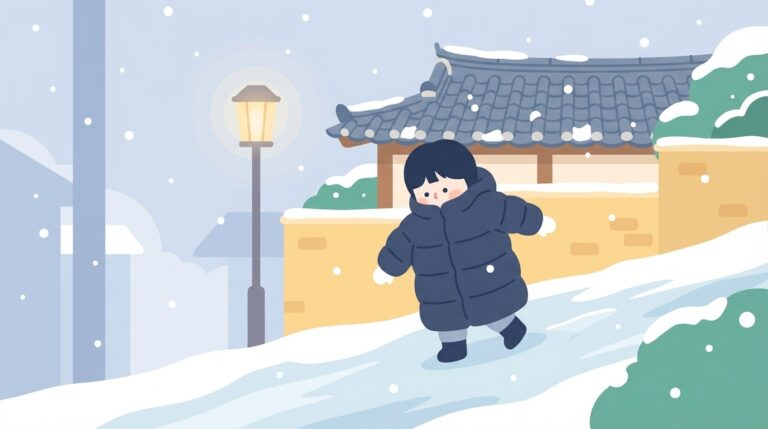
When Koreans say “길이 미끄러워요,” it usually comes with a specific body language: slightly hunching the shoulders, keeping hands out of pockets (despite the freezing cold—this is crucial for balance!), and taking small, flat-footed steps. We affectionately call this the 펭귄 걸음 (Penguin Walk). Never walk with your hands in your pockets on an icy Korean street; it’s considered very dangerous!
4-2. K-Travel Connection: The Reality of Seoul’s Topography
If you travel to Korea in winter, you will quickly realize that Seoul is not flat. Popular tourist spots like Itaewon, Namsan, and Ihwa Mural Village are located on steep hills (오르막길).
When you tell a taxi driver an address located on a steep hill during a snowstorm, they might say, “눈이 와서 거기는 못 올라가요” (It snowed, so I can’t go up there). It’s not that they are being rude; it’s genuinely too slippery for regular cars! Knowing this phrase will help you understand why you might need to get dropped off at the bottom of the hill and do the ‘penguin walk’ to your Airbnb.
Phase 5: Immersive Roleplay
Scenario A: Leaving the Cafe in Yeonnam-dong
Setting: It’s 9 PM in Yeonnam-dong. You just finished a slice of cake and a hot Americano with your Korean friend, Minji. When you open the cafe door, you realize it snowed heavily while you were inside, and the sidewalk looks like an ice rink.
Minji: 헉, 언제 눈이 이렇게 왔지? 길 엄청 미끄럽겠다. 🥶
(Heok, eonje nuni ireoke watji? Gil eomcheong mikkeureopgetda.)
[Gasp, when did it snow this much? The road must be super slippery.]
(🎭 Stage Direction: Minji carefully steps out and immediately slides a little, grabbing the door frame.)
You: 그러니까! 우리 지하철역까지 어떻게 가지?
(Geureonikka! Uri jihacheolyeokkaji eotteoke gaji?)
[Tell me about it! How are we going to get to the subway station?]
Minji: 야, 내 팔 꽉 잡아. 눈이 와서 길이 너무 미끄러워.
(Ya, nae pal kkwak jaba. Nuni waseo giri neomu mikkeureowo.)
[Hey, grab my arm tightly. It snowed so the road is too slippery.]
🔀 Your Turn! How do you respond to Minji?
– A) “괜찮아! 난 눈을 좋아해! 막 뛰어가자!” (I’m fine! I love snow! Let’s just run!)
– B) “고마워. 넘어지지 않게 조심하자. 우리 펭귄처럼 걷자!” (Thanks. Let’s be careful not to fall. Let’s walk like penguins!)
– C) “길이 미끄럽습니다. 조심하십시오.” (The road is slippery. Please be careful.)✅ Best Choice: B — This shows you understand both the B1 grammar (
-지 않게) and the cultural humor of the “penguin walk.”
⚠️ Choice A Analysis: Running on Korean hills in winter is a recipe for disaster. Minji will be very worried!
⚠️ Choice C Analysis: This is textbook formal Korean. Saying this to your close friend Minji will make her think you suddenly turned into a robot!
Scenario B: Bonus Roleplay – The Winter Taxi
Taxi Driver: 손님, 저 골목길은 눈이 와서 못 들어가요. 빙판길이라 위험해요.
(Sonnim, jeo golmokgireun nuni waseo mot deureogayo. Bingpangirira wiheomhaeyo.)
[Customer, I can’t go into that alley because it snowed. It’s an icy road, so it’s dangerous.]
You: 아, 네 이해해요. 그럼 여기서 내려주세요. 기사님도 빙판길 조심하세요!
(A, ne ihaehaeyo. Geureom yeogiseo naeryeojuseyo. Gisanimdo bingpangil josimhaseyo!)
[Ah, yes I understand. Then please drop me off here. You be careful of the icy roads too, driver!]
Phase 6: 10-Second Shadowing Drill
Repeat after me! Pay attention to the pauses (/) and the emotion.
🥺 밖은 / 눈이 와서 / 길이 너~무 미끄러워요. / 넘어지지 않게 / 조심하세요!
(bageun / nun-i waseo / gil-i neo~mu mikkeureowoyo. / neomeojiji anke / josimhaseyo!)
Tip: Drag out the “너~무” (too/so) to emphasize how dangerously slippery it is!
Phase 7: K-Culture Glossary
| Korean Word | Romanization | English | Cultural Context |
|---|---|---|---|
| 첫눈 | cheotnun | First snow | Highly romanticized in Korea. Lovers or friends often promise to meet during the first snow. |
| 롱패딩 | rongpaeding | Long padded jacket | The unofficial winter uniform of South Korea. It looks like a sleeping bag with armholes and is essential for survival! |
| 빙판길 | bingpangil | Icy road | A road covered in ice, often ‘black ice’ which is invisible and very dangerous. |
| 오르막길 | oreumakgil | Uphill road | Very common in Seoul. Beautiful for cafe views, terrifying in winter. |
| 핫팩 | hatpaek | Hot pack | Disposable hand warmers. Koreans buy these in bulk during winter. |
Phase 8: Traveler’s Survival Kit
If you are traveling to Korea between December and February, keep this kit handy!
🆘 Survival Phrases for Winter Travel
– 🇰🇷 “여기 길이 얼었어요?” (yeogi gil-i eoleosseoyo?)
– 🗣️ Meaning: Is the road frozen here?
– 📍 Where to use: Asking hotel staff or locals before heading out.
– 🇰🇷 “천천히 가주세요. 길이 미끄러워서요.” (cheoncheonhi gajuseyo. gil-i mikkeureowoseoyo.)
– 🗣️ Meaning: Please drive slowly. It’s because the road is slippery.
– 📍 Where to use: In a taxi if you feel the car sliding.
– 🇰🇷 “가까운 다이소가 어디예요?” (gakkaun daisoga eodiyeyo?)
– 🗣️ Meaning: Where is the nearest Daiso?
– 📍 Where to use: When you need emergency winter gear!📌 Editor’s Travel Note
– Daiso is your best friend: If the roads are dangerously slippery, go to Daiso (Korean dollar store). They sell cheap “핫팩” (hot packs) and, more importantly, anti-slip attachments for your shoes (아이젠 – crampons). It’s a lifesaver!
– KakaoT (Taxi App): On snowy days, it might be incredibly hard to catch a taxi. Always plan to take the subway (지하철) when it snows heavily in Seoul, as it runs underground and isn’t affected by icy roads.
Phase 9: Think Deeper — “One Step Further”
🧠 Think Deeper: Media vs Reality
In K-Dramas like Goblin or Winter Sonata, snow is always portrayed as a magical, romantic entity. Characters wear stylish wool coats and ankle boots while catching snowflakes. However, the reality of a Korean winter is quite different! The biting Siberian wind makes stylish coats useless, leading to the nationwide phenomenon of the “Long Padding” (롱패딩). Furthermore, the steep hills of Seoul turn romantic snowy scenes into extreme survival situations. This shows how media creates an aesthetic fantasy, while language and fashion reflect the practical reality of living in a mountainous peninsula with harsh winters.💬 Your Turn: Have you ever experienced a “Reality vs Expectation” moment regarding weather in a foreign country? Share it in the comments!
Phase 10: FAQ & Troubleshooting
Q: Can I use “빙판길 조심해” to my Korean boss?
No! Drop the informal tone. If you are texting your boss, it is much better to say: “부장님, 눈이 와서 길이 미끄럽습니다. 출근길 조심하십시오.” (Boss, it snowed so the road is slippery. Please be careful on your way to work.)
Q: Why do Koreans use the past tense ‘눈이 와서’ when the snow is still on the ground?
Great B1 grammar question! -아/어서 indicates the cause. The event of the snow falling (cause) has already happened, which resulted in the slippery road (effect). So we say “눈이 와서” (because it snowed) rather than “눈이 와서” (because it is snowing right now), although both translate similarly in casual English.
❌ Common Mistake: Confusing 미끄럽다 (slippery) with 부드럽다 (soft).
Foreign learners sometimes mix these up because both describe textures.
“눈이 와서 길이 부드러워요.” -> “It snowed so the road is soft.” (This sounds like you are walking on a marshmallow!)
✅ Do this: Always use 미끄럽다 for icy, dangerous, or slippery surfaces.
Phase 11: Wrap-up & Action Items
One-Liner Summary: When the romantic first snow ends, use “눈이 와서 길이 미끄러워요” to show off your B1 Korean skills and your warm Korean Jeong (정)!
🎯 Action Mission 3 Steps:
– 🥉 Bronze (Solo): Look out your window (even if it’s not snowing) and say “눈이 와서 길이 미끄러워요. 조심하세요!” 3 times out loud.
– 🥈 Silver (Online): Go to a K-Pop idol’s Weverse or Instagram on a snowy day in Korea and leave a comment: “오빠/언니, 빙판길 조심하세요! 펭귄 걸음 잊지 마세요! 🐧”
– 🥇 Gold (Real World): Next time you are in Korea during winter (or speaking to a Korean friend when it snows), warn them first before they warn you!
🎬 K-Culture Mission:
Watch a winter scene from your favorite K-Drama. Look closely at the background extras—are any of them doing the “penguin walk” while the main characters are being romantic? Spotting this is the ultimate K-Culture flex!
Phase 12: Interactive Quiz
1. Situational Judgment: You are leaving a cafe in Seoul during a snowstorm. The friendly cafe owner says “손님, 눈 엄청 오네요. 조심히 가세요!” What is the most natural B1-level response?
– A) 네, 사장님도 길이 미끄러우니까 조심하세요!
– B) 네, 길은 빙판길입니다.
– C) 아니요, 저는 안 미끄러워요.
2. Fill in the Blank:
“____ 와서 길이 _____. 넘어지지 않게 조심해!” (It snowed so the road is slippery. Be careful not to fall!)
3. True or False – K-Culture Edition:
In Korea, it is considered safe and stylish to walk with your hands in your pockets during a snowstorm. (T/F)
(Answers below!)
Click to reveal answers!
1. Answer: A. It’s polite, natural, and returns the well-wishes. B sounds like a robot reporting the news. C sounds rude and overly literal.
2. Answer: 눈이, 미끄러워요.
3. Answer: False. It is highly dangerous due to black ice. Always keep your hands out of your pockets to break a fall, and do the “penguin walk”!
Did you enjoy today’s lesson? Stay warm, stay safe, and don’t forget to practice your penguin walk! See you in the next Daily Hangul post! 🐧❄️
Frequently Asked Questions (FAQ)
Q: What does "눈이 와서 길이 미끄러워요." mean in Korean and how do you pronounce it?
A: In Korean, "눈이 와서 길이 미끄러워요." is pronounced [nun-i waseo gil-i mikkeureowoyo. [nu-ni / wa-seo / gi-ri / mi-ggeu-reo-wo-yo] and means: (Literal) Snow came, so the road is slippery. (Real nuance) It snowed, so be careful because it's slippery out there.
Q: What does "넘어지지 않게 조심하세요." mean in Korean and how do you pronounce it?
A: In Korean, "넘어지지 않게 조심하세요." is pronounced [neomeojiji anke josimhaseyo. [neo-meo-ji-ji / an-ke / jo-sim-ha-se-yo] and means: Please be careful not to fall/slip.
Q: What does "빙판길 조심해!" mean in Korean and how do you pronounce it?
A: In Korean, "빙판길 조심해!" is pronounced [bingpangil josimhae! [bing-pan-gil / jo-sim-hae] and means: Watch out for the icy roads!







