Hello there! I’m the Lead Editor at Daily Hangul.
Picture this: You are watching your favorite K-Drama. The female lead catches a cold after walking in the rain. What happens next? The male lead dramatically piggybacks her to the emergency room, right?
Well, in real life, getting sick in Korea is much less dramatic, but it can be a lot more confusing if you don’t know the system! Whether you ate too much spicy Tteokbokki (떡볶이) and have a stomachache, or you caught the famous Korean ‘change-of-season cold’ (환절기 감기), knowing how to navigate a local clinic is an essential survival skill.
You might look at your textbook and see “의사 선생님을 만나고 싶습니다” (I want to meet a doctor). But if you say that at a local clinic in Hongdae, the nurses might tilt their heads in confusion.
Today, I’m going to teach you the real Korean you need to make a hospital appointment smoothly, just like a local. Let’s get you feeling better, fast!
Phase 2: Deep Dive into Core Expressions
Let’s break down the most essential phrases you need at the clinic reception desk.
1. 진료 예약하고 싶은데요.
- Pronunciation: jinryo yeyakago sipeundeyo [jin-ryo ye-yak-ah-go shee-peun-de-yo]
- Sound-alike guide: ‘jin-ryo’ sounds like “gene-ryo”, ‘ye-yak’ sounds like “yay-yak”, and ‘sipeundeyo’ sounds like “she-pun-day-yo”.
- Meaning: Literal = I want to book a medical treatment. / Real nuance = I’d like to make an appointment to see a doctor.
- K-Culture Moment: In Korea, you don’t ‘meet’ a doctor; you ‘receive a medical consultation’ (진료). This is the magic phrase you say the moment you walk through the clinic’s glass doors.
- Editor’s Insight: The ending ‘~는데요’ (~neundeyo) makes your sentence soft and polite. It leaves the floor open for the receptionist to respond, like “I’d like to make an appointment… (is that possible?).”
- Situation Spectrum:
[🚫 Do Not Use] ———— [⚠️ Caution] ———— [✅ Freely Use]
- Casual friends: 🚫 (Too formal)
- Clinic Staff / Strangers: ✅
- 🤔 Think About It: Why do Koreans use soft endings like ‘~는데요’ instead of a direct “I want an appointment”? How does your culture handle requests to service workers?
2. 어디가 불편하세요?
- Pronunciation: eodiga bulpyeonhaseyo? [oh-dee-gah bool-pyeon-ha-se-yo?]
- Sound-alike guide: ‘eodi’ sounds like “oh-dee” (where), ‘bulpyeon’ sounds like “bull-pyeon” (uncomfortable).
- Meaning: Literal = Where is uncomfortable? / Real nuance = What are your symptoms? / How can we help you today?
- K-Culture Moment: This is the #1 question you will hear from Korean doctors and nurses. Instead of bluntly asking “What’s your disease?”, they ask what is making you uncomfortable.
- Editor’s Insight: You don’t need to know the medical terms for your illness. Just point to your throat or stomach and say “여기가 아파요” (Here hurts).
- Situation Spectrum:
[🚫 Do Not Use] ———— [⚠️ Caution] ———— [✅ Freely Use]
- Doctors/Nurses asking patients: ✅
- You asking a sick friend: ✅
- 🤔 Think About It: “불편하다” (uncomfortable) is a very considerate word. In what other situations could you use this word in Korea?
3. 오늘 진료 볼 수 있어요?
- Pronunciation: oneul jinryo bol su isseoyo? [oh-neul jin-ryo bowl-soo ees-uh-yo?]
- Meaning: Literal = Can I see a medical treatment today? / Real nuance = Can I see the doctor today? (Do you accept walk-ins?)
- K-Culture Moment: Korea has a “Pali-Pali” (Hurry, hurry) culture. Because local clinics are everywhere, many Koreans just walk in without calling ahead. If you just walk in, ask this first!
- Editor’s Insight: It sounds very natural and native. It shows you know how the fast-paced Korean clinic system works!
- Situation Spectrum:
[🚫 Do Not Use] ———— [⚠️ Caution] ———— [✅ Freely Use]
- Clinic Reception: ✅
Phase 3: Textbook vs. Real Life Korean
Let’s see how textbook phrases compare to what actually happens on the streets of Seoul.
| Situation | 📖 Textbook Korean | 🗣️ Real Korean | 💡 Why is it different? |
|---|---|---|---|
| Booking an appointment | 저는 내일 의사 선생님을 만나고 싶습니다. (I want to meet the doctor tomorrow.) | 내일 진료 예약 되나요? (Can I book a consultation tomorrow?) | Koreans use the specific word ‘진료’ (consultation/treatment) rather than ‘meeting a doctor’ to be concise. |
| Saying where it hurts | 저는 머리에 두통이 있습니다. (I have a headache in my head.) | 머리가 아파요. / 열이 나요. (My head hurts. / I have a fever.) | Real Korean favors simple, direct symptom descriptions using ‘아파요’ (hurts) over complex nouns. |
| Handing over your ID | 여기 제 신분증이 있습니다. (Here is my ID.) | (Handing it over) 여기요. (Here you go.) | Action speaks louder! A simple “Here” with the polite “요” is all you need. |
Bottom Note for A2 Learners: Don’t stress about exact medical terms. Pointing and saying “아파요” (It hurts) will save you 90% of the time!
Phase 4: Cultural Deep Dive
4-1. Non-verbal Communication: The Two-Hand Rule
When the receptionist asks for your ID or Alien Registration Card (외국인등록증) to process your appointment, never hand it over with one hand—especially if you are handing it to someone older or in a professional setting. Use both hands, or support your right arm with your left hand. It’s a silent sign of respect that will instantly make the staff think, “Wow, this foreigner really understands our culture!”
4-2. K-Culture Connection: The ‘Clinic Building’ Phenomenon
If you’ve watched K-Dramas like Hospital Playlist (슬기로운 의사생활), you might think you need to go to a giant university hospital for a stomachache. Don’t do that!
In Korea, major hospitals are for emergencies and surgeries. For everyday sickness, Koreans go to a ‘동네 병원’ (Neighborhood Clinic). Walk down any busy street in Seoul, look up at a commercial building, and you’ll often see an ENT (이비인후과), a dentist (치과), and a dermatologist (피부과) all on different floors of the same building. And guess what? The pharmacy (약국) is strategically located on the 1st floor to catch you on your way out. It’s the ultimate ‘Pali-Pali’ (hurry up) convenience!
Phase 5: Immersive Roleplay Scenario
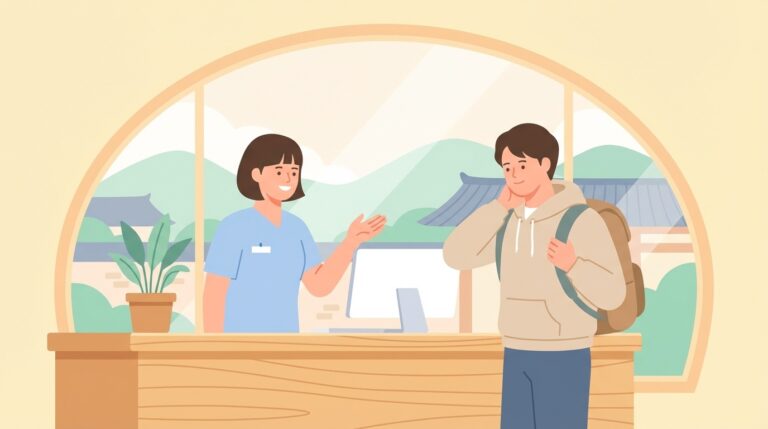
Setting: It’s a Tuesday morning. You caught a bad cold after a sudden temperature drop in Seoul. You walk into a cozy neighborhood ENT clinic (이비인후과). The waiting room has a TV playing a morning talk show. You approach the reception desk.
Characters:
– YOU (The Reader): A traveler or expat who just wants this sore throat to go away.
– Nurse Kim (Receptionist): Friendly, efficient, typing rapidly on her keyboard.
(Dialogue begins)
YOU: 안녕하세요. 진료 예약하고 싶은데요. 🤧
(annyeonghaseyo. jinryo yeyakago sipeundeyo.)
[Hello. I’d like to book a consultation.]
(🎭 Stage Direction: You sniffle and walk up to the desk)
Nurse Kim: 네, 처음 오셨어요?
(ne, cheoeum osyeosseoyo?)
[Yes, is this your first time here?]
YOU: 네, 처음이에요.
(ne, cheoeumieyo.)
[Yes, it’s my first time.]
Nurse Kim: 신분증이나 외국인등록증 있으세요?
(sinbunjeungina oegugindeungnokjeung isseuseyo?)
[Do you have an ID card or Alien Registration Card?]
YOU: 네, 여기요.
(ne, yeogiyo.)
[Yes, here you go.]
(🎭 Stage Direction: You hand over your card with both hands)
Nurse Kim: 네, 감사합니다. 어디가 불편하세요?
(ne, gamsahamnida. eodiga bulpyeonhaseyo?)
[Yes, thank you. Where are you uncomfortable? / What are your symptoms?]
🔀 Your Turn! How should you answer?
– A) “저에게는 심각한 질병이 있습니다.” (I have a serious disease.)
– B) “목이 아프고 열이 나요.” (My throat hurts and I have a fever.)
– C) “저는 병원에 왔어요.” (I came to the hospital.)✅ Best Choice: B — It’s simple, direct, and answers the “where is uncomfortable” question perfectly.
⚠️ Choice A Analysis: This sounds like a line from a historical drama! It will definitely scare the nurse.
YOU: 목이 아프고 열이 나요.
(mogi apeugo yeori nayo.)
[My throat hurts and I have a fever.]
Nurse Kim: 아, 목감기인 것 같네요. 저기 앉아서 조금만 기다려주세요.
(a, mokgamgiin geot gamneyo. jeogi anjaseo jogeumman gidaryeojuseyo.)
[Ah, looks like a throat cold. Please sit over there and wait a little bit.]
YOU: 네, 감사합니다.
(ne, gamsahamnida.)
[Yes, thank you.]
(🎭 Stage Direction: You sit down, relieved that you survived the Korean clinic reception!)
Phase 6: 10-Second Shadowing Drill
Let’s practice the magic phrase. Read this out loud in 10 seconds!
🤧 (Polite and slightly weak) 안녕하세요. / 진료 / 예약하고 싶은데요.
(annyeonghaseyo. / jinryo / yeyakago sipeundeyo.)
Pro tip: Don’t speak too fast! Pause at the slashes (/) to sound natural. Since you are sick, you don’t need to be overly energetic. A polite, soft tone is perfect.
Phase 7: K-Culture Glossary (Medical Edition)
| Korean | Romanization | English | Context |
|---|---|---|---|
| 진료 | jinryo | Medical Consultation | What you get from the doctor. |
| 처방전 | cheobangjeon | Prescription | You must take this paper to the pharmacy. |
| 약국 | yakguk | Pharmacy | Always marked with a big “약” (Yak) sign. |
| 내과 | naegwa | Internal Medicine | Go here for stomachaches, flu, or general sickness. |
| 이비인후과 | ibiinhugwa | ENT (Ear, Nose, Throat) | Go here for severe colds or sore throats. |
| 외국인등록증 | oegugindeungnokjeung | Alien Registration Card (ARC) | The ID card expats must bring to the clinic for health insurance. |
Phase 8: Traveler’s Survival Kit
If you are traveling in Korea and get sick, keep these expressions on your phone!
🆘 Survival Phrase #1: Finding the pharmacy
– 🇰🇷 “가장 가까운 약국이 어디예요?” (gajang gakkaun yakgugi eodiyeyo?)
– 🗣️ Pronunciation guide: [gah-jang gah-kka-oon yak-goog-ee oh-dee-ye-yo?]
– 📍 Where to use: Convenience stores, hotel concierges, people on the street.🆘 Survival Phrase #2: Describing Pain
– 🇰🇷 “여기 아파요.” (yeogi apayo.)
– 📍 Where to use: Clinic, pharmacy.
– 💡 Pro Tip: Literally “Here hurts.” Just point to your body part. It works 100% of the time!📌 Editor’s Travel Note
– App Tip: Use Naver Map or KakaoMap and search “내과” (Internal Medicine) or “약국” (Pharmacy) in Korean. English searches often miss local spots!
– Hospital vs Pharmacy: In Korea, doctors diagnose you, but they do not give you medicine at the clinic. They give you a paper “처방전” (prescription). You must take this paper to a separate “약국” (pharmacy) to get your pills.
Phase 9: Think Deeper — “One Step Further”
Language & Care: The Power of ‘Uncomfortable’
Have you noticed that Korean medical staff ask “어디가 불편하세요?” (Where are you uncomfortable?) instead of “Where is the pain?” This choice of words is deeply rooted in Korean indirectness and empathy. By using the word ‘uncomfortable’ (불편하다), the speaker shows respect and softens the clinical nature of the hospital. It reframes the patient not as ‘someone with a disease’, but as ‘a valued guest experiencing an inconvenience’.
💬 Your Turn: In your culture, how do doctors or receptionists ask about your symptoms? Are they direct, or do they use softening words? Let me know in the comments!
Phase 10: FAQ & Troubleshooting
Q: Do I need to book days in advance for a neighborhood clinic?
A: Not usually! Unlike in many Western countries, Korean local clinics accept “walk-ins” easily. Just walk in, say today’s phrase, and you might see a doctor within 15 minutes!
Q: Do Korean clinics speak English?
A: In major tourist areas (Gangnam, Itaewon, Hongdae), many doctors speak excellent English. However, the receptionists might not. That’s why learning today’s booking phrases is so crucial!
❌ Common Mistake: Going to the Emergency Room (응급실 – eunggeupsil) for a basic cold or mild stomachache.
✅ Do this instead: Go to a local “내과” (Internal Medicine). The ER in Korea is extremely expensive for minor issues and you will wait for hours.
Phase 11: Wrap-up & Action Items
Summary: To see a doctor in Korea, walk into a clinic and politely say, “진료 예약하고 싶은데요” (I’d like to book a consultation).
Your Action Missions:
– 🥉 Bronze (Solo): Look in the mirror, pretend you have a cold, and say “어디가 불편하세요?” and answer “여기가 아파요!” 3 times.
– 🥈 Silver (Online): Open Google Maps or Naver Maps, zoom into Seoul, and type “내과” to see how many clinics pop up on a single street!
– 🥇 Gold (Real Life): The next time you visit a Korean pharmacy to buy painkillers or vitamins, try using both hands to hand over your credit card.
K-Culture Mission: Open YouTube and search for a clip of “슬기로운 의사생활” (Hospital Playlist). Can you spot any scenes where patients check in at the front desk?
Did you ever get sick while traveling abroad? How did you survive? Share your story in the comments below! 👇
Phase 12: Interactive Quiz
Let’s test your Korean clinic survival skills!
1. (Situational) You walk into a clinic. What is the very first thing you should say to the receptionist?
A) 의사 선생님, 사랑해요. (Doctor, I love you.)
B) 진료 예약하고 싶은데요. (I’d like to book a consultation.)
C) 처방전 주세요. (Give me a prescription.)
2. (T/F Culture Edition) In Korea, the doctor will give you your medicine directly inside the clinic.
– True or False?
3. (Fill in the Blank) The nurse asks: “어디가 _________?” (Where are you uncomfortable?)
– Hint: starts with ‘불’ (bul)
(Answers below!)
👉 Click to see answers!
1. B (A is for fanmeetings, C is for the pharmacy after you see the doctor!)
2. False (You must take the prescription paper to a separate pharmacy/약국!).
3. 불편하세요 (bulpyeonhaseyo)
Frequently Asked Questions (FAQ)
Q: What does "진료 예약하고 싶은데요." mean in Korean and how do you pronounce it?
A: In Korean, "진료 예약하고 싶은데요." is pronounced [jinryo yeyakago sipeundeyo [jin-ryo ye-yak-ah-go shee-peun-de-yo] and means: Literal = I want to book a medical treatment. / Real nuance = I'd like to make an appointment to see a doctor.
Q: What does "어디가 불편하세요?" mean in Korean and how do you pronounce it?
A: In Korean, "어디가 불편하세요?" is pronounced [eodiga bulpyeonhaseyo? [oh-dee-gah bool-pyeon-ha-se-yo?] and means: Literal = Where is uncomfortable? / Real nuance = What are your symptoms? / How can we help you today?
Q: What does "오늘 진료 볼 수 있어요?" mean in Korean and how do you pronounce it?
A: In Korean, "오늘 진료 볼 수 있어요?" is pronounced [oneul jinryo bol su isseoyo? [oh-neul jin-ryo bowl-soo ees-uh-yo?] and means: Literal = Can I see a medical treatment today? / Real nuance = Can I see the doctor today? (Do you accept walk-ins?)