

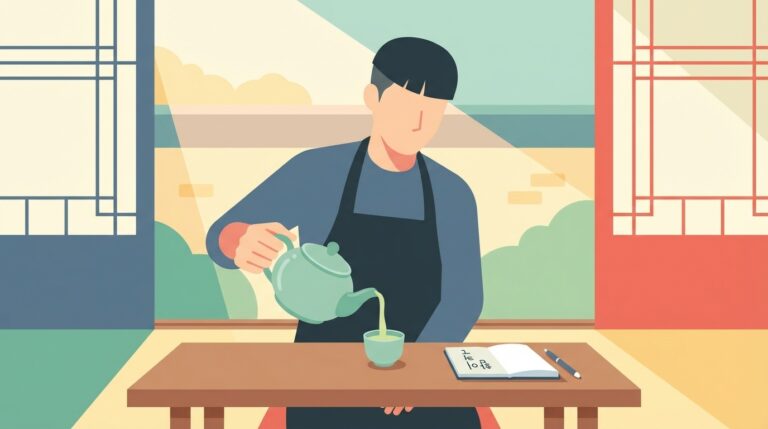
Phase 1: 공감 — 몰입형 오프닝 (Immersive Hook)
Hello! I’m your Daily Hangul Editor, back with another deep dive into the beautiful nuances of the Korean language.
Picture this: You are sitting in a sun-drenched, modern Hanok studio in Bukchon. The scent of roasted leaves fills the air. You’ve enrolled in an elite Tea Sommelier Certification Course (티 소믈리에 자격증 과정) in Seoul. The instructor, a master with decades of experience, gracefully pours a pale golden liquid into a delicate celadon cup. You take a sip. All eyes are on you.
Your brain scrambles. “Uh… 맛있어요 (It’s delicious)?”
Ouch. While masisseoyo is perfectly fine for a plate of tteokbokki at a street stall, in a sommelier class, it feels aggressively inadequate. It’s like sipping a 50-year-old aged Bordeaux and saying, “Yummy juice!”
If you want to sound like a true insider—someone who doesn’t just speak Korean, but feels it—you need the sensory vocabulary of a sommelier. Today, we are moving past beginner textbooks and stepping into the C1-level world of taste, aroma, and the profound philosophy of Korean tea culture.
Let’s steep some knowledge!
Phase 2: 핵심 표현 심층 분석 (Deep Dive)
Here are the three essential expressions you need to survive and thrive in a Korean tea evaluation setting.
1. 우려내다 (To steep / to coax out the flavor)
- Pronunciation: u-ryeo-nae-da [The ‘u’ is round like an owl’s hoot, and ‘ryeo’ sounds like a light tap of the tongue on the roof of your mouth.]
- Meaning: (Literal) To steep/brew. (Real nuance) To patiently extract the hidden essence or flavor with time and care.
- K-Culture Moment: You’ll hear this a lot in artisanal cafes or traditional tea houses. But it’s also a poetic metaphor in K-Dramas! When a character makes a heartfelt confession, someone might say, “진심을 우려낸 위로” (comfort brewed from sincere feelings).
- Editor’s Insight: You don’t just ‘make’ (만들다) tea in Korea; you woo-ryeo-nae-da it. It implies a slow, deliberate process. Using this verb immediately elevates your Korean from “tourist” to “connoisseur.”
- Situation Spectrum:
[🚫 절대 금지] ———— [⚠️ 주의] ———— [✅ 자유롭게]
- Casual / Friends: ✅
- Semi-formal / Classmates: ✅
- Formal / Instructors: ✅ (Used universally, just add formal endings: 우려냈습니다)
- 🤔 Think About It: Why does Korean have a specific verb for extracting flavor over time, rather than just using “boil” or “make”? What does this say about the cultural value placed on patience and preparation?
2. 구수하다 (Earthy, comforting, and savory-sweet)
- Pronunciation: gu-su-ha-da [Say it softly, like ‘goo-soo-ha-da’.]
- Meaning: (Literal) Savory. (Real nuance) That soul-warming, roasted, earthy flavor found in barley tea, scorched rice, or certain fermented teas.
- K-Culture Moment: If you’ve ever watched a Korean variety show where celebrities visit a rural village and drink hot tea from a cauldron, they will inevitably exhale a deep breath and exclaim, “아, 구수하다~” It’s the ultimate compliment for traditional Korean teas.
- Editor’s Insight: There is no exact English equivalent for 구수하다. It’s not salty-savory (like meat), but rather the comforting, roasted grain flavor. It’s the taste of nostalgia for Koreans.
- Situation Spectrum:
[🚫 절대 금지] ———— [⚠️ 주의] ———— [✅ 자유롭게]
- Casual / Friends: ✅
- Semi-formal / Classmates: ✅
- Formal / Instructors: ✅
- 🤔 Think About It: Western tea culture often values floral or sweet notes. Korean tea culture highly prizes the “earthy and roasted” profile. How does a culture’s staple food (like roasted rice) influence its palate for beverages?
3. 떫은맛이 돌다 (A lingering astringency)
- Pronunciation: tteol-beun-ma-si dol-da [Tteol requires a tense, double ‘tt’ sound. Imagine the dry feeling in your mouth when biting into an unripe persimmon.]
- Meaning: (Literal) An astringent taste circulates. (Real nuance) A hint of tannins or a dry, sophisticated finish.
- K-Culture Moment: In your sommelier class, describing a tea simply as 쓰다 (bitter) sounds unrefined. Instead, noting that it has a pleasant 떫은맛 (astringency) that provides structure to the tea shows a C1-level palate.
- Editor’s Insight: 돌다 literally means “to circulate or spin.” Koreans use it to describe a flavor that gently coats the mouth and lingers, rather than just hitting the tongue and disappearing.
- Situation Spectrum:
[🚫 절대 금지] ———— [⚠️ 주의] ———— [✅ 자유롭게]
- Casual / Friends: ✅
- Semi-formal / Classmates: ✅
- Formal / Instructors: ✅
- 🤔 Think About It: Notice how Korean uses verbs of motion (돌다 – to circulate) to describe taste? It treats flavor as a dynamic, living thing inside the mouth. Do you describe flavor as a stationary object or a moving experience in your native language?
Phase 3: 교과서 vs 진짜 한국어 (Textbook vs Real Life)
Let’s compare what you learned in intermediate textbooks with what real sommeliers say.
| 상황 | 📖 교과서 한국어 | 🗣️ 진짜 한국어 | 💡 왜 다를까? |
|---|---|---|---|
| 1. 맛이 약간 쓸 때 | 이 차는 조금 써요. (This tea is a bit bitter.) | 쌉싸름한 맛이 매력적이네요. (The mildly bitter taste is charming.) | ‘쌉싸름하다’ conveys a pleasant bitterness, showing you appreciate the complexity rather than complaining. |
| 2. 마시고 난 후의 느낌 | 끝맛이 좋아요. (The aftertaste is good.) | 목 넘김이 부드럽고 여운이 기네요. (It goes down smoothly and has a long lingering finish.) | Using ‘여운’ (lingering imagery/emotion) elevates the sensory description to an artistic level. |
| 3. 차의 색깔을 말할 때 | 차 색깔이 예뻐요. (The tea color is pretty.) | 수색(水色)이 아주 맑고 투명하네요. (The liquor color is very clear and transparent.) | In professional settings, Sino-Korean words like ‘수색’ (water color) are used over native Korean words for precision and formality. |
Phase 4: 문화적 맥락 — K-Culture 딥다이브 (Cultural Deep Dive)
4-1. 비언어적 요소 (Non-verbal Communication in the Tea Room)
In a Korean tea ceremony or a professional sommelier setting, Nunchi (눈치) is everything. It’s not just about what you say, but how you hold the space.
– The Two-Hand Rule: When receiving tea from the master, your right hand holds the cup, and your left hand gently supports the bottom.
– Eye Contact & Pacing: Do not gulp the tea like a tequila shot! Sip quietly, close your eyes to appreciate the aroma, and wait for the master to speak first. Nunchi dictates that you match the calm, unhurried rhythm of the room.
4-2. K-Culture 연결 고리 (K-Drama & K-Travel Connection)
If you’ve watched historical K-Dramas like Mr. Queen or Alchemy of Souls, you’ve seen the solemn, aesthetic beauty of Dado (다도, The Way of Tea). In dramas, the act of brewing and pouring tea is often used to show a character’s inner peace—or to dramatically poison a political rival!
But in modern Seoul, traditional tea is experiencing a massive renaissance. If you visit trendy neighborhoods like Seongsu-dong or Bukchon, you won’t just find grandmas drinking tea. You’ll find hyper-modern, minimalist “Tea Omakase” bars where young Koreans pair aged Puerh or local fermented teas with vegan Yakgwa (honey pastries). Knowing the advanced vocabulary from this lesson bridges the gap between the ancient Hanok and the modern hipster cafe.
Phase 5: 실전 롤플레이 시나리오 (Immersive Roleplay)
메인 롤플레이: The Blind Tasting Challenge
- Setting: Week 3 of the “Mastering Korean Teas” Sommelier Course in a minimalist studio in Gangnam. A row of white tasting cups lines the table.
- Characters:
- YOU: An expat living in Seoul, determined to pass the certification.
- 이 선생님 (Master Lee, 50s): The strict but passionate head instructor.
이 선생님: 자, 이번에 우려낸 차는 하동에서 온 발효차입니다. 향을 먼저 맡아보세요. 🍵
(Ja, ibeone uryeonaen chaneun Hadongeseo on balhyochaimnida. Hyangeul neonjeo mateoboseyo.)
[Translation] Now, the tea I just brewed is a fermented tea from Hadong. Please smell the aroma first.
(🎭 Stage Direction: Master Lee gestures to the cups gracefully)
YOU: (Taking a gentle sniff) 음… 낙엽 같은 향이 나네요.
(Eum… nagyeop gateun hyangi naneyo.)
[Translation] Mmm… it has an aroma like fallen leaves.
이 선생님: 아주 좋은 표현입니다. 그럼 이제 한 모금 마셔볼까요? 수색(水色)도 함께 관찰해 보세요.
(Aju joeun pyohyeonimnida. Geureom ije han mogeum masyeobolkkayo? Susaekdo hamkke gwanchalhae boseyo.)
[Translation] Very good expression. Shall we take a sip now? Please observe the liquor color as well.
YOU: (Sipping slowly) 수색이 호박색처럼 진하고 예뻐요.
(Susaegi hobaksaekcheoreom jinhago yeppeoyo.)
[Translation] The color is deep and pretty like amber.
이 선생님: 네, 맞습니다. 맛의 밸런스는 어떻게 느껴지나요? 🧐
(Ne, matseumnida. Maseui baelleonseuneun eotteoke nyeukkyeojinayo?)
[Translation] Yes, that’s correct. How do you perceive the balance of taste?
🔀 당신의 차례! 어떻게 대답할까요? (Decision Point)
– A) “맛있어요. 따뜻해서 좋아요.”
– B) “첫맛은 구수하고, 끝에 약간 떫은맛이 돌아서 매력적이에요.”
– C) “진짜 대박! 완전 제 스타일이에요!”✅ Best Choice: B — Reason: Option B perfectly utilizes the C1 sommelier vocabulary (구수하다, 떫은맛이 돌다). It shows professional analytical skills.
⚠️ Choice A & C 분석: Option A is too basic (A1 level). Option C is for hanging out with your friends at a pop-up store, not a certification course with a master.
이 선생님: (Smiling warmly) 정확합니다! 떫은맛이 입안을 깔끔하게 정리해 주죠. 여운이 꽤 길지 않나요?
(Jeonghwakamnida! Tteolbeunmasi ibaneul kkalkkeumhage jeongrihae jujo. Yeouni kkwae gilji annayo?)
[Translation] Exactly! The astringency cleanses the palate neatly. The lingering finish is quite long, isn’t it?
YOU: 네, 목 넘김 후에 단맛이 은은하게 남아서 정말 훌륭하네요.
(Ne, mok neomgim hue danmasi euneunhage namaseo jeongmal hullyunghaneyo.)
[Translation] Yes, the subtle sweetness that remains after swallowing is truly excellent.
이 선생님: 훌륭한 테이스팅이었습니다. 다음 주 실기 시험도 문제없겠네요.
(Hullyunghan teiseuting-ieotseumnida. Daeum ju silgi siheomdo munjeeopgenneyo.)
[Translation] An excellent tasting. You’ll have no problem with the practical exam next week.
YOU: 감사합니다. 선생님 덕분에 차의 진정한 매력을 알게 되었어요!
(Gamsahamnida. Seonsaengnim deokbune chaui jinjeonghan maeryeogeul alge doeeosseoyo!)
[Translation] Thank you. Thanks to you, I’ve discovered the true charm of tea!
Phase 6: 10초 섀도잉 드릴 (Shadowing Drill)
Let’s practice your pronunciation and pacing. Korean sommelier talk should be slow, thoughtful, and calm.
🧐 진지하게 / 😌 차분하게
첫맛은 / 아주 구수하고, (cheotmaseun / aju gusu-hago)
끝에는 / 기분 좋은 떫은맛이 / 도네요. (kkeuteneun / gibun joeun tteolbeunmasi / doneyo)
여운이 / 참 깁니다. (yeouni / cham gimnida)
Phase 7: K-Culture 미니 사전 (K-Culture Glossary)
Expand your sommelier lexicon with these essential terms:
| 한국어 | Romanization | 영어 | 맥락 설명 |
|---|---|---|---|
| 다도 | dado | Tea ceremony | The “Way of Tea.” The traditional etiquette and philosophy of preparing and drinking tea. |
| 다기 | dagi | Teaware | The collective term for teapots, cups, and tools used in brewing. Artisanal dagi can be extremely expensive! |
| 바디감 | badigam | Body / Mouthfeel | A borrowed word (body + gam ‘feeling’). Describes the weight or thickness of the tea in your mouth. |
| 여운 | yeoun | Lingering finish | The aftertaste or the emotional resonance left after drinking. A highly poetic and professional term. |
| 수색 | susaek | Liquor color | The color of the brewed tea. Evaluated carefully in sommelier courses. |
Phase 8: 여행자 서바이벌 키트 (Traveler’s Survival Kit)
Even if you aren’t taking a certification course, visiting a traditional tea house (다원) in Insadong or Hadong is a must-do in Korea. Here are your survival phrases:
🆘 서바이벌 표현 TOP 3
– 🇰🇷 1. “이 차는 어떻게 우려내나요?” (i chaneun eotteoke uryeonaenayo?)
– “How do I brew this tea?” (Some places give you the raw leaves and hot water to do it yourself!)
– 🇰🇷 2. “뜨거운 물 좀 더 부어주시겠어요?” (tteugeoun mul jom deo bueojusigesseoyo?)
– “Could you pour a little more hot water?” (Premium Korean teas can be steeped multiple times.)
– 🇰🇷 3. “가장 향이 진한 차로 추천해 주세요.” (gajang hyangi jinhan charo chucheonhae juseyo.)
– “Please recommend the tea with the deepest aroma.”📌 Editor’s Travel Note
– Hotspots: Insadong (Seoul) is famous for traditional houses, but if you want the real plantations, take a KTX to Boseong (Green tea) or Hadong (Wild/Fermented tea).
– Etiquette: When pouring tea for someone older, use two hands. Never pour your own tea first if you are with a senior or a master.
Phase 9: 비판적 사고 코너 — “한 발 더 깊이” (Think Deeper)
🧠 Think Deeper: Food, Identity & The Philosophy of “Emptiness”
Western high tea culture (think British afternoon tea) is often an expression of abundance—tiered stands of macarons, scones, and clotted cream, paired with lively conversation. Traditional Korean tea culture, however, is deeply rooted in Buddhism and the concept of 비움 (Emptiness).
The focus is not on what accompanies the tea, but on the tea itself and the space around it. The earthy, savory flavors (구수함) of Korean tea are meant to ground you, bringing your focus inward. The deliberate slowness of 우려내다 (steeping) is a rebellion against the modern Palli-palli (hurry-hurry) culture of Seoul. Through the vocabulary of tea, Koreans preserve a quiet, meditative identity that balances out their hyper-dynamic society.
💬 Your Turn: Does your culture’s traditional beverage focus on “socializing and abundance” or “meditation and emptiness”? Share your thoughts in the comments!
Phase 10: FAQ & 오해 방지 (Troubleshooting)
Q: “Can I use ‘구수하다’ to describe coffee?”
Yes! In fact, older generations in Korea often prefer Americanos with a dark, roasted, non-acidic profile and will happily describe a good cup of coffee as “구수하다.”
Q: “Is it rude to slurp tea in Korea?”
Unlike in Japan where a slurping sound during a tea ceremony can be a sign of appreciation, in Korea, it is generally considered polite to drink quietly.
❌ 흔한 실수 (Common Mistake): Confusing 맵다 (spicy), 떫다 (astringent), and 쓰다 (bitter).
✅ 이렇게 하세요:
– Dark Chocolate / Medicine = 쓰다 (Bitter)
– Unripe Persimmon / Heavy Tannin Black Tea = 떫다 (Astringent / Dry)
– Red Pepper / Gochujang = 맵다 (Spicy)
Phase 11: 요약 및 액션 아이템 (Wrap-up)
📝 One-Liner Summary: Elevate your Korean from basic to sommelier-level by understanding the time-honored concepts of 우려내다 (steeping), 구수하다 (earthy/savory), and 여운 (lingering finish).
🔥 Action Mission 3단계:
– 🥉 Bronze: Look at your morning tea or coffee tomorrow and describe its taste out loud in Korean using today’s words.
– 🥈 Silver: Leave a comment below describing your favorite tea using 여운 or 구수하다.
– 🥇 Gold: Visit a Korean tea house, order a fermented tea (발효차), and politely ask the staff, “이 차는 어떻게 우려내나요?”
🌸 K-Culture Mission:
Open Google Maps or Naver Map, search for “티 오마카세” (Tea Omakase) in Seoul. Check the reviews and see if you can spot words like 수색, 바디감, or 여운 in the Korean comments! It’s the best way to see real-life C1 Korean in action.
Phase 12: 퀴즈 — 인터랙티브 챌린지 (Interactive Quiz)
Test your new sommelier skills!
1. (Situational) You are at an upscale tea tasting. The tea has a thick mouthfeel and a long-lasting aftertaste. Which is the MOST professional way to describe it?
A) 입에 꽉 차고 끝이 좋아요.
B) 바디감이 묵직하고 여운이 깁니다.
C) 너무 안 떫어서 다행이에요.
2. (Fill in the Blank) 보리차(Barley tea)를 마셨을 때 한국인들이 가장 자주 하는 감탄사는?
“아, 정말 ( ______ )!”
3. (True/False – K-Culture Edition)
In a traditional Korean tea setting, it is best to drink the tea in one quick gulp to show you enjoyed it.
👀 정답 보기 (Click for Answers)
1. B – Using ‘바디감’ (body) and ‘여운’ (lingering finish) shows advanced proficiency.
2. 구수하다 (gusu-hada) – The ultimate descriptor for roasted grain flavors.
3. False – Tea should be sipped slowly to appreciate the aroma, flavor, and ‘여운’. Gulping is considered bad ‘Nunchi’ in a formal tea setting!
Frequently Asked Questions (FAQ)
Q: What does "우려내다 (To steep / to coax out the flavor)" mean in Korean and how do you pronounce it?
A: In Korean, "우려내다 (To steep / to coax out the flavor)" is pronounced [u-ryeo-nae-da [The 'u' is round like an owl's hoot, and 'ryeo' sounds like a light tap of the tongue on the roof of your mouth.] and means: (Literal) To steep/brew. (Real nuance) To patiently extract the hidden essence or flavor with time and care.
Q: What does "구수하다 (Earthy, comforting, and savory-sweet)" mean in Korean and how do you pronounce it?
A: In Korean, "구수하다 (Earthy, comforting, and savory-sweet)" is pronounced [gu-su-ha-da [Say it softly, like 'goo-soo-ha-da'.] and means: (Literal) Savory. (Real nuance) That soul-warming, roasted, earthy flavor found in barley tea, scorched rice, or certain fermented teas.
Q: What does "떫은맛이 돌다 (A lingering astringency)" mean in Korean and how do you pronounce it?
A: In Korean, "떫은맛이 돌다 (A lingering astringency)" is pronounced [tteol-beun-ma-si dol-da [Tteol requires a tense, double 'tt' sound. Imagine the dry feeling in your mouth when biting into an unripe persimmon.] and means: (Literal) An astringent taste circulates. (Real nuance) A hint of tannins or a dry, sophisticated finish.







