

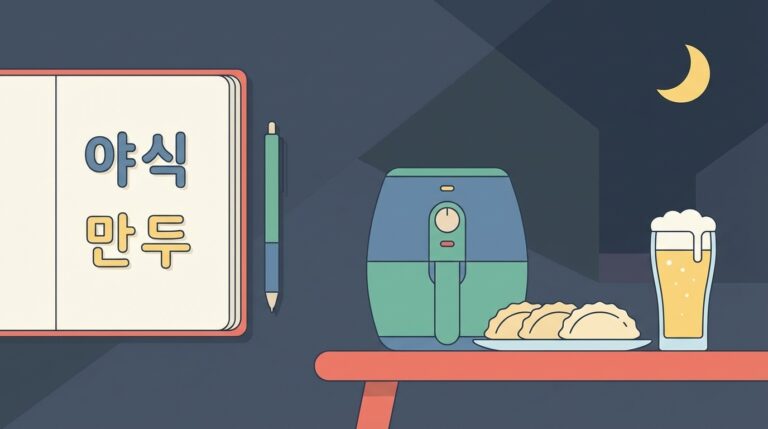
Hello! I’m your lead editor at Daily Hangul.
Picture this: It’s 11:30 PM. You’re deep into episode 12 of a gripping K-Drama. The main characters are sitting at a cozy apartment table, cracking open a cold beer, and biting into a steaming, perfectly crispy piece of fried chicken or a dumpling. Your stomach growls. You head to the freezer and pull out a bag of Korean frozen Mandu (dumplings) you bought from the Asian market.
But wait—if you were living in Seoul right now, how would you talk about this glorious late-night ritual?
Sure, textbook Korean teaches you, “밤에 음식을 먹습니다” (I eat food at night) and “오븐에 굽습니다” (I bake it in the oven). But if you say that to a Korean friend, they might look at you like you just stepped out of a 1990s language tape. In the modern Korean kitchen, the Air Fryer (에어프라이어) has completely revolutionized the frozen food game, spawning its own unique ecosystem of slang, abbreviations, and cultural rituals.
Today, as an advanced C2 learner, you’re not just learning words—you’re mastering the highly nuanced, trendy kitchen vernacular that will make you sound like a true local food influencer.
Phase 2: Core Expressions Deep Dive
Let’s unpack the absolute essential phrases you need for the ultimate Korean air fryer experience.
1. 겉바속촉 (Crispy outside, soft inside)
- Pronunciation: [geot-ba-sok-chok] + Sounds like a rhythmic, percussive beat box: GUT-bah-SOK-choke.
- Meaning: (Literal) Outside crispy, inside moist. / (Real nuance) The holy grail of food textures. The absolute perfect cook.
- K-Culture Moment: You’ll see this plastered across every frozen food package in Korea and every Mukbang YouTuber’s thumbnail. When you pull a perfectly air-fried mozzarella corn dog out and take a bite, you don’t say “It’s cooked well.” You wide-eye your friend and whisper, “Wow, 완전 겉바속촉…”
- Editor’s Insight: This is an acronym (줄임말) for 겉은 바삭하고 속은 촉촉하다. Advanced learners must know this to participate in any Korean food conversation. It captures the essence of modern Korean culinary desires.
- Situation Spectrum:
[🚫 절대 금지] ———— [⚠️ 주의] ———— [✅ 자유롭게]
- Casual with friends: ✅
- Semi-formal (coworkers at lunch): ✅
- Highly formal (with a strict CEO): ⚠️ (A bit too trendy/slangy for a serious dinner)
- 🤔 Think About It: Why is the Korean language so obsessed with abbreviating 4-syllable phrases (사자성어 style) like 겉바속촉 or 단짠단짠 (sweet and salty)? How does this reflect the ‘빨리빨리’ (Pali-pali / hurry-hurry) culture even in linguistics?
2. 에프에 돌리다 (To pop it in the air fryer)
- Pronunciation: [e-peu-e dol-li-da] + Sounds like the English letter ‘F’ + eh-DOHL-lee-dah.
- Meaning: (Literal) To spin it in the AF. / (Real nuance) To heat/cook something in the air fryer.
- K-Culture Moment: You’re too tired to cook. Your roommate asks what’s for dinner. You throw a bag of frozen chicken tenders on the counter and say, “그냥 에프에 돌려 먹자” (Let’s just pop it in the AF and eat).
- Editor’s Insight: Koreans shorten ‘에어프라이어’ to ‘에프’. More importantly, the verb 돌리다 (to spin) is the golden native verb used for appliances with a timer or cycle: 세탁기를 돌리다 (run the washing machine), 청소기를 돌리다 (run the vacuum), 전자레인지에 돌리다 (microwave it). Using ‘요리하다’ (to cook) for frozen food sounds extremely unnatural.
- Situation Spectrum:
[🚫 절대 금지] ———— [⚠️ 주의] ———— [✅ 자유롭게]
- Casual with friends: ✅
- Semi-formal: ✅
- Formal: ⚠️ (Say ‘에어프라이어로 조리하다’ instead)
- 🤔 Think About It: Notice how ‘돌리다’ implies delegating the work to a machine. How does appliance terminology in your native language compare?
3. 야식 당긴다 (Craving a midnight snack)
- Pronunciation: [ya-sik dang-gin-da] / Often pronounced colloquially as 땡긴다 [ttaeng-gin-da].
- Meaning: (Literal) Midnight snack is pulling me. / (Real nuance) I’m hardcore craving a late-night snack.
- K-Culture Moment: 10 PM. You’re studying or working late. Someone rubs their belly, lets out a sigh, and says, “아… 야식 땡기지 않아?” (Ah… aren’t you craving a late-night snack?). It’s the universal Korean mating call for ordering delivery or firing up the air fryer.
- Editor’s Insight: ‘당기다’ literally means ‘to pull’, but in food context, it means ‘to crave’ (your appetite is being pulled towards the food). Native speakers almost always pronounce it heavily as ‘땡긴다’ for emphasis.
- Situation Spectrum:
[🚫 절대 금지] ———— [⚠️ 주의] ———— [✅ 자유롭게]
- Casual with friends: ✅
- Semi-formal: ✅
- Formal: 🚫 (Say ‘야식 드시고 싶으신가요?’)
Phase 3: Textbook vs. Real Life Korean
Let’s upgrade your C2 vocabulary. Here’s how you bridge the gap between classroom Korean and real-life kitchen banter.
| Situation | 📖 Textbook Korean | 🗣️ Real Korean | 💡 Why the difference? |
|---|---|---|---|
| Heating frozen food | 에어프라이어로 요리하세요. | 에프에 15분 돌려. | ‘에프’ is the standard abbreviation; ‘돌리다’ is the native verb for machine-assisted cooking. |
| Describing the perfect texture | 겉은 바삭하고 속은 촉촉합니다. | 와, 이거 완전 겉바속촉이야! | Koreans love 4-syllable acronyms to describe sensory experiences efficiently. |
| Expressing a craving at night | 밤에 음식을 먹고 싶어요. | 아, 야식 땡긴다. | ‘땡기다’ carries a visceral, undeniable physical craving that ‘고 싶다’ lacks. |
| Suggesting a beer pairing | 맥주도 같이 마실까요? | 야, 이건 무조건 맥주 각이다. | ‘각이다’ (It’s an angle/setup) is a slang meaning ‘this situation perfectly calls for…’. |
Phase 4: Cultural Deep Dive — The K-Kitchen Ecosystem
4-1. Non-verbal Communication: The ‘One Bite’ Nunchi (눈치)
When you make a midnight snack in Korea—even if it’s just for yourself—the unwritten rule of Nunchi dictates that you MUST ask whoever is in the room: “한 입 먹을래?” (Do you want a bite?) or “같이 먹을래?” (Do you want to eat together?). Eating alone in front of someone without offering, especially delicious late-night AF-cooked food, is considered a severe lack of Jeong (정 – affection/bond). Even if they said they were on a diet 10 minutes ago, you must offer. (Spoiler: They will usually take a bite).
4-2. K-Culture Connection: The Air Fryer ‘Home-Cafe’ & K-Drama Aesthetics
The Air Fryer didn’t just change cooking in Korea; it changed the K-Food market. Major companies started releasing products specifically branded as “에어프라이어 전용” (Air Fryer Exclusive). In recent K-Dramas, you rarely see characters slaving over a hot stove for late-night PPL (Product Placement). Instead, you see them effortlessly tossing frozen 핫도그 (corn dogs) or 치즈볼 (cheese balls) into a sleek air fryer, leaning against the counter, and having deep emotional conversations while the machine hums in the background. It represents the modern, efficient, yet high-quality lifestyle of young Korean single households (1인 가구).
Phase 5: Immersive Roleplay — The Late Night Temptation
Setting: Friday night, 11:45 PM. You are chilling in the living room with your Korean friend/roommate, 민수 (Min-su, 28, a foodie with zero impulse control). You’re both watching Netflix, but the silence is getting loud.
Min-su: 아… 배고프다. 너 안 출출해? 🤤
(A… baegopeuda. Neo an chulchulhae?)
[Ah… I’m hungry. Aren’t you feeling a bit peckish?]
(🎭 Stage Direction: Min-su aggressively scrolls through a food delivery app.)
YOU: 약간? 근데 이 시간에 배달시키면 너무 늦지 않을까?
(Yakgan? Geunde i sigane baedalsikimyeon neomu neutji aneulkka?)
[A little? But wouldn’t it be too late to order delivery at this hour?]
Min-su: 그치. 배달비도 비싸고. 아! 냉동실에 저번에 산 핫도그 있다!
(Geuchi. Baedalbido bissago. A! Naengdongshire jeobeone san hatdogeu itda!)
[Right. And delivery fees are expensive. Oh! We have those frozen corn dogs we bought last time in the freezer!]
Min-su: 내가 가져올게. 이거 어떻게 요리해야 제일 맛있지?
(Naega gajyeoolge. Igeo eotteoke yorihaeya jeil masitji?)
[I’ll go get them. How should we cook these to make them taste the best?]
🔀 Your Turn! How do you respond like a true native?
– A) “전자레인지에 2분 동안 요리해!” (Safe, textbook, but a bit sad for texture)
– B) “오븐에 굽는 게 제일 좋아.” (A bit formal and time-consuming)
– C) “무조건 에프지! 에프에 15분 돌리자! 완전 겉바속촉일걸?”✅ Best Choice: C — By using “무조건 에프지!” (It absolutely has to be the AF!), “돌리자” (let’s run it), and “겉바속촉” (crispy outside, soft inside), you instantly elevate your Korean to C2 Native level. Min-su will likely look at you in awe and crown you the master of the Korean kitchen.
Phase 6: 10-Second Shadowing Drill
Channel your inner Korean food vlogger. Read this aloud, matching the emotion!
😤 단호하게 (Firmly/With conviction):
야, / 냉동 핫도그는 / 무조건 에프에 돌려야 돼!
(Ya, / naengdong hatdogeuneun / mujogeon e-peu-e dollyeoya dwae!)😊 기대하며 (With excitement):
그래야 / 완전 겉바속촉 / 미쳤거든!
(Geuraeya / wanjeon geot-ba-sok-chok / michyeotgeodeun!)
Phase 7: K-Culture Glossary (Midnight Snack Edition)
| 한국어 | Romanization | English | Cultural Context |
|---|---|---|---|
| 에프 | e-peu | Air Fryer | The essential abbreviation for Air Fryer in modern Korea. |
| 야식 | ya-sik | Late-night snack | A cultural pillar of Korean nightlife, involving delivery or frozen foods. |
| 겉바속촉 | geot-ba-sok-chok | Crispy outside, soft inside | The ultimate compliment for any fried or baked food. |
| 치맥 / 만맥 | chi-maek / man-maek | Chicken & Beer / Mandu & Beer | Combining food names with ‘Maekju’ (beer) for the perfect late-night pairing. |
| 해동하다 | hae-dong-ha-da | To thaw/defrost | Essential vocabulary found on the back of every Korean frozen food package. |
Phase 8: Traveler’s Survival Kit 🧳
If you are visiting a Korean mart (E-mart, Lotte Mart) or a convenience store to buy late-night snacks for your Airbnb, you MUST know how to read the packaging instructions.
🆘 Survival Expressions for the K-Mart
– 🇰🇷 “전자레인지 전용” (jeon-ja-re-in-ji jeon-yong) = Microwave ONLY.
– 🇰🇷 “에어프라이어 조리 시” (e-eo-peu-ra-i-eo jo-ri si) = When cooking with an air fryer…
– 🇰🇷 “해동 없이” (hae-dong eop-si) = Without thawing (cook straight from frozen).
– 💡 Pro Tip: Look for the term 별미 (byeol-mi) on packaging. It means “a special delicacy” and is often used for unique frozen snacks!📌 Editor’s Travel Note
If your Airbnb only has a microwave, do NOT buy raw frozen foods (like raw mandu meant for boiling). Look for “간편조리” (Easy Cook) or items specifically designed for microwave use, otherwise, you might end up with a soggy, half-cooked disaster!
Phase 9: Think Deeper — “A Step Further” 🧠
Food & Identity: The Paradox of the ‘Yasik’ Culture
The boom of the Air Fryer and premium frozen foods in Korea is deeply tied to the rise of the “1인 가구” (single-person household). Historically, Korean food culture is deeply communal—eating from the same stews, sharing side dishes. However, as more young Koreans live alone, work late, and face intense societal pressures, solitary Yasik (late-night snacking) using an air fryer has become a vital form of self-care and stress relief (소확행 – small but certain happiness). Yet, ironically, they still share this solitary experience by posting their “에프 굽굽” (Air Fryer baking) moments on Instagram or eating alongside Mukbang videos to simulate communal dining.
💬 Your Turn: Does your culture have a specific “late-night eating” ritual? Do you prefer cooking for yourself or ordering delivery when you are stressed? Share in the comments!
Phase 10: FAQ & Troubleshooting
❌ Common Mistake #1: Saying “에어프라이어를 켜주세요” (Turn on the air fryer).
✅ Do this instead: Say “에프 좀 돌려줘” (Run the AF). We use ‘켜다/끄다’ (turn on/off) for lights and TVs, but ‘돌리다’ for cyclic machines.Q: Can I use “땡긴다 (ttaeng-gin-da)” with my boss or professor?
A: NO! 🚫 “야식 땡기네요” sounds way too casual and almost rebellious in a formal setting. If you must express a craving to a superior, use the polite standard: “~드시고 싶으신가요?” (Would you like to eat…?) or “생각이 나네요” (I am reminded of/craving…).Q: Why do my frozen dumplings in Korea taste different when microwaved vs. air-fried?
A: Korean frozen dumplings (Mandu) are engineered differently. “군만두” (fried dumplings) are pre-oiled to crisp up in an air fryer. If you microwave them, the oil makes them soggy. Always check the package for the golden words: “에어프라이어 추천” (Air Fryer Recommended).
Phase 11: Wrap-up & Action Items
One-Liner Summary: To master the Korean late-night kitchen, ditch the textbook ‘cook’ and embrace “에프에 돌려서 겉바속촉하게 먹자!”
Your 3-Step Action Mission:
– 🥉 Bronze (Solo): Look at your microwave or air fryer right now and say “돌리다” out loud 3 times with confidence.
– 🥈 Silver (Online): Go to a K-Food YouTube video (like a Mukbang) and leave a comment: “와 겉바속촉 너무 맛있겠어요!”
– 🥇 Gold (Real Life): Next time you are at a Korean grocery store or restaurant, ask a Korean friend, “오늘 야식 땡기는데 에프에 뭐 돌려 먹을까요?”
🎯 K-Culture Special Mission: Go to a local Asian market, find the Korean frozen food section, and see if you can spot the word “에어프라이어” or “해동” on the back of a package!
Engagement: What is your ultimate “겉바속촉” comfort food? Let me know in the comments below! 👇
Phase 12: Interactive Challenge 퀴즈!
1. Fill in the blank:
친구: 아, 스트레스 받아. 매운 떡볶이 안 ( _______ )?
(Friend: Ah, I’m stressed. Aren’t you craving spicy Tteokbokki?)
Hint: The casual slang for craving!
2. Situational Judgment:
You want to tell your Korean roommate to cook the frozen pizza in the air fryer. What is the most natural way to say this?
A) 피자를 에어프라이어로 요리해.
B) 피자 에프에 좀 돌려.
C) 피자를 에어프라이어에 켜.
3. True or False – K-Culture Edition:
In Korea, it is considered polite to eat your late-night snack secretly in your room without asking your roommate if they want a bite so you don’t disturb them. (T/F)
🚨 Click here for the Answers!
1. 땡겨 / 당겨 (ttaeng-gyeo) – The perfect slang for craving!
2. B – “에프에 돌려” is the golden phrase. ‘요리해’ is too formal/textbook, and ‘켜’ is the wrong verb for this machine.
3. False! Always offer a bite (한 입 먹을래?). The culture of ‘Jeong’ means sharing food is a core social courtesy, even at midnight!
Frequently Asked Questions (FAQ)
Q: What does "겉바속촉 (Crispy outside, soft inside)" mean in Korean and how do you pronounce it?
A: In Korean, "겉바속촉 (Crispy outside, soft inside)" is pronounced [geot-ba-sok-chok] and means: (Literal) Outside crispy, inside moist. / (Real nuance) The holy grail of food textures. The absolute perfect cook.
Q: What does "에프에 돌리다 (To pop it in the air fryer)" mean in Korean and how do you pronounce it?
A: In Korean, "에프에 돌리다 (To pop it in the air fryer)" is pronounced [e-peu-e dol-li-da] and means: (Literal) To spin it in the AF. / (Real nuance) To heat/cook something in the air fryer.
Q: What does "야식 당긴다 (Craving a midnight snack)" mean in Korean and how do you pronounce it?
A: In Korean, "야식 당긴다 (Craving a midnight snack)" is pronounced [ya-sik dang-gin-da] and means: (Literal) Midnight snack is pulling me. / (Real nuance) I'm hardcore craving a late-night snack.







