

Hello! I am the Lead Editor of Daily Hangul, your premium Korean tutoring brand. As a veteran tutor and your local culture navigator who has explored every corner of Seoul, I am here to guide you through real, breathing Korean.
Imagine this: You are standing in front of the breathtaking Gyeongbokgung Palace. The sun is shining, tourists are taking photos in beautiful Hanbok (traditional Korean clothes), and you are ready to explore. But wait… where do you buy a ticket? You see a sign that says 매표소, but how do you actually ask for a ticket without awkwardly pointing and sweating?
In K-Dramas, the main characters always seem to magically have their tickets ready for the train to Busan or the amusement park date. But in reality, knowing how to navigate a ticket office is your very first step to unlocking Korea’s best experiences. Let’s dive in and make sure you get that VIP insider treatment!
Phase 2: Core Expressions Deep Dive
Let’s look at the absolute must-know phrases for the ticket office. Don’t worry, A1 beginners—we’ll keep it simple and highly useful!
1. 매표소가 어디예요? (Where is the ticket office?)
- Pronunciation: maepyosoga eodiyeyo? [mae-pyo-so-ga eo-dee-yeh-yo]
(Sound tip: ‘eo’ sounds like the ‘u’ in ‘uh-oh’.)- Meaning: Ticket office (매표소) + where is it? (어디예요?)
- K-Culture Moment: You are at a massive K-Pop concert venue like the KSPO Dome. You need to pick up your will-call ticket, but the arena is huge. You ask a friendly-looking Korean fan, “매표소가 어디예요?”
- Editor’s Insight: This is a magic phrase. You can replace “매표소” with any place! (e.g., 화장실이 어디예요? – Where is the restroom?)
- Situation Spectrum:
[🚫 Do Not Use] ———— [⚠️ Caution] ———— [✅ Freely Use]
- Casual with friends: ⚠️ (Use ‘어디야?’ instead)
- Strangers/Staff (Polite): ✅
- 🤔 Think About It: In English, we usually start with “Excuse me, could you tell me…” but in Korean, starting directly with the location + “어디예요?” is perfectly polite if your tone is soft. Why do you think Korean relies so much on tone rather than long, indirect sentence structures?
2. 표 한 장 주세요. (One ticket, please.)
- Pronunciation: pyo han jang juseyo. [pyo hahn jahng joo-seh-yo]
(Sound tip: ‘pyo’ rhymes with the Spanish name ‘Pio’.)- Meaning: Ticket (표) + one (한) + counter for flat objects (장) + please give me (주세요).
- K-Culture Moment: Buying a KTX (high-speed train) ticket to Busan. You confidently step up to the glass window and say this. The staff immediately knows you mean business!
- Editor’s Insight: “주세요” (Please give me) is your best friend in Korea. Learn it, love it, use it everywhere—from cafes to ticket booths.
Situation Spectrum:
[🚫 Do Not Use] ———— [⚠️ Caution] ———— [✅ Freely Use]
- Friends: 🚫 (Too formal)
- Staff/Clerks: ✅
- 🤔 Think About It: Korean has specific “counters” for different items (e.g., ‘장’ for paper/tickets, ‘명’ for people). Does your native language group objects by their shape or type when counting?
3. 얼마예요? (How much is it?)
- Pronunciation: eolmayeyo? [ull-mah-yeh-yo]
- Meaning: How much is it?
- K-Culture Moment: You’re at the Lotte World amusement park ticket booth. You want to know if the afternoon pass is cheaper.
- Editor’s Insight: Even if you don’t understand the Korean numbers they reply with, asking this prompts them to show you the price on a calculator or screen!
- Situation Spectrum:
[🚫 Do Not Use] ———— [⚠️ Caution] ———— [✅ Freely Use]
- Everywhere you buy things: ✅
Phase 3: Textbook vs Real Life
| Situation | 📖 Textbook Korean | 🗣️ Real Korean | 💡 Why is it different? |
|---|---|---|---|
| Asking for a ticket | 표를 사고 싶습니다. (I want to buy a ticket.) | 표 한 장 주세요. / 티켓 하나요. | Koreans prefer short, direct requests with “주세요” over stating their desires. Also, younger Koreans often use the English loanword “티켓” (ticket)! |
| Asking for location | 매표소는 어디에 있습니까? (Where is the ticket office located?) | 저기요, 매표소 어디예요? | Adding “저기요” (Excuse me) makes it softer, and dropping the particles makes it sound natural and less robotic. |
Bottom Note for A1 Learners: Stick to the “Real Korean” phrases above! They are polite (ending in ‘요’) but natural enough that locals won’t feel like they are talking to a textbook.
Phase 4: Cultural Deep Dive
4-1. Non-verbal Communication: The Two-Hand Rule
When you are at the ticket booth (매표소) and it’s time to hand over your credit card or cash, always use two hands, or support your right arm with your left hand. This is a crucial part of Korean etiquette that shows respect. The staff will also hand your ticket and receipt back with two hands. It’s a beautiful, silent exchange of mutual respect!
4-2. K-Travel Connection: The Hanbok Hack!
Did you know that if you wear a traditional Hanbok, entry to major palaces in Seoul (like Gyeongbokgung and Changdeokgung) is completely FREE? You don’t even need to say “표 한 장 주세요.” You just walk up to the gate, show off your beautiful outfit, and they wave you right in! However, if you’re not in a Hanbok, you must visit the 매표소.
Also, at movie theaters (영화관), physical ticket offices are disappearing. Most people use self-service kiosks (키오스크). But at tourist spots and bus terminals, the trusty 매표소 is still very much alive!
Phase 5: Immersive Roleplay Scenario
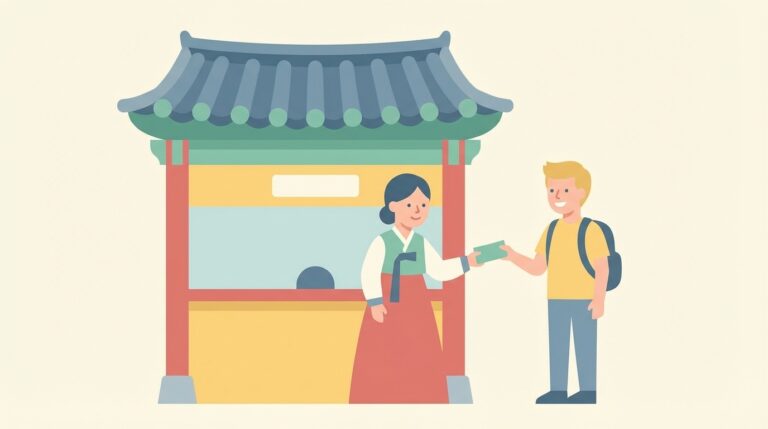
Setting: It’s a crisp autumn morning at Gyeongbokgung Palace. You didn’t rent a Hanbok today, so you need to buy a ticket. You walk up to the traditional-looking booth.
Characters:
– YOU: A tourist ready to explore Korean history.
– Staff (직원): A polite Korean lady behind the glass.
Dialogue:
YOU: 저기요… 매표소가 어디예요?
(jeogiyo… maepyosoga eodiyeyo?)
[Excuse me… where is the ticket office?]
(🎭 Stage Direction: You ask a nearby guard.)
Guard: 바로 저기예요.
(baro jeogiyeyo.)
[It’s right over there.]
(You walk up to the booth)
YOU: 안녕하세요! 표 한 장 주세요.
(annyeonghaseyo! pyo han jang juseyo.)
[Hello! One ticket, please.]
Staff: 네, 성인 한 분이시죠? 3,000원입니다.
(ne, seongin han bunisijyo? samcheon-wonimnida.)
[Yes, one adult? It is 3,000 won.]
YOU: 카드로 할게요. (kadeuro halgeyo.) [I’ll pay by card.]
🔀 Your Turn! How do you hand your credit card to the staff?
– A) Slide it across the counter with one hand while looking at your phone.
– B) Hand it to her using both hands, making brief eye contact and smiling.
– C) Toss it onto the counter.✅ Best Choice: B — Reason: Handing items with two hands is the ultimate sign of respect in Korea. It instantly marks you as a polite traveler who appreciates the culture!
⚠️ Choice A & C Analysis: This might seem normal in Western cultures, but in Korea, tossing or one-handed sliding can be seen as rude or arrogant, especially to someone older than you.
Bonus Scenario: K-Pop Concert Will-Call
At the stadium, you see a sign that says ‘티켓 수령’ (Ticket Pickup).
YOU: 안녕하세요, 예매한 티켓 받으러 왔어요. (Hello, I came to pick up my reserved ticket.)
Staff: 신분증 보여주세요. (Please show your ID.)
YOU: 여기 있습니다! (Here it is!)
Pro-tip: For K-pop concerts, always have your passport ready!
Phase 6: 10-Second Shadowing Drill
Practice these phrases with the correct intonation and pausing. The slash (/) means a slight pause.
- 🥺 Politely asking for directions:
저기요, / 매표소가 / 어~~디예요?
(jeogiyo, / maepyosoga / eo~~diyeyo?) -
😊 Confidently buying your ticket:
안녕하세요! / 표 / 한 장 / 주세요.
(annyeonghaseyo! / pyo / han jang / juseyo.)
Phase 7: K-Culture Glossary
| Korean | Romanization | English | Contextual Meaning |
|---|---|---|---|
| 매표소 | maepyoso | Ticket Office | The physical booth where tickets are sold. |
| 표 / 티켓 | pyo / tiket | Ticket | ‘Pyo’ is native Korean, ‘tiket’ is the English loanword. Both are widely used! |
| 입장료 | ipjangnyo | Admission Fee | The cost to enter a tourist attraction. |
| 영수증 | yeongsujeung | Receipt | Often they will ask “영수증 드릴까요?” (Would you like a receipt?). |
| 대기 | daegi | Waiting/Queue | You’ll see this word on screens at popular restaurants or ticket booths. |
Phase 8: Traveler’s Survival Kit
If you are traveling in Korea, the ticket office is just the beginning. Keep these survival phrases in your back pocket!
🆘 Survival Phrases for Moving Around
– 🇰🇷 “성인 두 명이에요.” (seongin du myeong-ieyo.) = Two adults, please.
– 🇰🇷 “영수증 주세요.” (yeongsujeung juseyo.) = Please give me the receipt.
– 🇰🇷 “어디로 가야 해요?” (eodiro gaya haeyo?) = Where should I go? (Useful after buying the ticket!)
📌 Editor’s Travel Note:
– Useful Apps: Never use Google Maps in Korea! Always use KakaoMap or Naver Map. They will even show you exactly where the 매표소 is on the map.
– Cash vs Card: Korea is a cashless society. Even a 1,000 won (less than $1) ticket can be paid with a card. However, for charging your T-Money (transit card) at convenience stores, you MUST have cash!
Phase 9: Think Deeper — “Korean in the Global Era”
🧠 Think Deeper: Language in the Global Era
Have you noticed that young Koreans often say “티켓” (tiket) instead of the traditional word “표” (pyo)? As Korea becomes more globalized, especially through K-Pop and international events, English loanwords (called Konglish or purely borrowed words) are everywhere. While a bus station in the countryside will definitely use “표” (pyo), a trendy exhibition in Gangnam might use “티켓” (tiket). This shows how language is a living, breathing thing that changes depending on generations and locations.💬 Your Turn: Does your native language borrow a lot of English words for modern activities? Share your thoughts in the comments!
Phase 10: FAQ & Troubleshooting
Q: “Can I just say ‘티켓 주세요’ (Ticket juseyo) instead of ‘표 한 장 주세요’?”
Yes, absolutely! Since ‘티켓’ is widely understood, saying “티켓 하나 주세요” (One ticket, please) is perfectly natural and safe for an A1 learner.
Q: “Is there a discount for foreigners at tourist spots?”
Usually, no. However, age-based discounts (seniors, youth) are common. The most famous “discount” is the free entry for wearing Hanbok at the palaces!
❌ Common Mistake #1: Forgetting to use a counter.
Saying “표 한 주세요” (Ticket one please – without the counter ‘장’) sounds broken. If you can’t remember ‘장’ (jang), just use the universal counter ‘하나’ (hana – meaning one): “표 하나 주세요.”❌ Common Mistake #2: Tipping the staff.
Never leave a tip at the ticket booth! Korea has absolutely zero tipping culture. The staff will chase you down thinking you forgot your change!
Phase 11: Wrap-up & Action Items
Summary: To conquer the ticket booth in Korea, simply smile, use both hands, and say “표 한 장 주세요!”
Your Action Missions:
– 🥉 Bronze (Solo): Stand in front of a mirror and practice saying “매표소가 어디예요?” three times with a confused but polite face.
– 🥈 Silver (Online): Go to a K-Drama or K-Pop forum and leave a comment using “표 한 장 주세요” (e.g., “If only I could say 표 한 장 주세요 at a BTS concert…”).
– 🥇 Gold (Real Life): If there is a Korean mart or cafe near you, try handing your card over with two hands when you pay!
🎯 K-Culture Mission for this Unit:
Open Naver Map or KakaoMap on your browser, search for “경복궁” (Gyeongbokgung), and use Street View to “walk” around the entrance. Try to spot the 매표소 before you even travel to Korea!
Did you enjoy today’s tutoring? Let me know in the comments which K-Pop concert or K-Drama location you want to buy a ticket for! 👇
Phase 12: Interactive Quiz Challenge
1. Fill in the Blank:
You are at the Busan KTX train station. You want one ticket.
“안녕하세요! ____ 한 장 주세요.”
(Hint: The native Korean word for ticket)
2. True or False — K-Culture Edition:
You are wearing a beautiful Hanbok at Gyeongbokgung Palace. You must go to the 매표소 to buy a discounted ticket. (T/F)
3. Situational Judgment:
You bought your ticket and the staff is handing you your credit card and receipt. What is the most “Korean” way to receive it?
A) Grab it quickly with one hand and say “Thanks!”
B) Take it with both hands and slightly bow your head.
C) Tell them to keep the change as a tip.
🚨 Click here for the answers!
1. 표 (pyo). You can also say 티켓 (tiket)!
2. False! If you are wearing Hanbok, entry is completely FREE. You don’t even need a ticket; just walk through the main gate!
3. B. Taking items with both hands and giving a slight head bow is the perfect way to show respect in Korea. (And remember, C is wrong because there is no tipping!)
Frequently Asked Questions (FAQ)
Q: What does "매표소가 어디예요? (Where is the ticket office?)" mean in Korean and how do you pronounce it?
A: In Korean, "매표소가 어디예요? (Where is the ticket office?)" is pronounced [maepyosoga eodiyeyo? [mae-pyo-so-ga eo-dee-yeh-yo] and means: Ticket office (매표소) + where is it? (어디예요?)
Q: What does "표 한 장 주세요. (One ticket, please.)" mean in Korean and how do you pronounce it?
A: In Korean, "표 한 장 주세요. (One ticket, please.)" is pronounced [pyo han jang juseyo. [pyo hahn jahng joo-seh-yo] and means: Ticket (표) + one (한) + counter for flat objects (장) + please give me (주세요).
Q: What does "얼마예요? (How much is it?)" mean in Korean and how do you pronounce it?
A: In Korean, "얼마예요? (How much is it?)" is pronounced [eolmayeyo? [ull-mah-yeh-yo] and means: How much is it?







