

Phase 1: 공감 — 몰입형 오프닝 (Immersive Hook)
Hello! I’m the Lead Editor of Daily Hangul.
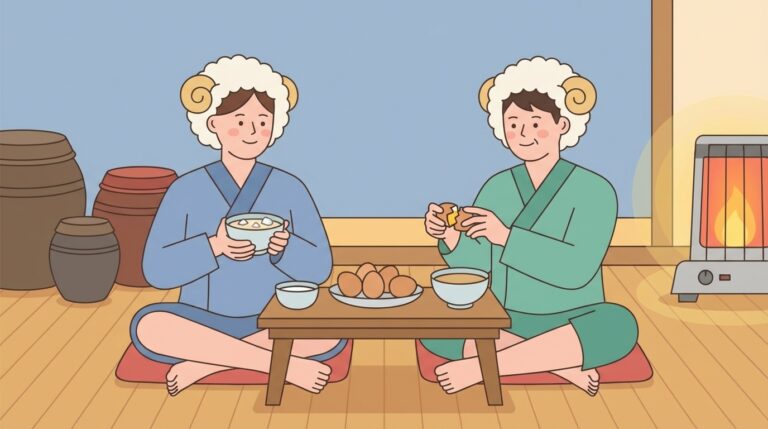
Picture this K-Drama scene: The main characters, after a stressful day of fighting corporate villains or navigating a love triangle, are sitting on a warm wooden floor. They are wearing matching oversized T-shirts, shorts, and those iconic towels folded like sheep horns on their heads (양머리). Suddenly, one of them grabs a brown egg and CRACK! smashes it against the other person’s head. Then, they take a long sip of an icy, sweet rice beverage.
Welcome to the Jjimjilbang (찜질방), the Korean public bathhouse and sauna!
If you visit Korea, spending a night or a lazy afternoon at a Jjimjilbang is a must-do cultural experience. But the real highlight isn’t just sweating in the heated rooms—it’s the trip to the 매점 (Maejeom), the snack bar. If you don’t know how the unique Jjimjilbang payment system works or how to order these iconic snacks naturally, you might find yourself awkwardly holding cash while the cashier stares at your wrist.
Don’t worry! This guide is based on real experiences from my students who successfully lived out their K-Drama sauna dreams. Let’s learn how to order like a true local!
Phase 2: 핵심 표현 심층 분석 (Deep Dive)
Here are the top 3 expressions you need at the Jjimjilbang snack bar.
1. 식혜 하나랑 구운 계란 세 개 주세요.
- Pronunciation: sikhye hanarang guun gyeran se gae juseyo. [sheek-heh ha-na-rang goo-oon gyeh-ran seh geh joo-seh-yo]
- Meaning: Give me one Sikhye and three roasted eggs, please.
- K-Culture Moment: You’ve just walked out of the 70°C (158°F) salt room. You’re sweating, and you need immediate hydration. You walk up to the counter and say this magical phrase.
- Editor’s Insight: Notice the use of ‘랑’ (rang). In textbooks, you might learn ‘와/과’ (and), but in everyday spoken Korean, especially when ordering food, we almost always use ‘-(이)랑’. It sounds much friendlier and natural!
- Situation Spectrum:
[🚫 절대 금지] ———— [⚠️ 주의] ———— [✅ 자유롭게]
- Casual with friends: ✅ (Drop ‘주세요’ and say ‘주라’ or ‘먹자’)
- Ordering to the staff: ✅ (Perfectly polite and standard)
- 🤔 Think About It: Why do Koreans use counters like ‘하나’ (one) and ‘세 개’ (three items) instead of just saying “one Sikhye”? Does your language have specific counting units for different objects?
2. 락커 키로 결제할게요. (or 키로 찍어주세요.)
- Pronunciation: rakkeo kiro gyeoljehalgeyo. [rah-kuh kee-ro gyul-jeh-hal-geh-yo]
- Meaning: (Literal) I will pay with the locker key. / (Real nuance) Just scan my bracelet.
- K-Culture Moment: You try to hand the cashier your credit card, but she taps a small scanner on the counter. In most modern Jjimjilbangs, your locker key bracelet has an RFID chip. You buy everything by tapping it, and you pay the total bill when you leave the facility!
- Editor’s Insight: “결제할게요” is standard, but you will often hear locals say “키로 찍어주세요” (Please scan the key). ‘찍다’ literally means ‘to stamp’ or ‘to scan’ in this context.
- Situation Spectrum:
[🚫 절대 금지] ———— [⚠️ 주의] ———— [✅ 자유롭게]
- To the cashier: ✅
- 🤔 Think About It: The “scan now, pay later” system requires a level of trust. How does this reflect the convenience-focused (빨리빨리 – ppalli ppalli) culture of Korea?
3. 머리에 깨도 돼요?
- Pronunciation: meorie kkaedo dwaeyo? [muh-ree-eh ggae-doh dweh-yo?]
- Meaning: Can I crack (the egg) on your head?
- K-Culture Moment: You’re sitting with your Korean friend. You have the roasted egg. It’s time for the K-Drama moment. You ask this playfully before immediately smashing it on their head (gently, please!).
- Editor’s Insight: ‘깨다’ means to break or crack. ‘-도 돼요?’ is a super useful B1 grammar point asking for permission. Say this with a mischievous smile!
- Situation Spectrum:
[🚫 절대 금지] ———— [⚠️ 주의] ———— [✅ 자유롭게]
- Close friends: ✅
- Older colleagues/Boss: 🚫 (Do NOT crack an egg on your boss’s head unless you want to be fired!)
Phase 3: 교과서 vs 진짜 한국어 (Textbook vs Real Life)
| 상황 (Situation) | 📖 교과서 한국어 (Textbook) | 🗣️ 진짜 한국어 (Real Life) | 💡 왜 다를까? (Why the difference?) |
|---|---|---|---|
| Ordering items | 식혜 한 잔과 계란 세 개를 주십시오. | 식혜 하나랑 계란 세 개요. | In spoken Korean, particles like ‘를’ are dropped, and ‘랑’ is preferred over ‘과’. |
| Paying | 신용카드로 지불하겠습니다. | 키로 할게요. / 키 찍을게요. | Efficiency! “I’ll do it with the key” is faster and perfectly understood. |
| Handing the key | 제 열쇠를 받으세요. | (Just holds out the wrist silently) | Non-verbal communication (Nunchi) is huge in Korea. Actions speak louder! |
Phase 4: 문화적 맥락 — K-Culture 딥다이브 (Cultural Deep Dive)
4-1. 비언어적 요소 (Non-verbal Communication): The Egg Smash and Nunchi
When eating 구운 계란 (Guun Gyeran – slow-roasted brown eggs), the tradition is to crack it on someone’s head. But here is where Korean 눈치 (Nunchi – social sense) comes in: you must assess the hardness of the egg and the mood of your friend. If you hit too hard, it actually hurts! Also, when paying, simply extending your wrist with the electronic band toward the scanner is standard behavior. No need for long sentences.
4-2. K-Drama Connection: The “Yangmeori” and Bonding
Have you seen the drama Crash Landing on You or Legend of the Blue Sea? The Jjimjilbang acts as a temporary refuge, a place for secret meetings, or a cheap place to sleep after running away from home. Making a 양머리 (Sheep Head) out of a Jjimjilbang towel is an essential K-Drama trope.
Critical View: In dramas, characters often look flawless even after sweating in a 80°C room. In reality? You will be red-faced, your hair will be messy, and you will be desperately craving that ice-cold Sikhye. Embrace the messiness—that’s the real Korean experience!
Phase 5: 실전 롤플레이 시나리오 (Immersive Roleplay)
시나리오 A: 매점 앞에서의 결전 (The Snack Bar Showdown)
- Setting: Saturday afternoon, Dragon Hill Spa in Seoul. The heated floor is packed with people. You and your Korean friend, Minji, just got out of the Ice Room.
- Characters:
- YOU: A language learner excited to try Jjimjilbang snacks.
- Minji (28): Your Korean friend who guided you here.
- Cashier (이모님): A busy, friendly middle-aged staff member.
Minji: 아, 땀 빼니까 목마르다. 우리 매점 갈래?
(Ah, ttam ppaenikka mongmareuda. Uri maejeom gallae?)
[Ah, sweating makes me thirsty. Shall we go to the snack bar?]
YOU: 좋아요! 제가 살게요.
(Joayo! Jaega salgeyo.)
[Sounds good! I’ll buy.]
(🎭 Stage Direction: You both walk up to the busy counter filled with stacks of brown eggs and slushy machines)
Cashier: 네, 주문하세요~
(Ne, jumunhaseyo~)
[Yes, what would you like to order?]
YOU: 이모님, 식혜 두 잔이랑 구운 계란 세 개 주세요.
(Imonim, sikhye du janirang guun gyeran se gae juseyo.)
[Ma’am, two Sikhye and three roasted eggs, please.]
Cashier: 네~ 5,500원입니다. 키 주세요.
(Ne~ o-cheon-o-baek-won-imnida. Ki juseyo.)
[Okay~ That’s 5,500 won. Give me your key.]
🔀 당신의 차례! 어떻게 대답할까요? (Decision Point)
– A) (Pull out a 10,000 won cash bill) “여기 현금 있습니다!”
– B) (Look confused) “무슨 키요? 자동차 키요?”
– C) (Hold out your wrist with the locker bracelet) “아, 네. 여기 찍어주세요!”✅ Best Choice: C — “Ah, yes. Please scan here!”
⚠️ Choice A 분석: Taking your wallet into the sauna area is a hassle and highly uncommon now. Everything is done via the wristband!
Cashier: (Beeps your wristband) 네, 결제됐습니다. 맛있게 드세요!
(Ne, gyeoljedwaetseumnida. Masitge deuseyo!)
[Yes, payment is complete. Enjoy!]
YOU: 감사합니다!
시나리오 B: 계란 깨기 (Bonus: The Egg Crack)
(🎭 You and Minji sit on the floor. You hand her an egg.)
YOU: 민지 씨, 이거 머리에 깨도 돼요?
(Minji ssi, igeo meorie kkaedo dwaeyo?)
[Minji, can I crack this on your head?]
Minji: 헉… 살살 깨요! 진짜 아파요!
(Heok… salsal kkaeyo! Jinjja apayo!)
[Gasp… crack it gently! It really hurts!]
YOU: (Smash!) 앗, 미안해요. 너무 세게 쳤나 봐요! 🤣
Phase 6: 10초 섀도잉 드릴 (Shadowing Drill)
Practice this until it flows naturally. Pay attention to the pauses (/) and the emotion tags!
😊 이모님~ / 식혜 두 잔이랑 / 구운 계란 주세요!
(i-mo-nim~ / si-kye du ja-ni-rang / gu-un gye-ran ju-se-yo!)😌 아~ / 땀 빼고 먹으니까 / 진짜 맛있다!
(a~ / ttam ppae-go meo-geu-ni-kka / jin-jja ma-sit-da!)
[Ah~ Eating after sweating makes it taste so good!]
Phase 7: K-Culture 미니 사전 (K-Culture Glossary)
| 한국어 | Romanization | 영어 (English) | 맥락 설명 (Context) |
|---|---|---|---|
| 찜질방 | jjimjilbang | Korean dry sauna | A 24-hour public bathhouse with various heated rooms, sleeping areas, and snack bars. |
| 식혜 | sikhye | Sweet rice beverage | A traditional sweet, icy drink made from malt and rice. The ultimate Jjimjilbang soulmate. |
| 구운 계란 | guun gyeran | Roasted eggs | Eggs slowly roasted in the hot saunas. They turn brown and have a chewy texture. |
| 양머리 | yangmeori | Sheep head towel | A specific way of folding a towel to look like sheep horns. A K-Drama staple! |
| 매점 | maejeom | Snack bar/Kiosk | The place inside the Jjimjilbang where you buy food and drinks. |
| 락커 키 | rakkeo ki | Locker key | A wristband that serves as your locker key and your credit card inside the facility. |
Phase 8: 여행자 서바이벌 키트 (Traveler’s Survival Kit)
Are you heading to a Jjimjilbang during your Korea trip? Memorize these!
🆘 서바이벌 표현 TOP 3
1. 🇰🇷 수건 좀 더 주실 수 있나요? (sugeon jom deo jusil su innayo?)
– Can I have some more towels? (Note: Men’s locker rooms usually have unlimited towels, but women’s rooms often give exactly two at the entrance due to high loss rates!)
2. 🇰🇷 여자/남자 사우나가 어디예요? (yeoja/namja saunaga eodiyeyo?)
– Where is the women’s/men’s sauna? (Crucial so you don’t walk into the wrong area!)
3. 🇰🇷 여기 자리 있어요? (yeogi jari isseoyo?)
– Is this seat taken? (Before you lay your mat down on the heated floor.)📌 Editor’s Travel Note
– Cashless Zone: Leave your wallet inside your locker. The wristband does everything.
– Naked vs Clothed: The wet baths (showers, hot tubs) are strictly separated by gender and require you to be completely naked. The Jjimjilbang (sauna rooms and snack areas) is co-ed, and you MUST wear the provided T-shirt and shorts (찜질복).
– Tattoos: Unlike Japan, most Korean saunas are okay with tattoos, though extremely large ones might attract some stares from older generations.
Phase 9: 비판적 사고 코너 — “한 발 더 깊이” (Think Deeper)
🧠 Think Deeper: Food & Identity (음식과 정체성)
Why do Koreans crave an ice-cold, sweet drink (Sikhye) while sweating in a boiling hot room? This reflects the Korean culinary philosophy of 이열치열 (Iyeolchiyeol – fighting heat with heat) and its opposite—finding perfect balance. By heating the body from the outside and cooling it from the inside, Koreans believe they are restoring their body’s energy (기 – Gi). Furthermore, sharing snacks on the floor of a Jjimjilbang isn’t just about eating; it’s a communal bonding ritual. Cracking an egg on someone’s head breaks down physical and social barriers, making relationships instantly closer.
💬 Your Turn: Does your culture have a unique bathing, sauna, or spa culture? What kind of food or drinks do you enjoy there? Share in the comments!
Phase 10: FAQ & 오해 방지 (Troubleshooting)
Q: “이모님 (Imonim – Auntie)”이라고 부르면 기분 나빠하지 않으실까요?
A: In restaurants or snack bars, calling a middle-aged female staff member “이모님” is very friendly and completely acceptable. However, do NOT use this in a formal setting (like a bank or department store). If unsure, “사장님 (Boss/Owner)” is always a safe alternative!
Q: 식혜 안의 밥알(rice grains)은 먹어도 되나요?
A: Yes! Those soft, sweet rice grains at the bottom are the best part of Sikhye. Shake it gently before drinking so they don’t all sink to the bottom.
❌ 흔한 실수 #1 (Common Mistake): Handing the wristband to the cashier.
✅ 이렇게 하세요: You don’t need to take it off. Just extend your arm and let the cashier tap their scanner against your wrist.❌ 흔한 실수 #2: Bringing outside food.
✅ 이렇게 하세요: Jjimjilbangs strictly prohibit outside food (external drinks, snacks). Buy everything at the Maejeom to support the business!
Phase 11: 요약 및 액션 아이템 (Wrap-up)
💡 One-Liner Summary: When at a Jjimjilbang, order your Sikhye and eggs with “~랑 ~주세요” and pay simply by offering your wristband (키로 결제할게요)!
🔥 Action Mission 3단계
– 🥉 Bronze: Say “식혜 하나랑 계란 세 개 주세요” out loud 3 times while imagining you are wearing a sheep-head towel.
– 🥈 Silver: Leave a comment below in Korean telling me what you would order at the Jjimjilbang!
– 🥇 Gold: Next time you visit Korea (or a local Korean spa in your country), try ordering entirely in Korean using today’s phrases.
🧖♀️ K-Culture Mission:
Search “Jjimjilbang egg smash” on YouTube or watch an episode of a Korean variety show (like Running Man) where they go to a sauna. Watch how they interact and listen for the “키로 결제할게요” moment!
Phase 12: 퀴즈 — 인터랙티브 챌린지 (Interactive Quiz)
Let’s test your Jjimjilbang survival skills!
1. You want to order two Sikhye and two eggs. Which is the most natural way to say it?
A) 식혜 두 잔과 계란 두 개를 주십시오.
B) 식혜 두 잔이랑 계란 두 개 주세요.
C) 식혜 둘에 계란 둘 결제할게요.
2. True or False: You should bring your credit card to the snack bar inside the sauna.
– T / F
3. (Situational) Your friend just bought roasted eggs. What should you ask before playfully hitting them on the head with it?
A) 머리에 깨도 돼요?
B) 머리를 때려도 돼요?
C) 계란이 아파요?
👀 정답 보기 (Click for Answers)
1. B (Using ‘랑’ and ‘주세요’ is the most natural spoken B1 Korean.)
2. False (Leave your wallet in the locker! You pay by scanning your locker key wristband.)
3. A (머리에 깨도 돼요? = Can I crack it on your head? ‘B’ means ‘Can I hit your head?’ which sounds aggressive without context!)
Happy sweating, and enjoy your Sikhye! Until next time! 💛
Frequently Asked Questions (FAQ)
Q: What does "식혜 하나랑 구운 계란 세 개 주세요." mean in Korean and how do you pronounce it?
A: In Korean, "식혜 하나랑 구운 계란 세 개 주세요." is pronounced [sikhye hanarang guun gyeran se gae juseyo. [sheek-heh ha-na-rang goo-oon gyeh-ran seh geh joo-seh-yo] and means: Give me one Sikhye and three roasted eggs, please.
Q: What does "락커 키로 결제할게요. (or 키로 찍어주세요.)" mean in Korean and how do you pronounce it?
A: In Korean, "락커 키로 결제할게요. (or 키로 찍어주세요.)" is pronounced [rakkeo kiro gyeoljehalgeyo. [rah-kuh kee-ro gyul-jeh-hal-geh-yo] and means: (Literal) I will pay with the locker key. / (Real nuance) Just scan my bracelet.
Q: What does "머리에 깨도 돼요?" mean in Korean and how do you pronounce it?
A: In Korean, "머리에 깨도 돼요?" is pronounced [meorie kkaedo dwaeyo? [muh-ree-eh ggae-doh dweh-yo?] and means: Can I crack (the egg) on your head?







