

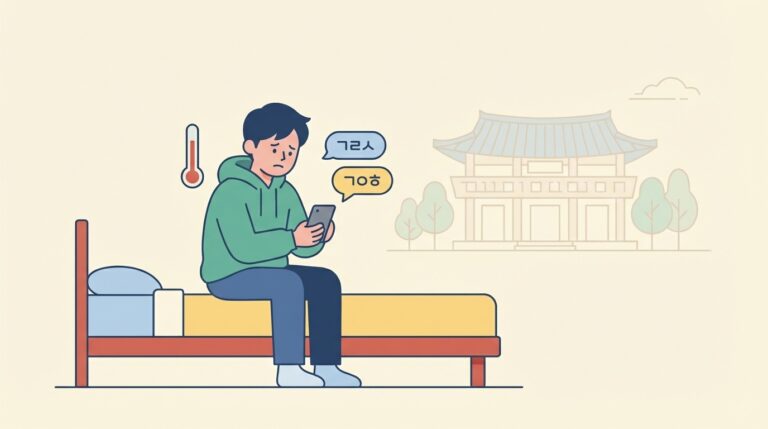
Phase 1: Immersive Hook — The Morning Panic
Hello there! I’m the Lead Editor of Daily Hangul.
Picture this K-Drama scene: The main character’s eyes snap open. They check their phone and gasp. It’s 9:30 AM, and their Korean university class started at 9:00 AM! In a panic, they frantically type a message to their professor or their senior (Sunbae). But wait… what exactly are they typing? If you look at the subtitles, it just says “I’m sorry I’m late.” But in Korean, there’s an entire art to making excuses and calling in sick.
If you simply say, “I’m not coming today,” you might accidentally sound like a rebel who just hates studying! In Korean culture, showing that you want to be there but cannot due to circumstances is crucial. Knowing how to report an absence politely will not only save your grades but also earn you that sweet ‘Insider’ (In-ssa) respect from your Korean peers.
(Transparency note: This guide is built from the real-life panicked KakaoTalk messages of my actual language students!)
Phase 2: Deep Dive into Core Expressions
Here are the top 3 lifesaver expressions you need when you can’t make it to class.
1. 저 오늘 아파서 학교에 못 가요.
- Pronunciation: [Jeo oneul apaseo hakgyoe mot gayo.]
- Sound-alike guide: ‘mot’ sounds like ‘moat’, and ‘apaseo’ sounds like ‘ah-pah-suh’.
- Meaning: (Literal) I today sick because school to cannot go. / (Real nuance) I can’t go to school today because I’m sick.
- K-Culture Moment: You wake up with a fever in your dorm. You text this to your language exchange partner or your Korean language teacher.
- Editor’s Insight: The absolute keyword here is 못 (mot), which means “cannot”. If you use 안 (an), it means “will not” (I’m choosing not to go), which sounds very defiant! Always use ‘못’ to show it’s out of your control.
- Situation Spectrum:
[🚫 절대 금지] ———— [⚠️ 주의] ———— [✅ 자유롭게]
- Close Friends (Casual): ✅ (Drop the ‘요’ -> 못 가)
- Classmates/Tutor (Semi-formal): ✅
- University Professor (Formal): ⚠️ (Needs a more formal ending like 못 갈 것 같습니다)
- 🤔 Think About It: Why is it so important to distinguish between “cannot (못)” and “will not (안)” in Korean society? How does this reflect the culture’s emphasis on group harmony and duty?
2. 몸이 안 좋아서 병원에 다녀오겠습니다.
- Pronunciation: [Mom-i an joaseo byeong-won-e danyeo-ogetseumnida.]
- Meaning: (Literal) Body is not good so hospital to I will go and come back. / (Real nuance) I’m not feeling well, so I’m going to see a doctor.
- K-Culture Moment: This is the ultimate “get out of jail free” card. In Korea, “병원” (hospital) is used for any medical clinic, even just for a mild cold.
- Editor’s Insight: Instead of saying “I’m sick” (아프다), saying “my body condition isn’t good” (몸이 안 좋다) sounds slightly more professional and gentle. Also, “다녀오겠습니다” (I will go and return) implies you are actively trying to get better to return to your duties!
- Situation Spectrum:
[🚫 절대 금지] ———— [⚠️ 주의] ———— [✅ 자유롭게]
- Close Friends (Casual): ⚠️ (Too formal for friends)
- Classmates/Tutor (Semi-formal): ✅
- University Professor (Formal): ✅
3. 죄송하지만, 조금 늦을 것 같아요.
- Pronunciation: [Joesonghajiman, jogeum neujeul geot gatayo.]
- Meaning: (Literal) I am sorry but, a little late it seems like. / (Real nuance) I’m sorry, but I think I’ll be a little late.
- K-Culture Moment: You are stuck in the Seoul subway during rush hour. You know you’ll be 10 minutes late. You send this to your study group group-chat (단톡방).
- Editor’s Insight: Notice the ending “~것 같아요” (it seems like / I think). Koreans love softening negative news. Instead of bluntly saying “I will be late,” saying “I think I will be late” makes the listener feel less shocked and shows humility.
- Situation Spectrum:
[🚫 절대 금지] ———— [⚠️ 주의] ———— [✅ 자유롭게]
- Close Friends (Casual): ✅ (미안, 조금 늦을 것 같아)
- Classmates/Tutor (Semi-formal): ✅
- University Professor (Formal): ⚠️ (Use 늦을 것 같습니다 instead)
Phase 3: Textbook vs. Real Life
| Situation | 📖 Textbook Korean | 🗣️ Real Korean | 💡 Why the difference? |
|---|---|---|---|
| Telling your teacher you are sick | 저는 감기에 걸렸습니다. 그래서 결석합니다. (I caught a cold. Therefore I am absent.) | 선생님, 죄송한데 저 오늘 몸이 안 좋아서 못 갈 것 같아요. ㅠㅠ | Textbooks sound like military reports. Real Korean uses “몸이 안 좋다” (body isn’t good) and softens it with “~것 같아요”. |
| Telling a friend you’re late | 나는 늦게 도착할 것입니다. (I will arrive late.) | 헐 미안! 나 좀 늦을 듯 ㅠㅠ! (OMG sorry! Think I’ll be late ㅠㅠ!) | Friends use text slang like “헐” (OMG) and shorten grammar like “~듯” instead of “~것 같아” for typing speed. |
| Having a doctor’s appointment | 저는 병원 예약이 있습니다. (I have a hospital appointment.) | 저 오늘 병원 가야 해서요. (I have to go to the clinic today, so…) | Ending a sentence with “~해서요” (because…) leaves the conclusion open, which is a polite, indirect way to make an excuse. |
Bottom Note: For A2 learners, you don’t need to use heavy slang! Just switching “아파요” to “몸이 안 좋아요” will immediately make you sound like a local.
Phase 4: Cultural Deep Dive
4-1. Non-verbal Communication & Nunchi
When making an excuse in Korea, Nunchi (눈치) is everything. If you are texting a professor or a senior, reply immediately if they ask where you are. Never leave them on ‘read’ (읽씹). Also, when you finally return to class, make sure to do a slight bow to the teacher and say, “걱정해 주셔서 감사합니다” (Thank you for worrying about me) to smooth things over.
4-2. K-Culture Connection: The Dreaded “조별과제” (Group Project)
If you’ve watched K-Dramas like Cheese in the Trap or My ID is Gangnam Beauty, you know about the infamous 조별과제 (Group Projects). Missing a regular class might just affect your own grade, but missing a group project meeting? That’s a social disaster!
If you must miss a group meeting, you cannot just say “I’m sick.” You must profusely apologize and offer an alternative: “진짜 죄송해요. 대신 제가 자료 조사는 다 할게요!” (I’m so sorry. I’ll do all the research instead!). This shows you are still a team player despite your absence.
Phase 5: Immersive Roleplay — The Group Chat Crisis
Setting: It’s Tuesday morning. You are an exchange student taking a Korean literature class. You woke up with a terrible stomachache. You have a team meeting at a cafe in 30 minutes with your Korean classmates, including Minsu, your group leader (Sunbae).
Dialogue:
Minsu: 다들 어디쯤이에요? 저 카페 도착했어요! ☕
(Dadeul eodijjeumieyo? Jeo kape dochakaesseoyo!)
[Where is everyone? I arrived at the cafe!]
Ji-eun: 선배님, 저는 지금 버스 내렸어요! 5분 뒤 도착이요.
(Seonbaenim, jeoneun jigeum beoseu naeryeosseoyo! O-bun dwi dochagiyo.)
[Senior, I just got off the bus! Arriving in 5 mins.]
(🎭 Stage Direction: Your stomach growls painfully. You are still in bed. You need to tell them you can’t make it.)
🔀 Your Turn! How should you reply in the group chat?
– A) “저 안 가요. 배가 아파요.” (I’m not going. Stomach hurts.)
– B) “선배님, 정말 죄송해요. 저 오늘 몸이 너무 안 좋아서 못 갈 것 같아요. ㅠㅠ”
– C) “미안! 나 아파서 결석!”✅ Best Choice: B — Why: It uses polite language to a senior (선배님), softens the bad news (몸이 안 좋다 + ~것 같아요), and shows genuine regret with ‘정말 죄송해요’ and the crying emoji ‘ㅠㅠ’.
⚠️ Choice A Analysis: Remember Phase 2? Using “안 가요” sounds like you are refusing to go on purpose! Very rude!
⚠️ Choice C Analysis: This is half-speech (반말). Never use this with a Sunbae or in a formal group chat!
Minsu: 헉, 괜찮아요? ㅠㅠ 무리하지 말고 푹 쉬어요!
(Heok, gwaenchanayo? ㅠㅠ Murihaji malgo puk swieoyo!)
[Gasp, are you okay? Don’t overdo it and get some good rest!]
Phase 6: 10-Second Shadowing Drill
Read these out loud! Pay attention to the pauses / and the emotion tags.
- 🥺 애교 섞어서 (Soft & Apologetic):
선생님, / 저 오늘 / 몸이 안 좋아서 / 못 갈 것 같아요.
(Seonsaengnim, / jeo oneul / mom-i an joaseo / mot gal geot gatayo.) -
😢 아쉽게 (Regretful):
진짜 가고 싶은데, / 병원에 / 다녀와야 할 것 같아요.
(Jinjja gago sipeunde, / byeong-won-e / danyeowaya hal geot gatayo.)
Phase 7: K-Culture Glossary
| Korean | Romanization | English | Cultural Context |
|---|---|---|---|
| 눈치 | nunchi | Social tact | The art of reading the room. Knowing when and how to make an excuse. |
| 선배 | seonbae | Senior | Someone who entered the school or company before you. You must use polite language with them. |
| 단톡방 | dantokbang | Group chat | A KakaoTalk group chatroom. Essential for school projects. |
| 조별과제 | jobyeolgawje | Group project | The ultimate test of teamwork (and patience) in Korean universities. |
| 병원 | byeong-won | Hospital/Clinic | In Korea, you go to a “hospital” even for a minor cold. It usually means a local neighborhood clinic. |
Phase 8: Traveler & Student Survival Kit
Whether you’re a student or a traveler, if you’re skipping plans because you’re sick, you need to know how to get medicine!
🆘 Survival Phrases at the Pharmacy (약국)
– 🇰🇷 “감기약 좀 주세요.” (Gamgiyak jom juseyo.) – Please give me some cold medicine.
– 🇰🇷 “여기 아파요.” (Yeogi apayo.) – It hurts here. (Point to the body part)
– 🇰🇷 “머리가 아파요.” (Meoriga apayo.) – I have a headache.📌 Editor’s Travel Note:
– Map Apps: Use KakaoMap or Naver Map and search “약국” (Yakguk) for pharmacies or “내과” (Naegwa) for internal medicine clinics.
– Cost: Medical care in Korea is incredibly fast and affordable! A quick consultation at a local clinic might cost you around $10-$20 even without insurance.
Phase 9: Think Deeper — “A Step Further”
Language & Power: The Art of Softening the Blow
Have you noticed how Koreans rarely say a direct “No” or “I will be late” to superiors? Expressions like “~할 것 같아요” (it seems like…) or “몸이 안 좋아요” (body condition isn’t good) are linguistic cushions. In Korean society, directly inconveniencing someone of higher status (like a professor or a Sunbae) causes “friction.” By using indirect, softened language, you protect the harmony of the relationship and show respect for their authority.
💬 Your Turn: In your culture, do you prefer to give a direct reason for being absent (e.g., “I have food poisoning”), or do you keep it vague and polite? Share in the comments!
Phase 10: FAQ & Troubleshooting
Q: Can I use emojis like ㅠㅠ or 😭 when messaging a professor?
A: Maybe. If the professor is young and friendly, a single ‘ㅠㅠ’ to show sadness is okay. However, for older, strict professors, stick to standard punctuation. No emojis!
Q: Do I need a doctor’s note to miss a university class?
A: Yes! If you want an excused absence (출석 인정), you usually need a 진단서 (jindanseo – medical certificate) or a prescription receipt from the pharmacy. Always ask: “진단서 필요할까요?” (Do you need a medical certificate?).
❌ Common Mistake #1: Saying “안 가요” (I won’t go).
✅ Do this instead: Always use “못 가요” (I cannot go) to show it is outside of your control!
Phase 11: Wrap-up & Action Items
One-Liner Summary: When calling in sick in Korea, remember to use 못 (cannot), soften your sentences, and show genuine regret!
Your 3-Step Action Mission:
– 🥉 Bronze (Solo): Stand in front of a mirror, look deeply apologetic, and say “몸이 안 좋아서 못 갈 것 같아요” 3 times.
– 🥈 Silver (Online): Leave a comment below using today’s expression: “에디터님, 저 오늘 [reason] 못 갈 것 같아요!”
– 🥇 Gold (Real Life): The next time you are running late for a language exchange or a class, try messaging your partner: “조금 늦을 것 같아요!”
🎬 K-Culture Mission:
Watch one episode of a campus K-Drama (like Weightlifting Fairy Kim Bok-joo). Pay attention to how students talk to their professors when they are late. Do they bow? What do their faces look like? Notice the Nunchi!
Phase 12: Interactive Quiz 🧠
1. Fill in the blank: You wake up with a terrible fever and cannot go to your Korean class. You text your teacher:
“선생님, 저 오늘 아파서 학교에 ( ) 가요.”
A) 안
B) 못
C) 잘
2. True or False – K-Culture Edition:
“If you are sick in Korea, you must go to a massive university hospital, not a small neighborhood clinic.”
3. Situational Judgment: You are 5 minutes late for a group project meeting. What is the most natural message to send to the group chat?
A) 나는 지각합니다. (I am late.)
B) 얘들아 미안! 나 조금 늦을 것 같아 ㅠㅠ
C) 안 가요.
(Answers: 1. B – because it’s out of your control! / 2. False – ‘병원’ usually refers to small local clinics which are perfect for colds! / 3. B – it uses the softening grammar and shows regret!)
Frequently Asked Questions (FAQ)
Q: What does "저 오늘 아파서 학교에 못 가요." mean in Korean and how do you pronounce it?
A: In Korean, "저 오늘 아파서 학교에 못 가요." is pronounced [Jeo oneul apaseo hakgyoe mot gayo.] and means: a key conversational Korean expression covered in this lesson.
Q: What does "몸이 안 좋아서 병원에 다녀오겠습니다." mean in Korean and how do you pronounce it?
A: In Korean, "몸이 안 좋아서 병원에 다녀오겠습니다." is pronounced [Mom-i an joaseo byeong-won-e danyeo-ogetseumnida.] and means: (Literal) Body is not good so hospital to I will go and come back. / (Real nuance) I'm not feeling well, so I'm going to see a doctor.
Q: What does "죄송하지만, 조금 늦을 것 같아요." mean in Korean and how do you pronounce it?
A: In Korean, "죄송하지만, 조금 늦을 것 같아요." is pronounced [Joesonghajiman, jogeum neujeul geot gatayo.] and means: (Literal) I am sorry but, a little late it seems like. / (Real nuance) I'm sorry, but I think I'll be a little late.







