

Locked Out? How to Survive Korean Tech Support Without Losing Your Mind 🔓
### Phase 1: Immersive Hook
Hello! It’s your Daily Hangul editor, your favorite veteran tutor and Seoul-ite friend! 😊
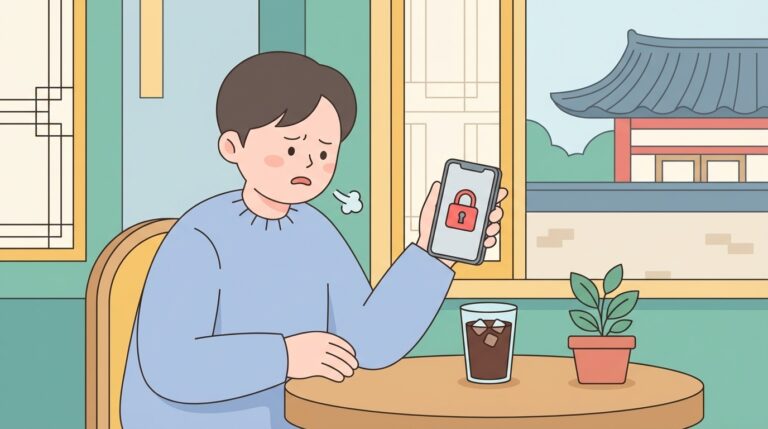
Picture this: It’s 8:55 AM on a Monday. You have a crucial Zoom meeting with your Korean team at 9:00 AM. You confidently type in your intranet password.
Beep.
You type it again.
Beep.
Suddenly, a terrifying pop-up appears: “비밀번호 5회 오류. 계정이 잠겼습니다.” (Password failed 5 times. Account locked.) Your heart drops. You look across the office at the IT department. You need to ask for help, but how do you do it politely without sounding like you’re barking orders?
Just like in those K-Dramas where the protagonist stares at a frozen screen in horror before a big presentation, tech issues happen to the best of us. But don’t worry! Knowing how to navigate IT support in Korean isn’t just about fixing a computer—it’s about mastering office Nunchi (눈치) and polite indirectness. Let’s dive in!
—
### Phase 2: Deep Dive into Core Expressions
> ### 1. 비밀번호를 까먹은 것 같아요.
> – Pronunciation: bibeon-eul kkameogeun geot gatayo.
> – Sound-alike guide: bee-beon-eul kka-mo-geun got ga-ta-yo.
> – Meaning: Literal: “It seems like I forgot my password.” / Real nuance: “I definitely forgot my password, please help me.”
- K-Culture Moment: You’ll hear this a lot at PC Bangs (Internet cafes) when someone is frantically trying to log into a ticketing site to snag front-row seats for their favorite K-Pop idol, only to realize they forgot their login info in the heat of the moment.
> – Editor’s Insight: Notice the~것 같아요(it seems like). Even if you are 100% sure you forgot it, saying “I forgot it” directly can sound a bit blunt. Softening it with “it seems like” is a classic Korean communication strategy to sound more humble and approachable.
> – Situation Spectrum:
>[🚫 절대 금지] ———— [⚠️ 주의] ———— [✅ 자유롭게]
> – 친구 사이 (Casual): ✅
> – 직장 동료 (Semi-formal): ✅
> – 직장 상사·어른 (Formal): ⚠️ (Better to use 잊어버렸습니다)
> – 🤔 Think About It: Why do Koreans soften their mistakes with “it seems like”? Does your native language have a similar way to soften self-blame?> ### 2. 자꾸 로그인 오류가 나요.
> – Pronunciation: jakku rogeu-in oryu-ga nayo.
> – Sound-alike guide: ja-kkoo ro-geu-in oh-ryu-ga na-yo.
> – Meaning: Literal/Real nuance: “Login errors keep occurring.”- K-Culture Moment: Imagine you’re trying to order late-night chimaek (chicken and beer) on a delivery app, but the app keeps crashing. You call customer service, and this is the exact phrase you use.
> – Editor’s Insight: We don’t say “I am making an error.” We say “An error is occurring” (오류가 나요). It shifts the blame from you to the system. It’s not my fault, it’s the computer’s fault! 😅
> – Situation Spectrum:
>[🚫 절대 금지] ———— [⚠️ 주의] ———— [✅ 자유롭게]
> – 친구 사이 (Casual): ✅
> – 직장 동료 (Semi-formal): ✅
> – 고객센터/IT 부서 (Customer Service/IT): ✅
> – 🤔 Think About It: How does shifting the subject from “I” to “the error” change the power dynamic in a tech support conversation?> ### 3. 해킹당한 것 같습니다. 확인 부탁드려요.
> – Pronunciation: haeking-dang-han geot gatseumnida. hwagin butakdeuryeoyo.
> – Sound-alike guide: hae-king-dang-han got gat-seum-ni-da. hwa-gin boo-tak-deu-ryeo-yo.
> – Meaning: Literal: “It seems I suffered hacking. I request a check.” / Real nuance: “I think I’ve been hacked. Could you please look into it?”- K-Culture Moment: The ultimate nightmare. You get a KakaoTalk alert saying your account logged in from an IP address in another country. Panic ensues.
> – Editor’s Insight: The word당하다(to suffer/experience something negative) is crucial here. It implies you are the victim of the action. Following it up with확인 부탁드려요(Please check) is the golden B2-level phrase for making polite professional requests without sounding bossy.
> – Situation Spectrum:
>[🚫 절대 금지] ———— [⚠️ 주의] ———— [✅ 자유롭게]
> – IT 부서/고객센터 (IT Support/CS): ✅
> – 직장 상사 (Formal): ✅
> – 친구 사이 (Casual): ⚠️ (Too formal, just say “나 해킹당한 듯!”)—
### Phase 3: Textbook vs Real Life 한국어
| 상황 | 📖 교과서 한국어 | 🗣️ 진짜 한국어 | 💡 왜 다를까? |
|—|—|—|—|
| 비밀번호 분실 | 비밀번호를 잊어버렸습니다. | 아, 비번 까먹었어요. | Koreans love abbreviating! ‘비밀번호’ becomes ‘비번’, and ‘까먹다’ is the everyday spoken version of ‘잊어버리다’. |
| 시스템 멈춤 | 시스템이 작동하지 않습니다. | 화면이 먹통이에요. / 자꾸 튕겨요. | ‘먹통’ means ‘unresponsive/dead’, and ‘튕기다’ (to bounce out) vividly describes an app crashing. |
| 비밀번호 변경 | 비밀번호를 변경해 주십시오. | 비번 리셋 링크 좀 보내주시겠어요? | Direct commands sound rude. Asking them to send a link puts the ball in your court gracefully. |—
### Phase 4: K-Culture Deep Dive
#### 4-1. Non-verbal Communication: The Art of “Coffee Diplomacy” ☕
When approaching the IT department in a Korean company, you don’t just walk up and demand a password reset. You approach with Nunchi (눈치). You walk over slightly hesitantly, make eye contact, and ideally, you bring an “아아” (Iced Americano). Handing over an iced coffee while saying “바쁘신데 죄송해요…” (I’m sorry to bother you while you’re busy…) will get your password reset 10x faster!#### 4-2. The Final Boss of Korean Tech: 본인인증 (Identity Verification) 📱
If you’ve traveled to or lived in Korea, you know the true villain of the internet is not hackers—it’s 본인인증 (Identity Verification). Whether you want to order a pizza, buy K-Pop concert tickets, or connect to public Wi-Fi, you often need to verify your identity using a Korean phone number. It drives foreigners crazy! In K-Dramas, characters transfer millions of won with a quick fingerprint scan, but in reality, if you forget your password, you might be stuck in a loop of verifying your phone number, your alien registration card, and an authentication certificate (공인인증서). Welcome to the highly secure, sometimes maddening world of Korean IT!—
### Phase 5: Immersive Roleplay
#### Scenario A: The Monday Morning Panic
– Setting: Monday morning, 8:55 AM. The Seoul office of a tech company. The hum of air conditioning and furious typing fills the air.
– Characters:
– YOU: A foreign employee who just locked themselves out of the intranet.
– Min-su (30): The tech-savvy junior employee who handles IT issues. Friendly but looks like he hasn’t slept.YOU: 민수 씨, 지금 많이 바쁘세요? 😥
(min-su ssi, jigeum mani bappeuseyo?)
[Min-su, are you very busy right now?]
(🎭 Stage Direction: You approach Min-su’s desk cautiously)민수: 아, 아니요. 괜찮아요. 무슨 일 있으신가요?
(a, aniyo. gwaenchayo. museun il isseusingayo?)
[Oh, no. I’m fine. Is something wrong?]YOU: 제가 인트라넷 비번을 까먹은 것 같아요. 계속 오류가 나네요.
(jega inteuranet bibeoneul kkameogeun geot gatayo. gyesok oryu-ga naneyo.)
[I think I forgot my intranet password. Keep getting an error.]민수: 아, 제가 확인해 볼게요. (타이핑 소리) 어? 5회 이상 틀려서 계정이 잠겼네요.
(a, jega hwagin-hae bolgeyo. eo? o-hoe isang teullyeoseo gyejeong-i jamgyeonneyo.)
[Ah, let me check. Oh? You failed more than 5 times so the account is locked.]> 🔀 당신의 차례! 어떻게 대답할까요? (Your Turn!)
> – A) “빨리 제 비밀번호 바꿔주세요! 회의가 있어요!” (Change it quickly! I have a meeting!)
> – B) “헐 대박! 어떡해요?” (Omg crazy! What do I do?)
> – C) “아, 정말요? 죄송한데 혹시 잠금 해제해 주실 수 있나요?” (Ah, really? I’m sorry, but could you possibly unlock it for me?)> ✅ Best Choice: C — Why: It shows empathy (
죄송한데), acknowledges the inconvenience, and makes a soft request (~해 주실 수 있나요?).
> ⚠️ Choice A Analysis: Absolutely 🚫! Direct commands in Korean workplaces, especially to colleagues who aren’t your direct subordinates, are considered extremely rude.(Continuing with Choice C)
민수: 네, 바로 리셋 링크 이메일로 보내드릴게요. 임시 비번으로 로그인하시고 다시 설정하세요.
(ne, baro riset ringkeu imeillo bonaedeurilgeyo. imsi bibeon-euro rogeu-in-hasigo dasi seoljeonghaseyo.)
[Yes, I’ll send a reset link to your email right away. Log in with the temporary password and set it up again.]YOU: 너무 감사합니다! 이따 커피 한 잔 살게요! ☕
(neomu gamsahamnida! itta keopi han jan salgeyo!)
[Thank you so much! I’ll buy you a coffee later!]—
### Phase 6: 10-Second Shadowing Drill
Let’s practice the rhythm and intonation! Follow the slashes for natural pauses.
🥺 민수 씨, / 제가 비번을 까먹어서 / 그런데요... / 혹시 / 리셋해 주실 수 / 있나요?
(min-su ssi, / jega bibeoneul kkameogeoseo / geureondeyo… / hoksi / riset-hae jusil su / innayo?)—
### Phase 7: K-Culture Glossary (IT Survival Edition)
| 한국어 | Romanization | 영어 | 맥락 설명 |
|—|—|—|—|
| 비번 | bibeon | Password | Short for 비밀번호. Used daily in text and speech. |
| 본인인증 | bonin injeung | Identity Verification | The rigorous process of proving who you are online in Korea. |
| 먹통이다 | meoktong-ida | Unresponsive/Frozen | Used when a device or app completely stops working. |
| 튕기다 | twinggida | App crash/Bounced out | When an app suddenly closes or kicks you out of the server. |
| 아아 | a-a | Iced Americano | The lifeblood of Korean office workers and the universal IT bribe. |—
### Phase 8: Traveler’s Survival Kit 🎒
Even if you’re just visiting Korea, tech issues will find you! Whether you’re at a cafe or trying to use a local app.
> 🆘 서바이벌 표현 TOP 3
> – 🇰🇷 “와이파이 비번이 뭐예요?” (wa-i-pa-i bibeon-i mwoyeyo?)
> – 🗣️ Meaning: What’s the Wi-Fi password?
> – 📍 쓰이는 곳: Cafes, restaurants, hotels.
> – 🇰🇷 “앱이 자꾸 튕겨요.” (aeb-i jakku twinggyeoyo.)
> – 🗣️ Meaning: The app keeps crashing.
> – 📍 쓰이는 곳: Using a taxi app (Kakao T) or delivery app.
> – 🇰🇷 “본인인증을 어떻게 하는지 모르겠어요.” (bonin injeung-eul eotteoke haneunji moreugesseoyo.)
> – 🗣️ Meaning: I don’t know how to do the identity verification.
> – 📍 쓰이는 곳: Phone stores, setting up concert tickets, creating accounts.> 📌 Editor’s Travel Note
> In Korean cafes, the Wi-Fi password is almost ALWAYS written at the bottom of your physical receipt (영수증). Before you ask the busy barista, check your receipt! If it’s not there, look for a small sign near the pickup counter.—
### Phase 9: Think Deeper 🧠
Language & Power: Blaming the Machine
Have you noticed that in Korean, people rarely say “I made an error” when dealing with technology? Instead, we use passive phrasing: “오류가 났어요” (An error occurred) or “비밀번호가 틀렸다고 나와요” (It says the password is wrong). This isn’t just a grammatical quirk; it deeply reflects Korean workplace culture. By shifting the blame to the machine or the system, you preserve your own Kibun (face/pride) and avoid making the situation tense. Direct blame, even on oneself, makes the atmosphere heavy. Indirectness keeps the social gears turning smoothly.💬 Your Turn: In your culture, when technology fails because of human error, do people openly admit “I messed up,” or do they blame the computer? Share in the comments!
—
### Phase 10: FAQ & Troubleshooting
Q: Can I say “비번 까먹었어요” to my boss?
A: NO.비번is slang, and까먹다is too casual. If you are speaking to someone senior, use the textbook version: “비밀번호를 잊어버렸습니다.” (I forgot my password).Q: How do I find the “Forgot Password” button on Korean websites?
A: Look for “비밀번호 찾기” (Find Password) or “비밀번호 재설정” (Reset Password) usually placed right under the login button.> ❌ 흔한 실수 #1: Saying “내 비밀번호 바꿔주세요” (Change my password).
> ✅ 이렇게 하세요: This sounds like an order from a king to a servant! Always use a request form: “비밀번호를 어떻게 바꾸나요?” (How do I change my password?) or “리셋해 주실 수 있나요?” (Could you reset it?).—
### Phase 11: Wrap-up & Action Items
🔥 One-Liner Summary: Soften your tech emergencies by using passive phrases like
오류가 나요and polite requests like확인 부탁드려요!🎯 Action Mission:
– 🥉 Bronze: Say “아, 비번 까먹었다!” (Ah, I forgot my password!) out loud 3 times.
– 🥈 Silver: Change your favorite app’s language to Korean for 1 hour and try to locate the로그아웃(Logout) and비밀번호 설정(Password Settings) menus.
– 🥇 Gold: The next time you visit a Korean cafe, confidently ask: “혹시 와이파이 비번이 뭐예요?”—
### Phase 12: Interactive Quiz 📝
1. You are at work and your computer freezes. What is the most natural thing to say to your IT colleague?
A) 제가 컴퓨터를 망가뜨렸어요. (I broke the computer.)
B) 컴퓨터 화면이 먹통이에요. 확인 좀 부탁드려요. (The computer screen is frozen. Please check it.)
C) 야, 고쳐줘! (Hey, fix it!)2. Fill in the blank: “앱이 자꾸 _______.” (The app keeps crashing/kicking me out.)
A) 튕겨요
B) 뛰어요
C) 날아요3. True or False: In a Korean cafe, you should always shout to ask for the Wi-Fi password before buying a drink.
A) True
B) False(Answers: 1. B – Always shift the blame to the machine and politely request!, 2. A – 튕기다 means to bounce out, 3. False – Check your receipt first!)
Frequently Asked Questions (FAQ)
Q: What does "본인인증" mean in Korean and how do you pronounce it?
A: In Korean, "본인인증" is pronounced [Identity Verification] and means: . Whether you want to order a pizza, buy K-Pop concert tickets, or connect to public Wi-Fi, you often need to verify your identity using a Korean phone number. It drives foreigners crazy! In K-Dramas, characters transfer millions of won with a quick fingerprint scan, but in reality, if you forget your password, you might be stuck in a loop of verifying your phone number, your alien registration card, and an authentication certificate (







