

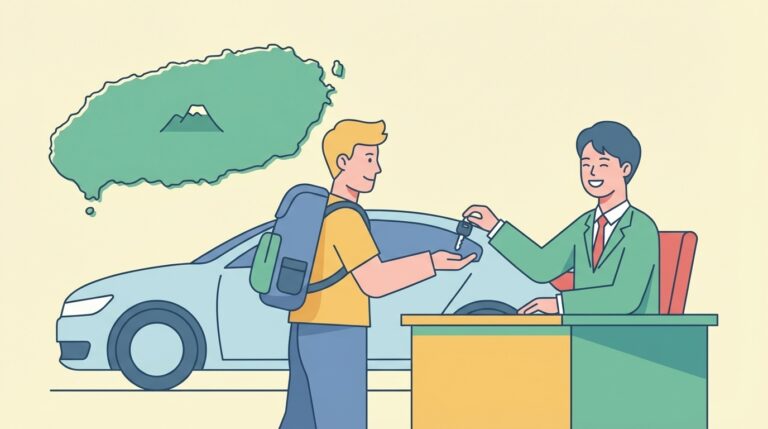
Phase 1: Immersive Hook\n\nHello! This is your Daily Hangul Editor.\n\nPicture this: You are starring in your very own K-Drama. You’ve just landed in Jeju Island. The ocean breeze is hitting your face, your playlist is cued up with your favorite K-Pop tracks, and you’re ready to drive down the stunning Aewol coastal road just like the main leads in Welcome to Samdal-ri. It’s the ultimate romanticized travel fantasy!\n\nBut then… the camera cuts. You are standing at the rental car counter. The agent is speaking at rapid-fire speed, pointing to a labyrinth of insurance options, and asking about an \”International Driving Permit\” in a way that makes you sweat. The subtitles have disappeared. If you’ve reached C2 level in Korean, you can easily order a meal or debate social issues, but the highly specific jargon of Korean car rentals and the unwritten rules of the \”pali-pali\” (hurry up) roads? That’s a whole different beast.\n\nNavigating the rental process and driving in Korea isn’t just about knowing vocabulary; it’s about understanding the bureaucratic efficiency and the high-tech, fast-paced culture of Korean roads. Let’s dive into the insider phrases that will make you look like a seasoned local behind the wheel!\n\n—\n\n### Phase 2: Deep Dive into Core Expressions\n\nLet’s move past the beginner phrases and look at the actual terminology you must know to protect yourself and communicate effectively at the rental counter.\n\n> ### 1. 혹시 완전자차에 휴차보상료도 포함되어 있나요?\n>\n> – Pronunciation: [Hoksi wanjeon-jacha-e hyucha-bosangryo-do poham-dwe-eo innayo?]\n> – Meaning: (Literal) By any chance, does the complete self-car insurance include the resting car compensation fee? / (Real nuance) Does the premium insurance cover the loss-of-use fee if the car is out of service?\n> – K-Culture Moment: Insurance in Korea is categorized uniquely. 일반자차 (Basic waiver) leaves you with a deductible. 완전자차 (Super/Full waiver) covers almost everything. But here is the catch: if you crash, the rental company loses money while the car is in the shop. This is called 휴차보상료 (loss-of-use fee). Asking this question immediately signals to the agent, \”Ah, this foreigner knows the system.\”\n> – Editor’s Insight: This is a high-level survival phrase. The word 자차 is an abbreviation for 자기차량손해 (damage to one’s own vehicle). Say this with a polite but firm tone.\n> – Situation Spectrum: [🚫 절대 금지] ———— [⚠️ 주의] ———— [✅ 자유룽게]\n> – Formal business/Service counter: ✅\n> – 🤔 Think About It: Why does Korean have so many specific abbreviations for insurance and contracts (like 자차, 휴차)? How does this reflect the societal drive for efficiency and speed in business transactions?\n\n> ### 2. 차량 외관 동영상으로 한 바퀴 쭉 찍어둘게요.\n>\n> – Pronunciation: [Charyang oegwan dongyeongsang-euro han bakwi jjuk jjigeo-dulgeyo.]\n> – Meaning: (Literal) I will take a video of the car’s exterior for one circle. / (Real nuance) I’m just going to walk around and film the car’s exterior to document its condition.\n> – K-Culture Moment: When you receive the car, the agent will do a rapid walk-around, pointing out tiny scratches at lightning speed. It’s an unspoken rule in Korea to record a video of the car yourself before driving off to avoid any disputes later. The word 쭉 (jjuk) adds a native flavor, meaning \”in one continuous motion.\”\n> – Editor’s Insight: By announcing this, you are establishing boundaries. It’s polite but shows you are diligent.\n> – Situation Spectrum: [🚫 절대 금지] ———— [⚠️ 주의] ———— [✅ 자유룽게]\n> – Rental agent (Informational): ✅\n> – 🤔 Think About It: Koreans love the word \”한 바퀴\” (one round/circle). We use it for cars, walking (한 바퀴 돌자), or even drinking (술 한 바퀴 돌리자). What does this circular view of space and activity suggest about the culture?\n\n> ### 3. 비상깜빡이 켜주세요! (Or 켜야 돼요!)\n>\n> – Pronunciation: [Bisang-kkamppagi kyeo-juseyo!]\n> – Meaning: (Literal) Please turn on the emergency blinkers! / (Real nuance) Put your hazard lights on!\n> – K-Culture Moment: This is the absolute core of Korean driving etiquette. Hazard lights (비상깜빡이 – note the cute onomatopoeic word 깜빡 for blinking) are not just for emergencies. If you suddenly brake, you flash them. If someone lets you merge in tight Seoul traffic, you flash them 2-3 times to say \”Thank you.\” If you accidentally cut someone off, you flash them to say \”I’m sorry!\” It is the ultimate non-verbal communication tool on the road.\n> – Editor’s Insight: In Western countries, hazard lights are strictly for distress. In Korea, they are the road’s equivalent of bowing or smiling. If you don’t use them to say thank you after merging, you might get honked at!\n> – Situation Spectrum: [🚫 절대 금지] ———— [⚠️ 주의] ———— [✅ 자유룽게]\n> – Conversational/Driving with friends: ✅\n> – 🤔 Think About It: How does repurposing the hazard light as a social tool reflect the Korean concept of Nunchi (눈치) and maintaining harmony even among strangers in metal boxes?\n\n—\n\n### Phase 3: Textbook vs Real Life\n\n| Situation | 📖 Textbook Korean | 🗣️ Real Korean | 💡 Why the difference? |\n|—|—|—|—|\n| Asking about insurance | 자동차 보험에 가입하고 싶습니다. (I want to buy car insurance.) | 완전자차로 할게요. (I’ll do the full waiver.) | Koreans heavily abbreviate industry terms for efficiency. |\n| Toll gate device | 요금소 자동 결제 기계가 있나요? (Is there an automatic toll payment machine?) | 하이패스 단말기 꽂혀 있나요? (Is the Hi-Pass device plugged in?) | \”Hi-Pass\” is the ubiquitous brand name used as a generic noun. |\n| Navigating | 길을 안내해 주세요. (Please guide me on the way.) | 내비에 목적지 찍을게요. (I’ll punch the destination into the Navi.) | Using “찍다” (to stamp/punch) implies quickly inputting data, fitting the fast pace. |\n\nBottom Note: At a C2 level, using words like 내비 (Navi instead of Navigation) and 찍다 (instead of 입력하다) bridges the gap between sounding like a well-read scholar and an actual Seoul resident.\n\n—\n\n### Phase 4: Cultural Deep Dive\n\n#### 4-1. Non-verbal Communication: The Art of the Quick Handover\nWhen you are at the rental desk, the interaction is highly transactional and fast. Do not expect long, leisurely chats about your itinerary. The Nunchi here is about readiness: have your passport, home country driver’s license, International Driving Permit (IDP), and credit card out and ready in your hand before you reach the desk. Hand them over with both hands or with your right hand supported by your left. When they do the vehicle inspection, mirror their speed. Nod, acknowledge, and record. \n\n#### 4-2. K-Travel Connection: The Surveillance Reality vs Drama Fantasy\nIn K-Dramas, wealthy CEOs angrily do U-turns in the middle of a bridge and speed down empty highways. Reality check! South Korea is incredibly strict with traffic enforcement, but it’s largely automated. There are speed cameras (과속 단속 카메라) almost every 500 meters in city zones. \n\nFurthermore, Google Maps does not provide driving directions in Korea due to national security laws regarding map data. You must use Naver Map (네이버 지도) or KakaoMap (카카오맵). These apps are brilliant—they don’t just tell you to turn left; they tell you exactly which lane to be in, warn you about speed bumps (방지턱), and loudly alert you to upcoming speed cameras. A crucial survival tip: trust the Korean navigation app with your life!\n\n—\n\n### Phase 5: Immersive Roleplay\n\n#### Scenario A: The Jeju Airport Rental Counter\nSetting: Friday morning, 9:30 AM. The massive rental car shuttle drop-off area near Jeju International Airport. It’s loud, crowded, and efficient. You finally get to the counter.\nCharacters: \n- YOU: A seasoned traveler ready for a road trip.\n- Agent (지훈, 28): Fast-talking, polite, just wants to process the queue quickly.\n\n지훈: 고객님, 예약하신 성함이랑 국제운전면허증, 여권, 신용카드 한 번에 주시겠어요?\n(Gogaengnim, yeyak-hasin seongham-irang gukje-unjeon-myeonheojeung, yeogwon, sinyong-kadeu han beon-e jusigesseoyo?)\n[Customer, could you give me the name you booked under, your International Driving Permit, passport, and credit card all at once?]\n(🎭 Stage Direction: Ji-hoon is already typing on his keyboard before you even speak.)\n\nYOU: 네, 여기 있습니다. 예약할 때 일반자차로 했는데, 혹시 지금 완전자차로 업그레이드 가능한가요?\n(Ne, yeogi isseumnida. Yeyak-hal ttae ilban-jacha-ro haenneunde, hoksi jigeum wanjeon-jacha-ro eopgeureideu ganeung-hangayo?)\n[Yes, here you go. I booked with basic insurance, but is it possible to upgrade to full coverage now?]\n\n지훈: 네, 가능하십니다. 하루에 만 오천 원 추가되시고요, 완전자차 하셔도 타이어나 휠 파손은 고객님 부담이세요. 괜찮으신가요?\n(Ne, ganeung-hasimnida. Haru-e man ocheon won chuga-doesigoyo, wanjeon-jacha hasyeodo taieo-na hwil pasoneun gogaengnim budamiseyo. Gwaenchaneusingayo?)\n[Yes, it’s possible. It will be an additional 15,000 won per day, and even with full coverage, tire or wheel damage is the customer’s responsibility. Is that okay?]\n\n> 🔀 Your Turn! How do you respond to ensure you’re fully covered and sound like a pro?\n> – A) \”아, 그래요? 그럼 안 할게요.\” (Oh, really? Then I won’t do it.)\n> – B) \”네, 괜찮습니다. 혹시 휴차보상료도 커버되는 조건 맞죠?\” (Yes, that’s fine. It does cover the loss-of-use fee too, right?)\n> – C) \”대박 비싸네요! 깎아주세요!\” (That’s crazy expensive! Give me a discount!)\n>\n> ✅ Best Choice: B — By confirming the hyucha-bosangryo, you ensure there are zero hidden traps if an accident occurs, showing you thoroughly understand Korean rental policies.\n> ⚠️ Choice C Analysis: Haggling at corporate rental counters in Korea is completely unacceptable and will only cause confusion and embarrassment.\n\n지훈: 네, 휴차보상료도 면제되십니다. 차량은 3구역에 있고요, 출발하시기 전에 스크래치 있는지 꼭 확인해 주세요.\n(Ne, hyucha-bosangryo-do myeonje-doesimnida. Charyang-eun sam-guyeoge itgoyo, chulbal-hasigi jeon-e seukeuraechi inneunji kkok hwagin-hae juseyo.)\n[Yes, the loss-of-use fee is also waived. The car is in Zone 3, and please make sure to check for any scratches before you depart.]\n\nYOU: 알겠습니다. 타기 전에 동영상으로 한 바퀴 꼼꼼히 찍어둘게요. 감사합니다!\n(Algesseumnida. Tagi jeon-e dongyeongsang-euro han bakwi kkomkkomhi jjigeo-dulgeyo. Gamsahamnida!)\n[Understood. I’ll thoroughly take a video walking around it before getting in. Thank you!]\n\n#### Scenario B: Bonus – The Sudden Stop\nSetting: Driving in downtown Seoul. You had to brake suddenly because a delivery scooter darted out.\nYOU: (Hits the brakes hard)\nPassenger (Friend): 헉! 깜짝이야. (Gasp! That startled me.)\nYOU: 미안해! 빨리 비상깜빡이 세 번만 눌러줘. 뒷차한테 미안하다고 해야 해.\n(Mianhae! Ppalli bisang-kkamppagi se beon-man nulleojwo. Dwitcha-hante mianhadago haeya hae.)\n[Sorry! Quickly press the hazard lights three times. We have to say sorry to the car behind us.]\n(🎭 You blend in perfectly with the local driving etiquette!)\n\n—\n\n### Phase 6: 10-Second Shadowing Drill\n\nPractice your pacing and intonation. This sentence requires a smooth, professional rhythm.\n\n😊 출발하기 전에 / 차량 외관을 / 동영상으로 쭉~ / 찍어두는 게 / 좋아요.\n(chulbal-hagi jeon-e / charyang oegwaneul / dongyeongsang-euro jjuk~ / jjigeo-duneun ge / joayo.)\n\nFocus on drawing out the \”쭉~\” (jjuk) slightly to emphasize the continuous sweeping motion of recording the car.\n\n—\n\n### Phase 7: K-Culture Glossary (Driving Edition)\n\n| Korean | Romanization | English | Context |\n|—|—|—|—|\n| 내비 | naebi | GPS / Navigation | Short for 내비게이션. Always use Naver or Kakao Map. |\n| 블랙박스 (블박) | beullaek-bakseu | Dashcam | Almost 100% of cars in Korea have dashcams for insurance purposes. |\n| 비상깜빡이 | bisang-kkamppagi | Hazard lights | Used for emergencies, apologizing, or saying thank you. |\n| 하이패스 | hai-paeseu | Hi-Pass | The electronic toll collection system. Rentals usually have the machine, but you need your own card, or they bill you later. |\n| 대리기사 | daeri-gisa | Designated driver | If you drink even one drop of Soju, you call a Daeri, who arrives on a scooter, drives your car to your hotel, and leaves. |\n\n—\n\n### Phase 8: Traveler’s Survival Kit\n\nIf you forget everything else, save these phrases to your phone:\n\n> 🆘 Survival Phrases for the Road\n> – 🇰🇷 \”가까운 주유소가 어디예요?\” (gakkaun juyuso-ga eodiyeyo?) — Where is the nearest gas station?\n> – 🇰🇷 \”가득 채워주세요.\” (gadeuk chaeweo-juseyo.) — Fill it up, please. (Used at full-service stations).\n> – 🇰🇷 \”방지턱 조심하세요.\” (bangjiteok josim-haseyo.) — Watch out for the speed bump.\n\n> 📌 Editor’s Travel Note\n> – The IDP Rule: Korea strictly adheres to the Geneva Convention (1949) for International Driving Permits. If your country only issues Vienna Convention permits, you cannot drive in Korea. Always double-check your IDP stamp!\n> – Toll Gates: Don’t have a Hi-Pass card? Look for the lane that says 현금/카드 (Cash/Card) usually colored pink or clearly marked. Do not go through the blue Hi-Pass lane!\n> – Self-Service Gas: Most gas stations (셀프 주유소) only have Korean menus on the screen. Look for \”시작\” (Start), select your payment method (신용카드), and match the pump colors: Yellow is Gasoline (휘발유), Green/Blue is Diesel (경유). Never mix them up!\n\n—\n\n### Phase 9: Think Deeper — Media vs Reality\n\n🨀 Think Deeper: K-Dramas often portray driving in Korea as a solitary, emotional experience—the protagonist crying behind the wheel at night with no traffic in sight. In reality, Korean roads are the ultimate expression of its highly interconnected, hyper-monitored society. The constant chatter of the GPS warning you of speed zones, the dashcams recording every angle, and the communal language of hazard lights show that in Korea, you are never truly \”alone\” on the road. You are constantly participating in a collective social contract of safety and efficiency.\n\n💬 Your Turn: Does your country have unique \”unwritten rules\” on the road like flashing hazard lights to say thank you? Share in the comments!\n\n—\n\n### Phase 10: FAQ & Troubleshooting\n\n- Q: Can I turn right on a red light in Korea?\n – A: The laws recently got much stricter. You must come to a complete stop (0 km/h) before turning right on red. If pedestrians are waiting at the crosswalk, you cannot move until they have completely cleared the area. When in doubt, follow the car in front of you, or just wait.\n- Q: I accidentally went through the Hi-Pass toll lane without a card! What do I do?\n – A: DO NOT STOP OR BACK UP! It is incredibly dangerous. Just keep driving. The cameras have captured your license plate, and the toll fee will simply be billed to your rental car company, who will charge your credit card later.\n\n> ❌ Common Mistake: Handing over just your home country’s driver’s license.\n> ✅ Do This Instead: You must present your home country license, your Passport, AND the physical booklet of your International Driving Permit. They are legally required to see all three.\n\n—\n\n### Phase 11: Wrap-up & Action Missions\n\nOne-Liner Summary: Mastering car rental vocabulary and Korean driving etiquette isn’t just about renting a vehicle; it’s your ticket to participating in Korea’s fast-paced, highly-organized road culture.\n\nAction Missions:\n- 🥉 Bronze: Say \”완전자차로 할게요\” (I’ll take full coverage) to yourself in the mirror 3 times.\n- 🥈 Silver: Download Naver Map or KakaoMap right now and search for \”제주 국제공항\” (Jeju International Airport) to see how the interface looks.\n- 🥇 Gold: On your next trip to Korea, confidently record the exterior of your rental car and flash your hazard lights to thank someone who lets you merge!\n\n🎥 K-Culture Mission: Watch an episode of any modern K-Drama and pay close attention to the cars. Can you spot the glowing blue light of the \”Black Box\” (dashcam) near the rearview mirror? It’s always there!\n\n—\n\n### Phase 12: Interactive Quiz\n\n1. Situational Judgment: You are merging into a heavy traffic lane on the Gangbyeon Expressway in Seoul. A kind driver slows down to let you in. What is the most \”Korean\” way to say thank you?\nA) Roll down the window and yell \”감사합니다!\”\nB) Wave your hand inside the car.\nC) Flash your hazard lights (비상깜빡이) 2-3 times.\n\n2. Fill in the Blank: At the rental counter, you want the absolute best insurance that covers everything including loss-of-use. You say: \”_____(으)로 업그레이드 해주세요.\”\nA) 일반자차\nB) 완전자차\nC) 내비게이션\n\n3. True or False – K-Culture Edition: If you miss your exit on a Korean highway, you can rely on Google Maps to quickly reroute you.\n\n(Scroll down for answers)\n
\nAnswers: \n1. C (Hazard lights are the universal thank-you sign on Korean roads!)\n2. B (완전자차 – Super Collision Damage Waiver)\n3. False (Google Maps does not provide driving directions in Korea. You must use Naver Map or KakaoMap!)






