

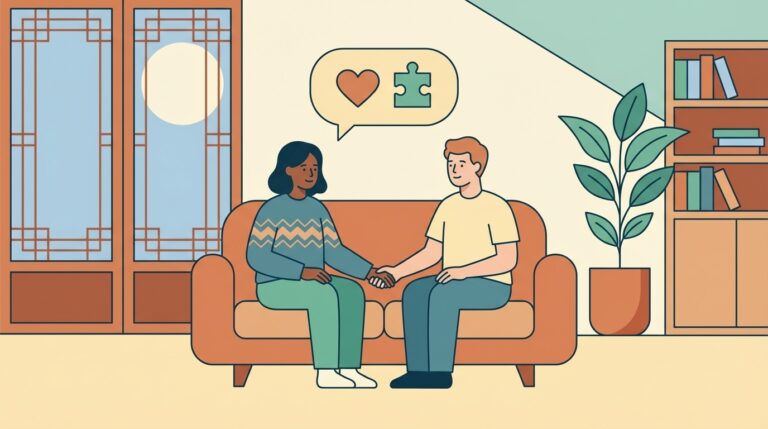
Hello there! I’m the Lead Editor at Daily Hangul, your veteran tutor and local cultural navigator.
Let’s set the scene: You’re watching a classic Korean weekend family drama (주말 연속극). The protagonist is sitting on the edge of the bed, letting out a deep sigh while their spouse awkwardly stands by the door. The subtitles read: “I’m disappointed.” But if you listen closely, they didn’t say they were angry or sad. They said, “서운해 (seounhae).”
If you are in an intercultural marriage or a serious relationship with a Korean partner, you know that translating words is the easy part—translating cultures is where the real challenge lies. Whether it’s navigating the infamous ‘In-Law World’ (시월드) or deciphering your partner’s silent sighs, the C2 level of Korean isn’t just about complex grammar; it’s about mastering emotional intelligence.
Today, we are going deep into the beautiful, complex, and sometimes frustrating reality of intercultural marriage in Korea. This guide is based on real late-night counseling sessions with my advanced students who love their partners but sometimes just want to scream, “What do you mean I have to call your unmarried brother ‘Young Master’?!”
Let’s dive in.
Phase 2: Core Expressions Deep Dive
To resolve conflicts in a Korean relationship, you need the vocabulary of empathy and compromise. Here are the top expressions you absolutely must master.
1. 서운하다
- Pronunciation: [seounhada] (Sounds like: so-oon-ha-da)
- Meaning: (Literal) To feel sad/disappointed. (Real nuance) To feel emotionally hurt because your expectations of affection or care weren’t met.
- K-Culture Moment: This is the bread and butter of Korean relationship arguments. It’s not fiery rage; it’s a quiet, lingering hurt. If your spouse forgets an anniversary or takes their mother’s side during a minor disagreement, they aren’t 화났다 (angry); they are 서운하다.
- Editor’s Insight: Think of 서운하다 as a symptom of 정 (Jeong). You can only feel 서운하다 toward someone you deeply care about. It translates to “I expected more from you because I love you.”
- Situation Spectrum:
[🚫 절대 금지] ———— [⚠️ 주의] ———— [✅ 자유롭게]
- Spouse/Partner (Casual): ✅
- Close friends: ✅
- In-laws (Formal): ⚠️ (Use carefully: “어머니, 조금 서운하려고 해요~” with a heavy dose of aegyo to soften the blow)
- 🤔 Think About It: Why does Korean have a specific word for “hurt feelings due to unmet expectations of affection”? How does your native language express this nuanced vulnerability without sounding overly aggressive?
2. 눈치가 보이다
- Pronunciation: [nunchiga boida] (Sounds like: noon-chee-gah boy-da)
- Meaning: (Literal) Nunchi is seen. (Real nuance) To feel self-conscious, pressured, or like you are walking on eggshells around someone.
- K-Culture Moment: It’s the first Chuseok (Korean Thanksgiving) after the wedding. You are sitting in the living room while your mother-in-law is cooking. Nobody told you to help, but the air is thick. You are 눈치가 보이는 state.
- Editor’s Insight: As a foreign spouse, you might feel this often because you aren’t sure of the unspoken rules. Saying “여보, 나 눈치 보여” (Honey, I feel like I’m walking on eggshells) is the fastest way to signal to your partner that you need them to intervene.
- Situation Spectrum:
[🚫 절대 금지] ———— [⚠️ 주의] ———— [✅ 자유롭게]
- Spouse/Friends (Casual): ✅
- Co-workers (Semi-formal): ✅ (e.g., “팀장님 눈치가 보여요”)
- Directly to the person causing it: 🚫 (Never say “당신 눈치 보여” directly to your mother-in-law!)
- 🤔 Think About It: Nunchi is the art of reading the room. Is intercultural marriage essentially the clashing of two different Nunchi operating systems?
3. 맞춰가다
- Pronunciation: [matchwogada] (Sounds like: mah-choo-uh-gah-dah)
- Meaning: (Literal) To go adjusting. (Real nuance) To continually compromise, adapt, and sync with each other over time.
- K-Culture Moment: This is the ultimate “green flag” vocabulary in Korean dating and marriage. When a couple has a major cultural clash, the healthy resolution ends with: “우리가 서로 더 맞춰가자” (Let’s keep adjusting to each other).
- Editor’s Insight: It acknowledges that harmony isn’t natural; it’s a continuous, active process. It’s perfect for reminding your partner that you are a team tackling the cultural gap together.
- Situation Spectrum:
[🚫 절대 금지] ———— [⚠️ 주의] ———— [✅ 자유롭게]
- Spouse/Partner (Casual/Formal): ✅
- 🤔 Think About It: Notice the directional verb 가다 (to go) at the end. It implies a forward journey. How does this reframe the concept of “compromise” from a loss to a shared progression?
Phase 3: Textbook vs Real Life
When conflicts arise, the textbook Korean you learned in language school will make you sound like a robotic HR manager. Let’s look at how real couples argue and resolve things.
| Situation | 📖 Textbook Korean | 🗣️ Real Life Korean | 💡 Why the difference? |
|---|---|---|---|
| Expressing disappointment | 당신의 행동에 실망했습니다. (I am disappointed in your actions.) | 나 진짜 서운해. / 좀 섭섭하다. (I’m really hurt/disappointed.) | “실망하다” is too harsh and final for a spouse. “서운하다” leaves room for them to make it up to you. |
| Asking them to take your side | 제 편을 들어주세요. (Please take my side.) | 내 편 좀 들어주면 안 돼? / 눈치 좀 챙겨! (Can’t you take my side? / Read the room!) | Spouses use intimate, sometimes exasperated tones (눈치 챙겨 is a slightly blunt but common way to say “Be more tactful”). |
| Suggesting a compromise | 우리는 타협해야 합니다. (We must compromise.) | 우리 조금씩 맞춰가자. (Let’s adjust to each other little by little.) | “타협(compromise)” sounds like a business negotiation. “맞춰가다” is emotional and relational. |
Phase 4: Cultural Deep Dive
4-1. Non-verbal Communication: The Art of the ‘Sigh’ (한숨)
In Korean culture, direct confrontation is often avoided. Before a Korean spouse verbalizes their frustration, they will likely deploy the 한숨 (heavy sigh). If your partner is aggressively washing the dishes while sighing heavily, they are engaging in a high-context communication tactic known as 삐지다 (to sulk). Do not ignore the sigh! It is an invitation to ask, “자기야, 무슨 일 있어?” (Honey, is something wrong?).
4-2. K-Culture Connection: The “In-Law” K-Drama Trope
If you’ve watched any Korean drama, you’ve seen the classic trope: the formidable mother-in-law (시어머니) handing an envelope of cash to the protagonist, demanding they break up with her son. While real life isn’t that dramatic, the concept of 시월드 (Si-world: The In-Law World) is a massive topic in Korea.
Traditionally, a married woman became “part” of her husband’s family, leading to immense pressure during holidays (명절 증후군 – Holiday Syndrome). Today, MZ generation couples are aggressively changing this, advocating for equal time spent with both families (반반 명절). If you and your spouse are navigating these changing tides, you are living out the plot of a modern, progressive K-Drama!
Phase 5: Immersive Roleplay — The Holiday Road Trip
Setting: It’s the day before Seollal (Lunar New Year). You and your Korean spouse, Min-woo, are stuck in bumper-to-bumper traffic on the highway heading to Busan to see his parents. The tension is high. You are nervous about the cultural expectations; he is tired from driving.
Characters:
– YOU: An expat who loves their spouse but feels overwhelmed by the strict etiquette expected by the in-laws.
– Min-woo (32): Your loving but currently stressed Korean husband.
Dialogue:
Min-woo: 아, 차 진짜 엄청 막히네. 자기야, 많이 피곤하지?
(Ah, cha jinjja eomcheong makhine. Jagiya, mani pigonhaji?)
(Ah, the traffic is insane. Honey, you’re really tired, right?)
YOU: 괜찮아. 근데… 나 내일 어머님 아버님 뵈면 실수할까 봐 너무 걱정돼.
(Gwaenchana. Geunde… na naeil eomeonim abeonim boemyeon silsuhalkka bwa neomu geokjeongdwae.)
(I’m okay. But… I’m so worried I’ll make a mistake when we see your parents tomorrow.)
Min-woo: 에이, 실수 좀 하면 어때. 외국인이니까 부모님도 다 이해하셔.
(Ei, silsu jom hamyeon eottae. Oegugininikka bumonimdo da ihaehasyeo.)
(Hey, so what if you make a mistake. You’re a foreigner, so my parents will understand.)
(🎭 Stage Direction: Min-woo waves his hand dismissively, trying to comfort you, but missing the point.)
🔀 Your Turn! How do you respond?
– A) “그래도 완벽하게 하고 싶단 말이야!” (But I want to do it perfectly!)
– B) “그 말이 더 서운해. 나도 이제 가족인데 언제까지 ‘외국인’ 핑계를 대?”
– C) “알았어, 그럼 내일 나 아무것도 안 한다?”✅ Best Choice: B — “Geu mari deo seounhae. Nado ije gajoginde eonjekkaji ‘oegugin’ pinggyereul dae?” (That makes me feel more hurt. I’m family now too, how long are we going to use the ‘foreigner’ excuse?)
Reasoning: This is a C2-level emotional masterclass. You express 서운하다 effectively, pointing out that you want to integrate, not just be excused as an outsider. This triggers a deep, meaningful conversation.
⚠️ Choice C Analysis: Highly passive-aggressive. It might escalate the conflict in an already stressful car ride!
Min-woo: 아… 미안해. 내가 생각이 짧았네. 우리 가서 너무 눈치 보지 말고, 힘들면 나한테 바로 눈짓해. 내가 다 커버할게. 조금씩 맞춰가자.
(Ah… mianhae. Naega saenggagi jjalbanne. Uri gaseo neomu nunchi boji malgo, himdeulmyeon nahante baro nunjithae. Naega da keobeohalge. Jogeumssik matchwogaja.)
(Ah… I’m sorry. I was being short-sighted. Let’s not walk on eggshells too much there, and if it gets hard, give me a look. I’ll cover for you. Let’s keep adjusting little by little.)
Phase 6: 10-Second Shadowing Drill
Let’s practice the ultimate conflict-resolution sentence. Remember, it’s not about anger; it’s about vulnerable communication.
🥺 자기야, / 나 아까 / 그 말은 / 조금 서운했어.
(jagiya, / na akka / geu mareun / jogeum seounhaesseo.)
Honey, I felt a little hurt by what you said earlier.
Pro-Tip: Elongate the “조~금 (jo~geum)” to soften the blow. Keep your tone gentle, not accusatory.
Phase 7: K-Culture Glossary (Marriage Edition)
| 한국어 | Romanization | English | Contextual Explanation |
|---|---|---|---|
| 시월드 | si-wol-deu | The In-Law World | A slang portmanteau of ‘Si’ (husband’s family) and ‘World’. Refers to the stressful environment/expectations of the husband’s family. |
| 처가댁 | cheo-ga-daek | Wife’s family home | The respectful term for the wife’s family. |
| 효도 | hyo-do | Filial piety | The Confucian duty of respecting and caring for one’s parents. A common root of marital friction when deciding how much time/money to give to parents. |
| 삐지다 | ppi-ji-da | To sulk | A state of being mildly upset and showing it through silence or withdrawn behavior rather than direct communication. |
| 눈치 | nun-chi | Social tact / Reading the room | Essential for surviving family gatherings. The ability to sense the mood and act appropriately without being explicitly told. |
Phase 8: Traveler’s Survival Kit (The In-Law Road Trip)
Since resolving cultural conflicts often happens during the stressful holiday migrations (귀성길), here are your survival phrases for the highway rest stops (휴게소) and arriving at the hometown.
🆘 Survival Phrases: Holiday Travel Edition
– 🇰🇷 “아버님, 어머님! 차가 많이 막혀서 늦었습니다.” (abeonim, eomeonim! chaga mani makhyeoseo neujeotseumnida.)
– English: “Father, Mother! The traffic was bad so we are late.”
– 📍 Where to use: The exact moment you walk through the door of the in-laws’ house.
– 🇰🇷 “휴게소 들러서 호두과자 좀 사 갈까요?” (hyugeso deulleoseo hodugwaja jom sa galkkayo?)
– English: “Shall we stop at the rest area and buy some walnut cakes?”
– 📍 Where to use: In the car. Pro Tip: Walnut cakes (호두과자) are the iconic Korean road trip snack. Offering to buy them shows immense cultural fluency!📌 Editor’s Travel Note
– Navigation Apps: Use T-Map or Kakao Navi for driving. They accurately predict traffic during the chaotic 명절 (holidays).
– Rest Stop Culture: Korean highway rest areas are a culinary destination. Don’t just use the restroom; try the Sotteok Sotteok (sausage and rice cake skewers) to relieve marital tension!
Phase 9: Think Deeper — Language & Power in the Family
🧠 Think Deeper: The Patriarchy Embedded in Titles
If you marry a Korean man, you are expected to call his unmarried younger brother 도련님 (Young Master) and his sister 아가씨 (Young Lady). Historically, these were titles used by servants addressing nobles. Conversely, a Korean man calls his wife’s younger siblings 처남 (Wife’s brother) or 처제 (Wife’s sister)—purely descriptive terms with no elevated status.At a C2 level, you begin to see how deeply patriarchal Confucian values are hardwired into the Korean language itself. Many modern Korean couples actively protest this, choosing to use names or more egalitarian terms. The language is currently in a tug-of-war between tradition and modern equality.
💬 Your Turn: Does your native language have specific titles for in-laws? Do they reflect a power dynamic, or are they neutral? Share in the comments!
Phase 10: FAQ & Troubleshooting
Q: Should I use honorifics (존댓말) with my spouse in front of the in-laws?
A: YES! Even if you use casual language (반말) at home, it is highly recommended to switch to 존댓말 when speaking to or about your spouse in front of their parents. It shows respect for the parents by treating their child with dignity.
Q: I don’t want to call my brother-in-law ‘도련님’. What do I do?
A: Discuss this with your spouse before meeting the family. Many young couples agree to just use “~씨” (Mr./Ms.) if the siblings are of similar age, but the parents might frown upon it. It’s a classic case of needing to 맞춰가다 (adjust).
❌ Common Mistake #1: Calling your mother-in-law “어머니” (Eomeoni) immediately.
✅ Do this instead: Until you are incredibly close, use “어머님” (Eomeonim). That extra “ㅁ(m)” at the end adds a crucial layer of formal respect. “어머니” sounds too familiar and casual for a newlywed.
Phase 11: Wrap-up & Action Items
📌 One-Liner Summary: Resolving cultural conflicts in a Korean marriage requires expressing vulnerability (서운하다) without placing blame, and committing to the continuous journey of adapting (맞춰가다).
🎯 Action Missions:
– 🥉 Bronze (Solo): Look in the mirror and practice saying, “여보, 나 조금 서운했어” with a soft, sad expression.
– 🥈 Silver (Online): Write a short journal entry in Korean about a cultural difference you and your partner (or a friend) had to 맞춰가다.
– 🥇 Gold (Real Life): The next time you feel a slight cultural misunderstanding with a Korean loved one, use “서운하다” instead of “화나다” to explain your feelings.
– 💝 K-Culture Mission: Watch an episode of a Korean reality show like 동상이몽 (Same Bed, Different Dreams). Listen carefully to how the celebrity couples argue and resolve their issues. Count how many times they say 서운해!
Phase 12: Interactive Quiz
1. Situational Judgment: Your Korean spouse ate the last slice of pizza you were saving. You aren’t furious, but you feel slightly betrayed because they know how much you love it. What is the most natural Korean reaction?
– A) 당신한테 진짜 화났어! (I am really angry at you!)
– B) 나 진짜 서운해… (I am really hurt/disappointed…)
– C) 우리 타협하자. (Let’s compromise.)
2. True or False – K-Culture Edition:
– T/F: It is considered polite to use formal language (존댓말) to your spouse when you are visiting your in-laws, even if you normally use casual language at home.
3. Fill in the Blank:
– 문화가 달라서 힘들 때도 있지만, 우리가 서로 ( _______ ) 가면 돼.
– (Hint: To adapt/adjust to each other)
👉 Click here for Answers!
- B – “서운하다” perfectly captures that feeling of mild emotional betrayal by a loved one.
- True – Using 존댓말 elevates your spouse in front of their parents, showing that you respect the child they raised.
- 맞춰 (맞춰가면 돼) – The beautiful verb of continuous compromise.
Did you ever experience a ‘Si-world’ culture shock? Or maybe your partner experienced one in your culture? Tell me your story in the comments below!
Frequently Asked Questions (FAQ)
Q: What does "서운하다" mean in Korean and how do you pronounce it?
A: In Korean, "서운하다" is pronounced [seounhada] and means: (Literal) To feel sad/disappointed. (Real nuance) To feel emotionally hurt because your expectations of affection or care weren't met.
Q: What does "눈치가 보이다" mean in Korean and how do you pronounce it?
A: In Korean, "눈치가 보이다" is pronounced [nunchiga boida] and means: (Literal) Nunchi is seen. (Real nuance) To feel self-conscious, pressured, or like you are walking on eggshells around someone.
Q: What does "맞춰가다" mean in Korean and how do you pronounce it?
A: In Korean, "맞춰가다" is pronounced [matchwogada] and means: (Literal) To go adjusting. (Real nuance) To continually compromise, adapt, and sync with each other over time.






