

Phase 1: Immersive Hook
Hello! I’m your Daily Hangul Editor.
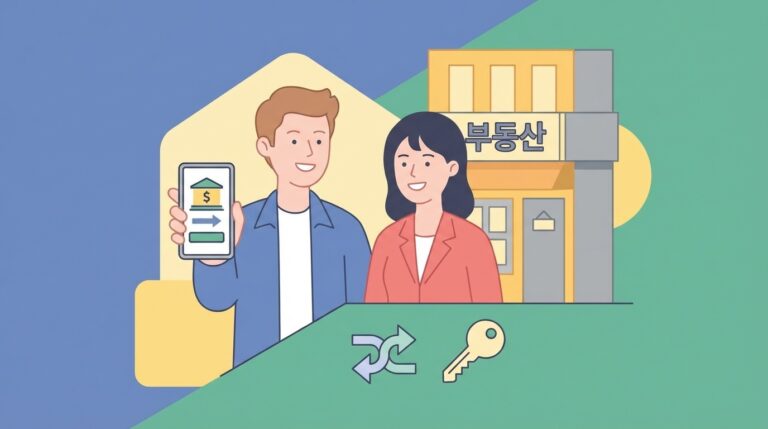
Have you ever watched a K-Drama where the main character finally gets their own cozy rooftop room (옥탑방)? They look at their banking app, take a deep breath, and hit ‘Transfer’. The landlord smiles, hands over the keys, and the screen fades out. It looks so easy on TV, right?
But in reality, moving into a new place in Korea as a foreigner can feel like a boss fight in a video game. You’ve signed the contract, paid the deposit (계약금), and now moving day is here. You need to pay the final balance—known as 잔금 (Jangeum).
If you don’t know the right words, you might end up staring awkwardly at your real estate agent (공인중개사) while holding your phone. But don’t worry! Today, I will teach you the exact phrases you need to smoothly pay your balance and finally get the passcode to your new Korean home. Let’s dive in!
Phase 2: Deep Dive into Core Expressions
Here are the top 3 expressions you need on moving day.
1. 잔금 보냈습니다.
- Pronunciation: jangeum bonaetseumnida (sounds like: jahng-geum bo-naet-seum-nee-da)
- Meaning: (Literal) Balance sent. / (Real Nuance) I have transferred the final payment.
- K-Culture Moment: Picture a busy real estate office. You show your phone screen with the bank transfer receipt to the agent and confidently say this. It shows you are prepared and reliable.
- Editor’s Insight: This is polite and direct. In Korea, we love clear and fast communication. You don’t need a long explanation; just state that the action is done.
- Situation Spectrum:
[🚫 Never] ———— [⚠️ Be Careful] ———— [✅ Use Freely]
- Friends (Casual): 🚫 (You don’t pay rent to friends!)
- Realtor/Landlord (Semi-formal): ✅
- Bank Teller (Formal): ✅
- 🤔 Think About It: Why do Koreans use the formal ‘-습니다’ ending with landlords? In Korea, real estate transactions involve large sums of money and legal trust, so maintaining a formal tone is a sign of respect for the process.
2. 확인해 주세요.
- Pronunciation: hwaginhae juseyo (sounds like: hwa-geen-hae joo-seh-yo)
- Meaning: (Literal) Please confirm. / (Real Nuance) Please check your bank account to see if the money arrived.
- K-Culture Moment: This is a golden phrase! You will hear it everywhere in Korea—from cafes (‘Please check your receipt’) to offices. When you transfer money, you always say this so the other person knows to check their banking app.
- Editor’s Insight: The word 확인 (hwagin) means ‘check’ or ‘confirm’. Add ‘해 주세요’ (please do), and it becomes the polite way to ask someone to verify something.
- Situation Spectrum:
[🚫 Never] ———— [⚠️ Be Careful] ———— [✅ Use Freely]
- Friends (Casual): ⚠️ (Use ‘확인해’ without ‘주세요’)
- Realtor/Landlord (Semi-formal): ✅
- Formal situations: ✅
- 🤔 Think About It: In many cultures, asking someone to check their bank account immediately might seem rude or impatient. Why is it considered polite and efficient in Korea’s ‘Pali-Pali’ (hurry-hurry) culture?
3. 비밀번호 알려주세요.
- Pronunciation: bimilbeonho allyeojuseyo (sounds like: bee-meel-beon-ho ahl-lyeo-joo-seh-yo)
- Meaning: (Literal) Please tell me the secret number. / (Real Nuance) Please tell me the passcode for the door lock.
- K-Culture Moment: Keys? What keys? 99% of Korean homes use digital smart locks (도어락). Once the landlord confirms your payment, this is the magic phrase to get access to your new home!
- Editor’s Insight: ‘비밀번호’ literally means ‘secret number’ (password). You use this for doors, Wi-Fi, and luggage locks.
- Situation Spectrum:
[🚫 Never] ———— [⚠️ Be Careful] ———— [✅ Use Freely]
- Landlord: ✅
- Cafe staff (for Wi-Fi): ✅
Phase 3: Textbook vs Real Life
| Situation | 📖 Textbook Korean | 🗣️ Real Korean | 💡 Why is it different? |
|---|---|---|---|
| Sending money | 잔금을 송금하였습니다. (I have remitted the balance.) | 방금 이체했어요! (I just transferred it!) | ‘송금’ is formal banking terminology. ‘이체’ (transfer via app) is what people actually say daily. |
| Asking for the key | 열쇠를 주시겠습니까? (Would you give me the key?) | 도어락 비번이 뭐예요? (What’s the door lock password?) | No one uses physical keys anymore. ‘비번’ is the common slang for ‘비밀번호’ (password). |
| Saying it’s done | 결제가 완료되었습니다. (The payment is completed.) | 다 보냈어요~ (I sent it all~) | Adding ‘~요’ makes it sound friendly but still respectful, avoiding robotic textbook tones. |
Phase 4: Cultural Deep Dive
4-1. Non-verbal Communication: The ‘App Show’
In Korea, trust is built visually. When you transfer the Jangeum (balance), it is very common to immediately hold up your smartphone screen showing the ‘이체 완료’ (Transfer Complete) screen to the real estate agent. It saves time and prevents any awkward “Did you really send it?” moments.
4-2. K-Culture Connection: The Moving Day Feast (K-Food)
Have you noticed in K-Dramas that whenever someone moves into a new house, they sit on the bare floor surrounded by boxes and eat Jajangmyeon (자장면 – Black bean noodles)?
Once you pay your balance and get your door password, your next step is to order Jajangmyeon! Why? In the past, moving was exhausting and cooking was impossible since the stove wasn’t set up. Delivering cheap, fast, and delicious Jajangmyeon became a national tradition. When you pay that final balance, you are officially ready for your Jajangmyeon moment!
Phase 5: Immersive Roleplay
Setting: A Friday morning at the local ‘Budongsan’ (Real Estate Office). You are sitting on a small sofa across from Mr. Kim, your friendly real estate agent. You have your phone ready to pay the remaining 5 million won for your new studio apartment.
Mr. Kim (Realtor): 자, 계약서 여기 있고요. 이제 잔금 보내주시면 됩니다.
(ja, gyeyakseo yeogi itgoyo. ije jangeum bonaejusimyeon demnida.)
[Here is the contract. Now you just need to send the balance.]
(🎭 Stage Direction: Mr. Kim taps his pen on the desk, waiting.)
YOU: 네, 잠시만요. 은행 앱 켤게요.
(ne, jamsimanyo. eunhaeng aep kyeolgeyo.)
[Yes, one moment. I’ll open my banking app.]
Mr. Kim: 천천히 하세요~
(cheoncheonhi haseyo~)
[Take your time~]
YOU: (Tapping on your phone) 다 보냈습니다.
(da bonaetseumnida.)
[I sent it all.]
🔀 Your Turn! What should you say next to make sure he checks it?
– A) “제가 돈을 주었습니다!” (I gave the money!)
– B) “확인해 주세요.” (Please check.)
– C) “빨리 집 주세요.” (Give me the house quickly.)✅ Best Choice: B — Reason: It is the most natural and polite way to ask him to verify the transfer.
⚠️ Choice C Analysis: It sounds like a bank robbery! Never demand the house ‘quickly’ in this manner.
Mr. Kim: (Checking his computer) 네, 잔금 확인됐습니다. 축하합니다!
(ne, jangeum hwagindwaetseumnida. chukahamnida!)
[Yes, the balance is confirmed. Congratulations!]
YOU: 감사합니다! 그럼 이제… 비밀번호 알려주세요.
(gamsahamnida! geureom ije… bimilbeonho allyeojuseyo.)
[Thank you! Then now… please tell me the password.]
Phase 6: 10-Second Shadowing Drill
Let’s practice the perfect combo! Follow the intonation marks (/) and feelings.
😊 잔금 / 보냈습니다. (jangeum / bonaetseumnida.)
👀 확인해 / 주세요. (hwaginhae / juseyo.)
🙏 도어락 / 비밀번호 / 알려주세요! (doeorak / bimilbeonho / allyeojuseyo!)
Phase 7: K-Culture Glossary
| Korean | Romanization | English | Cultural Context |
|---|---|---|---|
| 부동산 | budongsan | Real Estate Office | You will see these shops everywhere in Korea, usually with big yellow or red signs. |
| 잔금 | jangeum | Final Balance | The final massive payment you make on moving day before getting the keys. |
| 도어락 | doeorak | Smart Door Lock | Korea is a keyless society. You just need a 4 to 6 digit password. |
| 계좌이체 | gyejwa-iche | Bank Transfer | The most common way to pay rent, bills, or split checks with friends in Korea. |
| 이사 | isa | Moving | Moving day is a big event in Korea, complete with specialized moving trucks that use ladders! |
Phase 8: Traveler & Expat Survival Kit
Paying the balance usually requires a Korean bank account. Here are survival phrases if things go wrong!
🆘 Survival Expression #1: Transfer Limits
– 🇰🇷 “이체 한도가 초과됐어요.” (iche handoga chogadwaesseoyo.)
– 🗣️ Pronunciation guide: ee-che han-do-ga cho-gwa-dwaet-seo-yo.
– 📍 When to use: When your bank app says your daily transfer limit is too low (A VERY common problem for foreigners!).
– 💡 Pro Tip: Newly opened bank accounts for foreigners in Korea often have a strict daily transfer limit (sometimes as low as 300,000 KRW). Visit your bank branch IN PERSON before moving day to temporarily raise your limit!
📌 Editor’s Note
– Useful Apps: KakaoBank, Toss, or your major Korean bank’s English app (KEB Hana, Shinhan).
– Cash vs Card: You CANNOT pay your housing balance with a credit card. It must be a direct bank transfer (계좌이체) to leave a legal paper trail.
Phase 9: Think Deeper — “One Step Further”
🧠 Think Deeper: Digital Speed vs High Trust
Why does buying or renting a house in Korea feel as fast as buying a coffee? It reflects Korea’s incredible digital infrastructure combined with a high-trust society. Once the contract is stamped with a personal seal (도장) or signed, the actual transfer of millions of Won happens in 3 seconds via a smartphone app. There are no paper checks clearing for 5 days. This Pali-Pali (hurry-hurry) efficiency shows how much Korean society values speed and digital reliability.💬 Your Turn: How does renting an apartment work in your country? Do you still use physical checks or keys? Share in the comments!
Phase 10: FAQ & Troubleshooting
Q: Can I just give the landlord cash for the final balance?
No! Always use a bank transfer. In Korea, bank transfers leave an automatic digital receipt. If you pay in cash, there is no proof you paid, which is dangerous for your deposit.
Q: The landlord told me the password. Can I change it?
Yes! In fact, you must change it immediately for safety. You can search YouTube for “How to change Korean door lock password” (도어락 비밀번호 변경).
❌ Common Mistake #1: Sending the final balance BEFORE seeing the empty house.
✅ Do this instead: Go to the new apartment on moving day, check if the previous tenant left, make sure nothing is broken, and THEN press ‘transfer’ on your app!
Phase 11: Wrap-up & Action Items
One-Liner Summary: When paying your final real estate balance in Korea, show your app and say, “잔금 보냈습니다. 확인해 주세요!” (I sent the balance. Please check!)
Your Action Missions:
– 🥉 Bronze (Solo): Practice saying “비밀번호 알려주세요” 3 times out loud so you can smoothly get your new passcode.
– 🥈 Silver (Online): Look up a picture of a Korean ‘도어락’ (Door lock) on Google Images and imagine entering your code.
– 🥇 Gold (Real Life): Check your Korean banking app to ensure you know how to find the ‘Transfer’ (이체) button!
K-Culture Mission:
Next time you watch a K-Drama, look closely at the door when a character goes home. You will always hear the famous beep-boop-beep-boop sound of the smart lock!
Phase 12: Interactive Quiz
Q1. You just transferred the rent balance to your landlord. What is the most natural thing to say?
A) 돈 확인! (Money check!)
B) 잔금 보냈습니다. 확인해 주세요. (I sent the balance. Please check.)
C) 빨리 이사 갈래요. (I want to move quickly.)
Q2. True or False: It is best to pay your housing balance using a credit card to get reward points.
True / False
Q3. Fill in the blank:
You need the code to open your new door. “도어락
[ _________ ] 알려주세요.”
(Answers: Q1-B, Q2-False (Always use bank transfer), Q3-비밀번호)
Frequently Asked Questions (FAQ)
Q: What does "잔금 보냈습니다." mean in Korean and how do you pronounce it?
A: In Korean, "잔금 보냈습니다." is pronounced [jangeum bonaetseumnida (sounds like: jahng-geum bo-naet-seum-nee-da] and means: (Literal) Balance sent. / (Real Nuance) I have transferred the final payment.
Q: What does "확인해 주세요." mean in Korean and how do you pronounce it?
A: In Korean, "확인해 주세요." is pronounced [hwaginhae juseyo (sounds like: hwa-geen-hae joo-seh-yo] and means: (Literal) Please confirm. / (Real Nuance) Please check your bank account to see if the money arrived.
Q: What does "비밀번호 알려주세요." mean in Korean and how do you pronounce it?
A: In Korean, "비밀번호 알려주세요." is pronounced [bimilbeonho allyeojuseyo (sounds like: bee-meel-beon-ho ahl-lyeo-joo-seh-yo] and means: (Literal) Please tell me the secret number. / (Real Nuance) Please tell me the passcode for the door lock.







