

How to Order Korean Street Food Like a Local: The ‘Gyeran-ppang’ Magic Phrase
Phase 1: Immersive Hook
Hello! I’m your Daily Hangul Editor, your veteran tutor and local cultural navigator in Seoul.
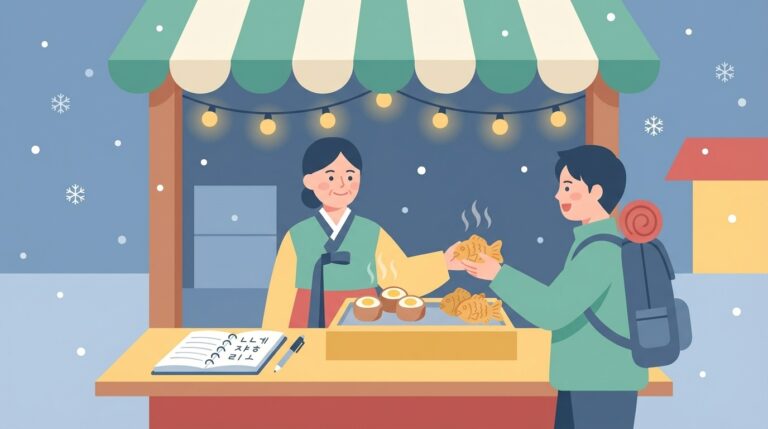
Picture this: It’s a crisp winter evening in Seoul. You just stepped out of the subway station, and the cold wind hits your face. But then, you smell it—a sweet, savory, buttery aroma floating through the air. You turn and see a cozy, steam-filled street food cart (Pojangmacha). It feels exactly like that iconic K-Drama scene where the male lead buys a warm snack to warm the female lead’s hands.
You want to try the famous Gyeran-ppang (Egg Bread), but panic sets in. The menu is entirely in Korean, and the friendly stall owner is looking right at you. The textbook taught you a 10-word sentence for ordering, but your mind goes blank.
Don’t worry! If you know just a few authentic, street-smart phrases, you won’t just get your food—you’ll get that warm ‘Insider’ smile from the locals. This guide is based on real struggles from my B1 students who wanted to survive the delicious streets of Myeongdong and Hongdae. Let’s dive in!
Phase 2: Deep Dive
Let’s break down the essential phrases you need to conquer any Korean street food stall.
1. 계란빵 하나 주세요
- Pronunciation: gyeran-ppang hana juseyo (gye-ran-ppang sounds like ‘gyeh-ran-pahng’. The ‘pp’ is tense, like the ‘p’ in ‘speak’. ‘hana’ means one, and ‘juseyo’ sounds like ‘joo-seh-yo’.)
- Meaning: Literal: Egg bread one please give. / Real nuance: I’ll have one egg bread, please.
- K-Culture Moment: You’ll hear this exact rhythm everywhere in Korea. Whether a fan is asking for a photocard at a K-Pop pop-up store (“포카 하나 주세요”) or a diner is asking for more kimchi (“김치 좀 주세요”). It is the ultimate magic wand of Korean ordering.
- Editor’s Insight: Forget complex grammar! Native speakers simply say the item, the quantity, and juseyo. No need for object particles like 을/를 here. It sounds too robotic! Just drop the particle and sound like a local.
- Situation Spectrum:
[🚫 절대 금지] ———— [⚠️ 주의] ———— [✅ 자유롭게]
- Casual with friends: ⚠️ (Use ‘줘’ instead of ‘주세요’)
- Street vendor / Staff (Semi-formal): ✅ (Perfect! Polite but natural)
- Formal business: ⚠️ (A bit too casual for a boardroom)
- 🤔 Think About It: Notice how the number (하나/one) comes after the noun (계란빵/egg bread)? Korean prioritizes what you are talking about before getting into the details of how many. Does your language put the number before or after the noun?
2. 이거 얼마예요?
- Pronunciation: igeo eolmayeyo? (‘igeo’ sounds like ee-gaw, ‘eolmayeyo’ sounds like uhl-mah-yeh-yo.)
- Meaning: Literal: This how much is? / Real nuance: How much is this?
- K-Culture Moment: At bustling markets like Gwangjang Market or Namdaemun, prices aren’t always written down. You just point and ask this phrase. It’s the essential traveler survival phrase!
- Editor’s Insight: Even if your Korean is limited, pairing “이거” (this) with pointing is your best friend.
Situation Spectrum:
[🚫 절대 금지] ———— [⚠️ 주의] ———— [✅ 자유롭게]
- Casual: ⚠️ (Say 이거 얼마야? to friends)
- Street vendor / Shopping: ✅
- Formal: ⚠️ (Use ‘얼마입니까?’ in very formal retail)
- 🤔 Think About It: Why do Koreans use ‘이거’ (this thing) so often? High-context cultures rely heavily on shared surroundings. If we both see it, we don’t need to name it!
3. 계좌이체 되나요?
- Pronunciation: gyejwa-iche doenayo? (gyeh-jwa-ee-cheh dweh-nah-yo?)
- Meaning: Literal: Account transfer become? / Real nuance: Do you accept bank transfers?
- K-Culture Moment: Korea is virtually cashless. Most young Koreans don’t carry physical wallets anymore. At street stalls that don’t take credit cards, you’ll see QR codes or account numbers taped to the cart.
- Editor’s Insight: This is a very modern, practical phrase. If you don’t have cash, asking this will make you look like a seasoned expat.
- Situation Spectrum:
[🚫 절대 금지] ———— [⚠️ 주의] ———— [✅ 자유롭게]
- Any payment situation: ✅
Phase 3: Textbook vs Real Life
Let’s see how what you learned in class compares to what you actually hear on the streets of Hongdae.
| Situation | 📖 Textbook Korean | 🗣️ Real Life Korean | 💡 Why is it different? |
|---|---|---|---|
| Ordering | “저에게 계란빵 한 개를 주시겠습니까?” (Would you give me one egg bread?) | “사장님, 계란빵 하나요!” (Boss, one egg bread!) | Koreans love efficiency. Dropping particles and shortening phrases saves time and sounds friendlier. |
| Asking price | “이 계란빵의 가격은 얼마입니까?” (What is the price of this egg bread?) | “이거 얼마예요?” (How much is this?) | Spoken Korean relies on context. ‘이거’ (this) replaces the whole noun phrase. |
| Saying it’s good | “이것은 매우 맛있습니다.” (This is very delicious.) | “와, 진짜 맛있어요!” (Wow, really delicious!) | ‘진짜’ (really) is the ultimate emotional enhancer in casual/semi-formal speech. |
Phase 4: Cultural Deep Dive
4-1. Non-verbal Communication & Nunchi
When ordering at a street stall, eye contact and pointing are perfectly fine, but there is a specific physical etiquette. When you hand over your cash or receive your food, try to use both hands, or at least rest your left hand on your right arm as you reach out. It’s a physical manifestation of respect. Also, Nunchi (reading the room) is key here: street stalls are small, so once you get your food, naturally step slightly to the side so other customers can order!
4-2. K-Food Connection: The Free Broth Culture
If you are eating at a stall that also sells Odeng (fish cake skewers), there will be a steaming vat of broth. In Korea, this broth is free and self-serve! You don’t usually need to ask. You just grab a paper cup provided on the counter, use the ladle, and drink it to warm up.
Critical Viewpoint: Why is the broth free? It stems from the Korean concept of Jeong (정)—a cultural focus on warmth, sharing, and community. Even in a fast-paced, modern city like Seoul, food is a medium for sharing affection. However, always make sure not to double-dip your skewers!
Phase 5: Immersive Roleplay
Scenario A: The Myeongdong Street Cart
Setting: A freezing Friday night in Myeongdong. The neon lights are bright, and you and your Korean friend, Min-su, stop by a food cart. Steam is billowing from the egg bread and fish cakes.
Characters:
– YOU: A Korean language learner, hungry for street food.
– Min-su (30): Your supportive Korean friend who wants you to practice.
– Imo-nim (Stall Owner): A friendly middle-aged woman running the cart.
Dialogue:
Min-su: 배고프지? 우리 여기서 뭐 좀 먹고 가자.
(baegopeuji? uri yeogiseo mwo jom meokgo gaja.)
[Translation: You’re hungry, right? Let’s eat something here before we go.]
(🎭 Stage Direction: Min-su nudges you toward the cart smelling of sweet batter.)
YOU: 좋아! 나 계란빵 먹어보고 싶었어.
(joa! na gyeran-ppang meogeobogo sipeosseo.)
[Translation: Sounds good! I’ve been wanting to try egg bread.]
Min-su: 그래, 네가 한번 직접 주문해 봐!
(geurae, nega hanbeon jikjeop jumunhae bwa!)
[Translation: Okay, try ordering it yourself!]
YOU: 음… 사장님, 이거 얼마예요?
(eum… sajangnim, igeo eolmayeyo?)
[Translation: Umm… Boss, how much is this?]
Imo-nim: 계란빵? 하나에 이천 원이에요~
(gyeran-ppang? hana-e icheon wonieyo~)
[Translation: Egg bread? It’s 2,000 won for one~]
🔀 Your Turn! How do you reply?
– A) “저에게 계란빵 한 개를 주시겠습니까?” (Textbook formal)
– B) “계란빵 하나 주세요!” (Natural & polite)
– C) “계란빵 내놔!” (Aggressive / Drama villain style)✅ Best Choice: B — Reason: It perfectly balances politeness and natural conversational flow.
⚠️ Choice A Analysis: Imo-nim might think you are reading from a dictionary! It’s too stiff.
(You chose B)
YOU: 계란빵 하나 주세요!
(gyeran-ppang hana juseyo!)
[Translation: I’ll have one egg bread, please!]
Imo-nim: 네~ 여기 있어요. 뜨거우니까 조심해요.
(ne~ yeogi isseoyo. tteugeounikka josimhaeyo.)
[Translation: Yes~ Here you go. It’s hot, so be careful.]
YOU: 감사합니다! 아, 계좌이체 되나요?
(gamsahamnida! a, gyejwa-iche doenayo?)
[Translation: Thank you! Ah, do you take bank transfers?]
Imo-nim: 그럼요~ 저기 번호로 보내주세요.
(geureomyo~ jeogi beonhoro bonaejuseyo.)
[Translation: Of course~ Please send it to the number over there.]
Scenario B: Bonus – K-Pop Merch Booth
This exact phrase structure works at K-Pop concerts too!
Staff: 다음 분, 뭐 드릴까요?
(da-eum bun, mwo deurilkkayo? – Next person, what can I get you?)
YOU: 응원봉 하나 주세요!
(eung-wonbong hana juseyo! – One lightstick, please!)
Phase 6: 10-Second Shadowing Drill
Let’s practice the rhythm! Pay attention to the pauses (/) and emotions.
😊 사장님~ / 이거 / 두 개 / 주세요!
(sajangnim~ / igeo / du gae / juseyo!)
[Translation: Boss~ / This / Two items / Please!]
Pro-tip: Extend the ‘~’ on sajangnim slightly to sound friendly and approachable!
Phase 7: K-Culture Glossary
| Korean | Romanization | English | Context |
|---|---|---|---|
| 포장마차 | pojangmacha | Street food cart / tent | The iconic covered carts selling street food and sometimes alcohol. |
| 사장님 / 이모님 | sajangnim / imonim | Boss / Auntie | Respectful titles for stall owners. Use ‘sajangnim’ safely for anyone. |
| 붕어빵 | bungeoppang | Fish-shaped pastry | A winter staple filled with sweet red bean or custard. |
| 오뎅 국물 | odeng gukmul | Fish cake broth | The hot, savory broth offered for free at stalls. |
| 계좌이체 | gyejwa-iche | Bank transfer | The most common way to pay at street stalls if you lack cash. |
Phase 8: Traveler’s Survival Kit
Are you heading to Korea soon? Keep these in your back pocket!
🆘 Survival Phrases TOP 3
– 🇰🇷 “포장해 주세요.” (pojanghae juseyo.)
– 🗣️ English: Please pack it to go (Takeout).
– 📍 Where to use: Cafes, restaurants, street stalls.
– 🇰🇷 “안 맵게 해 주세요.” (an maepge hae juseyo.)
– 🗣️ English: Please make it not spicy.
– 📍 Where to use: Ordering Tteokbokki or any red Korean dish!
– 🇰🇷 “영수증 주세요.” (yeongsujeung juseyo.)
– 🗣️ English: Please give me the receipt.
– 📍 Where to use: Convenience stores, taxis.📌 Editor’s Travel Note
– Cash vs Card: Korea is a “Card Heaven.” You can pay for almost anything with a card. However, for traditional markets (like Gwangjang) or street stalls, cash is still king. If you don’t have a Korean bank account for transfers, always carry a few 1,000 won bills!
– Tipping: Do NOT tip in Korea. Stall owners and restaurant staff will be confused or might even run after you to return your change.
Phase 9: Think Deeper
🧠 Think Deeper: Food & Identity
In Korea, eating is rarely a solitary act; it is deeply tied to the community. When you stand at a food cart, rubbing shoulders with strangers, drinking the shared Odeng broth out of a paper cup in the freezing winter, you are experiencing the essence of Korean culture. Food is not just fuel; it is warmth, shared space, and a silent language of care. This is why when Koreans greet each other, instead of “How are you?” they often ask, “밥 먹었어?” (Did you eat?).💬 Your Turn: How does your culture view street food? Is it a quick bite on the go, or a shared social experience? Let me know in the comments!
Phase 10: FAQ & Troubleshooting
Q: Can I use “주세요 (juseyo)” to older people?
Yes! “주세요” ends in “~요 (yo)”, which makes it polite (존댓말). It is perfectly safe and respectful to use with stall owners, taxi drivers, and shop staff.
Q: Should I call the stall owner “아줌마 (Ajumma)”?
No! While it literally means “middle-aged woman,” it can sometimes sound rude or overly familiar in modern Korea. Stick to “사장님 (Sajangnim – Boss/Owner)”. It is respectful and safe for everyone.
❌ Common Mistake #1: Saying “너 (You)” to the vendor.
✅ Do this instead: Never use “너” to someone you don’t know, even if it’s casual street food. You don’t need a pronoun at all! Just say “사장님, 이거 주세요.”
Phase 11: Wrap-up & Missions
One-Liner Summary: To order anything naturally in Korea, point and say: “이거 하나 주세요 (Igeo hana juseyo – Please give me one of this).”
Action Mission:
– 🥉 Bronze: Stand in front of your mirror, hold up a pen, and say “이거 하나 주세요!” 3 times.
– 🥈 Silver: Next time you are at a Korean restaurant in your home country, try asking for water by saying “물 좀 주세요 (Mul jom juseyo).”
– 🥇 Gold: Walk up to a street stall in Seoul and order your favorite snack entirely in Korean!
K-Culture Mission:
Tonight, watch an episode of a K-Drama. Every time a character orders food or drinks, listen closely. Can you hear them say “주세요”? Count how many times you hear it!
Phase 12: Interactive Quiz
1. Situational Judgment: You want two hotteok (sweet pancakes). How do you ask naturally?
– A) 호떡 두 개 주세요. (Hotteok du gae juseyo.)
– B) 나에게 호떡 둘을 주십시오. (Na-ege hotteok dureul jusipsio.)
(Answer: A. B is way too formal and awkward!)
2. Fill in the Blank: You want to know the price of a cute K-Pop keychain.
사장님, ______ 얼마예요? (Boss, how much is ______?)
(Answer: 이거 – igeo / this)
3. True or False – K-Culture Edition:
“If the street food stall owner provides great service, you should leave a 10% tip on the counter.”
(Answer: False! Tipping is not practiced in Korea and may cause confusion.)
Frequently Asked Questions (FAQ)
Q: What does "계란빵 하나 주세요" mean in Korean and how do you pronounce it?
A: In Korean, "계란빵 하나 주세요" is pronounced [gyeran-ppang hana juseyo (gye-ran-ppang sounds like 'gyeh-ran-pahng'. The 'pp' is tense, like the 'p' in 'speak'. 'hana' means one, and 'juseyo' sounds like 'joo-seh-yo'.] and means: Literal: Egg bread one please give. / Real nuance: I'll have one egg bread, please.
Q: What does "이거 얼마예요?" mean in Korean and how do you pronounce it?
A: In Korean, "이거 얼마예요?" is pronounced [igeo eolmayeyo? ('igeo' sounds like ee-gaw, 'eolmayeyo' sounds like uhl-mah-yeh-yo.] and means: Literal: This how much is? / Real nuance: How much is this?
Q: What does "계좌이체 되나요?" mean in Korean and how do you pronounce it?
A: In Korean, "계좌이체 되나요?" is pronounced [gyejwa-iche doenayo? (gyeh-jwa-ee-cheh dweh-nah-yo?] and means: Literal: Account transfer become? / Real nuance: Do you accept bank transfers?







