

Hello! I am the Senior Editor of Daily Hangul. I’ve spent years teaching Korean to wonderful folks like you, and living my best life navigating the neon-lit streets of Seoul.
Phase 1: Immersive Hook
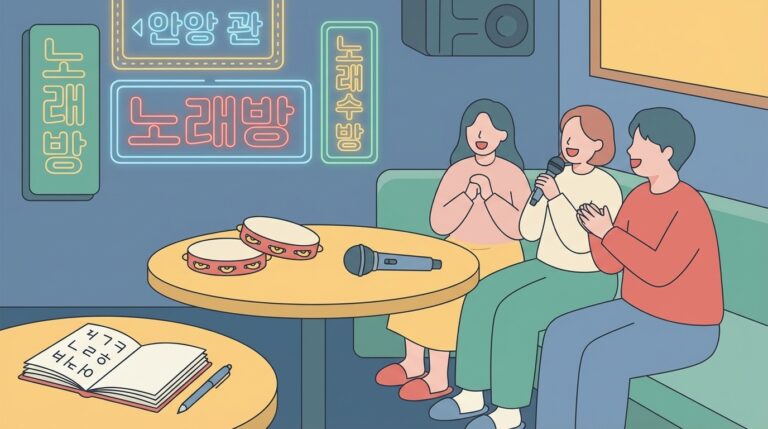
You’ve definitely seen this scene in a K-Drama. The main characters have just finished eating pork belly and drinking Soju at a BBQ restaurant. Suddenly, the scene cuts. They are in a dark room with flashing disco lights, aggressively shaking tambourines while belting out an emotional ballad or a high-energy K-Pop hit. Welcome to the Noraebang (노래방), the absolute heart of Korean nightlife!
Whether it’s after a team dinner (회식, hoesik) or a Friday night out with friends, going to a Noraebang is a cultural rite of passage. But imagine you’re there, the music is blasting, and a Korean friend hands you the mic. What do you say? How do you cheer them on? If you don’t know the basic Noraebang survival phrases, you might end up awkwardly staring at the lyrics screen.
Don’t worry! This guide is based on real questions from my beginner students who wanted to become true ‘insiders’ during their Korean nights out. Let’s dive in!
Phase 2: Deep Dive into Core Expressions
Let’s learn the top 3 survival phrases you need for a Korean karaoke night.
1. 노래방 가요! (Let’s go to Noraebang!)
- Pronunciation: Noraebang gayo! [No-ray-bang guy-yo!]
- Meaning: Let’s go to a karaoke room!
- K-Culture Moment: You’re standing outside a restaurant after dinner. Everyone is full, but nobody wants to go home yet. Someone yells this phrase, and the night officially begins.
- Editor’s Insight: ‘가요 (gayo)’ simply means ‘let’s go’ or ‘I go’. In Korean, we often skip the subject (‘we’). Just say the place and ‘gayo’! It’s enthusiastic and friendly.
- Situation Spectrum:
[🚫 절대 금지] ———— [⚠️ 주의] ———— [✅ 자유롭게]
- Friends (Casual): ✅ (Often just ‘노래방 가자!’ – Noraebang gaja!)
- Coworkers (Semi-formal): ✅ (Perfect for team dinners)
- Boss/Elders (Formal): ⚠️ (Let them suggest it first!)
- 🤔 Think About It: Why is Noraebang always the ‘second round’ (2차) in Korea, rather than the main event? How does your culture end a fun night out?
2. 다음 누구예요? (Whose turn is next?)
- Pronunciation: Daeum nuguyeyo? [Da-eum noo-goo-yeah-yo?]
- Meaning: Who is next?
- K-Culture Moment: The current song ends, the score ‘100’ flashes on the screen with loud applause, and the room goes quiet for a split second. You look around the room with the remote control in your hand and ask this.
- Editor’s Insight: ‘다음 (daeum)’ means next, and ‘누구 (nugu)’ means who. It’s a great way to keep the energy flowing without hogging the mic!
- Situation Spectrum:
[🚫 절대 금지] ———— [⚠️ 주의] ———— [✅ 자유롭게]
- Friends (Casual): ✅
- Coworkers (Semi-formal): ✅
- Boss/Elders (Formal): ✅ (Very polite way to pass the mic)
- 🤔 Think About It: In Korea, ensuring everyone gets a turn to sing is a way of showing ‘Nunchi’ (reading the room). Do you have a similar etiquette in your country?
3. 서비스 많이 주세요! (Please give us a lot of ‘service’!)
- Pronunciation: Seobiseu mani juseyo! [Seo-bee-seu mahn-ee joo-say-yo!]
- Meaning: Please give us lots of free extra time!
- K-Culture Moment: When paying at the counter before entering the room, your Korean friend might say this to the owner with a big smile.
- Editor’s Insight: In Korea, ‘Service’ doesn’t mean customer service—it means ‘on the house’ or ‘free stuff’! In a Noraebang, the owner often adds 15 or 30 extra minutes to your screen for free. It’s the magical word of Korean nightlife.
- Situation Spectrum:
[🚫 절대 금지] ———— [⚠️ 주의] ———— [✅ 자유롭게]
- To the Noraebang owner: ✅ (Say it brightly and politely!)
- 🤔 Think About It: The ‘Service’ culture shows Korean ‘Jeong’ (정, warmth/affection). By giving free time, the owner builds loyalty. Isn’t that a sweet business model?
Phase 3: Textbook vs Real Life
| Situation | 📖 Textbook Korean | 🗣️ Real Korean | 💡 Why is it different? |
|---|---|---|---|
| Suggesting Karaoke | 노래방에 갑시다. (Let us go to the karaoke.) | 2차는 노래방 고고! (2nd round, Noraebang go go!) | Using English ‘go go’ is super common and adds a playful vibe. |
| Cheering | 노래를 잘 부르네요. (You sing a song well.) | 대박! 완전 잘해! (Daebak! You’re totally good!) | ‘Daebak’ (awesome) is the ultimate reaction word for anything impressive. |
| Asking for extra time | 시간을 연장해 주시겠습니까? (Would you please extend the time?) | 사장님, 서비스 주세요~ (Boss, please give us service~) | Emotional connection (‘Boss’ + ‘Service’) works better than a robotic request. |
Bottom Note: As a beginner, sticking to ‘노래방 가요’ is safe and perfect. But dropping a ‘Daebak!’ when someone hits a high note will make you an instant insider!
Phase 4: Cultural Deep Dive
4-1. Non-verbal Communication: The Tambourine Etiquette
In a Korean Noraebang, you are never just a listener. When someone else is singing, sitting still and looking at your phone is considered a mood-killer (갑분싸, gapbunssa). What should you do? Grab the tambourine! Shake it to the beat, clap, and nod along. It shows you are actively supporting your friend’s performance.
4-2. K-Culture Connection: The Rise of ‘Coin Noraebang’ (코노)
While traditional Noraebangs are huge rooms meant for big groups and lots of food/drinks, younger K-Pop fans and introverts love Coin Noraebang (코인 노래방, affectionately called ‘코노 / Kono’).
– The Vibe: Tiny phone-booth-sized rooms where you pay per song (usually 1,000 won for 3-4 songs).
– K-Pop Connection: It’s the perfect place to practice your favorite idol’s fan-chants or sing solo without the pressure of a big audience. Many K-Pop idols even film vlog content at Konos!
– Critical View: Why did Kono become so popular? Modern Korean society is shifting from collective group culture (Hoesik) to valuing ‘Hon-jok’ (혼족, solo lifestyle). Kono perfectly reflects this desire for personal space!
Phase 5: Immersive Roleplay Scenario
Scenario A: The Team Dinner Aftermath
Setting: It’s 9 PM on a Friday near Gangnam Station. The pork belly dinner (1차) is over. Everyone is standing on the street, energized. You are with your Korean coworkers, including your friendly colleague Minsoo.
Minsoo: 아~ 배부르다! 우리 소화시킬 겸 노래방 가요! 🎤
(Ah~ baebureuda! Uri sohwa-sikil gyeom noraebang gayo!)
[Ah~ I’m full! Let’s go to Noraebang to digest our food!]
(🎭 Stage Direction: Minsoo excitedly points to a glowing neon microphone sign across the street.)
YOU: (Surprised but excited) 노래방이요? 좋아요!
(Noraebang-iyo? Joayo!)
[Noraebang? Sounds good!]
Minsoo: 오! 노래 잘해요? 무슨 노래 부를 거예요?
(O! Norae jalhaeyo? Museun norae bureul geoyeyo?)
[Oh! Do you sing well? What song will you sing?]
🔀 Your Turn! How should you respond?
– A) “저 노래 진짜 못해요… 안 부를래요.”
(I really can’t sing… I won’t sing.)
– B) “케이팝 좋아해요! 방탄소년단 노래 부를게요.”
(I like K-Pop! I’ll sing a BTS song.)
– C) “제가 여기 있는 사람보다 제일 잘해요.”
(I am the best singer here.)✅ Best Choice: B — It shows enthusiasm and shares your interest in K-Culture! Koreans love it when foreigners try singing K-Pop, even if it’s just the English chorus.
⚠️ Choice C Analysis: While funny, it might sound a bit too arrogant for a Korean workplace setting where humility is valued.
⚠️ Choice A Analysis: It’s okay to be shy, but flat-out refusing can kill the mood. Even if you can’t sing, you can say “I’ll play the tambourine!” (저는 탬버린 칠게요!).
Scenario B: Bonus – The Endless Night
Setting: Inside the Noraebang. The timer on the screen says ’01:00′ (1 minute left). Suddenly, the screen blinks, and it changes to ’30:00′.
YOU: 어? 시간이 늘어났어요! 뭐예요?
(Eo? Sigani neureonasseoyo! Mwoyeyo?)
[Huh? The time increased! What is this?]
Minsoo: 사장님이 서비스 주셨어요! 밤새 놀아요!
(Sajangnimi seobiseu jusyeosseoyo! Bamsae norayo!)
[The owner gave us service! Let’s play all night!]
YOU: (Internal screaming but smiling) 대박… 감사합니다!
(Daebak… gamsahamnida!)
[Awesome… thank you!]
Phase 6: 10-Second Shadowing Drill
Let’s practice the most important phrase with the right feeling!
😊 사장님, / 서비스 / 많이 주세요~~~
(sajangnim, / seobiseu / mani juseyo~~~)
[Tone Guide: Brightly, with a slight cute, pleading smile at the end!**]
Phase 7: K-Culture Glossary
| Korean | Romanization | English | Context |
|---|---|---|---|
| 눈치 | nunchi | Social awareness | The ability to read the room. Crucial when choosing a song (don’t pick a sad ballad when everyone is dancing!). |
| 회식 | hoesik | Team dinner | Corporate bonding event, usually ending at a Noraebang. |
| 탬버린 | taembeorin | Tambourine | The ultimate tool for those who can’t sing but want to participate. |
| 코노 | kono | Coin Noraebang | Short for 코인 노래방. Cheap, small booths popular with youth. |
| 서비스 | seobiseu | Service (Freebie) | Free extra time given by the Noraebang owner. |
Phase 8: Traveler’s Survival Kit (Noraebang Edition)
🆘 Survival Phrases for Kono (Coin Noraebang)
– 🇰🇷 “지폐 교환기 어디 있어요?” (Jipye gyohwangi eodi isseoyo?)
– 🗣️ Pronunciation: [Jee-pyeh gyo-hwan-gee uh-dee ee-suh-yo?]
– 📍 Where to use: Inside a Coin Noraebang.
– 💡 Meaning: Where is the bill exchanger? (You often need 1,000 won bills or 500 won coins, though many places accept cards now!)📌 Editor’s Travel Note
– Searching for a spot: Open KakaoMap or Naver Map and type ‘노래방’ or ‘코인노래방’. You’ll find one on almost every corner!
– Pop Songs: Don’t worry if you don’t know Korean songs. Korean karaoke machines have a huge ‘POP’ section with English hits!
– Price: Traditional Noraebang (around 20,000~30,000 KRW per hour). Kono (around 1,000 KRW for 3-4 songs).
Phase 9: Think Deeper — “Language & Group Identity”
🧠 Think Deeper: Food, Singing, and Korean Identity
Why do Koreans insist on going to Noraebang together after eating and drinking? In Korean culture, the workplace or school environment is often strict and hierarchical. The Noraebang serves as a socially acceptable ‘release valve’. When the manager sings an old trot song and the junior employee shakes the tambourine, the invisible walls of hierarchy briefly come down. It builds ‘Jeong’ (deep emotional connection) and group solidarity.💬 Your Turn: Does your culture have a specific activity designed to break down barriers between coworkers or new friends? Share it in the comments!
Phase 10: FAQ & Troubleshooting
Q: Do I HAVE to sing if I go to a Noraebang?
A: Not strictly, but trying at least one song is highly appreciated! If you are terrified, pick an easy English pop song (like “Let It Be”) and everyone will sing along with you. Or, simply master the tambourine!
Q: Can I use ‘서비스 주세요’ at a restaurant too?
A: Yes! But use it playfully. If you order a lot of meat, you can jokingly say “사장님, 서비스 주세요~” and they might give you a free soda or steamed egg.
❌ Common Mistake #1: Monopolizing the machine.
✅ Do this instead: Sing one song, then pass the remote. Wait for at least 2-3 other people to sing before you queue up your next song. Nunchi is key!
Phase 11: Wrap-up & Action Items
✨ One-Liner Summary: Surviving a Korean Noraebang is less about perfect vocals and more about great reactions, tambourine skills, and shouting “노래방 가요!”
Action Mission:
– 🥉 Bronze (Solo): Stand in front of a mirror and practice saying “사장님, 서비스 많이 주세요!” with your best friendly smile.
– 🥈 Silver (Online): Find a YouTube video of a K-Drama Noraebang scene and see if you can spot the tambourine player!
– 🥇 Gold (Real Life): Next time you are with your Korean friends, be the one to suggest: “우리 노래방 가요!”
🎤 K-Culture Mission: Search for your favorite K-Pop idol’s “Coin Noraebang (코노)” vlog on YouTube and see how they select songs and use the remote!
Phase 12: Interactive Quiz
1. Situational Judgment: Your boss just finished singing a terrible 90s ballad. The score is 65. What is the BEST reaction?
– A) Sit quietly and look at your phone.
– B) Say “대박! (Daebak!)” and clap loudly.
– C) Say “다음 누구예요? (Who is next?)” immediately to move on.
2. True or False: In Korea, ‘Service’ in a Noraebang means the staff will come and clean your room. (T/F)
3. Fill in the blank: You want to suggest going to a karaoke room to your friends. “우리 _______ 가요!”
– A) 화장실 (Restroom)
– B) 노래방 (Noraebang)
– C) 편의점 (Convenience store)
🚨 Click here for Answers!
1. B – Always support the singer, no matter the score! Nunchi is everything.
2. False – ‘Service’ means free extra time added to your machine by the owner!
3. B – 노래방 (Noraebang).
Frequently Asked Questions (FAQ)
Q: What does "노래방 가요! (Let's go to Noraebang!)" mean in Korean and how do you pronounce it?
A: In Korean, "노래방 가요! (Let's go to Noraebang!)" is pronounced [Noraebang gayo! [No-ray-bang guy-yo!] and means: Let's go to a karaoke room!
Q: What does "다음 누구예요? (Whose turn is next?)" mean in Korean and how do you pronounce it?
A: In Korean, "다음 누구예요? (Whose turn is next?)" is pronounced [Daeum nuguyeyo? [Da-eum noo-goo-yeah-yo?] and means: Who is next?
Q: What does "서비스 많이 주세요! (Please give us a lot of 'service'!)" mean in Korean and how do you pronounce it?
A: In Korean, "서비스 많이 주세요! (Please give us a lot of 'service'!)" is pronounced [Seobiseu mani juseyo! [Seo-bee-seu mahn-ee joo-say-yo!] and means: Please give us lots of free extra time!






