

Phase 1: Immersive Hook
Hello! I’m your Daily Hangul Editor, your friendly neighborhood Korean tutor and local culture guide.
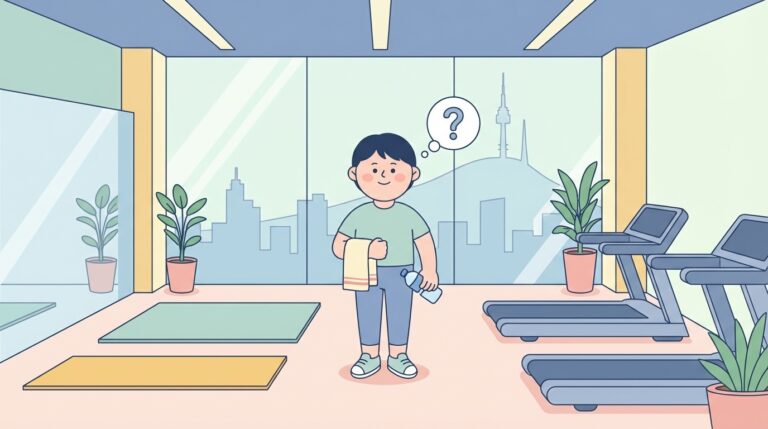
Remember those K-Dramas where the wealthy CEO protagonist is working out in a massive, completely empty gym with dramatic lighting? Well, let me give you a reality check! If you walk into a 헬스장 (Gym) in Seoul at 7 PM, it’s absolutely packed. K-Pop is blasting, people are intensely checking their posture in the mirrors, and every single squat rack seems to be taken.
You finally spot a machine you want to use, but there’s a towel draped over it, and a guy looking at his phone next to it. You need to ask if he’s done, but… wait, how do you say that without sounding rude? If you don’t know the right words, you might just awkwardly stand there for 20 minutes!
Don’t worry. This guide is built from the real sweat and tears of my beginner students. Today, we are going to learn exactly how to survive—and thrive—in a Korean gym.
Phase 2: Deep Dive into Core Expressions
Let’s master the top 3 phrases you need to navigate a Korean gym confidently.
1. 여기 쓰세요? (Are you using this?)
- Pronunciation: yeogi sseuseyo? [yuh-gee / ss-seh-yo]
- Sound guide: ‘yeo-gi’ sounds like Yogi Bear. ‘sseu’ sounds like the disgusted “ew” sound but with an “ss” in front.
- Meaning: Literal = “Do you use here?” / Real nuance = “Are you using this machine? / Is this taken?”
- K-Culture Moment: This is the ultimate “excuse me” phrase at the gym. In Korea, people often “reserve” a machine by leaving their towel or water bottle on it while resting. You use this phrase to gently check if they are still doing their sets.
- Editor’s Insight: It’s incredibly polite but casual enough for strangers. You don’t need a long, complicated sentence. Just point at the machine and ask this with a slight nod!
- Situation Spectrum:
[🚫 절대 금지] ———— [⚠️ 주의] ———— [✅ 자유롭게]
- Strangers at the gym (Polite): ✅
- Friends (Casual): ⚠️ (Drop the ‘yo’: 여기 써?)
- Formal/Business: 🚫 (Not suited for office talk)
- 🤔 Think About It: Notice how the subject “You” and object “Machine” are completely dropped? Korean is a high-context language. If you point at the machine, everyone knows what you mean. Why use extra words when the context does the talking?
2. 한 달에 얼마예요? (How much is it for one month?)
- Pronunciation: han dare eolmayeyo? [han / da-reh / ul-ma-yeh-yo]
- Meaning: Literal = “In one month, how much is it?” / Real nuance = “How much is a one-month membership?”
- K-Culture Moment: Before you start lifting, you need to register! Most Korean gyms (often called “Fitness Centers” or “Health Jangs”) offer massive discounts if you sign up for 3, 6, or 12 months. But it’s always safe to ask for a one-month price first!
- Editor’s Insight: The phrase ‘얼마예요? (How much is it?)’ is your golden ticket in Korea. Add ‘한 달에 (for one month)’ in front of it, and you sound like a local negotiating a gym contract.
- Situation Spectrum:
[🚫 절대 금지] ———— [⚠️ 주의] ———— [✅ 자유롭게]
- Speaking to Gym Staff (Polite): ✅
- 🤔 Think About It: Negotiating prices isn’t common in Korean retail, but gym memberships are a rare exception where “promotions” can sometimes be flexibly applied. Have you ever haggled for a gym price back home?
3. 수고하셨습니다 (Thank you for your hard work)
- Pronunciation: sugo-hasyeot-seumnida [soo-go / ha-shot / sum-ni-da]
- Meaning: Literal = “You put in effort/hard work.” / Real nuance = “Good job today / Have a good one / Thank you.”
- K-Culture Moment: You just finished a grueling PT (Personal Training) session. As you leave, you bow slightly to your trainer and say this. It’s the ultimate polite sign-off in Korean society.
- Editor’s Insight: It’s more than just “bye.” It acknowledges the shared effort. You can also say “수고하세요 (sugo-haseyo – Keep up the good work)” to the front desk staff as you walk out the door.
- Situation Spectrum:
[🚫 절대 금지] ———— [⚠️ 주의] ———— [✅ 자유롭게]
- Leaving the gym/Trainer: ✅
- To a close friend: ⚠️ (Too formal, just say ‘안녕~’)
Phase 3: Textbook vs Real Life
| Situation | 📖 Textbook Korean | 🗣️ Real Korean | 💡 Why is it different? |
|---|---|---|---|
| Asking to use a machine | 운동기구를 사용하십니까? (Are you using the exercise equipment?) | 여기 쓰세요? (Are you using here?) | Koreans love brevity. In a gym, pointing and saying “here” is much faster. |
| Saying goodbye to staff | 안녕히 계세요 (Stay in peace) | 수고하세요 (Keep up the hard work) | Acknowledging someone’s labor is considered warmer than a standard goodbye. |
| Telling a friend you worked out | 저는 오늘 운동을 완료했습니다. (I completed my exercise today.) | 오운완! (O-Woon-Wan!) | Internet slang! An acronym for “오늘 운동 완료” (Today’s workout complete). |
Bottom Note: For A1 beginners, “여기 쓰세요?” is the absolute lifesaver. Keep it short and sweet!
Phase 4: Cultural Deep Dive
4-1. Non-verbal Communication at the Gym
When asking “여기 쓰세요?”, eye contact shouldn’t be too intense. Give a slight 15-degree bow (a polite nod), point to the machine with your whole hand (not just one finger, which is considered rude), and use a soft, questioning tone. This is where 눈치 (Nunchi – social awareness) comes in. If their towel is on the bench and they are panting nearby, use your nunchi—they are definitely resting between sets!
4-2. K-Culture Connection: The “오운완” Phenomenon
If you follow any K-Pop idols on Instagram or Weverse, you’ve definitely seen mirror selfies taken at the gym with the hashtag #오운완 (O-Woon-Wan). It stands for “오늘 운동 완료” (Today’s Workout Complete). In Korea, going to the gym isn’t just a hobby; it’s a lifestyle of self-improvement and hustling. Fans love it when idols post their O-Woon-Wan selfies. So, after your workout, take a mirror selfie and proudly post it!
Phase 5: Immersive Roleplay Scenario
Setting: Friday evening, 7:30 PM. A trendy gym in Gangnam. K-Pop EDM remixes are bumping through the speakers. You want to use the Leg Press, but there’s a towel on the seat.
Characters:
– YOU: An expat trying to stick to your New Year’s resolution.
– Minho (28): A local gym bro who looks incredibly buff. He is currently sitting on a bench near the Leg Press, staring at his phone.
Dialogue:
Minho: (Puffing out a breath, wiping sweat) 하아… 힘들다.
(Haa… himdeulda.)
[English] Haa… this is hard.
(🎭 Stage Direction: Minho takes a sip of water but leaves his towel on the Leg Press seat.)
YOU: (Approaching cautiously, pointing at the Leg Press)
🔀 Your Turn! How should you respond?
– A) 저기요, 비켜주세요. (Excuse me, move.)
– B) 저기요… 여기 쓰세요? (Excuse me… are you using this?)
– C) 이거 얼마예요? (How much is this?)✅ Best Choice: B — Perfect execution! “저기요” (Excuse me) grabs his attention politely, and “여기 쓰세요?” asks nicely if he’s still using the machine.
⚠️ Choice A Analysis: NEVER say “비켜주세요” (move) to a stranger. It sounds like you’re picking a fight in a K-Drama action scene!
⚠️ Choice C Analysis: You just asked the buff guy how much the gym machine costs to buy. He will be very confused.
Minho: 아, 네! 한 세트 남았어요. 금방 끝나요.
(Ah, ne! han sete namasseoyo. geumbang kkeunnayo.)
[English] Ah, yes! I have one set left. I’ll finish quickly.
YOU: 아, 네. 천천히 하세요.
(Ah, ne. cheoncheonhi haseyo.)
[English] Ah, okay. Take your time.
Phase 6: 10-Second Shadowing Drill
Let’s practice the magic phrase. Speak out loud! The slashes (/) indicate where to pause.
- 🙋♂️ Polite & Cautious:
저기요... / 여기 / 쓰세요? (jeogiyo... / yeogi / sseuseyo?) -
😊 Friendly Sign-off to Staff:
감사합니다~ / 수고하세요! (gamsahamnida~ / sugohaseyo!)
Phase 7: K-Culture Glossary (Gym Edition)
| Korean | Romanization | English | Cultural Context |
|---|---|---|---|
| 헬스장 | heol-seu-jang | Gym | Konglish for “Health” + “Jang” (place). The most common word for a gym. |
| 피티 (PT) | pi-ti | Personal Training | Highly popular in Korea. Trainers closely monitor your diet via messaging apps too! |
| 인바디 | in-ba-di | InBody | A body composition machine. Koreans are obsessed with measuring their muscle-to-fat ratio. |
| 오운완 | o-un-wan | Workout Complete | The trendy hashtag for finishing a workout. |
| 눈치 | nun-chi | Social Sense | Reading the room. E.g., not hogging a machine when it’s crowded. |
Phase 8: Traveler’s Survival Kit
Even if you’re just visiting Korea for a week, you might want to hit the gym. Here is your survival kit!
🆘 Survival Phrases for the Gym
– 🇰🇷 “하루 이용권 있어요?” (haru iyonggwon isseoyo?)
– 🗣️ Guide: [ha-roo / ee-yong-gwon / ee-sso-yo?]
– 📍 Meaning: “Do you have a one-day pass?”
– 💡 Pro Tip: Many gyms in Korea offer a one-day pass (usually 15,000 KRW ~ 20,000 KRW) for travelers!
📌 Editor’s Gym Travel Note
– Indoor Shoes Only! This is CRITICAL. In Korea, you cannot wear your street shoes inside the gym. You must bring a separate, clean pair of “실내용 운동화 (indoor sneakers)” to change into in the locker room. If you wear street shoes, the staff will definitely stop you!
– Free Workout Clothes: Many Korean gyms provide uniform workout clothes and towels for free or a tiny fee. Look for the neatly folded stacks of shirts and shorts!
Phase 9: Think Deeper — “Media vs Reality”
🧠 Think Deeper:
In K-Dramas, the gym is often portrayed as a private, moody sanctuary where the handsome male lead runs on a treadmill at midnight, brooding over his love life. But the reality of a Korean Heol-seu-jang is vastly different! It is a bustling community hub. It reflects the intense “hustle culture” of modern Korea. After working 9-to-6, young Koreans flock to the gym to maximize their productivity. It’s not just about health; it’s about proving that you are diligently managing your life.💬 Your Turn: Does your culture treat going to the gym as a relaxing hobby, or is it treated as a strict self-improvement task like in Korea? Let me know in the comments!
Phase 10: FAQ & Troubleshooting
Q: “Can I wear my sneakers from outside if I wipe them off?”
No! Unless the gym specifically says “외출화 가능 (Outdoor shoes allowed),” always assume you need a completely clean pair of shoes that have never touched the pavement.
Q: “Can I use ‘수고하세요’ to an older gym owner?”
Yes and No. “수고하세요” is totally fine to say to service workers (like a front desk clerk or a younger trainer). However, if the owner is significantly older than you, it might sound slightly condescending. A simple “감사합니다. 안녕히 계세요” (Thank you. Goodbye) is much safer for elders.
❌ Common Mistake:
Asking “Are you using this?” by saying “너 이거 써?” (neo igeo sseo?)
✅ Do this instead:
“너” means “You” but it’s ONLY for very close friends. Saying it to a stranger at the gym is highly offensive. Always use “여기 쓰세요?” instead!
Phase 11: Wrap-up & Action Items
One-Liner Summary: To survive a Korean gym, remember to pack indoor shoes and politely ask “여기 쓰세요? (Are you using this?)” before grabbing a machine!
Action Mission:
– 🥉 Bronze: Stand in front of a mirror, point to an imaginary machine, and ask “저기요… 여기 쓰세요?” 3 times.
– 🥈 Silver: Leave a comment on this blog using today’s K-Culture hashtag: #오운완
– 🥇 Gold: Go to a Korean gym (or any Korean establishment) and warmly say “수고하세요!” to the staff as you leave.
K-Culture Mission:
Check out your favorite K-Pop idol’s Instagram or Weverse. Search for the hashtag #오운완. You will definitely find a mirror selfie of them at the gym!
Phase 12: Interactive Quiz
1. You are at a gym in Seoul and want to ask if the treadmill is taken. What is the BEST phrase?
A) 비켜주세요 (Move)
B) 얼마예요? (How much?)
C) 여기 쓰세요? (Are you using here?)
(Answer: C. It’s the most natural and polite way to ask.)
2. True or False: It is completely fine to wear the sneakers you wore on the subway into a Korean gym.
(Answer: False! You must bring clean indoor shoes.)
3. Fill in the blank: The popular hashtag for “Workout Complete” is #___ .
(Answer: 오운완 / O-Woon-Wan)
4. Situation Judgment: You finished paying for a one-day pass at the front desk. As you walk away to the locker room, you want to be friendly to the staff. What do you say?
A) 수고하세요! (Keep up the good work!)
B) 운동기구 사용하십니까? (Are you using the exercise equipment?)
(Answer: A. It is the perfect polite phrase for service workers!)
Frequently Asked Questions (FAQ)
Q: What does "여기 쓰세요? (Are you using this?)" mean in Korean and how do you pronounce it?
A: In Korean, "여기 쓰세요? (Are you using this?)" is pronounced [yeogi sseuseyo? [yuh-gee / ss-seh-yo] and means: a key conversational Korean expression covered in this lesson.
Q: What does "한 달에 얼마예요? (How much is it for one month?)" mean in Korean and how do you pronounce it?
A: In Korean, "한 달에 얼마예요? (How much is it for one month?)" is pronounced [han dare eolmayeyo? [han / da-reh / ul-ma-yeh-yo] and means: Literal = "In one month, how much is it?" / Real nuance = "How much is a one-month membership?"
Q: What does "수고하셨습니다 (Thank you for your hard work)" mean in Korean and how do you pronounce it?
A: In Korean, "수고하셨습니다 (Thank you for your hard work)" is pronounced [sugo-hasyeot-seumnida [soo-go / ha-shot / sum-ni-da] and means: Literal = "You put in effort/hard work." / Real nuance = "Good job today / Have a good one / Thank you."







