

Phase 1: Immersive Hook
Hello! I’m the Lead Editor at Daily Hangul. If you’ve been studying Korean for a while, you probably already know how to order an Americano or ask for directions. But today, we are diving into the absolute masterclass of Korean local living.
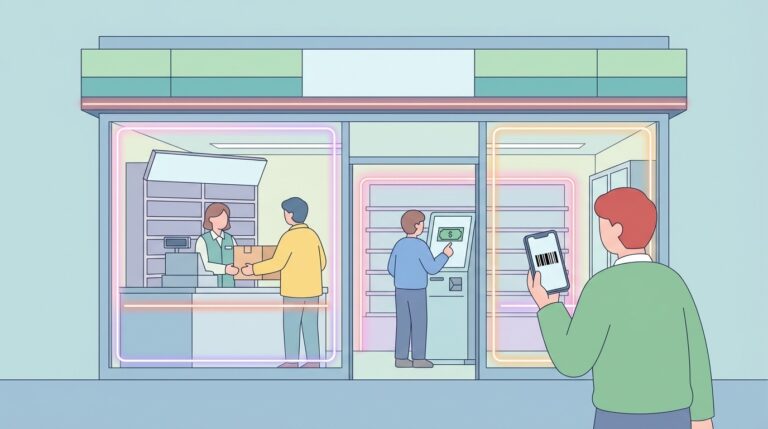
Imagine this: You’re watching a K-Drama. The protagonist just had a massive argument. Where do they go to cool off? Not a bar, but the glowing neon oasis of a convenience store (편의점 – pyeon-ui-jeom). But notice what happens next. They aren’t just buying a triangle kimbap or a bottle of Soju. They are printing documents, picking up a laundry delivery, handing the clerk a QR code to pay their gas bill, and trading a secondhand item they bought online.
Welcome to the modern Korean convenience store—the hyper-local, socio-cultural micro-hub of society. If you only know how to buy snacks here, you are missing out on 80% of what this ecosystem offers. Textbooks might teach you to go to the post office or the bank, but if you do that for every little chore, your Korean friends will look at you like you’re living in the 1990s.
Today, I’m going to upgrade your Korean from a tourist level to a “Seoulite who has lived here for 5 years” level. Let’s dive in!
Phase 2: Deep Dive into Key Expressions
1. 반값택배 접수할게요.
- Pronunciation: [ban-kkap-taek-bae jeop-su-hal-kke-yo.] / bahn-kkap-teck-bae jup-soo-hal-kkeh-yo
- Meaning: (Literal) I will register a half-price parcel. / (Real Nuance) I’d like to send a package using your store-to-store delivery service.
- K-Culture Moment: You bought a photocard of your favorite K-Pop idol on X (Twitter), and the seller asks, “CU끼리 택배 괜찮으세요?” (Are you okay with CU-to-CU delivery?). Because convenience stores have their own massive logistics networks, you can send packages from one store to another for half the price of a regular courier.
- Editor’s Insight: The word ‘반값’ (half-price) mixed with ‘택배’ (delivery) is the holy grail of modern Korean budget living. You operate the kiosk yourself, but you tell the clerk this when you bring the printed label to the counter.
- Situation Spectrum:
[🚫 절대 금지] ———— [⚠️ 주의] ———— [✅ 자유롭게]- Clerk at the counter: ✅ (Perfectly natural and polite)
- Formal Business: ⚠️ (Use regular couriers for professional business)
- 🤔 Think About It: Korea has one of the fastest delivery infrastructures in the world. Why do you think people prefer “store-to-store” delivery even if it takes a day longer? (Hint: It relates to the safety of single-person households!)
2. 공과금 지로 납부할 수 있나요?
- Pronunciation: [gong-gwa-geum ji-ro nap-bbu-hal ssu in-na-yo?] / gong-gwa-geum jee-ro nahp-bboo-hal ssoo in-nah-yo?
- Meaning: (Literal) Can I pay my utility GIRO bill? / (Real Nuance) Can I pay my gas/water/electricity bill here using this barcode?
- K-Culture Moment: It’s 11 PM. You just realized your electricity bill is due at midnight. Do you panic? No. You walk down in your pajamas to the GS25 on the corner, hand them the paper bill with a barcode (GIRO), and pay it along with your late-night ramen.
- Editor’s Insight: This phrase instantly marks you as a true resident, not a tourist. ‘공과금’ means utility bills. Say this clearly, and the clerk will simply take out their scanner.
- Situation Spectrum:
[🚫 절대 금지] ———— [⚠️ 주의] ———— [✅ 자유롭게]- Any Convenience Store: ✅
- 🤔 Think About It: How does the 24/7 availability of financial services at convenience stores affect the work-life balance of Koreans?
3. 종량제 봉투 20리터짜리 하나 주세요.
- Pronunciation: [jong-nyang-je bong-tu i-sim-ni-teo-jja-ri ha-na ju-se-yo.] / jong-nyang-jeh bong-too ee-shim-nee-tuh-jja-ree ha-nah joo-seh-yo
- Meaning: (Literal) Please give me one 20-liter volume-rate garbage bag. / (Real Nuance) I need a standard city garbage bag to use as a shopping bag (and later for my trash).
- K-Culture Moment: You are checking out with an armful of groceries. The clerk asks, “봉투 필요하세요?” (Do you need a bag?). Instead of buying a useless plastic bag for 50 won, a true local asks for a ‘종량제 봉투’ (standardized municipal garbage bag). You use it to carry your items home, and then use it for your trash!
- Editor’s Insight: This is the ultimate C2 level survival hack. Because garbage bags are strictly regulated by district (구), buying them at the convenience store is a daily routine.
- Situation Spectrum:
[🚫 절대 금지] ———— [⚠️ 주의] ———— [✅ 자유롭게]- Convenience Store / Supermarket: ✅
- 🤔 Think About It: Korea has an incredibly strict waste sorting system (분리수거). How does buying garbage bags reflect a society’s approach to environmental responsibility?
Phase 3: Textbook vs Real Life
| 상황 | 📖 교과서 한국어 | 🗣️ 진짜 한국어 | 💡 왜 다를까? |
|---|---|---|---|
| 소포 보내기 (Sending a parcel) | 우체국이 어디에 있습니까? (Where is the post office?) | 반값택배 접수할게요. (I’ll register a half-price parcel.) | Post offices close at 6 PM, but convenience store kiosks are open 24/7. |
| 쇼핑백 요청 (Asking for a bag) | 비닐봉지 하나 주시겠어요? (Could you give me a plastic bag?) | 종량제 (봉투) 20리터 하나 주세요. (Give me a 20L garbage bag.) | Environmental laws restrict plastic bags; locals use municipal garbage bags instead. |
| 교통카드 충전 (Transit card) | 티머니 카드에 돈을 넣어주세요. (Please put money in the T-Money card.) | 만 원 충전해 주세요. (Please recharge it with 10,000 won.) | ‘충전’ (recharge) is the universally understood verb for all top-ups. |
Phase 4: Cultural Deep Dive
4-1. Non-verbal Communication: The Kiosk “Nunchi” (눈치)
When using the delivery kiosk at a convenience store, you need Nunchi (the subtle art of reading the room). These kiosks are often located right next to the ATM or the ramen water dispenser. If the store is crowded and you have 5 boxes to weigh and register, step aside and let people pay for their quick items first. Also, have your QR code or barcode ready on your phone’s screen with the brightness turned all the way up before you step up to the counter. It’s the unspoken rule of “Palli-palli” (hurry up) courtesy!
4-2. K-Culture Connection: The Single-Person Household Hub
In K-Dramas like Because This Is My First Life or Itaewon Class, convenience stores are the ultimate backdrop for people living alone (1인 가구 – 1-in ga-gu). Why? Because young professionals living in small studio apartments (원룸) often don’t have building concierges to receive packages securely. The convenience store acts as their personal mailroom, their pantry, and their financial hub. It is the architectural manifestation of Korea’s modern demographic shift toward hyper-individualized, yet hyper-connected living.
Phase 5: Immersive Roleplay
Scenario A: The Checkout Counter
Setting: It’s 8 PM on a Tuesday. You live in a small studio in Mapo-gu. You’ve just picked up a package from the kiosk, grabbed a forgotten utility bill, and picked up some late-night snacks. You approach the clerk.
YOU (독자): (Placing the items, the printed kiosk receipt, and the bill on the counter)
알바생 (Clerk): 어서 오세요. 포인트 적립하시나요?
(eo-seo o-se-yo. po-in-teu jeong-ni-pa-si-na-yo?)
(Welcome. Do you want to earn reward points?)
YOU: 아, 아니요. 괜찮습니다. 이거 공과금도 같이 결제해 주세요.
(a, a-ni-yo. gwaen-chan-seum-ni-da. i-geo gong-gwa-geum-do ga-chi gyeol-je-hae ju-se-yo.)
(Ah, no, it’s okay. Please process this utility bill together with these.)
알바생: 네, 택배랑 공과금, 상품 다 해서 25,000원입니다. 봉투 필요하세요?
(ne, taek-bae-rang gong-gwa-geum, sang-pum da hae-seo i-man-o-cheon-won-im-ni-da. bong-tu pi-ryo-ha-se-yo?)
(Yes, for the parcel, the bill, and the goods, it’s 25,000 won. Do you need a bag?)
🔀 당신의 차례! 어떻게 대답할까요? (Your Turn! How will you reply?)
– A) 네, 비닐봉지 주세요. (Yes, give me a plastic bag.)
– B) 아니요, 그냥 들고 갈게요. (No, I’ll just carry them.)
– C) 종량제 봉투 20리터짜리로 하나 주세요. (Please give me a 20L standard garbage bag.)✅ Best Choice: C — Why? As a true local, you know that buying a standard plastic bag is a waste of money because you can’t use it for trash later. Asking for a ‘종량제 봉투’ makes you look like a seasoned Seoul resident!
⚠️ Choice A Analysis: Convenience stores are legally restricted from giving out cheap disposable plastic bags. They will give you a paper bag or a reusable one, which costs more.
Scenario B: The C2C Trade (Bonus)
Setting: You bought an item on ‘Danggeun Market’ (Karrot), Korea’s biggest neighborhood trading app. The seller left the item at the local GS25 for you to pick up.
YOU: 저기요, 혹시 당근 거래 물품 맡겨주신 거 있나요?
(jeo-gi-yo, hok-si dang-geun geo-rae mul-pum mat-gyeo-ju-sin geo in-na-yo?)
(Excuse me, by any chance, is there an item left here for a Karrot trade?)
알바생: 아, 네! 핸드폰 번호 뒷자리 확인해 드릴게요.
(a, ne! haen-deu-pon beon-ho dwit-jja-ri hwa-gin-hae deu-ril-gge-yo.)
(Ah, yes! Let me check the last four digits of your phone number.)
Phase 6: 10-Second Shadowing Drill
Read this out loud to master the natural rhythm. Pay attention to the pauses (/) and the emotion!
😊 아, 저기요! / 이거 반값택배 / 접수할게요. / 그리고 / 종량제 봉투 이십 리터 하나 주세요!
(a, jeo-gi-yo! / i-geo ban-kkap-taek-bae / jeop-su-hal-kke-yo. / geu-ri-go / jong-nyang-je bong-tu i-sim-ni-teo ha-na ju-se-yo!)
Phase 7: K-Culture Glossary
| 한국어 | Romanization | 영어 | 맥락 설명 (Context) |
|---|---|---|---|
| 편세권 | pyeon-se-gwon | Convenience Store Sphere | A slang derived from real estate terms. It means living in an area where a convenience store is extremely close. A highly desired living condition! |
| 1인 가구 | i-rin ga-gu | Single-person household | The demographic group driving the evolution of convenience stores into lifestyle hubs. |
| 반값택배 | ban-kkap-taek-bae | Half-price delivery | A logistical marvel where you send and receive packages between convenience stores of the same brand. |
| 당근하다 | dang-geun-ha-da | To trade on Karrot | Used as a verb! Trading second-hand items with neighbors. Often done at convenience stores for safety. |
| 기프티콘 | gi-peu-ti-kon | Gifticon | Mobile barcode vouchers often used to claim free drinks or snacks at convenience stores. |
Phase 8: Traveler’s Survival Kit
Even if you are just passing through Korea, the convenience store is your ultimate safe zone. Here are the top survival phrases for the hyper-local hub.
🆘 서바이벌 표현 TOP 3
1. 🇰🇷 교통카드 만 원 충전해 주세요. (gyo-tong-ka-deu man won chung-jeon-hae ju-se-yo.)
– 🗣️ Meaning: Please recharge my transit card with 10,000 won.
2. 🇰🇷 이거 전자레인지에 얼마나 돌려야 돼요? (i-geo jeon-ja-re-in-ji-e eol-ma-na dol-lyeo-ya dwae-yo?)
– 🗣️ Meaning: How long should I microwave this for?
3. 🇰🇷 영수증은 버려주세요. (yeong-su-jeung-eun beo-ryeo-ju-se-yo.)
– 🗣️ Meaning: Please throw away the receipt. (Very commonly used!)📌 Editor’s Travel Note
– App Tip: Download the CU or GS25 app. You can check the real-time inventory of popular items (like viral K-pop collaboration snacks or the elusive Asahi Super Dry draft beer cans) before you even walk to the store!
– Payment: Apple Pay is becoming more common, but a physical credit card or T-Money card is foolproof.
Phase 9: Think Deeper — “한 발 더 깊이”
🧠 Think Deeper: Media vs Reality & The ‘Palli-Palli’ Culture
In K-Dramas, the convenience store often serves as a romantic rendezvous point—a place to share a quiet beer under a green umbrella. While that absolutely happens, the reality is much more pragmatic. The evolution of the convenience store into a hub where you can bank, ship, print, and trade is a direct reflection of Korea’s ‘Palli-Palli’ (hurry up) culture combined with the highest smartphone penetration rate in the world. It is an infrastructure built on the premise that time is the most valuable commodity. Why wait for the post office to open at 9 AM when your local CU is open at 3 AM? This hyper-efficiency shows how Korean society adapts to urban density by decentralizing essential services into neighborhood corners.
💬 Your Turn: Does your country have a “hub” that serves multiple, unrelated functions in everyday life? Or do you still visit separate buildings for mail, banking, and groceries? Let me know in the comments!
Phase 10: FAQ & Troubleshooting
Q: “Can I eat anything I buy inside the store?”
Yes! Most stores have a dining area (often with hot water dispensers and microwaves). However, it is strictly considered bad manners to leave your trash on the table. Always separate your trash in the designated bins (분리수거) before leaving.
Q: “Can I drink alcohol at the tables outside?”
Legally, drinking at convenience store outdoor tables is a gray area and technically prohibited if the store doesn’t have a specific restaurant license. However, it’s widely tolerated in reality. But making loud noise late at night will quickly get the police called by angry neighbors above.
❌ 흔한 실수 (Common Mistake) #1: Handing your credit card to the clerk with one hand while looking at your phone.
✅ 이렇게 하세요: Always offer your card with two hands, or at least with your right hand supported by your left hand. A quick nod of the head when receiving the card back goes a long way in showing respect.
Phase 11: Wrap-up & Action Items
One-Liner Summary: The Korean convenience store is not just a shop; it’s a 24/7 hyper-local community center where you can manage your entire life.
Action Mission:
– 🥉 Bronze (Solo): Stand in front of a mirror and practice saying “반값택배 접수할게요” three times naturally without stuttering.
– 🥈 Silver (Online): Go to a K-Drama forum or X (Twitter) and see if you can spot anyone mentioning ‘당근’ (Karrot) or ‘편의점 택배’ (Convenience store delivery) in their posts.
– 🥇 Gold (Real Life): Visit a Korean convenience store and ask for a 20L garbage bag instead of a plastic shopping bag using today’s phrase!
K-Culture Mission: Next time you watch a K-Drama, pay close attention to the convenience store scenes. Are they just buying food, or are they using the kiosk, paying bills, or picking up a package? You’ll start noticing it everywhere!
Phase 12: Interactive Quiz
1. You are at CU. You want to buy a bag that you can use to carry your snacks now, and use for trash at your Airbnb later. What should you ask for?
A) 비닐봉지 (Bi-nil-bong-ji)
B) 종량제 봉투 (Jong-nyang-je bong-tu)
C) 종이 가방 (Jong-i ga-bang)
2. True or False: If you buy a K-pop photocard online, you can have the seller ship it directly to your local GS25 instead of your house.
A) True
B) False
3. Fill in the blank: You want to add 10,000 won to your T-Money card. “만 원 ______해 주세요.”
A) 결제 (Gyeol-je – Pay)
B) 충전 (Chung-jeon – Recharge)
C) 환불 (Hwan-bul – Refund)
Answers (Click to reveal!)
1. B (Standardized volume-rate garbage bag. C2 level insider tip!)
2. True (This is the famous ‘반값택배’ store-to-store delivery system!)
3. B (충전 – Recharge/Top-up. Essential survival vocabulary!)
Frequently Asked Questions (FAQ)
Q: What does "반값택배 접수할게요." mean in Korean and how do you pronounce it?
A: In Korean, "반값택배 접수할게요." is pronounced [ban-kkap-taek-bae jeop-su-hal-kke-yo.] and means: (Literal) I will register a half-price parcel. / (Real Nuance) I’d like to send a package using your store-to-store delivery service.
Q: What does "공과금 지로 납부할 수 있나요?" mean in Korean and how do you pronounce it?
A: In Korean, "공과금 지로 납부할 수 있나요?" is pronounced [gong-gwa-geum ji-ro nap-bbu-hal ssu in-na-yo?] and means: (Literal) Can I pay my utility GIRO bill? / (Real Nuance) Can I pay my gas/water/electricity bill here using this barcode?
Q: What does "종량제 봉투 20리터짜리 하나 주세요." mean in Korean and how do you pronounce it?
A: In Korean, "종량제 봉투 20리터짜리 하나 주세요." is pronounced [jong-nyang-je bong-tu i-sim-ni-teo-jja-ri ha-na ju-se-yo.] and means: (Literal) Please give me one 20-liter volume-rate garbage bag. / (Real Nuance) I need a standard city garbage bag to use as a shopping bag (and later for my trash).






