

Phase 1: Empathy — Immersive Hook
Hello there! I’m the Lead Editor at Daily Hangul, your veteran tutor and local Seoul culture navigator.
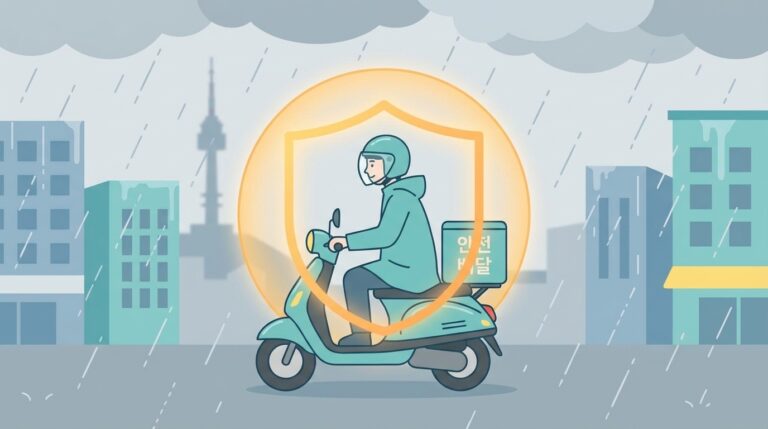
Picture this K-Drama scene: The protagonist is sitting in their cozy rooftop room (옥탑방) while a heavy monsoon rain (장마) pours outside. They crave spicy Tteokbokki. They open a delivery app, but before they can even select a menu, a pop-up appears on the screen: “Due to heavy rain, delivery times may be delayed. Please support our riders’ safe driving.”
If you’ve spent any time in Korea recently, you’ve likely noticed a massive cultural shift. Korea is globally famous for its 빨리빨리 (Pali-pali / Hurry, hurry) culture. But over the last few years, the narrative has evolved. As the gig economy booms, Korean society has started having deep, critical conversations about 라이더 안전 (Rider Safety) and 처우 개선 (Improving Working Conditions).
At a C1 level, mastering Korean isn’t just about knowing how to order food. It’s about navigating the social consciousness embedded in everyday language. If you know how to use these mindful expressions, your Korean friends—and the riders themselves—will instantly recognize you not just as a tourist, but as someone who truly understands modern Korean society.
Let’s dive right in!
Phase 2: Core Expressions Deep Dive
Let’s look at the exact phrases you’ll see on apps and hear in real life regarding rider safety and respect.
1. 천천히 오셔도 되니까 안전하게 와주세요.
- Pronunciation: [Cheoncheonhi osyeodo doenikka anjeonhage wajuseyo.] / “Chun-chun-hee oh-shuh-doh dweh-nee-kka ahn-jun-hah-geh wah-joo-seh-yo”
- Meaning: (Literal) Because it is okay to come slowly, please come safely. / (Real Nuance) Take your time, safety first!
- K-Culture Moment: You’ll frequently see this as a selectable “request to rider” checkbox on apps like Baedal Minjok (Baemin) or Yogiyo, especially during snowy or rainy days.
- Editor’s Insight: This phrase feels warm and considerate. The grammar structure
-아/어/여도 되다(it is okay to…) combined with-(으)니까(because) softens the request, showing empathy toward the rider’s working conditions. - Situation Spectrum:
[🚫 Never] ———— [⚠️ Caution] ———— [✅ Freely]- Delivery App Request Box: ✅
- Speaking directly to a rider: ✅
- To a friend (casual): 🚫 (Too formal, use “천천히 와~” instead)
- 🤔 Think About It: Korea built its modern economy on “Pali-pali.” Why do you think this specific phrase had to be institutionalized into delivery apps as a default checkbox? What does this say about the collective effort to change a deeply ingrained habit?
2. 기사님, 빗길 / 눈길 조심하세요.
- Pronunciation: [Gisanim, bitgil / nungil josimhaseyo.] / “Gee-sah-neem, beet-geel / noon-geel joh-sheem-hah-seh-yo”
- Meaning: Driver, please be careful on the rainy/snowy roads.
- K-Culture Moment: When receiving the food directly at the door during bad weather, saying this as you take the bag instantly shifts the dynamic from a cold transaction to a human connection.
- Editor’s Insight:
기사님is the standard, respectful title for drivers and riders in Korea. Never call them 아저씨 (Ajeossi)! Adding빗길(rainy road) or눈길(snowy road) shows high-level situational awareness. - Situation Spectrum:
[🚫 Never] ———— [⚠️ Caution] ———— [✅ Freely]- To Delivery Riders/Taxi Drivers: ✅
- To Coworkers leaving the office: ✅
- To a younger friend: ⚠️ (Use “조심해서 가” instead)
- 🤔 Think About It: Notice how Koreans frequently comment on the weather as a form of greeting or farewell. How does your native language incorporate weather into expressions of care?
3. 문 앞에 두고 벨 눌러주세요.
- Pronunciation: [Mun ape dugo bel nulleojuseyo.] / “Moon ah-peh doo-goh bel nool-luh-joo-seh-yo”
- Meaning: Please leave it in front of the door and ring the bell.
- K-Culture Moment: This is the ultimate “Contactless Delivery” (비대면 배달) phrase.
- Editor’s Insight: While originally popularized during the pandemic, this has remained the default. Why? Because it’s a win-win. It gives introverted Koreans peace of mind, and crucially, it saves the rider precious seconds, allowing them to take on more deliveries and earn more without the pressure of waiting for the customer to open the door.
- Situation Spectrum:
[🚫 Never] ———— [⚠️ Caution] ———— [✅ Freely]- Delivery App Note: ✅
Phase 3: Textbook vs Real Life
| Situation | 📖 Textbook Korean | 🗣️ Real Korean | 💡 Why the difference? |
|---|---|---|---|
| Addressing the rider | 배달원 선생님 (Mr. Delivery worker) | 기사님 (Gisa-nim) | “기사님” is the universally accepted, polite term for drivers in the service industry. |
| Bad weather warning | 비가 오니까 운전 조심하십시오. (Because it’s raining, drive carefully.) | 빗길 안전운행 하세요~ (Safe driving on the rainy road~) | Adding “안전운행” (safe driving) is standard industry jargon that sounds highly natural. |
| Receiving food | 배달해 주셔서 감사합니다. (Thank you for delivering.) | 수고하셨습니다~ (Thank you for your hard work~) | Recognizing the effort/labor (수고) is deeply embedded in Korean workplace and service culture. |
Bottom Note: At the C1 level, your goal is to sound natural, not like a dictionary. Swapping “감사합니다” for “수고하셨습니다” when dealing with service workers is an instant marker of fluency.
Phase 4: Cultural Deep Dive
4-1. Non-verbal Communication & Nunchi (눈치)
When receiving food directly, Nunchi plays a huge role. If the rider looks rushed, out of breath, or holding another bag, a lengthy “Thank you so much, the weather is so bad, I really appreciate it…” actually causes them stress! The best Nunchi here is a quick bow of the head, a swift “수고하십니다!” and quickly taking the food so they can rush to their next destination.
4-2. K-Culture Connection: The Evolution of K-Food Delivery
If you watch an older K-Drama from the 2000s, you’ll see characters calling a local Chinese restaurant directly and shouting, “아저씨, 언제 와요?!” (Sir, when are you coming?!). The restaurants had their own salaried delivery staff.
Today, Korea operates on a massive Platform Gig Economy (플랫폼 노동). Riders are independent contractors using apps like Baemin or Coupang Eats. This shift changed the language. Because riders are paid per delivery and penalized by algorithms for being late, social campaigns led by consumers and activists have heavily promoted the phrase “안전 배달” (Safe Delivery) over “총알 배달” (Bullet Delivery). Understanding this economic shift is crucial for advanced learners!
Phase 5: Immersive Roleplay
Scenario A: The Snowy Day Dilemma
- Setting: A Friday evening in January. It’s snowing heavily in Seoul (폭설). You are hanging out at your Korean friend’s apartment in Mapo-gu. You both are starving.
- Characters:
- YOU: An expat who is hyper-aware of Korean social issues.
- Ji-hoon (30): Your close Korean friend, usually very relaxed.
Ji-hoon: 아, 눈 너무 많이 오네. 나가기 귀찮다. 그냥 배달 시킬까? 🍕
(Ah, nun neomu mani one. Nagagi gwichanta. Geunyang baedal sikilkka?)
(Ah, it’s snowing too much. Too lazy to go out. Should we just order delivery?)
YOU: 이 날씨에 배달이 될까? 라이더분들 위험하지 않을까?
(I nalssie baedari doelkka? Raideobundeul wiheomhaji aneulkka?)
(Will delivery even work in this weather? Won’t it be dangerous for the riders?)
Ji-hoon: 그래서 배달 팁(Tip)이 엄청 올랐어. 지금 할증 붙어서 배달비만 7천 원이야.
(Geuraeseo baedal tibi eomcheong ollasseo. Jigeum haljeung buteoseo baedalbiman chil-cheon woniya.)
(That’s why the delivery tip went way up. With the surcharge, delivery alone is 7,000 won right now.)
YOU: 헐… 그래도 먹고 싶은데 어떡하지?
(Heol… geuraedo meokgo sipeunde eotteokhaji?)
(Omg… but I still want to eat, what should we do?)
Ji-hoon: 그냥 시키자. 대신 요청사항에 이거 꼭 체크하고!
(Geunyang sikija. Daesin yocheongsahange igeo kkok chekeuhago!)
(Let’s just order. Instead, make sure to check this box in the requests!)
🔀 Your Turn! What box is Ji-hoon pointing at?
– A) “최대한 빨리 와주세요” (Please come as fast as possible)
– B) “문 앞에 두고 벨 눌러주세요” (Leave at door and ring bell)
– C) “천천히 오셔도 되니까 안전하게 와주세요” (Take your time, please come safely)✅ Best Choice: C — In severe weather, choosing C shows excellent social awareness and reduces the algorithmic pressure on the rider.
Scenario B: Bonus K-Drama Trope Break
In a drama, the rider takes off his helmet, and he’s a gorgeous idol-actor, and you lock eyes.
Reality Check: The rider is wearing a balaclava, a heavy padded jacket, and just wants to drop the food off. You open the door slightly, exchange a quick “수고하셨습니다~” and the transaction is done in 2.5 seconds. The real romance is between you and the hot fried chicken.
Phase 6: 10-Second Shadowing Drill
Practice reading these out loud, focusing on the natural pauses (/) and the emotional tone!
- 🥺 Considerately: 기사님, / 눈길이니까 / 천~천히 오셔도 됩니다!
(Gisa-nim, / nungir-inikka / cheon~cheonhi osyeodo doemnida!) -
😊 Politely: 문 앞에 / 두시고 / 문자 한 통 / 남겨주세요.
(Mun ap-e / dusigo / munja han tong / namgyeojuseyo.) -
😤 Firmly (to a friend complaining about slow food): 야, / 오늘 기상 악화잖아. / 배달 재촉하지 마.
(Ya, / oneul gisang akwa-jana. / baedal jaechokhaji ma.)
Phase 7: K-Culture Glossary
| 한국어 | Romanization | English | Contextual Meaning |
|---|---|---|---|
| 기상 악화 | gisang akwa | Severe weather | A formal term used in apps to explain delays due to rain, snow, or typhoons. |
| 배달 팁 | baedal tip | Delivery fee | Unlike Western “tips” given voluntarily, this is the mandatory delivery fee set by the app. |
| 할증 | haljeung | Surcharge | Extra fees added during late nights or bad weather to compensate workers. |
| 비대면 | bidaemyeon | Non-face-to-face | Contactless delivery/service. A staple word post-2020. |
| 플랫폼 노동자 | peullaetpom nodongja | Platform worker | Gig economy workers (riders, drivers). A key term in Korean social issues. |
Phase 8: Traveler’s Survival Kit
Even as a tourist, you will likely use food apps at your hotel or Airbnb. Here is your advanced survival guide for navigating the delivery ecosystem.
🆘 Survival Phrases for App Notes
– 🇰🇷 “공동현관 비밀번호: 1234* 입니다.” (gongdong-hyeongwan bimilbeonho: 1234* imnida.)
– 🗣️ Meaning: The main building entrance passcode is 1234*.
– 📍 Where to use: App request box.
– 💡 Pro Tip: Riders waste the most time stuck outside building lobbies. Providing the code directly is the ultimate form of rider consideration!📌 Editor’s Travel Note
– Cash vs Card: Do not try to pay riders in cash. Almost 99% of deliveries in Korea are pre-paid (선결제) through the app.
– Tipping Culture: There is absolutely NO tipping culture in Korea. Do not hand the rider a 5,000 won bill; it will confuse them and might even make them uncomfortable. Your “delivery tip” was already paid in the app.
– Late Night cravings: If you order after midnight, expect a “심야 할증” (late-night surcharge).
Phase 9: Think Deeper — “A Step Further”
Language & The Social Cost of Convenience (언어와 편의성의 사회적 비용)
🧠 Think Deeper:
The shift in Korean vocabulary from “빨리빨리” (Pali-pali) to “안전 배달” (Safe delivery) perfectly encapsulates a society maturing and confronting the shadows of its rapid growth. As the gig economy expands globally, language reflects our collective guilt and responsibility. By standardizing phrases like “천천히 오셔도 됩니다” (You may come slowly) in user interfaces, Korean tech companies are essentially using language to re-educate the public on empathy. It begs the question: Can changing the phrases we are forced to click actually change how much we value the unseen labor of platform workers?💬 Your Turn: Does your country have a specific term for “Gig economy workers”? How does society view and discuss their safety and rights? Share in the comments!
Phase 10: FAQ & Troubleshooting
Q: If the food is really late, can I complain to the rider?
– No. Riders rarely control the cooking time or the app’s dispatch algorithm. Complaining to the rider is considered very bad form (갑질 – abuse of power). If there’s an issue, use the app’s customer service chat.
Q: Should I use honorifics (존댓말) to the rider even if they look younger than me?
– Absolutely YES. In Korean service culture, you always use 존댓말 to service workers regardless of age. Speaking in 반말 (casual language) to a worker is incredibly rude.
❌ Common Mistake #1: Saying “아저씨, 수고하세요” (Ajeossi, su-go-ha-se-yo).
✅ Do this instead: Say “기사님, 수고하셨습니다.” (Gisa-nim, su-go-ha-syot-seum-ni-da). “Ajeossi” can sound condescending depending on the tone, and “Gisa-nim” is the professional standard.
Phase 11: Wrap-up & Action Items
One-Liner Summary: True fluency in Korean means understanding that behind the convenience of K-Delivery lies the hard work of riders who deserve our respect and safe language!
Action Mission:
– 🥉 Bronze: Say “기사님, 수고하셨습니다” 3 times out loud to perfect the rhythm.
– 🥈 Silver: Next time you order food (even in your home country), write a kind note to the driver in Korean on your social media.
– 🥇 Gold (For those in Korea): Next time it rains, consciously select the “천천히 오셔도 되니까 안전하게 와주세요” option on Baemin or Yogiyo!
K-Culture Mission:
Read a Korean news headline regarding “플랫폼 노동자” (Platform workers) or “배달 라이더” (Delivery riders). You will spot the vocabulary we learned today immediately!
Phase 12: Interactive Quiz
1. Situational Judgment: It is pouring rain. The rider arrives 30 minutes later than the app predicted. What is the most culturally appropriate thing to say when opening the door?
– A) 왜 이렇게 늦었어요? (Why are you so late?)
– B) 아저씨, 음식 다 식었잖아요! (Sir, the food is all cold!)
– C) 비 오는데 수고 많으셨습니다. (Thank you for your hard work in the rain.)
2. Fill in the Blank:
When writing delivery notes for a contactless drop-off, you should write:
“[ ] 앞에 두고 [ ] 눌러주세요.”
3. True or False – K-Culture Edition:
“If a delivery rider in Korea brings my food during a snowstorm, I should tip them 5,000 won in cash at the door.” (T / F)
👀 Click here for answers!
1. C – The delay is likely due to the app’s algorithm or weather, not the rider. Politeness is key!
2. 문, 벨 (문 앞에 두고 벨 눌러주세요 / Leave at the door and ring the bell)
3. False – Korea does not have a tipping culture. The delivery fee is already paid in the app. Giving cash will cause awkwardness.
Frequently Asked Questions (FAQ)
Q: What does "천천히 오셔도 되니까 안전하게 와주세요." mean in Korean and how do you pronounce it?
A: In Korean, "천천히 오셔도 되니까 안전하게 와주세요." is pronounced [Cheoncheonhi osyeodo doenikka anjeonhage wajuseyo.] and means: (Literal) Because it is okay to come slowly, please come safely. / (Real Nuance) Take your time, safety first!
Q: What does "기사님, 빗길 / 눈길 조심하세요." mean in Korean and how do you pronounce it?
A: In Korean, "기사님, 빗길 / 눈길 조심하세요." is pronounced [Gisanim, bitgil / nungil josimhaseyo.] and means: Driver, please be careful on the rainy/snowy roads.
Q: What does "문 앞에 두고 벨 눌러주세요." mean in Korean and how do you pronounce it?
A: In Korean, "문 앞에 두고 벨 눌러주세요." is pronounced [Mun ape dugo bel nulleojuseyo.] and means: Please leave it in front of the door and ring the bell.






