

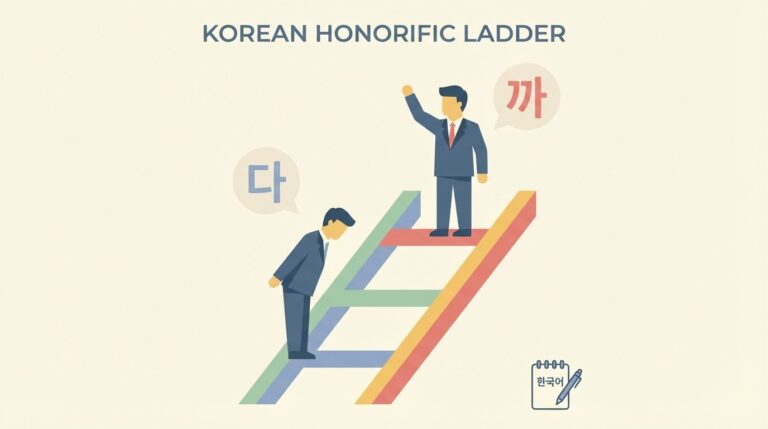
Phase 1: Immersion — The Sound of Discipline
안녕하세요! This is your Daily Hangul Editor.
Imagine this: You are watching the hit Netflix series D.P. or the classic Descendants of the Sun. The atmosphere is tense. A senior officer walks into the barracks. Suddenly, everyone freezes. The silence is broken by a thunderous, synchronized shout.
They aren’t just saying “Hello.” They are performing a ritual of hierarchy.
If you’ve ever wondered why Korean office workers sometimes sound like soldiers, or why your favorite K-Pop idols shout their introductions with such military precision, the answer lies here. Korea’s mandatory military service (군대) isn’t just about defense; it’s a cultural rite of passage that shapes the language of hierarchy and obedience (상명하복 – Sangmyeong-habok: Following orders from above).
Today, we aren’t just learning words; we are learning how to survive in a strict Korean hierarchy. Ready? 차렷 (Charyeot)! Attention!
Phase 2: Deep Dive into Military Speak
Here are the three expressions that define the “Order and Obey” culture, often spilling over into corporate life.
1. 알겠습니다 (Algesseumnida)
- Pronunciation: [Al-get-sseum-ni-da] (Sounds like: I’ll-get-some-knee-da)
- Meaning: Literal: I have understood. / Real Nuance: “Copy that,” “Roger,” or “Yes, Sir!”
- K-Culture Moment: In almost every workplace K-Drama (like Misaeng), when the boss gives an impossible task, the employee bows 45 degrees and says this. It’s the period at the end of a command.
- Editor’s Insight: In the military (and strict companies), you rarely say just “네 (Ne).” “알겠습니다” shows you have fully processed the order and are ready to execute. It implies action, not just hearing.
- Situation Spectrum:
[🚫 Friends] ———— [⚠️ Senior Colleagues] ———— [✅ Boss/Army]- 🤔 Think About It: Why does Korean require a longer, stiffer phrase for “Okay” in formal settings? Does length equal respect in your culture too?
2. 시정하겠습니다 (Sijeong-hagesseumnida)
- Pronunciation: [Si-jeong-ha-get-sseum-ni-da]
- Meaning: Literal: I will correct it. / Real Nuance: “I messed up, I admit it, and I will fix it immediately. Please stop yelling.”
- K-Culture Moment: A soldier is being scolded for messy boots. He doesn’t make excuses like “But it was raining…” He screams, “시정하겠습니다!“
- Editor’s Insight: This is the ultimate “Get Out of Jail Free” card in strict hierarchies. In the West, you might explain why a mistake happened. In Korean military culture, explanations = excuses. Just promise to fix it.
- Situation Spectrum:
[🚫 Casual] ———— [⚠️ Serious Business Error] ———— [✅ Military/Strict Boss]- 🤔 Think About It: Is it better to explain your side of the story or to simply accept fault to keep the peace? Korean culture often prefers the latter in high-pressure hierarchies.
3. 다나까 (Da-Na-Kka Style)
- Pronunciation: [Da-Na-Kka]
- Meaning: The rigid sentence ending rule.
- Editor’s Insight: In the military, almost every sentence must end in ~다 (statement) or ~까? (question). The softer ~요 (Yo) is often forbidden for new recruits because it sounds “too friendly” or “feminine” to old-school commanders.
- Usage: Instead of “밥 먹었어요?” (Did you eat? – Yo style), a soldier asks “식사 하셨습니까?” (Did you eat? – Kka style).
Phase 3: Textbook vs. Real Life (Military Edition)
| Situation | 📖 Textbook Korean | 🗣️ Real Military/Strict Biz | 💡 Why the difference? |
|---|---|---|---|
| Calling a superior | 저기요… (Excuse me…) | 행정관님! / 부장님! (Rank/Title!) | You never call a superior “Hey.” You address the Rank, not the person. |
| Sorry | 미안합니다 (Mianhamnida) | 죄송합니다 / 시정하겠습니다 | “Mian” feels too light. “Sijeong” implies corrective action. |
| Did you hear me? | 들었어요? (Deureosseoyo?) | 들었나? / 들었습니까? | Ending with ‘Yo’ kills the authority vibe. ‘Ka/Na’ maintains the wall of power. |
Bottom Note: Even in civilian life (companies), men who recently finished service often accidentally use “Da-Na-Kka” style because it’s hard to switch off!
Phase 4: Cultural Deep Dive — The Hierarchy Pyramid
4-1. The “Gak” (각 – Angle)
In the military, everything has an “angle.” Your beret, your salute, even the way you fold your blanket. This translates to body language in society. When listening to a superior (Sang-sa), you don’t lean back or cross your arms. You stand straight, hands at your side or clasped in front. Slouching is seen as rebellion.
4-2. K-Drama Connection: The “Kkondae” (꼰대)
You’ve seen the older manager in dramas who forces juniors to drink or demands absolute loyalty? This is the Kkondae—an older person who enforces rigid, military-style hierarchy in civilian life. They believe “My way is the highway” because that’s how they survived the army. Understanding military culture helps you understand why these characters exist (and why everyone hates them, yet obeys them).
Phase 5: Immersive Roleplay — The Strict Manager
Setting: Monday Morning Meeting at a conservative Korean company. The atmosphere is icy. Your Team Manager (Bu-jang-nim), who prides himself on his military background, is reviewing your report.
Characters:
* YOU: New employee (still learning the ropes).
* Mr. Choi: The authoritarian manager (50s, scary).
Start Dialogue:
Mr. Choi: (Throwing the paper on the desk) 김 대리, 보고서 형식이 이게 뭡니까? 글자 폰트가 안 맞잖아!
(Kim daeri, bogoseo hyeongsigi ige mwomnikka? Geulja ponteuga an matjana!)
[Assistant Manager Kim, what is this report format? The fonts don’t match!]
🔀 Your Turn! How do you respond?
Option A: “아, 컴퓨터가 좀 이상해서요. 고칠게요.” (Ah, my computer was acting weird. I’ll fix it.)
Option B: “죄송합니다! 바로 시정하겠습니다!” (Sorry! I will correct it immediately!)
Option C: “폰트가 중요한가요? 내용은 좋은데요.” (Is the font important? The content is good.)✅ Best Choice: B
Why: Mr. Choi is a stickler for rules. He doesn’t care about your computer glitches (Option A is an excuse). He wants immediate obedience. Option C would get you fired (metaphorically) in this culture.
Mr. Choi: (Nods, slightly satisfied by your attitude) 점심 먹기 전까지 다시 해서 가져오세요. 알겠습니까?
(Jeomsim meokgi jeon-kkaji dasi haeseo gajyeo-oseyo. Algesseumnikka?)
[Bring it back re-done before lunch. Understood?]
YOU: ____________________ ! (Fill in the blank with the correct acknowledgement)
Phase 6: 10-Second Shadowing Drill
Let’s practice the “snap” of military-style speech. Don’t drag the vowels. Short, sharp, loud.
- 😤 Confirming an order (Sharp):
알겠습니다! / 바로 / 처리하겠습니다!
(Al-get-sseum-ni-da! / Ba-ro / cheo-ri-ha-get-sseum-ni-da!) -
🙇 Apologizing (Serious & Low pitch):
죄송합니다. / 시정하겠습니다.
(Joe-song-ham-ni-da. / Si-jeong-ha-get-sseum-ni-da.)
Phase 7: K-Culture Mini Glossary
| Korean | Romanization | Meaning | Context |
|---|---|---|---|
| 군대 | Gundae | Military | Every able-bodied Korean male serves ~18 months. |
| 고문관 | Gomungwan | Clumsy Soldier | Slang for someone who is slow, makes mistakes, and frustrates the team. |
| 짬밥 | Jjambap | Army Food / Experience | “He has a lot of Jjambap” means he has a lot of experience/seniority. |
| 선임 / 후임 | Seonim / Huim | Senior / Junior | The strict senior-junior relationship within the military unit. |
Phase 8: Traveler’s Survival Kit — Dealing with Authority
Even as a tourist, you might encounter strict hierarchy (Police, DMZ Security, Border Control).
🆘 Survival Expression: “Check, please?” (Wait, no!)
In security situations (e.g., airport security, DMZ tour), do not joke around.Top Phrase to know:
🇰🇷 “협조해 주십시오” (Hyeopjohae jusipsio)
– Meaning: “Please cooperate.”
– Context: If a security guard says this, stop what you are doing immediately.💡 Pro Tip: If you visit the DMZ (Demilitarized Zone), the soldiers there are on active duty. Do not point cameras at them unless permitted. If they say “No photo,” reply with a bow and “Sorry” (Joesong-hamnida), then lower your camera instantly. No arguing.
Phase 9: Think Deeper — Language & Power
Why does Korean differentiate between “listening” and “obeying” so strictly?
The military culture (Gundae mindset) reinforces the Confucian idea that society is a vertical ladder, not a horizontal line. In English, respect is often earned through competence. In the traditional Korean framework, respect is initially demanded by position (Rank) and time (Age/Seniority).
However, the younger generation (MZ Generation) is fighting back. They use “Yo” endings more often and challenge the “Kkondae” culture. Yet, the ghost of military hierarchy still haunts the boardroom.
🧠 Think Deeper: In your country, how do you speak to a police officer vs. a grandfather? Is the difference as drastic as changing your verb endings?
Phase 10: FAQ & Troubleshooting
Q: Can I salute (충성 – Chungseong) to my Korean friends for fun?
A: Maybe. If it’s a close male friend who recently finished service, he might laugh or cringe (PTSD!). But never salute a stranger, an elder, or a police officer as a joke. It can be seen as mocking the uniform.
Q: Do women use this military language?
A: Generally, no. However, in formal business settings, women also use the “~da/na/kka” style to sound professional and authoritative, though they skip the specific military terms like “Sijeong-hagesseumnida.”
❌ Common Mistake:
Don’t say “알았어” (Arasseo – Casual “Okay”) to a superior just because you feel friendly. It is instant disrespect.
✅ Fix: Stick to “알겠습니다” (Algesseumnida) until they explicitly tell you to relax.
Phase 11: Wrap-up & Action Mission
One-Liner: “In Korea, Hierarchy is King, and ‘Algesseumnida’ is your shield.”
🚀 Your Mission:
– 🥉 Bronze: Practice saying “Algesseumnida” with a sharp, decisive tone in the mirror.
– 🥈 Silver: Watch a clip of Descendants of the Sun or D.P. and count how many times you hear “~Da” or “~Kka” endings.
– 🥇 Gold: Next time a Korean friend explains a rule or plan to you, reply with a firm “알겠습니다!” and see if they laugh at your discipline.
💬 Question: Have you ever worked in a place with a strict hierarchy? How did it change the way you spoke? Let me know in the comments!
Frequently Asked Questions (FAQ)
Q: What does "알겠습니다 (Algesseumnida)" mean in Korean and how do you pronounce it?
A: In Korean, "알겠습니다 (Algesseumnida)" is pronounced [Al-get-sseum-ni-da] and means: Literal: I have understood. / Real Nuance: "Copy that," "Roger," or "Yes, Sir!"
Q: What does "시정하겠습니다 (Sijeong-hagesseumnida)" mean in Korean and how do you pronounce it?
A: In Korean, "시정하겠습니다 (Sijeong-hagesseumnida)" is pronounced [Si-jeong-ha-get-sseum-ni-da] and means: Literal: I will correct it. / Real Nuance: "I messed up, I admit it, and I will fix it immediately. Please stop yelling."
Q: What does "다나까 (Da-Na-Kka Style)" mean in Korean and how do you pronounce it?
A: In Korean, "다나까 (Da-Na-Kka Style)" is pronounced [Da-Na-Kka] and means: The rigid sentence ending rule.







