

Beyond the K-Drama Tears: Understanding Korea’s Fight for Democracy 🇰🇷
Phase 1: The Hook — Why Are They Running? 🏃♂️💨
“Please, just let me go! My family is waiting!”
If you’ve watched K-Dramas like “Reply 1988” (응답하라 1988), “Youth of May” (오월의 청춘), or the movie “A Taxi Driver” (택시운전사), you’ve seen it. University students shouting slogans, green tear gas filling the streets, and ordinary citizens hiding terrified students from the police.
Foreigners often ask me: “Why are Korean dramas so obsessed with the 1980s? And why do Koreans seem so passionate when they protest today?”
To understand the modern Korean mindset—from the candlelight vigils in Gwanghwamun to the fierce loyalty of K-Pop fandoms—you must understand this era. Today, we aren’t just learning history; we are learning the soul of modern Korea. Specifically, we will look at the Democratization Movement (민주화 운동).
This isn’t just about the past; it’s about understanding why your Korean friend gets teary-eyed when talking about Gwangju, or why “solidarity” is such a strong concept here.
Phase 2: Deep Dive — The Language of Resistance ✊
Since you are at a B2 (Intermediate) level, let’s move beyond basic history terms and look at the words that carry heavy emotional weight.
1. 민주화 (Min-ju-hwa)
- Pronunciation: [Min-ju-hwa] Sounds like ‘Min-ju’ (a girl’s name) + ‘Hwa’ (flower, though the Hanja is different).
- Meaning: Democratization.
- K-Culture Moment: In the movie “1987: When the Day Comes,” characters aren’t just fighting for a political system; they are fighting for min-ju-hwa as a symbol of freedom and human dignity.
- Editor’s Insight: You will hear this word often in news and documentaries. But be careful—on some internet communities, this word has been misused as slang to mock the movement. In standard conversation, it is a sacred and serious word.
- Situation Spectrum:
[🚫 Slang/Joke] ———— [⚠️ Casual Chat] ———— [✅ Serious Discussion]
- Never use this as a joke. It is highly offensive.
- 🤔 Think About It: In your country, is there a specific word that represents a turning point in history? Does it carry an emotional weight like Min-ju-hwa does in Korea?
2. 투쟁 (Tu-jaeng)
- Pronunciation: [Tu-jaeng] The ‘Tu’ sounds sharp, like ‘Two’, and ‘jaeng’ rings out.
- Meaning: Struggle / Fight (usually for a cause).
- K-Culture Moment: You might see workers wearing red headbands in news clips or dramas. The text on the headband usually says “단결 투쟁” (Dan-gyeol Tu-jaeng – United Struggle).
- Editor’s Insight: This isn’t a fistfight (which is ssa-um). Tu-jaeng implies a philosophical or political battle against oppression. You might hear it jokingly used by students studying for exams (“exam struggle”), but its roots are in the labor and democracy movements.
- Situation Spectrum:
[🚫 Romantic Date] ———— [⚠️ Office Complaint] ———— [✅ Political Context]3. 진상 규명 (Jin-sang Gyu-myeong)
- Pronunciation: [Jin-sang Gyu-myeong]
- Meaning: Clarification of the truth / Getting to the bottom of the truth.
- Context: Whenever a tragedy occurs in Korea (historical or modern like the Sewol Ferry), you will see banners asking for this. It means the government must reveal the hidden truth.
- Editor’s Insight: This phrase captures the Korean people’s deep desire for transparency and justice. It’s a very B2/C1 level phrase that shows you understand social issues.
Phase 3: Textbook vs. Real Life 🗣️
How do Koreans actually talk about these heavy topics?
| Situation | 📖 Textbook Korean | 🗣️ Real Korean (Nuanced) | 💡 Why the difference? |
|---|---|---|---|
| Talking about 1980 | 5.18 민주화 운동 (The May 18 Democratization Movement) | 그때 광주에서… (Back then in Gwangju…) | In casual talk, mentioning the place (“Gwangju”) often implies the whole event because of its historical scar. |
| Participating in a protest | 시위에 참가하다 (Participate in a demonstration) | 촛불 들러 가다 (Go to hold a candle) | Since 2016, “holding a candle” has become the metonym for peaceful protest. |
| Remembering the victims | 희생자를 추모하다 (Commemorate the victims) | 잊지 않겠습니다 (I will not forget) | “I will not forget” is a pledge of active memory and solidarity, widely used on social media. |
Phase 4: Cultural Deep Dive — The “Han” (한) in History 🕯️
4-1. The Power of “The Square” (Gwanghwamun)
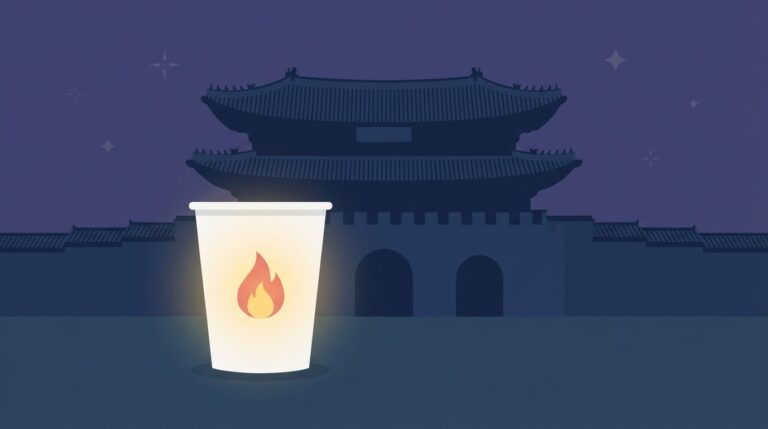
In many countries, protests happen everywhere. In Korea, Gwanghwamun Square (near the King Sejong statue) is the symbolic heart of democracy.
– K-Drama Connection: If you see a scene with thousands of candles at night in a drama set in the modern era, it’s likely referencing the Candlelight Revolution.
– Non-verbal Tip: If you visit a memorial altar (bun-hyang-so), you do not need to speak. Just bow your head. Silence is the loudest form of respect here.
4-2. Music as Resistance
Just like K-Pop unites fans today, Minjung Gayo (People’s Songs) united protesters in the 80s.
– Song to Know: “March for the Beloved” (임을 위한 행진곡). This is the anthem of the Gwangju movement. If you hear this melody in a movie, it signals a moment of solemn resistance. It’s as iconic as the national anthem in this specific context.
Phase 5: Immersive Roleplay — A Trip to Gwangju 🎞️
Setting: You are visiting the May 18th National Cemetery in Gwangju with your Korean friend, Ji-hoon (29). His uncle was a student activist back then. The atmosphere is quiet and solemn.
Ji-hoon: (Looking at a tombstone) 우리 삼촌이 그때 대학생이었거든. 사실 나도 태어나기 전이라 잘은 모르지만… 여기 오면 기분이 좀 이상해.
(Uri samchoni geuttae daehaksaeng-ieot-geodeun. Sasil nado taeeonagi jeonira jareun moreujiman… yeogi omyeon gibuni jom isanghae.)
(My uncle was a university student back then. Actually, it was before I was born so I don’t know it well… but coming here feels strange.)
🔀 Your Turn! How do you respond?
- A) “아, 정말 슬프네요. 날씨가 참 좋아요.” (Ah, so sad. The weather is nice.)
- B) “삼촌이 자랑스러우시겠어요. 민주화를 위해 싸우셨잖아요.” (You must be proud of your uncle. He fought for democratization.)
- C) “무서웠을 것 같아요. 저라면 도망갔을 거예요.” (It must have been scary. I would have run away.)
✅ Best Choice: B
“Samchoni jarang-seu-reo-u-si-ge-sseo-yo. Min-ju-hwa-reul wihae ssa-u-syeot-ja-na-yo.”
Why? It acknowledges the sacrifice and uses the respectful term Min-ju-hwa. It validates his family’s history.
⚠️ Choice A Analysis: Changing the subject to the weather is too abrupt and can seem dismissive in such a solemn place.
Ji-hoon: 고마워. 그분들 덕분에 우리가 지금 이렇게 자유롭게 사는 거겠지?
(Gomawo. Geubundeul deokbune uriga jigeum ireoke jayuropge saneun geogetji?)
(Thanks. It’s thanks to them that we live freely like this now, right?)
YOU: 맞아요.
(Choose your next sentence)
🔀 Your Turn!
– Option 1: “저도 한국 역사를 더 배우고 싶어요.” (I want to learn more about Korean history.)
– Option 2: “배고파요. 밥 먹으러 가요.” (I’m hungry. Let’s go eat.)
Phase 6: 10-Second Shadowing Drill 🗣️
Let’s practice a sentence you might write in a guestbook at a museum or say to a friend discussing history.
“We enjoy freedom today thanks to their courage.”
🇰🇷 그분들의 용기 덕분에 / 오늘날의 자유가 / 있다고 생각해요.
(Geubundeui yonggi deokbune / oneullal-ui jayuga / itdago saeng-gakaeyo.)
- Emotion: 🙏 Solemn and Thankful (진지하고 감사하게)
- Pause Guide:
- 그분들의 용기 덕분에 (Thanks to their courage) /
- 오늘날의 자유가 (today’s freedom) /
- 있다고 생각해요 (I think exists.)
Phase 7: K-Culture Mini Glossary 📘
| Korean | Romanization | English | Context in Culture |
|---|---|---|---|
| 독재 | Dok-jae | Dictatorship | The antagonist force in movies like 1987 or The Man Standing Next |
| 계엄령 | Gye-eom-nyeong | Martial Law | When the military takes control. A terrifying word in Korean history. |
| 시민군 | Simin-gun | Citizen Army | Ordinary people (taxi drivers, students) who took up arms in Gwangju to protect each other. |
| 최루탄 | Choe-ru-tan | Tear Gas | The white smoke you see in every 80s protest scene. |
Phase 8: Traveler’s Survival Kit (History Geek Edition) 🎒
If you are interested in this side of Korea, here are the Top 3 Places to visit and a phrase to use.
🆘 Survival Expression
– 🇰🇷 “혹시 이 근처에 5.18 기념공원이 있나요?”
– (Hoksi i geuncheo-e o-il-pal gi-nyeom-gong-woni innayo?)
– 🗣️ Meaning: “By any chance, is the May 18th Memorial Park near here?”
– 💡 Pro Tip: When asking for directions to historical sites, using “Hoksi” (By any chance) makes you sound very polite and cautious.📌 Editor’s Travel Note
– Gwangju: Visit the May 18th National Cemetery. It is heartbreaking but essential.
– Seoul: Visit the Seodaemun Prison History Hall. While it focuses on the colonial era, it connects to the theme of fighting for freedom.
– Movie: Watch “A Taxi Driver” before you go to Gwangju. The taxi route is a real tour course now!
Phase 9: Think Deeper — “Why so intense?” 🧠
Topic: The Culture of “Solidarity” (연대)
Have you noticed how K-Pop fans organize donation drives or protest trucks efficiently? Or how Koreans rallied to collect gold during the IMF crisis? This collective mindset is deeply rooted in the democratization movements.
Unlike the Western focus on individual liberty, Korean democracy was built on collective sacrifice—students dying for workers, citizens protecting students. This history created a society where “We” (Uri) is often more powerful than “I”. When you see a protest in Korea today, it is rarely chaotic; it is highly organized, reflecting decades of experience in civil organizing.
💬 Your Turn: Does your culture value individual rights or collective well-being more when it comes to social change? How does that change the language you use?
Phase 10: FAQ & Troubleshooting ⚠️
Q: Is it safe to talk about politics or history with Koreans?
A: Generally, yes, but be careful. The events of the 80s are still painful for many, and political views can be polarized by generation. It is better to ask questions respectfully (“I want to learn about…”) rather than give strong opinions. Avoid using slang terms related to these events.
Q: Is it dangerous to go near protests in Seoul?
A: Not at all. Modern Korean protests (especially in Gwanghwamun) are usually very peaceful, family-friendly, and safe. They are often more like festivals with music and candles.
❌ Common Mistake:
Don’t say “Rebellion” or “Riot” when referring to the Gwangju Uprising.
✅ Use: “Min-ju-hwa Un-dong” (Democratization Movement) or “Gwangju Uprising” (Gwangju Min-jung Hang-jaeng).
Phase 11: Wrap-up & Mission 🚀
Summary: Today we learned that Korean words like 민주화 (Democratization) and 투쟁 (Struggle) are not just textbook terms—they are the scars and badges of honor of modern Korea.
🔥 Action Mission:
– 🥉 Bronze: Say “Min-ju-hwa” and “Tu-jaeng” out loud 3 times to get the pronunciation right.
– 🥈 Silver: Watch the trailer for the movie “A Taxi Driver” (Song Kang-ho) on YouTube and listen for the Gwangju dialect.
– 🥇 Gold: Ask a Korean friend: “Have you seen the movie 1987? What did you think of it?” (This is a great conversation starter!)
Phase 12: Quiz — Time Check! ⏱️
- Situation: You are at a memorial for the democratic movement. What is the best attitude?
- A) Taking selfies with a V-sign.
- B) Staying silent and bowing your head.
- C) Asking people loudly, “Who won the fight?”
- Vocabulary: Which word means “Candlelight Vigil”?
- A) 횃불 (Hwaet-bul – Torch)
- B) 촛불 집회 (Chot-bul Jip-hoe)
- C) 불꽃놀이 (Bul-kkot-nori – Fireworks)
- True or False: It is considered polite to use “Min-ju-hwa” as a joke on the internet.
- ( )
Answers:
1. B (Respect and silence are key.)
2. B (Since 2016, this is the symbol of peaceful protest.)
3. False (It is extremely disrespectful and can get you into social trouble.)
Frequently Asked Questions (FAQ)
Q: What does "민주화 (Min-ju-hwa)" mean in Korean and how do you pronounce it?
A: In Korean, "민주화 (Min-ju-hwa)" is pronounced [Min-ju-hwa] and means: Democratization.
Q: What does "투쟁 (Tu-jaeng)" mean in Korean and how do you pronounce it?
A: In Korean, "투쟁 (Tu-jaeng)" is pronounced [Tu-jaeng] and means: Struggle / Fight (usually for a cause).
Q: What does "진상 규명 (Jin-sang Gyu-myeong)" mean in Korean and how do you pronounce it?
A: In Korean, "진상 규명 (Jin-sang Gyu-myeong)" is pronounced [Jin-sang Gyu-myeong] and means: Clarification of the truth / Getting to the bottom of the truth.







