

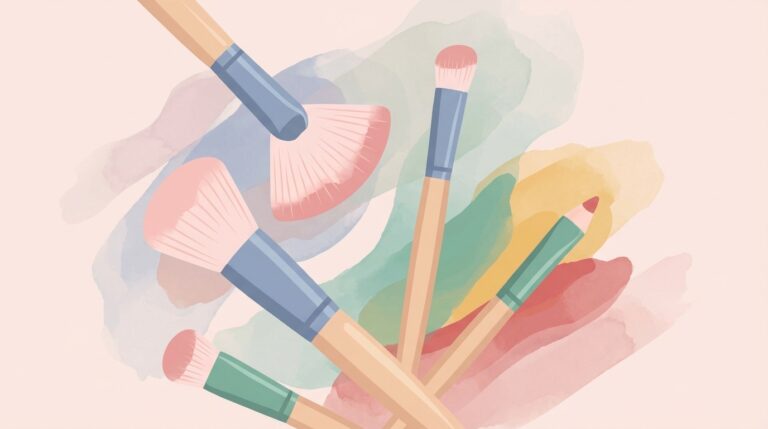
Phase 1: The Immersive Hook
Hello! This is your Senior Editor at Daily Hangul.
Picture this: You are watching a K-Beauty YouTuber like Pony or Risabae doing a “GRWM” (Get Ready With Me). They pick up a brush, look at the camera, and say, “Today, I’m going to give some shade to the triangle zone.”
The subtitles might just say “apply shadow,” but the Korean verb they used holds the secret to that seamless, watercolor-like gradient we see on K-Pop idols. In the world of K-Beauty, it’s not just about what you apply, but how you wield your tools. If you’ve ever walked into an Olive Young and felt overwhelmed by the wall of brushes, or if you want to understand exactly what your favorite beauty influencer is muttering while blending, this lesson is for you.
Today, we aren’t just learning words; we are learning the art of the “touch” (터치) that defines Korean makeup aesthetics.
Phase 2: Deep Dive into Key Expressions
1. 경계를 풀다 [Gyeonggye-reul pulda]
- Pronunciation: [gyeong-gye-reul pul-da] (Think: ‘Gyeong-gye’ sounds sharp, ‘pul-da’ sounds soft like ‘pulling’ something loose.)
- Meaning: Literally “to untie the boundary/border.” In makeup, it means “to blend out the harsh lines.”
- K-Culture Moment: You’ll hear this in almost every makeup tutorial. “If you leave it like this, it looks unnatural, so please loosen the boundaries (경계를 풀어주세요).”
- Editor’s Insight: This verb
풀다(to untie/solve/loosen) is incredibly versatile. You use it for stress (스트레스를 풀다), math problems (문제를 풀다), and here, for making your eyeshadow look like professional airbrushing. - Situation Spectrum:
[🚫 Formal(Boss)] ———— [✅ Semi-formal(Tutorials/Salons)] ———— [✅ Casual(Friends)] - 🤔 Think About It: Why does Korean beauty emphasize “no boundaries”? It reflects the cultural preference for the
꾸안꾸(Ggu-an-ggu: Effortless chic) look, where makeup shouldn’t look like a mask.
2. 삼각존을 채우다 [Samgak-jon-eul chae-uda]
- Pronunciation: [sam-gak-jon-eul chae-u-da]
- Meaning: “To fill in the triangle zone.”
- K-Culture Moment: Look at any K-Pop idol (like IVE’s Wonyoung or TWICE’s Sana). Do you see that slight shading on the outer lower lash line that makes their eyes look puppy-like and larger? That is the Triangle Zone.
- Editor’s Insight: This is a C1 level concept because it requires knowledge of K-Beauty anatomy.
채우다means to fill. If you go to a salon in Cheongdam-dong, you might say, “Please don’t fill the triangle zone too darkly” (삼각존 너무 진하게 채우지 마세요). - Situation Spectrum:
[✅ Universal Terminology in Beauty Contexts]
3. 쓸어주다 [Sseureo-juda]
- Pronunciation: [sseu-reo-ju-da]
- Meaning: “To sweep” or “to brush gently.”
- K-Culture Moment: Used when applying base color or finishing powder. It implies a very light, airy hand motion, unlike
문지르다(to rub hard). - Editor’s Insight: The auxiliary verb
-주다(to give) is added here to soften the command or action, implying doing it for the benefit of the face. It sounds much more elegant than just쓸다. - 🤔 Think About It: Korean instructional language often uses “benefactive” verbs (doing something for someone/something). We don’t just “sweep”; we “give a sweep.” How does this reflect the care taken in the action?
Phase 3: Textbook vs. Real Life
| Situation | 📖 Textbook Korean | 🗣️ Real Korean (K-Beauty) | 💡 Why the difference? |
|---|---|---|---|
| Applying base shadow | 눈두덩이에 바르세요. (Apply to the eyelid.) |
눈두덩이에 넓게 펴 발라주세요. (Spread it out broadly and gently.) |
‘Baruda’ is too simple. Precision requires direction (pyeo – spread) and care (-juda). |
| Using a point brush | 좁은 부위에 칠하세요. (Paint on the narrow area.) |
좁은 영역에 콕콕 찍어주세요. (Poke/tap it lightly on the narrow area.) |
Onomatopoeia (kok-kok) describes the exact motion and pressure required. |
| Blending | 색을 섞으세요. (Mix the colors.) |
블렌딩해 주세요 / 스머징해 주세요. (Please blend/smudge.) |
English loanwords are dominant in professional fields like fashion and beauty. |
Phase 4: Cultural Deep Dive
4-1. Non-verbal: The “Chin Lift”
When a Korean makeup artist says “Look down, please” (아래 보세요), they don’t want you to close your eyes completely. They want a “half-closed” state to smooth out the eyelid wrinkles without distorting the shape. They will often gently lift your chin with a puff or brush handle. Relax your eyelids; if you squeeze them shut, the brush can’t glide (미끄러지듯 발리다).
4-2. K-Culture Connection: The “Tool” Obsession
In K-Beauty, there is a brush for everything. There is a specific brush just for the Aegyosal (under-eye fat), another for the Samgak-jon, and another for glitter.
* K-Drama Trope: In “True Beauty” (여신강림), the transformation isn’t magic; it’s technique. The protagonist understands that using the wrong brush results in “jjang-gu eyebrows” (thick, dark cartoon eyebrows).
* Critical Perspective: This hyper-segmentation of tools drives consumption (you need 10 brushes instead of 2), but it also democratizes professional makeup techniques, allowing anyone to achieve high-quality results at home.
Phase 5: Immersive Roleplay
Scenario A: At a Professional Makeup Class in Gangnam
Setting: A bright, mirror-lined studio in Sinsa-dong. You are taking a one-day makeup class to learn K-Pop idol eye makeup.
Characters:
* YOU: An advanced learner wanting to perfect your gradient lip and eye look.
* Artist (Teacher): A trendy professional in her 30s, speaking quickly and using industry jargon.
Artist: 자, 이제 총알 브러시로 삼각존을 채워볼까요? 너무 진하지 않게 힘을 빼세요.
(Ja, ije chong-al beureosi-ro samgak-jon-eul chae-wo-bol-kka-yo? Neomu jin-ha-ji an-ge him-eul ppae-se-yo.)
“Okay, shall we fill the triangle zone with the bullet brush? Relax your hand so it’s not too dark.”
YOU:
(Op. 1) 네, 알겠습니다. (Standard response)
(Op. 2) 선생님, 발색이 잘 안 나오는데 섀도우를 더 묻혀야 할까요? (Specific technical question)
Artist: 아, 그럴 땐 문지르지 말고 톡톡 두드려서 얹어보세요.
(Ah, geureol ttaen munjireuji malgo tok-tok dudeuryeoseo eonjeoboseyo.)
“Ah, in that case, don’t rub it; try tapping it lightly to lay the color down.”
🔀 Decision Point: How do you check your progress?
* A) “Is this good?” (이거 좋아요?)
* B) “Did I blend the boundaries well?” (저 경계 잘 풀었나요?)
* C) “It looks weird.” (이상해요.)✅ Best Choice: B — This shows you understood the assignment’s technical goal. It impresses the teacher with your specific vocabulary.
Scenario B: Bonus – Olive Young Shopping
Staff: 찾으시는 거 있으세요? (Looking for anything?)
YOU: 아이홀 블렌딩하기 좋은 천연모 브러시 있나요? (Do you have a natural hair brush good for blending the eyehole?)
Staff: 네, 피카소 제품이 인기가 많아요. (Yes, the Picasso products are popular.)
Phase 6: 10-Second Shadowing Drill
Let’s practice the sentence you’ll hear most in tutorials. Match the intonation!
😊 “Base color looks best / when you sweep it on / lightly like watercolor.”
베이스는 / 수채화처럼 / 가볍게 쓸어줘야 / 예뻐요.
(Base-neun / suchaehwa-cheoreom / gabyeop-ge sseureo-jwoya / yeppeoyo.)
- Tip: Elongate ‘cheoreom’ (like) slightly to emphasize the simile.
- Key Word:
수채화(Watercolor) – The ultimate compliment for K-Beauty eye makeup application.
Phase 7: K-Culture Mini Glossary
| Korean | Romanization | Meaning | Context |
|---|---|---|---|
| 발색 | Balsaek | Color Payoff | “The color payoff is weak” (발색이 약해요). Crucial for reviewing products. |
| 가루날림 | Garu-nallim | Fallout | When eyeshadow powder falls on your cheeks. “This brush causes too much fallout.” |
| 애교살 | Aegyosal | Under-eye fat | The pocket of fat under the eye; highlighting this is essential in K-makeup. |
| 총알 브러시 | Chong-al beureosi | Bullet Brush | A small, tapered blending brush shaped like a bullet. Essential for detail work. |
| 꾸안꾸 | Ggu-an-ggu | Effortless chic | “Ggumindeut an ggumindeut” (Dressed up like you didn’t dress up). The goal of natural blending. |
Phase 8: Traveler’s Survival Kit (Beauty Edition)
Visiting an Olive Young or Chicor? Here is your brush shopping survival kit.
🆘 Survival Phrases
* “테스터 해봐도 되나요?” (Can I test this?)
* [Te-seu-teo haebwado doenayo?]
* “이거 따갑지 않나요?” (Is this scratchy/prickly?)
* [Igeo ttagapji annayo?] – Critical when buying brushes! Check specifically for ‘ttagapda’.
* “세척은 어떻게 해요?” (How do I wash/clean this?)
* [Se-cheok-eun eotteoke haeyo?]📌 Editor’s Travel Note
* Tax Refund: Most major Olive Young stores offer immediate tax refunds. Bring your passport!
* Tools: Don’t ignore the “spatulas” for foundation. It’s the hottest K-Beauty tool right now.
Phase 9: Think Deeper — “The Philosophy of Softness”
Media vs. Reality:
In Western makeup tutorials, we often see “cut creases” and sharp contours that emphasize bone structure. In contrast, K-Beauty terminology focuses on words like 풀다 (loosen), 번지다 (smudge/spread), and 물들다 (to be stained/dyed).
Why? K-Beauty standards often idealize a “baby face” (동안). Sharp lines are associated with maturity or fierceness (센 언니 vibe), while soft, gradient borders mimic the natural flush of youth. When you learn to “loosen the boundaries” with your brush, you aren’t just applying makeup; you are performing a cultural ritual of softening one’s impression to appear more approachable and youthful.
💬 Your Turn: Does your culture prefer sharp, defined makeup or soft, blended looks? How does the language of makeup reflect that?
Phase 10: FAQ & Troubleshooting
- Q: Can I use the word
칠하다(to paint) for makeup?- A: ⚠️ Avoid it if possible.
칠하다sounds like painting a wall or a fence. It lacks the delicacy of makeup. Use바르다(apply),얹다(place on), or터치하다(touch) instead.
- A: ⚠️ Avoid it if possible.
- Q: How do I ask a makeup artist to make it stronger?
- A: Don’t say “Stronger!” Say, “좀 더 진하게 해주세요” (Please do it darker/deeper) or “음영을 더 넣어주세요” (Please add more shading/depth).
❌ Common Mistake:
* Saying “Make my eyes bigger” directly (눈 크게 해주세요) to a stranger.
* ✅ Better: “I want my eyes to look more defined.” (눈매가 또렷해 보이면 좋겠어요.)
Phase 11: Wrap-up & Action Mission
One-Liner: To master K-Beauty, stop “painting” your face and start “loosening the boundaries” (경계를 풀다) for that watercolor effect.
🚀 Action Missions:
* 🥉 Bronze: Look at your makeup brush and say aloud: “Let’s loosen the boundaries.” (자, 경계를 풀어보자!)
* 🥈 Silver: Watch a Korean makeup tutorial (search ‘아이메이크업 튜토리얼’) and count how many times they say 슥슥 (seuk-seuk – sound of sweeping) or 톡톡 (tok-tok – tapping).
* 🥇 Gold: Go to a cosmetic store, pick up a brush, and ask the staff: “Is this brush good for the triangle zone?” (이거 삼각존 채우기에 좋아요?)
Phase 12: Quiz — The K-Beauty Guru Challenge
- Situation: You applied eyeshadow, but it looks like a harsh line. What verb describes the action you need to take?
- A) 칠하다 (Chilhada)
- B) 경계를 풀다 (Gyeonggye-reul pulda)
- C) 지우다 (Jiuda)
- Vocabulary: Which term refers to the “color payoff” or how visible the color is on skin?
- A) 발색 (Balsaek)
- B) 검색 (Geomsaek)
- C) 탈색 (Talsaek)
- K-Culture Truth: In Korean makeup, the “Triangle Zone” (Samgak-jon) is usually filled to…
- A) Make the eyes look fiercer and lifted.
- B) Make the eyes look deeper, larger, and slightly puppy-like.
- C) Hide dark circles.
Answers: 1. (B), 2. (A), 3. (B)
Frequently Asked Questions (FAQ)
Q: What does "경계를 풀다 [Gyeonggye-reul pulda]" mean in Korean and how do you pronounce it?
A: In Korean, "경계를 풀다 [Gyeonggye-reul pulda]" is pronounced [gyeong-gye-reul pul-da] and means: Literally "to untie the boundary/border." In makeup, it means "to blend out the harsh lines."
Q: What does "삼각존을 채우다 [Samgak-jon-eul chae-uda]" mean in Korean and how do you pronounce it?
A: In Korean, "삼각존을 채우다 [Samgak-jon-eul chae-uda]" is pronounced [sam-gak-jon-eul chae-u-da] and means: "To fill in the triangle zone."
Q: What does "쓸어주다 [Sseureo-juda]" mean in Korean and how do you pronounce it?
A: In Korean, "쓸어주다 [Sseureo-juda]" is pronounced [sseu-reo-ju-da] and means: "To sweep" or "to brush gently."






