

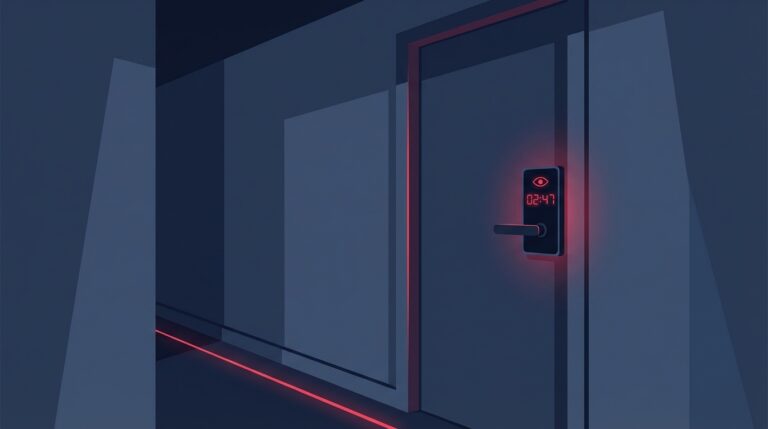
Phase 1: Immersive Hook — The “Beep-Beep-Beep-Click” of Anxiety
Greeting: 안녕하세요! This is your Daily Hangul Chief Editor. 👋
K-Drama Scene: Imagine this. You are watching a suspense thriller K-Drama. The protagonist lives in a high-tech Seoul apartment. It’s raining outside. Suddenly, the digital door lock (a staple of Korean housing) lights up on its own. Beep. Beep. Beep. Error. Then, the Wallpad (the smart home hub screen in the living room) flickers, and a stranger’s voice comes out of the AI speaker. Chills, right?
In Korea, where “Everything is Connected” is not just a slogan but a reality, IoT (Internet of Things) devices are everywhere. From boilers you control with your phone to fridges that talk to you. But as we say in the industry: “편리함 뒤에는 항상 대가가 따른다” (Convenience always comes with a price).
Today, we are moving beyond survival Korean. We are stepping into the C2 Advanced Zone. We will discuss IoT vulnerabilities (보안 취약점) and how to protect your digital life in Korea. Because if you want to live like a true modern Seoulite, you need to know how to lock your digital doors, not just physical ones.
Phase 2: Deep Dive — Critical Security Vocabulary
Since we are at C2 level, we will focus on Sino-Korean words (Hanja) used in news and formal discussions.
1. 사생활 침해 (Sasaenghwal Chimhae)
- Pronunciation: [Sa-saeng-hwal Chim-hae] (Sounds like: Sa-crifice Sang-guine Hwal-ibut Chim-ney Hae-ir)
- Meaning: Invasion of Privacy (Literal: Private Life Infringement)
- K-Culture Moment: You’ll hear this in news reports about “Wallpad Hacking” (월패드 해킹) scandals, where hackers accessed cameras in thousands of Korean apartments. It’s also the core conflict in dramas where a stalker hacks a victim’s phone.
- Editor’s Insight: This is a heavy word. You don’t use this when your mom enters your room without knocking. You use this when a drone flies over your window or your IoT camera footage is leaked.
- Situation Spectrum:
[🚫 Casual Friends] ———— [✅ News/Debate/Legal]- 🤔 Think About It: Why does Korean distinguish so sharply between ‘Personal Life’ (사생활) and ‘Public Life’ (공생활)? How does this affect the severity of this crime?
2. 보안 취약점 (Boan Chwiyakjeom)
- Pronunciation: [Bo-an Chwi-yak-jeom]
- Meaning: Security Vulnerability / Weak Point
- K-Culture Moment: In cyberpunk webtoons or corporate K-Dramas, the ‘white hat hacker’ character always says: “시스템에 치명적인 취약점이 발견되었습니다.” (A fatal vulnerability has been discovered in the system.)
- Editor’s Insight: 취약 (Chwiyak) means ‘fragile’ or ‘weak.’ It implies a structural flaw, not just a one-time mistake. It’s a very professional term.
- Situation Spectrum:
[🚫 Casual] ———— [⚠️ Work] ———— [✅ Tech Discussion]3. 무단 접속 (Mudan Jeopsok)
- Pronunciation: [Mu-dan Jeop-sok]
- Meaning: Unauthorized Access
- K-Culture Moment: When a K-Pop idol’s social media account posts strange crypto ads, the agency releases a statement apologizing for “무단 접속” (unauthorized access/hacking).
- Editor’s Insight: 무단 (Mudan) means “without permission/reason.” You see it in 무단 횡단 (jaywalking) or 무단 결석 (truancy).
Phase 3: Textbook vs. Real Life (The “Hacker” Edition)
| Situation | 📖 Textbook Korean | 🗣️ Real Korean (In the Field) | 💡 Why the difference? |
|---|---|---|---|
| Warning a friend | 비밀번호를 변경하는 것이 좋습니다. (It is good to change your password.) | 야, 비번 좀 갈아. 털리기 딱 좋아. (Hey, swap your PW. It’s perfect for getting robbed.) | 털리다 (Teollida) literally means “to be dusted off” or “robbed,” but is the go-to slang for getting hacked. |
| Software Update | 펌웨어를 최신 상태로 유지하세요. (Keep firmware up to date.) | 업뎃 좀 미루지 마. 그러다 훅 간다. (Don’t delay updates. You’ll be gone in a flash.) | 훅 간다 (Hook ganda) means to fail/die suddenly. Koreans hate waiting for updates (Palli-Palli), so this warning is necessary. |
Phase 4: Cultural Deep Dive — The “Wallpad” Panic
4-1. The Repository of Korean Home IoT: The Wallpad (월패드)
In almost every modern Korean apartment, there is a screen on the wall called a “Wallpad.” It controls lights, gas, heating, and even calls the elevator.
Recently, this became a massive issue in Korea. Why? Because the Wallpad has a camera. Hackers compromised the central servers of apartment complexes and leaked private videos from living rooms.
Lesson: If you move into a Korean apartment, look for the Wallpad camera. Many Koreans now cover it with a sticker (스티커로 가리다). It’s not paranoia; it’s a modern Korean survival habit.
4-2. The “Birthday Password” Culture
Koreans love using birthdays (YYMMDD) for everything. Door locks, luggage, bank PINs.
Critical Thinking: In a high-context society like Korea, asking “When is your birthday?” is a common icebreaker (to establish age hierarchy). This cultural openness makes “Social Engineering Hacking” surprisingly easy.
Tip: Never use your birthday as your door lock code in Korea. Everyone knows the format.
Phase 5: Immersive Roleplay — The Tech-Savvy Neighbor
Setting: A newly built “Smart Apartment” in Pangyo (Korea’s Silicon Valley). You have just moved in. Your friend Min-jae (30, IT Developer) is visiting for a housewarming party.
Characters:
* YOU: An expat executive, proud of your new smart home gadgets.
* Min-jae: Your cynical, security-conscious Korean friend.
(Dialogue Start)
Min-jae: 와, 집 진짜 좋다! 완전 최첨단이네. 근데 현관 비밀번호 아직도 ‘0000’은 아니지? 🤨
(Wa, jip jinjja joda! Wanjeon choecheomdanine. Geunde hyeongwan bimilbeonho ajikdo ‘0000’eun aniji?)
(Wow, the house is great! Totally high-tech. But the door passcode isn’t still ‘0000’, right?)
YOU: (Laughing) 설마요. 제 생일로 바꿨어요.
(Seolmayo. Je saeng-illo bakkwosseoyo.)
(No way. I changed it to my birthday.)
Min-jae: 야! 미쳤어? 생일은 만국 공통 ‘프리 패스’라고! 보안 의식이 너무 없는 거 아니야? 🤦♂️
(Ya! Michyeosseo? Saeng-ireun man-guk gongtong ‘free pass’rago! Boan uisik-i neomu eomneun geo aniya?)
(Hey! Are you crazy? Birthdays are a universal ‘free pass’! Isn’t your security awareness too low?)
🔀 Your Turn! How do you defend yourself?
– A) “에이, 누가 우리 집을 턴다고 그래요?” (Dismissive/Casual)
– B) “아, 맞다. 취약점이 될 수 있겠네요. 바로 바꿀게요.” (Acknowledging/Formal)
– C) “그래서 2단계 인증도 걸어놨죠!” (Smart/Advanced)
Min-jae (Response to C): 오~ 역시! 이중 보안(Double security) 설정을 해두다니, 인정! 그래도 카메라는 가려놔.
(Oh~ Yeoksi! Setting up double security, respect! Still, cover that camera.)
Phase 6: 10-Second Shadowing Drill
Let’s practice a sentence you can use to explain why you are paranoid about security.
😤 (Serious & Firm)
IoT 기기는 / 편리하지만 / 보안 취약점이 / 많아서 / 항상 조심해야 해요.
(IoT gigineun / pyeollihajiman / boan chwiyakjeomi / manaseo / hangsang josimhaeya haeyo.)
“IoT devices are convenient, but since they have many security vulnerabilities, we must always be careful.”
Phase 7: K-Culture Mini Dictionary (Cyber Edition)
| Korean | Romanization | English | Context |
|---|---|---|---|
| 털리다 | Teollida | To be hacked/robbed | Slang. Originally “to be dusted off/shaken.” Used like “My ID got hacked.” |
| 비번 | Bibeon | PW | Short for 비밀번호 (Bimilbeonho). Everyone says ‘Bibeon’. |
| 도어락 | Do-eo-rak | Digital Door Lock | The symbol of Korean housing security. |
| 홈캠 | Hom-kaem | Home Camera | IoT cameras for pets/babies. High risk of hacking. |
| 낚이다 | Nakkida | To get fished/scammed | Slang for falling for Phishing (보이스피싱) or fake links. |
Phase 8: Traveler’s Survival Kit — Hidden Cameras (Molka)
Even if you aren’t living in Korea, the fear of “Molka” (Spy cams) in Airbnbs or motels is a real issue related to IoT security.
🆘 Survival Expression: Checking for Spy Cams
– 🇰🇷 “혹시 여기 숨겨진 카메라 탐지기 있나요?”
– (Hoksi yeogi sumgyeojin kamera tamjigi innayo?)
– Meaning: “Do you happen to have a hidden camera detector?”
– 📍 Where: Some high-end motels or Airbnb hosts might provide this to reassure guests.📌 Editor’s Note:
There are apps that claim to detect hidden IR cameras using your phone’s sensor. Search for “불법 촬영 탐지” (Illegal filming detection) in the App Store.
Phase 9: Think Deeper — “Palli-Palli” vs. Security
Why is Korea’s cyber security landscape so unique?
Korea is the land of “Palli-Palli” (Hurry-Hurry). We adopted high-speed internet and IoT faster than almost anyone else. We want our doors to open fast, our payments to process instantly, and our deliveries to arrive by dawn.
The Trade-off: This obsession with speed and convenience often bypasses strict security protocols. We trade privacy for the convenience of an app that does everything.
🧠 Think Deeper: In your country, would people prefer a slow, secure analog lock, or a fast, convenient digital lock that might be hacked? Is “Speed” a vulnerability in itself?
Phase 10: FAQ & Troubleshooting
Q: Can I use the same password for Naver, Kakao, and my Door Lock?
A: 절대 안 됩니다 (Absolutely not). In Korea, if your Naver ID is hacked (털리다), your entire identity is compromised because Naver is linked to shopping, maps, and email. Keep your physical security (Door Lock) completely separate from your digital accounts.
❌ Common Mistake: Writing the door lock code on the wallpad or a sticky note near the door for delivery drivers.
✅ Do this instead: Use the “One-time Password” (일회용 비밀번호) feature provided by most modern Korean door locks if you have a guest or delivery.
Phase 11: Wrap-up & Mission
One-Liner: Convenience is a double-edged sword; enjoy the smart home, but cover the camera! 👁️
🏆 Action Mission:
– 🥉 Bronze: Check your phone settings. Change the language to Korean and find “개인정보 보호” (Privacy Protection).
– 🥈 Silver: Search for news about “월패드 해킹” (Wallpad hacking) on Naver/YouTube and read the headlines.
– 🥇 Gold: If you have a digital door lock (or a gym locker), change the password today. Do NOT use your birthday!
💬 Your Turn: Do you trust smart home devices? Or are you an “analog” person? Tell me in the comments! 👇
Frequently Asked Questions (FAQ)
Q: What does "사생활 침해 (Sasaenghwal Chimhae)" mean in Korean and how do you pronounce it?
A: In Korean, "사생활 침해 (Sasaenghwal Chimhae)" is pronounced [Sa-saeng-hwal Chim-hae] and means: Invasion of Privacy (Literal: Private Life Infringement)
Q: What does "보안 취약점 (Boan Chwiyakjeom)" mean in Korean and how do you pronounce it?
A: In Korean, "보안 취약점 (Boan Chwiyakjeom)" is pronounced [Bo-an Chwi-yak-jeom] and means: Security Vulnerability / Weak Point
Q: What does "무단 접속 (Mudan Jeopsok)" mean in Korean and how do you pronounce it?
A: In Korean, "무단 접속 (Mudan Jeopsok)" is pronounced [Mu-dan Jeop-sok] and means: Unauthorized Access







