

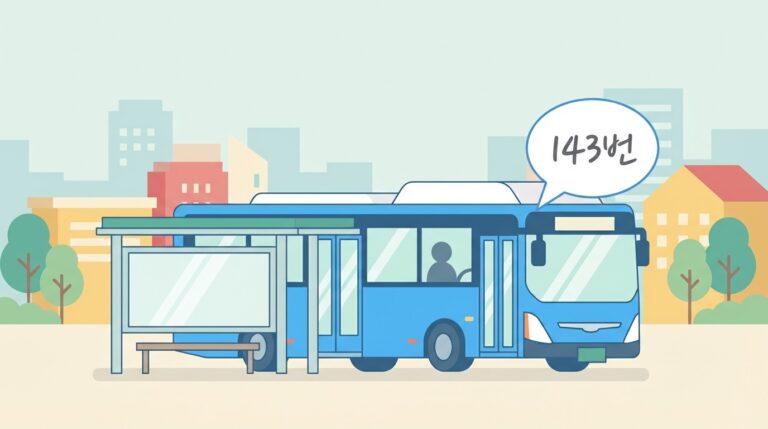
Survive the Seoul Commute: How to Say Bus Numbers Like a Local 🚌
Phase 1: The K-Drama Moment 🎬
Greeting: 안녕하세요! Welcome to Daily Hangul. I’m your editor, and today we are hitting the streets of Seoul.
The Scene: You know that classic K-Drama scene? The protagonist is heartbroken, standing at a bus stop in the rain. A blue bus approaches. They step on, tap their card with a melancholic beep, and sit in the back row staring out the window while a sad ballad plays.
But in reality? You are standing at Hongdae station, 10 different buses are rushing by, and you are frantically checking your app thinking, “Wait, is that bus 7011 or 701? How do I ask the driver if this goes to Myeongdong?”
If you hesitate, the bus leaves. Seoul drivers are efficient (read: fast). Today, we’ll master the art of catching the right bus so you don’t become a dramatic, rain-soaked main character left on the sidewalk.
Phase 2: Deep Dive into Core Expressions 🧠
To survive the Seoul bus system, you need Sino-Korean Numbers (il, i, sam…). Native numbers (hana, dul, set…) are for counting things, but bus numbers are like addresses or phone numbers—they are codes.
1. [Number] + 번 (beon)
- Pronunciation: [Number] + beon (Sounds like “bun” in “bun”)
- Meaning: Number [X] (Used for bus numbers, phone numbers, queue numbers)
- K-Culture Moment: In the variety show Running Man, members often yell numbers at taxi or bus drivers during missions. “Gisa-nim! 360-beon! (Driver! Number 360!)”
- Editor’s Insight: For 3 or 4 digit buses, you can read the full number (e.g., 402 = sa-baek-i-beon) OR digit-by-digit (sa-gong-i-beon). For beginners, the full number is safer, but you will hear “gong” (zero) often in spoken Korean.
- Situation Spectrum:
[🚫 Formal] ———— [✅ Standard] ———— [✅ Casual]
(This is a standard counter, usable everywhere.)- 🤔 Think About It: Why does Korean have two number systems? Sino-Korean is usually for “data” (dates, money, minutes, bus lines), while Native Korean is for “counting physical objects” (people, bottles, hours). Why do you think language separates math from physical existence?
2. 이 버스 [Place] 가요? (I beoseu [Place] gayo?)
- Pronunciation: ee buh-seu [Place] ga-yo?
- Meaning: Does this bus go to [Place]?
- Literal: This bus [Place] go?
- K-Travel Tip: This is your lifeline. Seoul bus routes are complex. Even locals ask this.
- Editor’s Insight: You don’t need a full sentence like “Does this bus go to…?” Just “Hongdae gayo?” with a rising intonation is perfect.
- Situation Spectrum:
[🚫 Banmal/Rude] ———— [⚠️ Polite] ———— [✅ Natural]
- Friend: “Hongdae ga?” (Casual)
- Stranger/Driver: “Hongdae gayo?” (Polite ✅)
Phase 3: Textbook vs. Real Life 🗣️
| Situation | 📖 Textbook Korean | 🗣️ Real Korean | 💡 Why the difference? |
|---|---|---|---|
| Checking destination | 실례합니다, 이 버스는 강남역에 갑니까? (Excuse me, does this bus go to Gangnam Station?) | (Head peek) 아저씨, 강남역 가요? (Mister, Gangnam Station go?) | Efficiency! The bus doors are open only for seconds. Short sentences save time. |
| Stopping the bus | 다음 정류장에서 내려 주세요. (Please let me off at the next stop.) | (Presses the red bell silently) 🔴 | In Korea, the bell is king. Verbal requests are rare unless the bell is broken. |
💡 Editor’s Note: “Ahjussi” (Mister) is common, but if you want to be extra polite to the driver, use “Gisa-nim” (Driver-nim).
Phase 4: Cultural Context — The “Palli-Palli” Bus 🇰🇷
4-1. Non-verbal Communication: The “Ready” Stance
Korean buses don’t wait for you to pack your bags.
– Boarding: Stand close to the curb as the bus approaches. If you sit on the bench looking at your phone, the driver might zoom past.
– Getting Off: Crucial! You must stand up and move to the back door before the bus fully stops. If you wait until the bus stops to stand up, you might get a glare from everyone or miss your stop. This is the “Palli-Palli” (Hurry Hurry) culture in action.
4-2. K-Travel Connection: The Color Code
Did you know Seoul bus colors aren’t random?
– 💙 Blue (Ganseon): Long distance, connecting districts. (3 digits)
– 💚 Green (Jiseon): Short distance, connecting to subway stations. (4 digits)
– ❤️ Red (Gwangyeok): Express buses going outside Seoul to satellite cities.
– 💛 Yellow (Sunhwan): Circular loops in tourist areas (like Namsan Tower).
🤔 Think About It: How does this color-coding help foreigners or people who can’t read Korean quickly? Does your city have a visual system like this?
Phase 5: Immersive Roleplay 🎭
Setting: It’s 8:00 AM, rush hour in Seoul. You are at a busy bus stop near Gwanghwamun. You need to get to Seoul Station, but three green buses just arrived at once.
Characters:
– YOU: A traveler late for a KTX train.
– Gisa-nim (Driver): A busy bus driver wearing sunglasses and white gloves.
YOU: (Approaching the open door of a green bus)
Jeogiyo, Gisa-nim! (Excuse me, Driver!)
Gisa-nim: (Looking at the mirror, foot on the gas)
네, 빨리 타세요! 🚌
(Ne, palli taseyo!)
(Yes, get on quickly!)
YOU: (Hesitating)
이거 7011번 맞아요?
(Igeo chil-gong-il-il-beon majayo?)
(Is this number 7011?)
Gisa-nim: 네, 맞아요. 어디 가는데요?
(Ne, majayo. Eodi ganeundeyo?)
(Yes, it is. Where are you going?)
🔀 Decision Point: How do you ask if it goes to Seoul Station?
A) “Seoul Station gayo?” (Simple & Direct)
B) “Seoul Station is where I want to go.” (Too long/Textbook)
C) Just get on without asking. (Risky!)
✅ Best Choice: A) “서울역 가요?” (Seoul-yeok gayo?)
YOU: 서울역 가요?
(Seoul-yeok gayo?)
Gisa-nim: 아니요! 이건 신촌 가요. 뒤에 오는 파란 버스 타세요!
(Aniyo! Igeon Sinchon gayo. Dwie oneun paran beoseu taseyo!)
(No! This goes to Sinchon. Take the blue bus coming behind!)
YOU: 아, 감사합니다!
(Ah, gamsahamnida!)
(Ah, thank you!)
Phase 6: 10-Second Shadowing Drill 🗣️
Let’s practice the most important survival phrase. Focus on the rising intonation at the end.
Emotion: 🥺 Urgent & Polite (You don’t want to miss the bus!)
이 버스 / 홍대 / 가요?
(I beoseu / Hongdae / gayo?)
Does / this bus / go to Hongdae?
Phase 7: K-Culture Glossary 📚
| Korean | Romanization | Meaning | Context |
|---|---|---|---|
| 교통카드 | Gyotong-card | Transportation Card | Usually T-Money. Cash is disappearing on buses! |
| 환승입니다 | Hwanseung-imnida | “It is a transfer” | The sound the machine makes when you transfer for free. The sweetest sound in Seoul. |
| 하차 태그 | Hacha-tag | Get-off Tag | Tapping your card when getting off. Essential to avoid extra charges! |
| 배차 간격 | Baecha-gangyeok | Dispatch Interval | The waiting time between buses. |
Phase 8: Traveler’s Survival Kit 🧳
Bus Number Edition
🆘 Survival Phrases TOP 3
1. “[Place] 가요?” (Does it go to [Place]?)
2. “이번 정류장이 어디예요?” (Ibeon jeongnyujang-i eodiyeyo?) – Where is this stop?
3. “카드 다시 대 주세요.” (Card dashi dae-juseyo) – Please tap your card again. (You’ll hear this from the driver if your tag failed).📌 Editor’s Travel Note:
– No Coffee Rule: You cannot bring takeout cups (coffee/soda) onto Seoul buses anymore. It’s a strict safety rule. Finish it or throw it away before boarding!
– Free Wi-Fi: Most Seoul buses have free high-speed Public Wi-Fi. Look for the sticker with the password (usuallyseoulorwifi).
Phase 9: Think Deeper — “Wait, why did everyone stand up?”
Topic: The Culture of ‘Nunchi’ and Efficiency
In a Seoul bus, you’ll notice everyone stands up before the bus arrives at the stop. If you wait until the bus stops to gather your things, you disrupt the flow. This is a mix of ‘Palli-Palli’ (Hurry Hurry) culture and ‘Nunchi’ (Social Awareness). By being ready, you are showing consideration for the dozens of other people who want to get home quickly. It might feel rushed to a Westerner, but in Seoul, speed is a form of politeness.
💬 Your Turn: In your country, is it polite to wait until the vehicle stops, or should you be ready at the door? Share in the comments!
Phase 10: FAQ & Troubleshooting 🛠️
Q: I saw a bus with number ’02’. Do I say ‘gong-i’ or ‘yeong-i’?
A: Use ‘gong’ (공) for zero in phone/bus numbers. So, ‘gong-i-beon’ (공이번). ‘Yeong’ is usually for math or temperature.
Q: Can I pay with cash?
A: Maybe, but don’t risk it. Many Seoul buses are becoming “Cashless Buses” (현금 없는 버스). Always have a T-Money card loaded.
❌ Common Mistake:
– Mistake: Trying to tap your credit card from your home country directly.
– Fix: Only specific foreign cards work (contactless). It’s safer to buy a T-Money card at a convenience store (CU, GS25) and load it with cash.
Phase 11: Wrap-up & Mission 🚀
Summary: Today we learned how to say bus numbers using Sino-Korean (il, i, sam) + beon, and the magic phrase “[Place] gayo?” to check your destination.
🏆 Action Missions:
– 🥉 Bronze: Stand in front of a mirror and practice saying “7011-beon” (Chil-gong-il-il-beon) three times.
– 🥈 Silver: Open Naver Maps or KakaoMap, look up a route in Seoul, and read the bus number out loud.
– 🥇 Gold: Watch a K-Drama scene with a bus and try to spot the bus color (Blue, Green, Red)!
Phase 12: Interactive Quiz 🧩
1. Situational Judgment:
You see a Red Bus (9100번). You are trying to go from Gangnam to Hongdae (both inside Seoul). Should you take it?
– A) Yes, red is fast!
– B) No, red buses go outside Seoul and are more expensive.
2. True or False:
In Seoul, you must tap your card again when you get OFF the bus.
– (True / False)
3. Fill in the Blank:
Driver: “Eodi gayo?” (Where are you going?)
You: “Myeongdong ______?”
Answers:
1. B) Red buses are Gwangyeok (Wide area) buses. They are expensive and for long commutes. Stick to Blue or Green for Gangnam-Hongdae.
2. True. You must ‘tag off’ to get free transfers to the subway or other buses.
3. gayo (Myeongdong gayo?)
Frequently Asked Questions (FAQ)
Q: What does "[Number] + 번 (beon)" mean in Korean and how do you pronounce it?
A: In Korean, "[Number] + 번 (beon)" is pronounced [Number] and means: Number [X] (Used for bus numbers, phone numbers, queue numbers)
Q: What does "이 버스 [Place] 가요? (I beoseu [Place] gayo?)" mean in Korean and how do you pronounce it?
A: In Korean, "이 버스 [Place] 가요? (I beoseu [Place] gayo?)" is pronounced [ee buh-seu [Place] and means: Does this bus go to [Place]?







