

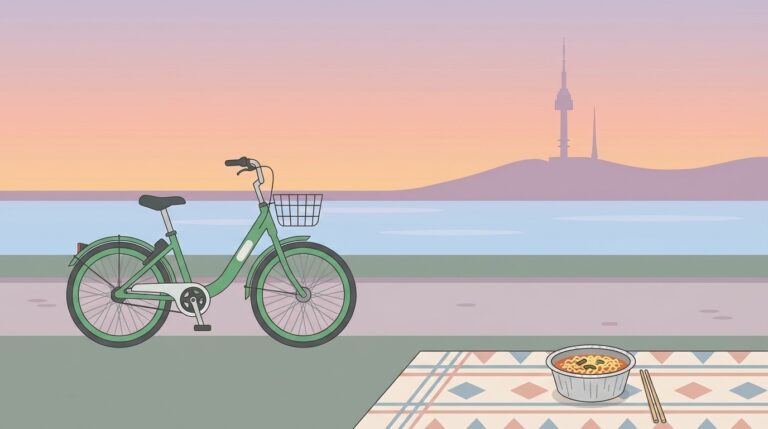
Phase 1: Immersive Hook
🚲 The Han River Romance vs. Reality
Hello! This is your Daily Hangul Editor.
Picture this: You’re watching your favorite K-Drama. The lead couple is riding bicycles along the Han River (Hangang) at sunset. The wind blows through their hair, an acoustic ballad plays in the background, and everything looks perfect. You think, “I want to do that when I visit Seoul!”
But wait.
When you actually get to the Han River park on a Saturday afternoon, it’s not just a romantic movie set. It’s a battlefield of professional cyclists in full spandex gear speeding by, families with toddlers, and couples eating ramen on the grass.
If a cyclist zooms past you shouting something, or if you need to pass a group of slow walkers, what do you say? If you don’t know the right words, that romantic scene can quickly turn into a collision.
Don’t worry. Today, I’ll teach you the survival Korean you need to enjoy a safe and “drama-worthy” bike ride in Korea. Let’s roll! 🚴♂️
Phase 2: Deep Dive into Key Expressions
1. 자전거 타러 가요 (Let’s go ride a bike)
- Pronunciation: [ja-jeon-geo ta-reo ga-yo]
- Sound-alike: “Ja” like Japan + “jeon” like John + “geo” (hard g) + “ta-reo” (roll the r slightly) + “ga-yo”.
- Meaning:
- Literal: To ride a bicycle, let’s go.
- Real Nuance: “Hey, wanna go biking?” (A friendly suggestion).
- K-Culture Moment: You’ll often hear K-Pop idols say this in their vlogs when they have a day off. “Members, let’s go ride bikes!” It implies a bonding activity, not just exercise.
- Editor’s Insight: The structure
-(으)러 가요means “going somewhere in order to do something.” It’s the magic formula for suggesting plans! - Situation Spectrum:
[🚫 Boss] ———— [⚠️ Colleague] ———— [✅ Friend/Date]- (Note: Use “gapsida” for formal, but “gayo” is fine for polite friendly situations.)
- 🤔 Think About It: Koreans often turn individual hobbies into social events. Why do you think we say “Let’s go…” instead of just doing it alone?
2. 좀 비켜 주세요 (Please move aside)
- Pronunciation: [jom bi-kyeo ju-se-yo]
- Sound-alike: “Jom” (like Joe + m) + “bi-kyeo” (bee-kyuh) + “ju-se-yo”.
- Meaning:
- Literal: Please step aside a little.
- Real Nuance: “Excuse me! Coming through!” (Used when the path is blocked).
- K-Culture Moment: In variety shows like Running Man, when members are chasing each other through a crowd, they shout this.
- Editor’s Insight: The word 좀 (jom) here softens the command. Without it, “비켜!” sounds like “Get out of my way!” (very rude). Always add “jom” to sound polite but urgent.
- Situation Spectrum:
[🚫 Elders (Use caution)] ———— [⚠️ Strangers] ———— [✅ Crowds] - 🤔 Think About It: In your language, do you apologize (“Sorry”) when asking someone to move, or do you ask them to move directly? Korean focuses on the action requested.
3. 천천히 가요 (Let’s go slowly)
- Pronunciation: [cheon-cheon-hi ga-yo]
- Sound-alike: “Cheon” (ch + on) + “cheon” + “hi” (he) + “ga-yo”.
- Meaning:
- Literal: Slowly let’s go.
- Real Nuance: “Slow down!” or “Let’s take it easy.”
- K-Culture Moment: The classic K-Drama scene where the girl is struggling to keep up on her bike, and she yells this to the guy who is speeding ahead to show off.
- Editor’s Insight: 천천히 (Cheon-cheon-hi) is a lifestyle word in Korea’s “Pali-Pali” (Hurry-Hurry) culture. It’s often used to calm someone down.
- Situation Spectrum:
[🚫 Military] ———— [⚠️ Boss] ———— [✅ Friends/Family] - 🤔 Think About It: Why does a culture famous for being fast (“8282”) also have such a commonly used phrase for “slowly”? Is it a wish for balance?
Phase 3: Textbook vs. Real Life
| Situation | 📖 Textbook Korean | 🗣️ Real Korean | 💡 Why the difference? |
|---|---|---|---|
| Suggesting a ride | 자전거를 탑시다. (Let’s ride a bicycle.) | 따릉이 타러 갈래? (Wanna go ride a Ddareungi?) | “Ddareungi” is the name of Seoul’s public bikes. Being specific sounds more natural! |
| Warning someone | 비키십시오. (Please step aside.) | 지나가요~ (Passing through~) | Instead of telling people to move, stating your action (“I am passing”) is softer and less confrontational. |
| Taking a break | 잠시 쉽시다. (Let’s rest for a moment.) | 라면 먹고 갈까? (Shall we eat ramen?) | At the Han River, “resting” = “eating ramen.” It’s the unwritten rule. |
Bottom Note: In A1 level, simpler is better. But knowing “Ddareungi” (Seoul Bike) instantly makes you sound like a local!
Phase 4: Cultural Deep Dive
4-1. Non-verbal Communication: The Bell 🛎️
Unlike in some Western countries where shouting “On your left!” is common, in Korea, using your bike bell is the standard way to say “I’m here.” If you don’t have a bell, a verbal “Passing through~” (지나가요~) is better than shouting specific directions, which might confuse people.
4-2. K-Food Connection: The “Hangang Ramyeon” Ritual 🍜
Riding a bike in Seoul is incomplete without Hangang Ramyeon.
* The Scene: You park your bike at a convenience store (CU, GS25) by the river.
* The Action: You don’t just buy cup noodles. You buy a packet, grab a foil bowl, and use the automatic cooking machine.
* Why: It’s not just about hunger. It’s about the vibe (감성 – gamseong). In dramas, this is where deep conversations happen.
* Critical Thought: Why is instant food considered a “treat” here? It represents a small, affordable luxury and freedom in a busy city life.
Phase 5: Immersive Roleplay
Scenario A: The Date (or Friendly Hangout)
Setting: It’s a breezy Sunday at Yeouido Han River Park. The cherry blossoms are falling. You are with Min-su (your Korean friend/crush).
Characters:
* YOU: An enthusiastic beginner cyclist.
* Min-su: Likes to ride fast and show off.
Dialogue:
Min-su: 날씨 진짜 좋다! 우리 저기까지 경주할까? 🏁
(Nalssi jinjja joda! Uri jeogi-kkaji gyeongju-halkka?)
(The weather is so good! Shall we race to over there?)
YOU: (You are tired and just want to enjoy the view.)
🔀 Decision Point: How do you respond?
* A) “아니요, 싫어요.” (No, I hate it.) – Too direct/harsh.
* B) “좋아요! 가요!” (Good! Let’s go!) – You might faint from exhaustion.
* C) “에이~ 천천히 가요!” (Eyy~ Let’s go slowly!)
✅ Best Choice: C
YOU: 에이~ 천천히 가요! 경치 구경하고 싶어요. 🌸
(Eyy~ cheon-cheon-hi ga-yo! Gyeongchi gugyeong-hago sipeo-yo.)
(Eyy~ Let’s go slowly! I want to look at the scenery.)
Min-su: (Laughs) 알겠어. 그럼 천천히 가자. 그리고 나중에 라면? 🍜
(Algesseo. Geureom cheon-cheon-hi gaja. Geurigo najunge ramyeon?)
(Okay. Then let’s go slow. And ramen later?)
YOU: 좋아요! 라면 먹으러 가요! 😋
(Joa-yo! Ramyeon meogeureo ga-yo!)
(Great! Let’s go eat ramen!)
Scenario B: Bonus K-Culture Moment
Situation: You accidentally almost bump into an “Ajumma” (middle-aged lady) walking on the bike path.
Ajumma: 어머! 조심해요! (Oh my! Be careful!)
YOU: 죄송합니다! (I’m sorry!)
(Stage Direction: Bow your head slightly even while riding past. This “moving bow” is crucial!)
Phase 6: 10-Second Shadowing Drill
Listen to the rhythm and emotion. Try to mimic the “sound.”
- 😊 Suggesting enthusiastically:
우리 / 한강에 / 자전거 타러 가요!
(Uri / Hangang-e / ja-jeon-geo ta-reo ga-yo!)
(Let’s go to Han River to ride bikes!) -
😰 Nervous/Polite warning:
잠시만요! / 지나가요~ / 비켜 주세요!
(Jamsimanyo! / jinagayo~ / bikyeo ju-se-yo!)
(Just a moment! Passing through~ Please move aside!) -
😌 Relaxed:
오늘 날씨가 / 너무 좋아서 / 천천히 가요.
(Oneul nalssiga / neomu joaseo / cheon-cheon-hi ga-yo.)
(The weather is so nice today, so let’s go slowly.)
Phase 7: K-Culture Mini Glossary
| Korean | Romanization | Meaning | Context |
|---|---|---|---|
| 따릉이 | Ddareungi | Seoul Public Bike | Named after the sound of a bell (“dring-dring”). Cheap and ubiquitous green bikes. |
| 한강 | Hangang | Han River | The soul of Seoul. The prime spot for cycling, dates, and chicken. |
| 치맥 | Chimaek | Chicken + Beer | The ultimate post-exercise meal. Often ordered by delivery to the park! |
| 둔치 | Dunchi | Riverbank | The grassy area where people lay out mats. |
| 장비빨 | Jangbi-bbal | Gear power | Relying on expensive equipment (gear) rather than skill. Koreans love good gear! |
Phase 8: Traveler’s Survival Kit (Bicycle Edition)
If you want to ride a bike in Korea, here is what you absolutely need to know.
🆘 Survival Phrase #1: Renting a Bike
* 🇰🇷 “한 시간에 얼마예요?” (Han sigan-e eolmayeyo?)
* 🗣️ Sounds like: Han she-gan-eh ol-ma-ye-yo?
* Meaning: How much for one hour?
* Where: Bike rental shops at Han River parks.🆘 Survival Phrase #2: Asking for the path
* 🇰🇷 “자전거 도로 어디예요?” (Ja-jeon-geo doro eodiyeyo?)
* 🗣️ Sounds like: Ja-jon-go do-ro oh-dee-ye-yo?
* Meaning: Where is the bicycle lane?
* Why: Walking paths and bike paths are often separate. Don’t ride on the walking path!📌 Editor’s Travel Note: Ddareungi App
* Pro Tip: Download the “Seoul Public Bike” (Ddareungi) app. You can switch the language to English. You can buy a pass with a foreign credit card! It’s much cheaper than rental shops (approx. 1,000 KRW for 1 hour).
Phase 9: Think Deeper — “Equipment Culture”
Topic: The Korean Love for “Gear” (Jangbi-bbal)
Have you noticed? Even for a casual hobby like cycling or hiking, many Koreans dress like professionals. You will see middle-aged men and women in full aerodynamic spandex, expensive sunglasses, and high-end helmets just for a weekend ride.
Why? In Korea, showing that you are “serious” about a hobby often involves looking the part. It’s a mix of respecting the activity and a bit of social signaling (showing you can afford the gear).
💬 Your Turn: In your country, do people dress up professionally for hobbies, or do they just wear old t-shirts? How does this reflect your culture’s view on “leisure”?
Phase 10: FAQ & Troubleshooting
- Q: Can I ride my bike on the sidewalk (pavement)?
- A: Officially, No. Bikes are vehicles. You should use bike lanes or the side of the road. However, in reality, many people ride on sidewalks if the road is dangerous. Just be extremely careful of pedestrians. Pedestrians always have priority.
- Q: Can I drink beer and ride a bike?
- A: NO! 🚫 Just like drunk driving, drunk cycling is illegal and you can be fined. Enjoy your Chimaek (Chicken & Beer) after you return the bike.
- ❌ Common Mistake: Ringing the bell aggressively at people.
- ✅ Better Way: Ring it once lightly from a distance. If you are too close, it scares people. Just say “Jina-gayo~” (Passing through).
Phase 11: Wrap-up & Action Mission
One-Liner Summary: Suggest a ride with “~reogayo,” be polite with “Jom bikyeo juseyo,” and enjoy the “Hangang Ramyeon” vibe!
🚀 Action Missions:
* 🥉 Bronze: Look in the mirror and practice saying “Jina-gayo~” (Passing through) softly 3 times.
* 🥈 Silver: Search “Han River Cycling” on YouTube and leave a comment in English/Korean: “가고 싶어요!” (I want to go!).
* 🥇 Gold: If you are in Korea, rent a Ddareungi bike and ride for 10 minutes. If not, go to a Korean convenience store/market and buy a Korean Ramen!
K-Culture Mission: Watch a clip of Running Man or a K-Drama where they ride bikes. Can you spot the difference between the “Professional Gear” ahjussis and the casual main characters?
Phase 12: Interactive Quiz
1. Situational Judgment:
You are riding a bike and a child runs in front of you. What is the safest thing to shout?
* A) 비켜!!! (Move!)
* B) 안녕하세요! (Hello!)
* C) 지나가요~ (Passing through~) or 조심해요! (Be careful!)
Answer: C. A is too rude/scary. B is polite but doesn’t warn them of danger.
2. True or False:
“It is polite to eat your ramen while riding the bicycle to save time.”
* (True / False)
Answer: False! That’s dangerous and messy. Koreans sit on a mat (dot-jari) or a bench to eat.
3. Fill in the Blank:
“Let’s go ride a bike!”
= 자전거 ______ 가요! (Hint: in order to ride)
Answer: 타러 (ta-reo)
See you on the bike path! Don’t forget your helmet! 안녕! 👋
Frequently Asked Questions (FAQ)
Q: What does "자전거 타러 가요 (Let's go ride a bike)" mean in Korean and how do you pronounce it?
A: In Korean, "자전거 타러 가요 (Let's go ride a bike)" is pronounced [ja-jeon-geo ta-reo ga-yo] and means: a key conversational Korean expression covered in this lesson.
Q: What does "좀 비켜 주세요 (Please move aside)" mean in Korean and how do you pronounce it?
A: In Korean, "좀 비켜 주세요 (Please move aside)" is pronounced [jom bi-kyeo ju-se-yo] and means: a key conversational Korean expression covered in this lesson.
Q: What does "천천히 가요 (Let's go slowly)" mean in Korean and how do you pronounce it?
A: In Korean, "천천히 가요 (Let's go slowly)" is pronounced [cheon-cheon-hi ga-yo] and means: a key conversational Korean expression covered in this lesson.







