

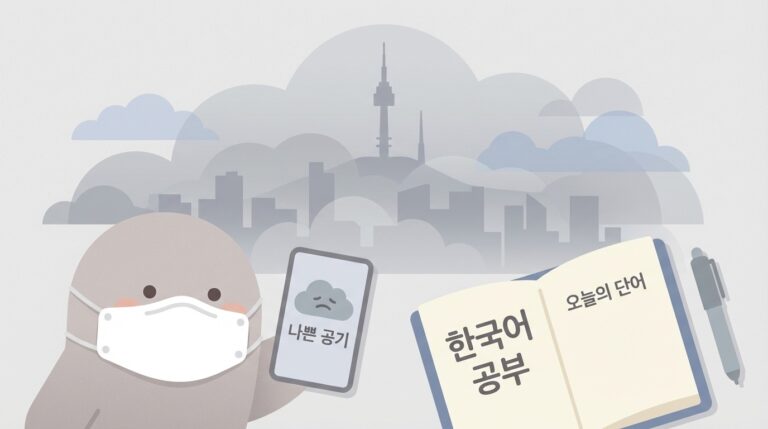
Phase 1: The Grey Sky Morning — Is It Fog or Dust?
Greeting: 안녕하세요! (Hello!) It’s your Daily Hangul Editor, back with another survival guide for life in Korea.
Picture this: You wake up in your Airbnb in Seoul, excited to visit Gyeongbokgung Palace. You open the curtains, expecting a bright blue sky, but instead… everything looks grey and hazy. Is it fog? Is it a gloomy K-Drama scene where the lead characters are about to break up? ☁️💔
Nope. Welcome to “Fine Dust” (미세먼지 – Misemonji) season.
If you walk out without preparation, you might find yourself coughing like a heavy smoker by lunchtime. In Korea, checking the air quality app is as important as checking your messages. Today, we’re going to learn the essential phrase to protect yourself and your friends: “Please wear a mask.”
Don’t worry, this isn’t a medical lecture. It’s about surviving Seoul like a local (and looking like a K-Pop star while doing it). Let’s dive in!
Phase 2: Deep Dive — 3 Key Expressions
1. 마스크 쓰세요 (Maseukeu sseuseyo)
- Pronunciation: [Ma-seu-keu sseu-se-yo]
- Tip: “Ma-seu-keu” sounds just like “Mask” but with a little extra vowel sound at the end. “Sseu-se-yo” sounds like you are saying “Say-yo” with a soft ‘s’ in front.
- Meaning: Please wear a mask.
- K-Culture Moment: You’ve seen those photos of K-Pop idols at Incheon Airport, right? Covered face to toe, bucket hat, and a black mask. That’s the vibe.
- Editor’s Insight: This is a polite way to tell someone to protect themselves. It shows you care about their health.
- Situation Spectrum:
[🚫 Boss/Elder] ———— [⚠️ Colleague] ———— [✅ Friend/Stranger]
(Note: For elders, just handing them a mask silently is often more polite than giving a command!) - 🤔 Think About It: Why is the word “Mask” (English) used? Korea modernized rapidly, and many medical terms were adopted from Western medicine or English.
2. 미세먼지 심해요 (Misemonji simhaeyo)
- Pronunciation: [Mi-se-mon-ji sim-hae-yo]
- Tip: “Mi-se” (Me-say) + “Mon-ji” (Mon-jee). “Sim-hae-yo” sounds a bit like “Seem-hey-yo.”
- Meaning: The fine dust is bad (severe).
- K-Drama Context: A mother packing a lunch for her child, looking worriedly at the window. “Don’t go outside today, misemonji simhaeyo.”
- Editor’s Insight: “Simhaeyo” is a great word for anything extreme—bad weather, a bad cold, or even a severe mood swing!
- Situation Spectrum:
[🚫 Strict Formal] ———— [⚠️ Polite] ———— [✅ Casual]
(Universal phrase suitable for most situations)
3. 목이 아파요 (Mogi apayo)
- Pronunciation: [Mo-gi a-pa-yo]
- Tip: “Mok” means throat, but when followed by “i”, it sounds like “Mogi”. Be careful! “Mogi” also means mosquito. Context is key! 🦟 vs 🗣️
- Meaning: My throat hurts.
- K-Pop Context: Before a concert, if your bias (favorite member) has a sore throat, fans will flood the comments with “Don’t get sick!”
- Editor’s Insight: Use this when you want to decline a Karaoke (Noraebang) invitation politely. “Sorry, mogi apayo.”
Phase 3: Textbook vs. Real Life
| Situation | 📖 Textbook Korean | 🗣️ Real Korean | 💡 Why is it different? |
|---|---|---|---|
| To a friend | 마스크를 착용하세요. (Please wear a mask.) |
마스크 썼어? (Did you wear a mask?) |
“착용” is too military/medical. Friends just check if you “did” it. |
| Buying a mask | 마스크 있습니까? (Do you have masks?) |
KF94 있어요? (Do you have KF94s?) |
We ask for the specific grade (KF94) because regular masks don’t work for dust. |
| Complaining | 공기가 안 좋습니다. (The air is not good.) |
아, 공기 최악이야. (Ah, the air is the worst.) |
Real emotions come out with strong words like “Choi-ak” (Worst). |
💡 Bottom Note: In Korea, “KF94” is basically a proper noun now. It stands for “Korea Filter 94%”. Just saying “KF94” works everywhere!
Phase 4: Cultural Deep Dive
4-1. Non-verbal: The “Mask Nunchi”
In Korea, wearing a mask isn’t just about your health; it’s about public etiquette. If you cough on the subway without a mask, you might feel the “laser eyes” of everyone around you. That’s the power of Nunchi (reading the room). If everyone is wearing one, you should too.
4-2. K-Culture Connection: Airport Fashion & “Idol Masks”
In Western media, masks are often associated with sickness. In K-Pop culture, masks are a fashion statement!
– The Black Mask: Often worn by idols to hide their no-makeup faces or to look chic.
– The White KF94: The standard for fine dust protection.
– K-Drama Trope: The main lead gently puts a mask on the love interest’s face. It’s an act of intimacy and protection. “Don’t get sick, I need you.” ( Cue romantic OST 🎵)
Phase 5: Immersive Roleplay — The Grey Morning
Setting: It’s Tuesday morning. You are meeting your Korean friend, Min-su, at a subway station exit. The sky is yellow-grey. The air smells slightly metallic.
Characters:
– YOU: An exchange student who forgot to check the weather app.
– MIN-SU: Your prepared Korean friend, wearing a heavy-duty white mask.
Dialogue:
Min-su: (Frowning and pointing at your bare face)
야! 너 마스크 안 가져왔어?
(Ya! Neo maseukeu an gajyeowasseo?)
(Hey! You didn’t bring a mask?)
YOU:
(Coughing slightly)
어… 깜빡했어요. 오늘 미세먼지 심해요?
(Eo… kkamppakhaesseoyo. Oneul misemonji simhaeyo?)
(Uh… I forgot. Is the fine dust bad today?)
Min-su:
완전 심해! 목 안 아파?
(Wanjeon simhae! Mok an apa?)
(It’s totally bad! Does your throat not hurt?)
🔀 Decision Point: How do you respond?
A) “괜찮아요. (Gwaenchana-yo.)” – It’s okay.
B) “편의점 어디예요? (Pyeonuijeom eodiyeyo?)” – Where is the convenience store?
C) “미세먼지 싫어요! (Misemonji sireoyo!)” – I hate fine dust!
✅ Best Choice: B
If the dust is bad, saying “I’m okay” (A) might worry your friend. Asking for a store (B) shows you want to solve the problem immediately. C is natural, but you still need a mask first!
Phase 6: 10-Second Shadowing Drill
Let’s practice complaining about the weather like a local. Repeat after me!
Emotion: 😫 Frustrated & Worried
“오늘 / 미세먼지 / 진짜 / 심해요!”
(Oneul / misemonji / jinjja / simhaeyo!)
Translation: Today / fine dust / really / is bad!
Focus: Emphasize “Jinjja” (Really) to sound authentic!
Phase 7: K-Culture Mini Glossary
| Korean | Romanization | Meaning | Context |
|---|---|---|---|
| 황사 | Hwangsa | Yellow Dust | Dust blowing in from deserts in spring. Often confused with fine dust. |
| 공기청정기 | Gonggi-cheongjeonggi | Air Purifier | Every Korean home/cafe has one. The “lifesaver” machine. |
| 방독면 | Bangdokmyeon | Gas Mask | Used jokingly: “Today is so bad, I need a bangdokmyeon.” |
| 삼겹살 | Samgyeopsal | Pork Belly | Myth: Koreans believe grease from pork belly “washes down” the dust from your throat. (Not scientifically true, but delicious!) |
Phase 8: Traveler’s Survival Kit
Did you land in Korea during a bad dust wave? Don’t panic.
🆘 Survival Card: Buying a Mask
– 🇰🇷 “KF94 마스크 주세요.” (KF-gusipsa maseukeu juseyo.)
– 🗣️ Say: “KF-94 Mask Ju-say-yo”
– 📍 Where: Any Convenience Store (GS25, CU, 7-Eleven), Pharmacy (약국)
– 💡 Pro Tip: Don’t buy the thin fashion masks for dust. Look for “황사 방역용” (Yellow Dust Protection) on the package.📌 Editor’s Travel Note
Download the app “MiseMise” (미세미세). It uses cute icons (smiling or crying faces) to tell you the air quality. You don’t even need to read Korean—if the screen is red or black, wear a mask!
Phase 9: Think Deeper — “Why Do We Mask?”
Topic: The Collective ‘We’
In many Western cultures, wearing a mask is often seen as protecting oneself. In Korea, it’s heavily tied to community consideration. Even before the pandemic, if you had a slight cough, you wore a mask so you wouldn’t infect your classmates or colleagues.
When the fine dust alarm rings, everyone masks up not just out of fear, but out of a shared rhythm of life. It’s a visual sign that says, “We are all enduring this bad air together.”
💬 Your Turn: In your country, if someone wears a mask, what do people think? Is it seen as “sick” or “stylish”? Let me know in the comments!
Phase 10: FAQ & Troubleshooting
Q: Can I just wear a scarf over my mouth?
A: You can, but people might look at you with pity. A scarf doesn’t block fine dust (PM2.5). Koreans take dust seriously, so a proper mask is better.
Q: Is it rude to wear a black mask?
A: No! Black masks are very trendy in Korea, thanks to K-Pop idols. White is medical/standard, Black is chic, Pink/Beige is for “color matching” with outfits.
❌ Common Mistake:
Thinking “Foggy weather” = “Romantic weather.”
✅ Correction: If it’s foggy in Seoul, check the AQI (Air Quality Index) immediately. It’s likely dust!
Phase 11: Wrap-up
One-Liner: When the sky is grey, check the app, grab a KF94, and say “Maseukeu sseuseyo!”
Action Missions:
– 🥉 Bronze: Say “Maseukeu sseuseyo” out loud 3 times right now.
– 🥈 Silver: Download a Korean air quality app (like MiseMise) and check today’s air in Seoul.
– 🥇 Gold: Go to a Korean mart (or online) and find a package of masks. Look for the letters “KF94”.
K-Culture Mission:
Next time you watch a K-Drama or K-Pop airport video, count how many different colors of masks you see! 🎭
Phase 12: Quiz — Interactive Challenge
- Situation: Your friend is coughing. What do you say?
- A) 목이 아파요. (My throat hurts.)
- B) 마스크 쓰세요. (Please wear a mask.)
- C) 미세먼지 좋아요. (The fine dust is good.)
- Culture: Which mask type is best for fine dust in Korea?
- A) KF94
- B) A thin cloth mask
- C) A bandana
- True or False: Koreans believe eating Samgyeopsal (Pork Belly) helps wash away dust.
- (True / False)
(Scroll down for answers)
.
.
.
Answers: 1. (B), 2. (A), 3. (True – even if it’s not scientific, it’s a tasty tradition!)*
Frequently Asked Questions (FAQ)
Q: What does "마스크 쓰세요 (Maseukeu sseuseyo)" mean in Korean and how do you pronounce it?
A: In Korean, "마스크 쓰세요 (Maseukeu sseuseyo)" is pronounced [Ma-seu-keu sseu-se-yo] and means: a key conversational Korean expression covered in this lesson.
Q: What does "미세먼지 심해요 (Misemonji simhaeyo)" mean in Korean and how do you pronounce it?
A: In Korean, "미세먼지 심해요 (Misemonji simhaeyo)" is pronounced [Mi-se-mon-ji sim-hae-yo] and means: a key conversational Korean expression covered in this lesson.
Q: What does "목이 아파요 (Mogi apayo)" mean in Korean and how do you pronounce it?
A: In Korean, "목이 아파요 (Mogi apayo)" is pronounced [Mo-gi a-pa-yo] and means: a key conversational Korean expression covered in this lesson.







