

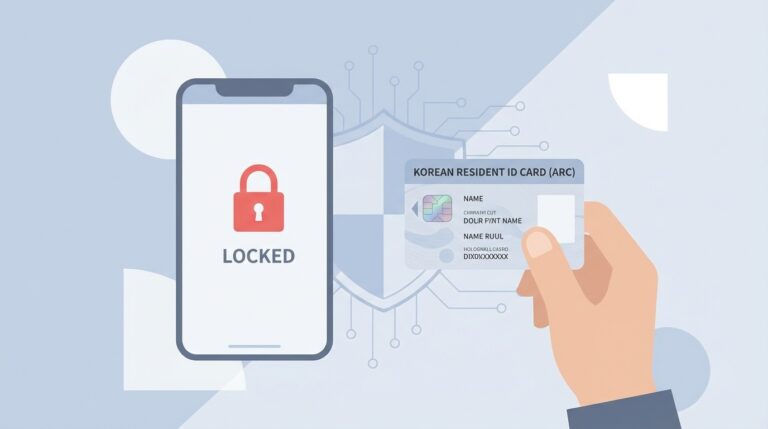
Panic at the ATM? Unlocking Your Korean Bank Account Like a Pro
Phase 1: The ‘Internal Scream’ Moment (Immersive Hook)
Greeting: 안녕하세요! It’s your Daily Hangul editor.
Picture this: It’s 7:55 PM. You are ready for the infamous “Ticketing War” (티켓팅 전쟁) to see your favorite K-Pop group. You have 5 minutes to transfer money to top up your balance. Your fingers tremble as you type your password into the banking app.
Beep. “비밀번호 오류입니다 (1/5).”
“Okay, calm down,” you think. You try again.
Beep. “비밀번호 오류입니다 (2/5).”
Now you’re sweating. You channel the dramatic tension of a K-Drama finale. One last try…
BEEP. “계좌가 잠겼습니다 (Account Locked).”
The world stops. We’ve all been there. In Korea, where digital banking is lightning fast but security is tighter than Fort Knox, a password error isn’t just an annoyance—it’s a crisis. But don’t worry. Today, we’re going to fix this together so you don’t miss that concert.
Phase 2: Deep Dive into Key Expressions
Here are the weapons you need to survive a banking lockdown.
1. 비밀번호 오류 (Bimil-beonho o-ryu)
- Pronunciation: [Bi-mil-beon-ho] + [O-ryu]
- Tip: ‘O-ryu’ is tricky. The ‘ryu’ sounds a bit like the start of ‘youth’ but with a tapped ‘R’.
- Meaning: Password Error (Literal & Real)
- K-Culture Moment: Think of that scene in a spy thriller where the hacker says, “Access Denied.” In Korea, you’ll see this phrase on ATMs, door locks, and apps constantly.
- Editor’s Insight: ‘오류’ is a formal word for ‘error’ or ‘glitch.’ You won’t use this to describe a mistake in your homework (that’s ‘실수’). This is for machines.
- Situation Spectrum:
[🚫 Casual] ———— [⚠️ Semi-formal] ———— [✅ Formal]
(Used mostly when reading screen messages or talking to staff)- 🤔 Think About It: Why does Korean banking give you only 3 or 5 tries? It reflects the “Ppalli-ppalli” (Hurry hurry) culture combined with high-tech security anxiety. Efficiency meets paranoia!
2. 본인 인증 (Bon-in in-jeung)
- Pronunciation: [Bon-in] + [In-jeung]
- Meaning: Identity Verification
- K-Culture Moment: If you live in Korea, this is your frenemy. From ordering fried chicken to signing up for a fan club, you must prove you are you. It’s the gatekeeper of K-Life.
- Editor’s Insight: When the bank teller asks for this, they aren’t doubting you. They are legally required to verify your ARC (Alien Registration Card) and phone number match perfectly.
- Situation Spectrum:
[🚫 Casual] ———— [⚠️ Semi-formal] ———— [✅ Formal]3. 재설정하다 (Jae-seol-jeong-ha-da)
- Pronunciation: [Jae] + [Seol-jeong] + [Ha-da]
- Meaning: To reset (literally: re-set-up)
- Editor’s Insight: You might want to say “Change” (바꾸다), but when you’ve forgotten it and need a new one, 재설정 (reset) is the more accurate technical term used by staff.
- 🤔 Think About It: Notice the prefix ‘재’ (Jae)? It means ‘Re-‘. You’ll see it everywhere: 재방송 (Re-run of a drama), 재입국 (Re-entry). It implies a cycle.
Phase 3: Textbook vs. Real Life
How to sound like a local, not a robot.
| Situation | 📖 Textbook Korean | 🗣️ Real Korean (Survival) | 💡 Why different? |
|---|---|---|---|
| Explaining the error | 비밀번호를 5회 틀렸습니다. (I got the password wrong 5 times.) | 비번 횟수 초과됐어요. (Pw attempts exceeded.) | ‘비번’ is the universal short form for 비밀번호. Efficiency wins! |
| Asking to fix it | 비밀번호를 다시 만들고 싶어요. (I want to make the password again.) | 비밀번호 재설정 하러 왔어요. (I came to reset my password.) | Using specific banking terms like ‘재설정’ speeds up the process. |
| Forgot password | 비밀번호를 잊어버렸습니다. (I forgot the password.) | 비번 까먹었어요. (Totally forgot my pw.) | ‘까먹다’ (like peeling and eating a fruit) is the colloquial verb for forgetting. |
💡 Bottom Note: In a bank, stick to the Real Korean column but keep your politeness level high (add -yo at the end!).
Phase 4: Cultural Context — The “Nunchi” of Banking
4-1. Non-verbal: The “Waiting” Game
When you enter a Korean bank, don’t walk straight to the counter. Look for the machine giving out 번호표 (Number tickets). Standing near the counter without a ticket shows a lack of Nunchi (situational awareness). Also, have your ID (ARC) and Passport ready in your hand before you sit down. It shows respect for the teller’s time.
4-2. K-Drama Connection: The “Blocked Funds” Trope
You know that trope where the rich CEO’s credit card gets declined because his father cut him off? That sound—Deeng!—is the sound of 거래 정지 (Transaction Suspended). In real life, for foreigners, this often happens because your visa information wasn’t updated in the bank’s system. It’s not dramatic family feuds; it’s usually just administrative sync issues!
Phase 5: Immersive Roleplay
Setting: Monday lunch hour at a bank in Gwanghwamun. It’s crowded. Office workers are everywhere. You finally hear your number: *”Ding-dong! 104-beon gogaek-nim.”
Characters:
* YOU: A foreign exchange student who locked their account.
* Teller (Kim): Efficient, fast, professional.
Dialogue:
Teller: 어서 오세요. 어떤 업무 도와드릴까요?
(Eoseo oseyo. Eotteon eomu dowadeurilkkayo?)
(Welcome. How can I help you today?)
YOU: 저… 인터넷 뱅킹 로그인이 안 돼요. 비밀번호 오류라고 나와요.
(Jeo… internet banking login-i an dwaeyo. Bimil-beonho o-ryu-rago nawayo.)
(Um… I can’t login to internet banking. It says password error.)
Teller: 아, 횟수 초과하셨나요? 신분증 주시겠어요?
(Ah, hoetsu chogwa-ha-syeonnayo? Sinbunjeung jusigesseoyo?)
(Ah, did you exceed the attempts? Can I have your ID?)
YOU:
(🎭 Stage Direction: You realize you only brought your passport, not your ARC)
🔀 Decision Point! What do you say?
- A) 여권밖에 없는데 괜찮나요? (I only have my passport, is that okay?)
- B) 아, 집에 있어요. (Ah, it’s at home.)
- C) 저 외국인이에요. (I am a foreigner.)
✅ Best Choice: A
* Analysis: Banks strictly require your ARC for most digital banking issues. However, if your passport is registered, A allows the teller to check. B ends the conversation immediately. C is irrelevant; they know you are a foreigner, but they need the ID.
Teller (Responding to A): 여권은 안 될 수도 있는데… 잠시만요. 혹시 핸드폰 본인 명의세요?
(Yeogwon-eun an doel sudo inneunde… jamsimanyo. Hoksi haendeupon bonin myeong-ui-seyo?)
(Passport might not work… one moment. Is the mobile phone under your name?)
YOU: 네, 제 이름으로 돼 있어요.
(Ne, je ireumeuro dwae isseoyo.)
(Yes, it’s under my name.)
Phase 6: 10-Second Shadowing Drill
Practice this until you can say it without shaking at the counter.
- Emotion: 😢 (Slightly apologetic and frustrated)
- Sentence: 비번을 / 자꾸 틀려서 / 계좌가 / 잠겨버렸어요.
- Romanization: Bibeon-eul / jakku teullyeoseo / gyejwaga / jamgyeo-beoryeosseoyo.
- Meaning: I got the password wrong repeatedly, so the account got locked up completely.
(Note: ‘버렸어요’ adds the nuance of “Oh no, it happened unfortunately.”)
Phase 7: K-Culture Mini Glossary
| Korean | Romanization | English | Context |
|---|---|---|---|
| 공인인증서 | Gong-in in-jeung-seo | Joint Certificate | The digital ID file required for banking. The final boss of Korean internet struggles. |
| OTP | O-T-P | One Time Password | That little device or card that generates a random number. Don’t lose this! |
| 창구 | Chang-gu | Bank Counter/Window | Where you meet the teller. |
| 계좌 이체 | Gyejwa Iche | Account Transfer | How you pay for everything from rent to street food (sometimes). |
Phase 8: Traveler’s & Expat’s Survival Kit
Even if you are just traveling, you might need an ATM. If you live here, this is vital.
🆘 Survival Phrases
- 🇰🇷 “글로벌 ATM 맞나요?” (Global ATM mannayo?)
- Use: To confirm if the machine accepts foreign cards.
- 🇰🇷 “체크카드가 안 돼요.” (Check card-ga an dwaeyo.)
- Use: When your debit card is rejected.
- 💡 Pro Tip: Most Korean banks close at 4:00 PM. This is shockingly early for many foreigners. If you have a password issue, go during your lunch break, or you will have to wait until tomorrow!
Phase 9: Think Deeper — “Digital Korea vs. Administrative Korea”
🧠 The Paradox:
Korea is one of the most digitally advanced nations (5G everywhere!), yet banking often feels stuck in the 90s with strict regulations (ActiveX, exe files). Why? It’s about Accountability. In Korea, financial anonymity is illegal to prevent fraud. This means every digital step requires a “digital fingerprint” (Certificate/Phone Auth).
💬 Your Turn: Does your country value speed or security more in banking? How hard is it to reset a password back home?
Phase 10: FAQ & Troubleshooting
- Q: Can I reset my password online without going to the bank?
- A: Maybe. If you have your OTP card and a valid Certificate on your PC/Phone, yes. But usually, if you are locked out, you are locked out of the tools needed to reset it. A branch visit is often faster.
- Q: Can I ask a Korean friend to call the bank for me?
- A: NO. Banks are extremely strict about privacy. They will not speak to a friend about your account details. You must be present.
- ❌ Common Mistake: Writing your password on a piece of paper and showing it to the teller.
- ✅ Do this: Use the keypad they provide. Never let anyone (even the teller) see your PIN visually.
Phase 11: Wrap-up & Mission
Summary: Today we learned how to say “Password Error” (비밀번호 오류), “Identity Verification” (본인 인증), and how to navigate the “Account Locked” (계좌 잠김) crisis.
🚀 Action Missions:
* 🥉 Bronze: Look at your banking app login screen. Find the word “오류” or “인증”.
* 🥈 Silver: Practice saying the Shadowing Drill sentence while pretending to hold a number ticket.
* 🥇 Gold: Go to the bank to update your contact info (even if not locked out) and use the phrase: “정보 업데이트하러 왔어요” (I came to update my info).
K-Culture Mission: Watch a scene in a drama where someone buys something online. Watch them suffer through the payment gateway!
Phase 12: Interactive Quiz
- Situation Check: You are at the ATM. You see the message “비밀번호 3회 오류”. What happens next if you try one more time and fail?
- a) The machine gives you money anyway.
- b) The police arrive.
- c) 계좌가 잠깁니다 (Account gets locked).
- True or False: You can send your Korean friend to the bank with your ID to fix your password because you are busy.
- ( True / False )
- Fill in the blank: To reset your password, you need to do ______ Verification.
- ( 본인 / 친구 ) 인증
(Answers: 1-c, 2-False, 3-본인)
Frequently Asked Questions (FAQ)
Q: What does "비밀번호 오류 (Bimil-beonho o-ryu)" mean in Korean and how do you pronounce it?
A: In Korean, "비밀번호 오류 (Bimil-beonho o-ryu)" is pronounced [Bi-mil-beon-ho] and means: a key conversational Korean expression covered in this lesson.
Q: What does "본인 인증 (Bon-in in-jeung)" mean in Korean and how do you pronounce it?
A: In Korean, "본인 인증 (Bon-in in-jeung)" is pronounced [Bon-in] and means: Identity Verification
Q: What does "재설정하다 (Jae-seol-jeong-ha-da)" mean in Korean and how do you pronounce it?
A: In Korean, "재설정하다 (Jae-seol-jeong-ha-da)" is pronounced [Jae] and means: To reset (literally: re-set-up)







