

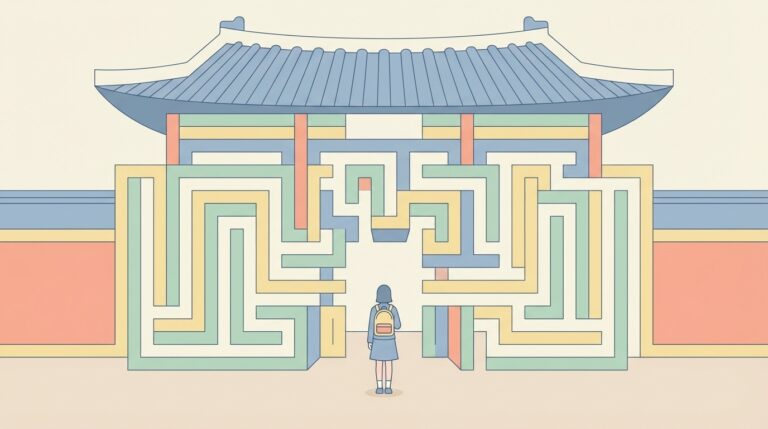
Phase 1: The Silence of the Suneung
Hello, Daily Hangul family! It’s your editor, here to take you deep into the intense heart of Korean society.
Picture this: It’s a crisp November morning. You’re at Incheon International Airport, and suddenly, all flights are grounded. No take-offs, no landings for 35 minutes. Is it a national emergency? A VIP visit?
No. It’s because hundreds of thousands of high school seniors are taking the English listening portion of the Suneung (CSAT). We ground planes so they can hear clearly. That is the weight of college admissions in Korea.
If you’ve watched the K-Drama Sky Castle or Crash Course in Romance, you know that Korean education isn’t just about learning—it’s a battlefield. Recently, the Korean government announced a major College Entrance System Reform (대학 입시 제도 개편). For a C1 learner, understanding this isn’t just about vocabulary; it’s about understanding the anxiety, the hope, and the fierce debate dominating Korean news right now.
Let’s decode the headlines and the heart of this issue together.
Phase 2: Deep Dive into Core Expressions
To discuss this topic at a C1 level, you need words that appear in news editorials and heated cafe debates, not just textbooks.
1. 변별력을 갖추다 (Byeonbyeollyeogeul gatchuda)
- Pronunciation: [byeon-byeol-lyeo-geul gat-chu-da] -> Sounds like “byun-byul-lyuh-geul got-chew-da”
- Meaning: To have the ability to discriminate/distinguish (between high and low performers).
- Context: In exams, if a test is too easy, everyone gets 100, and you can’t rank students. If it’s too hard, everyone fails. Finding that balance is “securing byeonbyeollyeok.”
- K-Culture Moment: In news reports after the Suneung, anchors always ask: “Did this year’s exam have enough byeonbyeollyeok?”
- Editor’s Insight: This is a cold, technical word, but it determines a student’s fate. It’s the difference between entering Seoul National University or not.
- Situation Spectrum:
[🚫 Formal Only] ———— [⚠️ Semi-Formal] ———— [✅ Casual]
(Mostly used in debates, news, or serious discussions about standards: ⚠️)- 🤔 Think About It: Why is “ranking” students so crucial in Korean society compared to a pass/fail system?
2. 킬러 문항 (Killeo munhang)
- Pronunciation: [kil-leo mun-hang] -> Literally “Killer” + “Moon-hang” (item/question)
- Meaning: “Killer Questions” (Extremely high-difficulty questions often outside public curriculum).
- Context: These are the notorious questions designed to distinguish the top 0.1%. The government recently vowed to remove these to reduce reliance on private tutoring.
- K-Culture Moment: Imagine a scene in a drama where a student collapses because of one math problem. That’s a Killer munhang.
- Editor’s Insight: This word symbolizes the “pain point” of Korean education. Using this word shows you follow current affairs.
- Situation Spectrum:
[🚫 Formal Only] ———— [⚠️ Semi-Formal] ———— [✅ Casual]
(Widely used in daily conversation now due to news coverage: ✅)3. 공정성을 강화하다 (Gongjeongseongeul ganghwahada)
- Pronunciation: [gong-jeong-seong-eul gang-hwa-ha-da]
- Meaning: To strengthen fairness/impartiality.
- Context: The ultimate justification for every policy change. “We are doing this to strengthen fairness.”
- Editor’s Insight: In Korea, Gongjeong (Fairness) is a sensitive trigger. Any hint of unfair advantage (like a wealthy parent manipulating the system) causes massive public outrage.
- 🤔 Think About It: Does removing difficult questions actually make a test “fairer,” or does it just make it harder to distinguish talent?
Phase 3: Textbook vs. Real Life
| Situation | 📖 Textbook Korean | 🗣️ Real Korean (News/Debate) | 💡 Why the difference? |
|---|---|---|---|
| Discussing difficulty | 시험이 너무 어려웠어요. (The test was too hard.) | 불수능이었어. (It was a “Fire Suneung.”) | Bul (Fire) implies a hellishly difficult exam. Conversely, Mul (Water) Suneung means it was too easy. |
| Talking about retaking | 시험을 다시 볼 거예요. (I will take the test again.) | 저 N수 할까 봐요. (I might do “N-su”.) | N-su refers to retaking the exam ‘N’ number of times (Jaesu=2nd, Samsu=3rd). It’s a cultural identity. |
| Policy change impact | 입시 제도가 바뀌어서 혼란스러워요. | 입시 판도가 뒤집혔어. (The entrance exam landscape has flipped.) | Koreans use dramatic metaphors like “landscape” or “game board” for systemic changes. |
Phase 4: Cultural Context — K-Drama & The “Hagwon” Life
4-1. The “Pig Mom” and Information Warfare
In dramas like Sky Castle, you see mothers gathering in brunch cafes to exchange info. This is real. There’s a slang term “Daechi-dong Pig Mom” (대치동 돼지엄마)—a mom who leads a group of other moms, hoarding high-quality exam info like a mother pig leading her piglets. The recent reforms aim to break this information asymmetry, but the “Pig Moms” are already analyzing the new strategies.
4-2. Non-verbal: The “Yeot” (엿)
Before the exam, you never give seaweed soup (miyeok-guk) because it’s slippery (you might “slip”/fail). Instead, you give Yeot (sticky taffy) or Chapssaltteok (glutinous rice cake) so the student “sticks” (붙다) to their desired university.
Phase 5: Immersive Roleplay — The Daechi-dong Debate
Setting: A frantic Starbucks in Daechi-dong (the epicenter of Korean private education) at 10 PM. Students are rushing to their next academy class.
Characters:
* YOU: An education columnist visiting Korea to research the new policy.
* Mr. Kim: A veteran Hagwon (cram school) math instructor who is worried about his job.
(Dialogue Start)
Mr. Kim: 이번 개편안 봤어요? 킬러 문항을 없애면 변별력은 도대체 어떻게 확보하겠다는 건지…
(Ibeon gaepyeon-an bwasseoyo? Killeo munhangeul eopsaemyeon byeonbyeollyeogeun dodaeche eotteoke hwakbo-ha get-daneun geonji…)
(Did you see the reform plan? If they get rid of killer questions, how on earth do they intend to secure discrimination power?)
YOU:
(Choose your response)
🔀 Your Turn! How do you respond?
- A) “그러게요. 오히려 실수 싸움이 될까 봐 걱정이에요.” (I know. I’m worried it will just become a battle of who makes fewer mistakes.)
- B) “하지만 사교육비를 줄이려면 필요한 조치 아닐까요?” (But isn’t it a necessary measure to reduce private education costs?)
- C) “와, 진짜 한국 입시는 드라마보다 더하네요.” (Wow, Korean entrance exams are more intense than dramas.)
✅ Best Choice: A) This shows high-level insight. If difficult questions vanish, one tiny mistake on an easy question drops your rank drastically. This is the core counter-argument in Korea right now.
⚠️ Choice B Analysis: This is the government’s stance. Mr. Kim (a private tutor) might get defensive!
Mr. Kim: 맞아요! 이제는 ‘물수능’이 되면 최상위권 학생들은 다 재수하러 갈 겁니다.
(Exactly! If it becomes a “Water Suneung” (too easy), all the top-tier students will go for a retake.)
YOU: 결국 공정성을 위한 정책이 또 다른 경쟁을 낳는 셈이네요.
(Gyeolguk gongjeongseongeul wihan jeongchaegi tto dareun gyeongjaengeul nanneun seminey.)
(So, in the end, a policy for fairness is essentially birthing another form of competition.)
Phase 6: 10-Second Shadowing Drill
Let’s practice the tone of a skeptical news anchor or intellectual.
- Emotion: Serious, Analytical (🤔)
- Sentence: 입시 제도가 / 바뀔 때마다 / 학생들의 혼란만 / 가중되고 있습니다.
- Romanization: Ipsi jedoga / bakkwil ttaemada / haksaeng-deurui hollanman / gajung-doego isseumnida.
- Meaning: Every time the entrance exam system changes, only the students’ confusion is aggravated.
Phase 7: K-Culture Mini Glossary
| Korean | Romanization | Meaning & Context |
|---|---|---|
| 수능 (수학능력시험) | Suneung | The CSAT. The “judgment day” for Korean students. |
| 내신 | Naesin | School GPA/Records. Recent reforms emphasize this more. |
| 일타 강사 | Ilta Gangsa | “No. 1 Star Instructor.” Celebrity tutors who earn millions (like in Crash Course in Romance). |
| 학벌 사회 | Hakbeol Sahoe | A society based on academic pedigree/background. |
| N수생 | N-su saeng | Students who re-take the college entrance exam N times. |
Phase 8: Traveler’s Survival Kit (Education Edition)
Even if you aren’t taking the exam, Suneung Day (usually the 3rd Thursday of November) affects travelers.
🆘 Suneung Day Survival Guide
* Public Transport: Subway hours are extended, but rush hour is shifted. Banks and offices open at 10 AM instead of 9 AM to keep roads clear for students.
* The English Listening Test: Around 1:05 PM ~ 1:40 PM. Planes do not fly. Buses drive slowly and don’t honk near schools. Construction stops.
* Cheering Squads: If you go near a high school gate at 7 AM, you will see juniors bowing and banging drums for their seniors. It’s a spectacle!
Phase 9: Think Deeper — “Hakbeol” & The Ladder
Topic: Meritocracy vs. Happiness
Korea’s obsession with entrance exam reform stems from the belief that education is the only fair ladder to social success. In the Joseon Dynasty, it was the Gwageo (civil service exam); today, it is the Suneung. But here is the critical question: Does a single exam day accurately measure a human’s potential?
The reforms try to shift focus from rote memorization to creativity (high school credit system), but as long as the prestigious university title (Hakbeol) dictates your salary and marriage prospects, can the competition ever truly cool down?
💬 Your Turn: In your country, does the university name determine your life’s path? Or is it just one of many factors?
Phase 10: FAQ & Troubleshooting
- Q: Can I ask a Korean high schooler “Which university do you want to go to?”
- Editor: ⚠️ Careful. This is a massive stress trigger. Unless you are very close, it’s better to say “공부하느라 힘들죠?” (Studying must be tough, right?) rather than asking for specific goals.
- Q: Is it true that police escort students?
- Editor: ✅ YES. If a student is running late on exam day, they can call 112. A police motorcycle will pick them up and blast through traffic to the test center. It’s a yearly tradition on the news!
- ❌ Common Mistake: Confusing 수시 (Susi – Early Admission) and 정시 (Jeongsi – Regular Admission based on Suneung).
- Correction: Recent reforms are adjusting the ratio between these two. Knowing the difference impresses Koreans immensely.
Phase 11: Wrap-up & Mission
Summary: Today we learned high-level terms like 변별력 (discrimination power) and 공정성 (fairness) to discuss the intense world of Korean college entrance reforms.
Action Missions:
* 🥉 Bronze: Stand before a mirror and practice saying “킬러 문항” with a serious face.
* 🥈 Silver: Find a YouTube news clip about “2028 대입 개편안” and listen for the word “변별력.”
* 🥇 Gold: Ask a Korean friend, “한국에서는 정말 대학 이름이 중요해?” (Is the university name really that important in Korea?) and listen to their honest story.
K-Culture Mission: Watch the first episode of Sky Castle or Black Dog: Being A Teacher. Look for the scene where teachers analyze the students’ records. That is the reality of 입시 (Ipsi).
See you next class!
Stay smart, stay curious.
Frequently Asked Questions (FAQ)
Q: What does "변별력을 갖추다 (Byeonbyeollyeogeul gatchuda)" mean in Korean and how do you pronounce it?
A: In Korean, "변별력을 갖추다 (Byeonbyeollyeogeul gatchuda)" is pronounced [byeon-byeol-lyeo-geul gat-chu-da] and means: To have the ability to discriminate/distinguish (between high and low performers).
Q: What does "킬러 문항 (Killeo munhang)" mean in Korean and how do you pronounce it?
A: In Korean, "킬러 문항 (Killeo munhang)" is pronounced [kil-leo mun-hang] and means: "Killer Questions" (Extremely high-difficulty questions often outside public curriculum).
Q: What does "공정성을 강화하다 (Gongjeongseongeul ganghwahada)" mean in Korean and how do you pronounce it?
A: In Korean, "공정성을 강화하다 (Gongjeongseongeul ganghwahada)" is pronounced [gong-jeong-seong-eul gang-hwa-ha-da] and means: To strengthen fairness/impartiality.







