

Phase 1: The Immersive Hook
Hello! This is your Senior Editor at Daily Hangul.
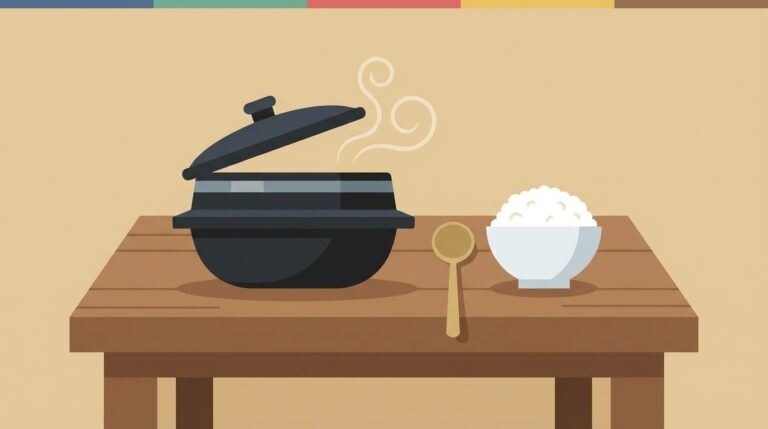
Imagine this scene from a K-Drama: The protagonist has just finished a hearty, spicy meal at a traditional restaurant. The table is covered in empty plates. But instead of asking for the check or a sweet dessert, the grandmotherly owner brings out a stone pot filled with… cloudy, brownish hot water?
The protagonist takes a sip, sighs a deep “Euuuh~,” and looks happier than they did during the main course.
If you’re new to Korea, you might panic. “Did they just serve me dishwater?” “Is this a mistake?”
Welcome to the world of Nu-rung-ji (누룽지) and Sung-nyung (숭늉). To the untrained eye, it looks like burnt rice and hot water. But to a Korean, this is the ultimate comfort, the original digestive medicine, and the most nostalgic flavor in our history. Today, we aren’t just learning words; we are learning the “taste of home.”
Phase 2: Deep Dive into Core Expressions
Let’s break down the vocabulary you need to navigate this savory finale.
1. 누룽지 (Nu-rung-ji)
- Pronunciation: [Nu-rung-ji] (Sounds like New-rung-jee)
- Meaning: Scorched rice / Crust of overcooked rice.
- K-Culture Moment: You’ll often see K-Pop idols playing games to win snacks, and “Nu-rung-ji candy” or “Nu-rung-ji chips” are frequent prizes. It represents a “Halmeoni-ipmat” (Grandma’s taste) which is surprisingly trendy right now.
- Editor’s Insight: Nu-rung-ji is the crispy layer left at the bottom of the pot. It’s not “burnt” (that’s tan-bap); it’s golden brown and crunchy. You can eat it dry as a snack or boil it.
- Situation Spectrum:
[🚫 Formal Banquets] ———— [⚠️ Restaurants] ———— [✅ Casual/Home]
(Note: At a fancy stone-pot rice restaurant, it is expected. At a formal western dinner, absolutely not.)🤔 Think About It: Why do you think a culture that values pure white, fluffy rice also cherishes the brown, crusty leftovers? Is it just frugality, or is there a texture preference here?
2. 숭늉 (Sung-nyung)
- Pronunciation: [Sung-nyung] (Sounds like Soong-nyoong — make your lips round!)
- Meaning: Scorched rice tea / Boiled scorched rice.
- K-Culture Moment: In historical dramas (Sageuk), you often see travelers stopping at a tavern asking for a bowl of Sung-nyung before anything else. It hydrates and warms the body.
- Editor’s Insight: This is made by pouring water/tea into the pot with the Nu-rung-ji. It acts as a palate cleanser (Ip-ga-sim) after a spicy or salty meal. It neutralizes the spice.
3. 구수하다 (Gu-su-ha-da)
- Pronunciation: [Gu-su-ha-da] (Goose-oo-hada)
- Meaning: Savory, earthy, nutty, rustic.
- Editor’s Insight: This is critical for B2 learners. Do not confuse this with Goso-hada (nutty like sesame oil). Gusu-hada is deeper—think miso soup, barley tea, or Nu-rung-ji. It smells like the countryside.
- Situation Spectrum:
[🚫 Describing Candy] ———— [⚠️ Describing People] ———— [✅ Describing Stews/Tea]
(Fun Fact: You can call a person “gusu-hada” if they are humble, down-to-earth, and unpretentious!)
Phase 3: Textbook vs. Real Life
| Situation | 📖 Textbook Korean | 🗣️ Real Korean (Street/Restaurant) | 💡 Why the difference? |
|---|---|---|---|
| Asking for water | 따뜻한 물 주세요. (Please give me warm water.) | 사장님, 여기 숭늉 물 좀 부어주세요! (Boss, pour some Sung-nyung water here!) | Specificity matters. In a stone pot place, you need specific hot tea, not just water. |
| Tasting it | 맛이 참 좋습니다. (The taste is very good.) | 와, 국물이 진짜 구수하네~ (Wow, the broth is seriously earthy/savory~) | Koreans praise the depth of flavor, not just the “goodness.” |
| Finishing the meal | 식사를 마쳤습니다. (I have finished the meal.) | 입가심으로 딱이다. (It’s perfect for a palate cleanser.) | Focuses on the function of the food (cleaning the mouth). |
Bottom Note: When you say “Gu-su-ha-da” instead of just “Mas-isseo-yo” (It’s delicious), older Koreans will look at you with shock and admiration. You immediately gain “Insider” status.
Phase 4: Cultural Deep Dive — The “Dolsot” Ritual
4-1. The Art of Timing (Non-verbal)
If you order Dolsot-bap (Stone Pot Rice), there is a silent timer ticking.
1. The pot arrives sizzling hot.
2. You must scoop the fluffy white rice into a separate bowl immediately.
3. DO NOT scrape the bottom. Leave the brown crust stuck to the stone.
4. Pour the provided hot water into the stone pot and close the lid.
5. Eat your meal. When you finish, open the lid. The Sung-nyung is ready.
If you scrape everything off at the beginning, you have failed the ritual. The waiter might look at you with sad eyes because you missed the best part.
4-2. K-Culture Connection: K-Food Philosophy
Why drink hot water after a meal? Western culture prefers cold desserts (ice cream, cake). Korean culture prefers “Yi-yeol-chi-yeol” (fighting heat with heat) and aiding digestion. The warm, starchy water settles the stomach after spicy kimchi or stew. It represents the Korean belief that a meal isn’t over until the stomach is comforted, not just full.
Phase 5: Immersive Roleplay Scenario
Setting: A busy Sundubu-jjigae (Soft Tofu Stew) restaurant in Jongno. It is lunch time. You are with Min-su (30, your Korean coworker).
Min-su: (Pushing a kettle towards you) 밥 덜었어? 물 빨리 부어야 해! 안 그러면 타버려.
(Bap deol-eoss-eo? Mul ppalli bu-eo-ya hae! An geureomyeon ta-beoryeo.)
[Did you scoop out the rice? You gotta pour the water fast! Otherwise, it’ll burn.]
(🎭 Stage Direction: Min-su looks urgent, holding the kettle handle)
YOU (Select your response):
🔀 Your Turn! How do you respond?
- A) “네, 물 주세요.” (Standard, polite, a bit dry)
- B) “잠깐만요! 저는 바삭한 누룽지가 좋아요.” (Wait! I like crispy scorched rice.)
- C) “오케이! 숭늉 만들어야죠. 구수하게!” (Okay! Gotta make sung-nyung. Make it savory!)
✅ Best Choice: C
Analysis: This shows you understand the goal of the process (making Sung-nyung) and the desired taste (Gusu-hada). Min-su will likely say, “Ooh, you know how to eat!”⚠️ Choice B Analysis: This is actually a valid preference! Some people prefer eating the crust dry and crispy as a snack (Gwan-sik) rather than making soup. If you say this, Min-su might say, “Ah, you like the crunchy style?”
Min-su: (Pouring water into his own pot) 역시 밥 다 먹고 숭늉 한 잔 마셔야 소화가 되지.
(Yeoksi bap da meok-go sung-nyung han jan ma-syeo-ya sohwa-ga doe-ji.)
[As expected, you have to drink a cup of Sung-nyung after eating for digestion.]
YOU:
“맞아요. ( 1. Insert Expression ).”
[That’s right. It’s really savory/earthy.]
(Answer: 구수하네요 / Gu-su-ha-ne-yo)
Phase 6: 10-Second Shadowing Drill
Practice this sentence to use at the end of your meal. The emotion is “satisfied relief.”
” 배부른데 / 숭늉 들어갈 배는 / 따로 있네요! “
(Bae-bu-reun-de / sung-nyung deureo-gal bae-neun / ttaro inne-yo!)
😊 Emotion: Happy & Surprised
Meaning: I’m full, but I have a separate stomach for Sung-nyung!
Guide: Stress on “Tta-ro” (separately/separate).
Phase 7: K-Culture Mini Glossary
| Korean | Romanization | English | Context |
|---|---|---|---|
| 돌솥 | Dolsot | Stone Pot | The heavy vessel that keeps rice hot and creates the crust. |
| 입가심 | Ip-ga-sim | Palate Cleanser | Something eaten/drunk at the end to wash away the aftertaste. |
| 소화제 | Sohwa-je | Digestive Medicine | Koreans jokingly call Sung-nyung “natural digestive medicine.” |
| 긁개 | Geulk-gae | Scraper | Some restaurants define the tool used to scrape the soaked rice as this. |
Phase 8: Traveler’s Survival Kit
Going to a traditional restaurant? Here is your survival card.
🆘 Survival Expressions
– 🇰🇷 “물 부어 드릴까요?” (Mul bu-eo deuril-kkayo?)
– Translation: Should I pour water for you?
– Context: Servers often ask this if you look confused with the kettle. Nod and say “Ne!”
– 🇰🇷 “누룽지 좀 싸주세요.” (Nu-rung-ji jom ssa-juse-yo.)
– Translation: Please pack the scorched rice for me.
– Context: If you didn’t pour water and kept it dry/crispy, you can ask to take the crust home as a snack!💡 Pro Tip: Be careful! The Dolsot is extremely hot. Never touch the stone part with your bare hands. Use the wooden base or a wet towel.
Phase 9: Critical Thinking — “Think Deeper”
Topic: Food and Collective Memory
Nu-rung-ji was born out of poverty and necessity. In the past, rice was precious, and wasting even the burnt bits at the bottom was unthinkable. Boiling it with water made it a meal for the poor or a drink when tea leaves were too expensive. Today, it is sold as a premium organic snack or served in expensive restaurants.
🧠 Think Deeper:
How does a food that symbolizes “hard times” transform into a symbol of “nostalgia and wellness”? Does your country have a “peasant food” that is now considered a delicacy or a health food?
Phase 10: FAQ & Troubleshooting
Q: Can I put soup (jjigae) into the stone pot instead of water?
Answer: No! 🚫 This is a common mistake. The stone pot is very hot. If you put spicy, salty soup in there, it will burn and create a very salty, strange crust. Only put the provided hot water (or barley tea) to make Sung-nyung.
Q: Is it rude to drink the Sung-nyung bowl by lifting it?
Answer: Maybe. In a very formal setting with elders, use a spoon. But in a casual restaurant, lifting the heavy stone pot (if it’s cool enough) or the metal bowl inside it to drink the last drop is seen as enjoying the meal thoroughly. Just be careful not to burn your lips!
❌ Common Mistake #1: Pouring cold water into the hot pot.
Fix: Use the kettle provided on the table. It usually contains hot water or tea. Cold water might crack the pot or just make lukewarm, unappetizing soup.
Phase 11: Wrap-up & Action Items
One-Liner Summary: Nu-rung-ji is the crispy crust, Sung-nyung is the savory tea made from it, and “Gusu-hada” is the magic word to describe the taste.
Action Missions:
– 🥉 Bronze: Search for “누룽지 먹방” (Nu-rung-ji Mukbang) on YouTube and listen to the crunch sound.
– 🥈 Silver: Go to a Korean supermarket and buy a pack of “Nu-rung-ji” (dried scorched rice). Eat it as a snack or boil it for breakfast.
– 🥇 Gold: Visit a restaurant serving “Dolsot-bap” (Stone pot rice). Perform the ritual: Scoop rice -> Pour water -> Wait -> Eat -> Drink Sung-nyung.
K-Culture Mission: Watch the drama “Little Forest” (Korean version). Pay attention to how simple meals involving rice are portrayed as healing processes.
Phase 12: Quiz — Interactive Challenge
- Situation Judgment: You are eating Dolsot-bap. You want to make Sung-nyung. What should you do first?
- A) Pour water immediately over the rice while eating.
- B) Scoop the rice into a separate bowl, leaving the crust.
- C) Scrape all the rice out until the pot is clean.
- Vocabulary Check: Which adjective best describes the taste of Sung-nyung?
- A) Maekom-hada (Spicy)
- B) Dalkom-hada (Sweet)
- C) Gusu-hada (Earthy/Savory)
- True or False: You should put your leftover Kimchi stew into the stone pot to make it tasty.
- (True / False)
Answers:
1. B (If you pour water over the main rice, you get soggy rice soup, not Sung-nyung dessert.)
2. C (It is the definition of Gusu-hada!)
3. False (Never! Only water or tea. Keep it pure.)
Frequently Asked Questions (FAQ)
Q: What does "누룽지 (Nu-rung-ji)" mean in Korean and how do you pronounce it?
A: In Korean, "누룽지 (Nu-rung-ji)" is pronounced [Nu-rung-ji] and means: Scorched rice / Crust of overcooked rice.
Q: What does "숭늉 (Sung-nyung)" mean in Korean and how do you pronounce it?
A: In Korean, "숭늉 (Sung-nyung)" is pronounced [Sung-nyung] and means: Scorched rice tea / Boiled scorched rice.
Q: What does "구수하다 (Gu-su-ha-da)" mean in Korean and how do you pronounce it?
A: In Korean, "구수하다 (Gu-su-ha-da)" is pronounced [Gu-su-ha-da] and means: Savory, earthy, nutty, rustic.







