

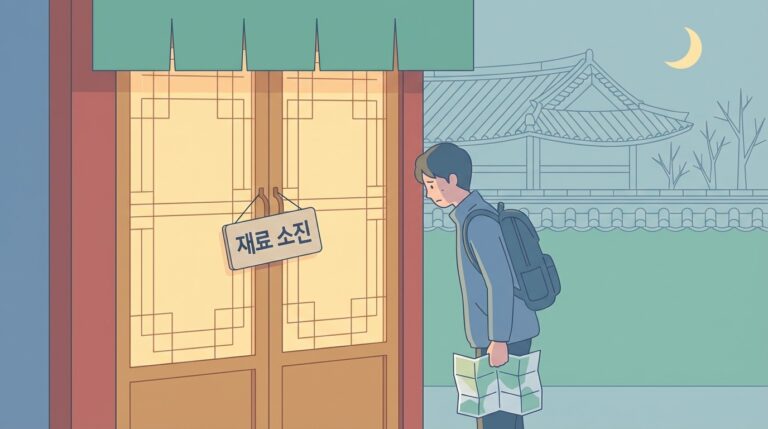
Phase 1: The Heartbreak of the “Sold Out” Sign 💔
Annyeonghaseyo! This is your Senior Editor at Daily Hangul.
Picture this K-Drama moment: The protagonist runs breathlessly to a hidden alleyway restaurant, the one their crush raved about. The music swells, they reach the door… and the lights go out. The owner flips a sign.
It doesn’t say “Closed.” It says four devastating syllables: 재료 소진 (Jae-ryo So-jin).
If you are a K-Food lover, you will experience this. In Korea, popular restaurants often close not when the clock strikes 9 PM, but when the food runs out. You might turn to your friend and say, “Wait, did they say they closed because they have no ingredients?”
Today, we aren’t just learning words; we are learning how to handle the specific heartbreak of a Korean “Matjib” (tasty house) rejection. Let’s decode the rumors and the signs so you don’t make a wasted trip!
Phase 2: Deep Dive into the “Sold Out” Nightmare 🕵️
1. 재료 소진 (Jaeryo Sojin)
- Pronunciation: [Jae-ryo So-jin] Sounds like ‘Jae-ryo’ (Ingredients) + ‘So-jin’ (Exhaustion)
- Meaning:
- Literal: Ingredients Exhaustion.
- Real Nuance: “We sold everything we prepared for today. Go home.”
- K-Culture Moment: You will see this written on a piece of cardboard or a whiteboard outside trendy Instagram spots (hot places). It’s actually a badge of honor for the restaurant—it proves they are fresh and popular.
- Editor’s Insight: This is a written expression (Hanja-based). You won’t usually say “Jaeryo sojin is happening.” You just read the sign.
- Situation Spectrum:
[🚫 Spoken Casual] ———— [⚠️ Spoken Formal] ———— [✅ Written Sign]
🤔 Think About It: Why do Korean restaurants take pride in closing early? In some cultures, running out of food is bad management. In Korea, it’s a sign of quality and freshness. How does this differ from your country?
2. 문 닫았대(요) (Mun dad-at-dae-yo)
- Pronunciation: [Mun da-dat-dae-yo]
- Meaning:
- Literal: (I heard) they closed the door.
- Real Nuance: “Word on the street is, they are closed.”
- Grammar Key (B1 Level): This uses the Indirect Quotation form.
- Original: “문 닫았다고 해요” (They say that they closed).
- Shortened: “문 닫았대요” -> “문 닫았대” (Casual).
- K-Drama Moment: The gossiping high school students in a drama: “Did you hear? Usually, handsome Min-su broke up with his girlfriend!” (민수 헤어졌대!).
- Editor’s Insight: Use this when conveying bad news you just found out to your group. “Guys… I checked Instagram… mun dad-at-dae.”
- Situation Spectrum:
[🚫 To Boss] ———— [⚠️ To Colleagues] ———— [✅ To Friends]
3. 헛걸음하다 (Heot-geoleum-hada)
- Pronunciation: [Heot-geo-reum-ha-da]
- Meaning:
- Literal: To do empty steps.
- Real Nuance: To make a wasted trip / To go all the way there for nothing.
- K-Culture Moment: A grandfather in a sitcom arriving at the community center on a Sunday: “Aigoo, I did heot-geoleum again.”
- Editor’s Insight: This perfectly captures the frustration of traveling to a Matjib (famous restaurant) only to find it closed. It’s a very emotional verb!
Phase 3: Textbook vs. Real Life 🥊
| Situation | 📖 Textbook Korean | 🗣️ Real Korean (Street) | 💡 Why the difference? |
|---|---|---|---|
| Sign on the door | 영업이 종료되었습니다. (Business has ended.) |
재료 소진 / 조기 마감 (Ingredients exhausted / Early close) |
“Business ended” feels like a bank. Restaurants emphasize why (no food left). |
| Telling friends | 식당이 문을 닫았다고 들었어요. (I heard the restaurant closed.) |
야, 거기 끝났대 / 닫았대. (Hey, they say it’s finished/closed.) |
Koreans love efficiency. We shorten ~dago hae to just ~dae. |
| Asking the owner | 음식이 있습니까? (Do you have food?) |
식사 돼요? (Is a meal possible?) |
We focus on the possibility of the action (eating) rather than the object (food). |
Bottom Note: If you use the textbook version, you sound like a polite news anchor. If you use the Real Korean version, you sound like a local foodie.
Phase 4: Cultural Context — The “Open Run” Phenomenon 🏃♂️💨
Since we are talking about Jaeryo Sojin (Sold Out), we must talk about the culture that causes it.
4-1. What is “Open Run” (오픈런)?
In K-Culture, popular spots (London Bagel Museum, famous Tonkatsu places) have lines forming hours before they open. This act of sprinting to get in as soon as the doors open is called an “Open Run.” If you don’t do an Open Run, you risk facing the Jaeryo Sojin sign by 2 PM.
4-2. The Psychology of Scarcity
Koreans are very trend-sensitive. If a place never runs out of ingredients, people might think, “Is it not popular?” The Jaeryo Sojin sign creates FOMO (Fear Of Missing Out). It turns eating into a competitive sport!
Phase 5: Immersive Roleplay 🎭
Setting: It is 7:30 PM on a Friday. You and your Korean friend, Jisoo, have just arrived at a famous BBQ place in Hongdae. The lights are dimming.
Characters:
* YOU: Hungry traveler.
* Jisoo: Your Korean friend who is slightly embarrassed.
* Owner: A busy middle-aged auntie (Imo-nim) wiping a table.
Dialogue:
Jisoo: (Looking at the dark sign) 헐, 어떡해? 불 꺼졌어.
(Heol, eotteokhae? Bul kkeojyeosseo.)
[Translation: Oh no, what do we do? The lights are out.]
YOU: (Confused) 벌써? 아직 7시 반인데?
(Beolsseo? Ajik ilgopsi ban-inde?)
[Translation: Already? It’s only 7:30?]
Owner: (Shouting from inside) 학생들 미안해요! 오늘 재료 다 떨어졌어요!
(Haksaeng-deul mianhaeyo! Oneul jaeryo da tteoreojyeosseoryo!)
[Translation: Sorry students! We are out of ingredients today!]
🔀 Decision Point! How do you respond?
- Option A: “네, 알겠습니다. 안녕히 계세요.” (Polite acceptance)
- Option B: “아, 사장님~ 멀리서 왔는데 1인분만 안 될까요?” (Using Aegyo to appeal to emotion)
- Option C: “왜 재료가 없어요?” (Direct complaint)
✅ Best Choice: Option B.
Reason: In Korea, there is a culture of Jeong (정). If you say “We came from far away” (multisero wasseoyo), sometimes—just sometimes—the owner might miraculously find one portion of meat hidden in the fridge. Option C is considered rude.
Phase 6: 10-Second Shadowing Drill 🗣️
Let’s practice reporting the bad news to your friends who are waiting for you.
Emotion: 😢 Disappointed & Apologetic
재료가 / 다 떨어졌대. / 우리 / 헛걸음했어.
(Jae-ryo-ga / da tteo-reo-jyeot-dae. / U-ri / heot-geo-reum-haet-seo.)
“They say the ingredients are all gone. We made a wasted trip.”
- Tip: Emphasize “Da” (all) and drop your pitch at “dae” to sound sad.
Phase 7: K-Culture Mini Glossary 📚
| Korean | Romanization | English | Context |
|---|---|---|---|
| 맛집 | Matjib | Tasty House | A highly renowned restaurant. |
| 웨이팅 | Weiting | Waiting | Standing in line. “Is the ‘waiting’ long?” |
| 브레이크 타임 | Beureikeu Taim | Break Time | Usually 3 PM – 5 PM. Don’t go then! |
| 마감 | Magam | Closing/deadline | “Magam” means no more orders taken. |
| 오픈런 | Opeun-reun | Open Run | Arriving before opening time to queue. |
Phase 8: Traveler’s Survival Kit 🧳
Don’t make a Heot-geoleum! Here is how to survive the Korean Matjib scene.
🆘 Survival Phrases
1. 🇰🇷 “지금 식사 돼요?” (Jigeum siksa doeyo?)
* Meaning: Can we eat right now?
* Use: When walking into a place that looks like it’s closing.
2. 🇰🇷 “웨이팅 얼마나 걸려요?” (Weiting eolmana geollyeoyo?)
* Meaning: How long is the wait?
3. 🇰🇷 “포장은 돼요?” (Pojang-eun doeyo?)
* Meaning: Is takeout okay? (Sometimes dining in is full/closed, but takeout is possible!)📌 Editor’s Travel Note: The Digital Queue
Popular places don’t just have lines; they have Tableling (테이블링) or CatchTable (캐치테이블) kiosks. You input your phone number to queue.
* Problem: Some require a Korean phone number.
* Hack: Look for staff and say “I don’t have a Korean number.” They will often help you input a dummy number or give you a paper ticket.
Phase 9: Think Deeper — Language & Society 🧠
Topic: The Power of “They Say” (~Dae)
In this lesson, we focused on ~대 (indirect quotation). Why is this so common in Korea? Korean culture is highly collectivistic and relies heavily on shared information. When you say “The door is closed” (문 닫았어요), it’s a factual statement from you. When you say “They say the door is closed” (문 닫았대요), you are sharing information from the group/source.
It also distances you from the bad news. It’s not my fault we can’t eat; it’s what they said. It softens the blow. Does your language have a way to soften bad news by shifting the source?
Phase 10: Troubleshooting & FAQ 🛠️
- Q: Can I use “~대” to my boss?
- A: NO! “~대” is the casual/Panmal version. To your boss, you must use the full polite form: “재료가 소진되었다고 합니다” or slightly softer “재료가 다 떨어졌대요” (add ‘Yo’).
- Q: The sign says “Last Order 20:00”. Can I order at 20:00?
- A: Risky. In Korea, “Last Order” is strict. If you arrive at 20:00 sharp, they might already be cleaning up. Aim for 19:50.
- Q: Is “Sold Out” (솔드아웃) used in Korean?
- A: Yes! Younger people and cafes use the Konglish “Sold Out.” But traditional restaurants use “재료 소진.”
Phase 11: Wrap-up & Action Mission 🎬
One-Liner: When the ingredients are gone, don’t just walk away sad—tell your friends “Jaeryo da tteoreojyeot-dae!”
🔥 Action Missions:
* 🥉 Bronze: Look in a mirror and practice the “disappointed face” while saying “Heot-geoleum-haesseo” (I made a wasted trip).
* 🥈 Silver: Go to Instagram, search hashtags like #재료소진 or #조기마감, and see how many shops posted this today.
* 🥇 Gold: Next time you visit a Korean restaurant (even in your country), ask the staff “When is your Last Order?” in Korean: “Laseuteu O-deo myeot si yeyo?”
💬 Comment Below: Have you ever traveled specifically for food only to find the place closed? Share your Heot-geoleum story!
Phase 12: Quiz — Interactive Challenge 🧩
- Situation Judgment: You see a sign saying “금일 휴업” (Geum-il Hyu-eup). What does it mean?
- a) Open late tonight.
- b) Closed today.
- c) Free appetizers today.
- Hint: ‘Hyu’ means rest.
- Fill in the Blank: Your friend asks why you are back so early. You say: “The soup ran out, so they said they closed!”
- “재료가 소진돼서 문 ___.”
- a) 닫았어 (dad-at-seo – direct)
- b) 닫았대 (dad-at-dae – indirect/hearsay)
- True or False: If a restaurant says “Break Time,” you can still sit inside and wait.
- (T/F)
Answers:
1. (b) Closed today.
2. (b) 닫았대 (Since you are reporting what the shop owner said/implied).
3. False. Usually, you must leave the shop entirely during break time so staff can rest and prep.
Frequently Asked Questions (FAQ)
Q: What does "재료 소진 (Jaeryo Sojin)" mean in Korean and how do you pronounce it?
A: In Korean, "재료 소진 (Jaeryo Sojin)" is pronounced [Jae-ryo So-jin] and means: Literal: Ingredients Exhaustion.
Q: What does "문 닫았대(요) (Mun dad-at-dae-yo)" mean in Korean and how do you pronounce it?
A: In Korean, "문 닫았대(요) (Mun dad-at-dae-yo)" is pronounced [Mun da-dat-dae-yo] and means: Literal: (I heard) they closed the door.
Q: What does "헛걸음하다 (Heot-geoleum-hada)" mean in Korean and how do you pronounce it?
A: In Korean, "헛걸음하다 (Heot-geoleum-hada)" is pronounced [Heot-geo-reum-ha-da] and means: Literal: To do empty steps.







