Phase 1: The “Grey Sky” Reality Check
Hello! This is your Daily Hangul Editor.
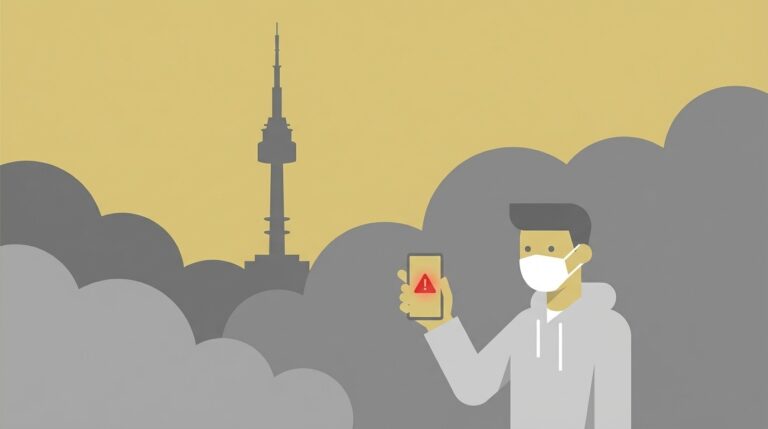
Imagine this: You wake up in your Seoul Airbnb, excited for a day of palace tours. You pull back the curtains, expecting that crisp blue sky you saw in travel vlogs. Instead, the world looks… sepia? Is it fog? Is it a filter?
Then your phone buzzes. It’s an emergency alert. You look down at the street, and everyone—from the stylish office worker to the grandma selling vegetables—is wearing a mask. Not the flimsy ones, but the heavy-duty ones.
Welcome to the world of 미세먼지 (Misemunji) or “Fine Dust.”
In K-Dramas, rain is romantic. In real Korean life, misemunji is the villain. If you don’t know how to talk about this, you might end up with a sore throat and a headache while wondering why everyone is looking at your bare face with concern. Today, let’s learn how to survive the grey days like a true local.
(Note: This guide is based on real struggles foreigners face during spring and autumn in Korea!)
Phase 2: Deep Dive into Expressions
1. 미세먼지 (Misemunji)
- Pronunciation:
[mi-se-meon-ji]- Sound Analogy: “Me-say” + “Mon” (like Monday) + “Gee” (like Gee whiz).
- Meaning: Fine dust / Particulate matter
- K-Culture Moment: You’ll see this word on every news channel, weather app, and even on bus displays. Idols often post selfies with the caption “미세먼지 조심하세요!” (Be careful of fine dust!).
- Editor’s Insight: This isn’t just “dust” under your bed. It’s a specific weather phenomenon. Don’t confuse it with 안개 (angae – fog). Fog is wet; Misemunji is dry and gritty.
- Situation Spectrum:
[🚫 Formal Only] ———— [✅ Universal] ———— [🚫 Slang Only]- (Used everywhere from news anchors to toddlers.)
2. 마스크를 써야 해요 (Maseukeu-reul sseo-ya haeyo)
- Pronunciation:
[ma-seu-keu-reul sseo-ya hae-yo] - Meaning: (I/You/We) have to wear a mask.
- 써야 해요: To wear (headgear/glasses/masks) + have to.
- Grammar Point: The ending ~야 해요 indicates obligation. It’s crucial for safety rules.
- K-Culture Moment: Remember those airport photos of K-Pop stars covering their faces? Originally for anonymity, now it’s standard etiquette. If you cough without a mask in a quiet library, you might feel the “laser eyes” of others.
- 🤔 Think About It: In many Western cultures, masks were historically associated with illness (only sick people wear them). In Korea, masks are preventative. How does this shift your mindset about seeing a sea of masked faces?
3. 목이 칼칼해요 (Mogi kal-kal-haeyo)
- Pronunciation:
[mo-gi kal-kal-hae-yo] - Meaning: My throat feels scratchy/dry/sore (specifically due to dust).
- Nuance: It’s not the sharp pain of a flu (which is 아파요). 칼칼하다 is that specific, dry, uncomfortable feeling, like you swallowed sand.
- K-Food Connection: Koreans often joke that they need to eat Samgyeopsal (pork belly) when their throat feels kalkal, believing the grease washes down the dust. (Science says no, but the culture says yes!)
Phase 3: Textbook vs. Real Life
| Situation | 📖 Textbook Korean | 🗣️ Real Korean | 💡 Why the difference? |
|---|---|---|---|
| Checking the air | 대기 오염이 심각합니다. (Air pollution is serious.) | 오늘 미세먼지 장난 아니야. (Today’s dust is no joke.) | “No joke” (장난 아니다) is the most common way to emphasize extreme weather conditions. |
| Warning a friend | 마스크를 착용하십시오. (Please wear a mask.) | 마스크 꼭 써! (Make sure to wear a mask!) | Friends skip the formalities. 꼭 (kkok) adds the caring nuance of “really/must.” |
| Symptom | 목이 아픕니다. (My throat hurts.) | 목이 아픈 건 아닌데… 좀 칼칼해. (It doesn’t hurt, but… it’s scratchy.) | Koreans distinguish between actual pain and the specific irritation caused by dust. |
💡 Editor’s Note: Use the “Real Korean” phrases with friends or young coworkers. Stick to the Textbook version with your boss or elders!
Phase 4: Cultural Deep Dive — The “KF” Standard
The Non-Verbal Code:
If you walk into a convenience store on a bad dust day without a mask, you aren’t just breaking a health rule; you might be seen as lacking 눈치 (Nunchi). Wearing a mask is a sign that you care about the community’s health, not just your own.
K-Culture Connection (Shopping):
When buying a mask, look for the “KF” (Korea Filter) rating. This is crucial survival knowledge!
* KF94: The Gold Standard. Blocks 94% of particles. Every K-Drama doctor and idol wears this shape. It’s harder to breathe, but you are safe.
* KF80: Easier to breathe, okay for mild days.
* KF-AD: Anti-Droplet. Good for summer/preventing spit, but useless against fine dust.
Don’t buy the KF-AD on a “Red Alert” dust day!
Phase 5: Immersive Roleplay
📍 Setting: A convenience store (CU or GS25) in Gangnam. The sky outside is yellow-grey. You forgot your mask at the hotel.
🎭 Characters:
* YOU: A traveler whose throat is already starting to tickle.
* Alba (Part-timer): A college student, busy stocking shelves.
(Scene Start)
YOU: (Approaching the counter) 저기요, 마스크 있어요?
(Jeogiyo, maseukeu isseoyo?)
Excuse me, do you have masks?
Alba: 네, 저쪽 코너에 있어요. 어떤 거 찾으세요?
(Ne, jeojjok koneo-e isseoyo. Eotteon geo chajeuseyo?)
Yes, they are in that corner. Which kind are you looking for?
YOU: 음… 오늘 미세먼지가 심해서요.
(Eum… oneul misemunji-ga simhaeseoyo.)
Hmm… because the fine dust is bad today.
Alba: 아, 그럼 KF94 쓰셔야 돼요.
(Ah, geureom KF94 sseuseoya dwaeyo.)
Ah, then you have to use KF94.
🔀 DECISION POINT: How do you respond?
- Option A: “이거 주세요.” (Give me this one.) – Simple & Direct.
- Option B: “숨쉬기 편한 거 없어요?” (Do you have one that’s easy to breathe in?) – Relatable struggle.
- Option C: “삼겹살도 있어요?” (Do you have pork belly too?) – The “local humor” approach.
✅ Editor’s Analysis:
* Option A is the safest.
* Option B is great natural Korean! The clerk might suggest a KF80.
* Option C shows you know the culture! The clerk will likely laugh and say, “Oh, because of the dust? We sell pork jerky!”
Phase 6: 10-Second Shadowing Drill
Let’s practice complaining about the weather naturally. Say this while frowning slightly at the sky.
“The fine dust is no joke today. I have to buy a mask.”
😤 Emotion: Annoyed & Worried
오늘 / 미세먼지 / 장난 아니에요.
(Oneul / misemunji / jangnan anieyo.)마스크 / 사야 돼요.
(Maseukeu / saya dwaeyo.)
Phase 7: K-Culture Glossary (Dust Edition)
| Korean | Romanization | Meaning | Context |
|---|---|---|---|
| 황사 | Hwangsa | Yellow Dust | Sand storms from deserts that come in spring. Worse than regular dust. |
| 공기청정기 | Gong-gi cheong-jeong-gi | Air Purifier | A must-have appliance in every Korean home and cafe. |
| 방역 | Bang-yeok | Quarantine/Prevention | You’ll hear this regarding viruses, but the concept applies to hygiene culture. |
| 최악 | Choe-ak | The Worst | Seen on weather apps when the air quality is terrible (Red/Black icon). |
Phase 8: Traveler’s Survival Kit
When the app says “Unhealthy” (나쁨), here is your toolkit.
🆘 Survival Phrase #1
* 🇰🇷 “오늘 마스크 안 쓰면 큰일 나요?” (Oneul maseukeu an sseumyeon keunil nayo?)
* 🗣️ Meaning: Is it a big deal if I don’t wear a mask today?
* 💡 Use this: To ask a local if the dust level is actually dangerous or just mild.📌 Editor’s Travel Note
* Must-Have Apps: Download MiseMise (미세미세). It uses cute/scary icons to show air quality. If the screen is black with a skull, stay indoors!
* Where to buy masks: Convenience stores (24/7), Pharmacies (Yak-guk), Daiso (Cheapest).
Phase 9: Think Deeper — Why so serious?
Topic: Collectivism and Public Health
Have you noticed that in Korea, people wear masks not just to protect themselves, but to avoid making others uncomfortable? It’s a part of the “We” culture (Woori). If you cough without a mask, you aren’t just a health risk; you are disrupting the social harmony. The mask is a shield, but also a signal of respect.
💬 Your Turn: Does your country have a similar “visual etiquette”? Or is individual comfort prioritized? Share your thoughts below!
Phase 10: FAQ & Troubleshooting
- Q: Can I wear a colorful fashion mask?
- A: Yes, but make sure it has a filter. If it’s just cloth, people might judge you silently on a bad dust day. Koreans value function over fashion when it comes to misemunji.
- Q: My weather app says “Clear” but it looks grey.
- A: Global apps sometimes miss local particulate data. Trust local apps like Naver or MiseMise.
❌ Common Mistake:
Don’t say “안개 (Fog)” when it’s dust.
* Say: “공기가 탁해요” (The air is murky/heavy).
Phase 11: Wrap-up & Mission
One-Liner Summary: When the sky is grey, check the app, grab a KF94, and tell your friends “목이 칼칼해!”
🎯 Action Missions:
* 🥉 Bronze: Say “오늘 미세먼지 조심하세요” to yourself in the mirror.
* 🥈 Silver: Download the “MiseMise” app and check the air quality in Seoul right now.
* 🥇 Gold: Go to a convenience store (or pretend to) and ask for a KF94 mask specifically.
📺 K-Culture Mission: Watch a K-Pop idol’s “Airport Arrival” video. Count how many are wearing masks and what type they are using!
Phase 12: Interactive Quiz
1. The weather app shows a black skull icon ☠️. Your friend suggests a picnic. What do you say?
* A) 좋아! 날씨 좋다. (Good! The weather is nice.)
* B) 미세먼지 때문에 안 돼. (We can’t because of fine dust.)
* C) 마스크 안 써도 돼. (You don’t need to wear a mask.)
2. Which mask is the best for a bad dust day?
* A) KF-AD
* B) KF80
* C) KF94
Answers:
1. B (Safety first! Picnics on dust days are a recipe for a sore throat.)
2. C (KF94 offers the highest protection.)
Frequently Asked Questions (FAQ)
Q: What does "미세먼지 (Misemunji)" mean in Korean and how do you pronounce it?
A: In Korean, "미세먼지 (Misemunji)" is pronounced [mi-se-meon-ji] and means: a key conversational Korean expression covered in this lesson.
Q: What does "마스크를 써야 해요 (Maseukeu-reul sseo-ya haeyo)" mean in Korean and how do you pronounce it?
A: In Korean, "마스크를 써야 해요 (Maseukeu-reul sseo-ya haeyo)" is pronounced [ma-seu-keu-reul sseo-ya hae-yo] and means: (I/You/We) have to wear a mask.
Q: What does "목이 칼칼해요 (Mogi kal-kal-haeyo)" mean in Korean and how do you pronounce it?
A: In Korean, "목이 칼칼해요 (Mogi kal-kal-haeyo)" is pronounced [mo-gi kal-kal-hae-yo] and means: My throat feels scratchy/dry/sore (specifically due to dust).