

Phase 1: The Immersive Hook
Hello, Daily Hangul family! This is your Senior Editor.
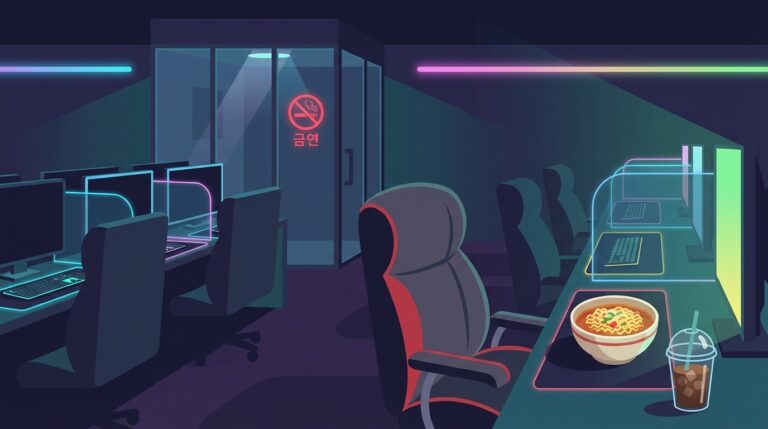
Imagine this: You’ve just finished a long day of sightseeing in Seoul. You walk into a neon-lit PC Bang (PC방), just like the one where the main characters in Reply 1988 or Twenty-Five Twenty-One spent their youth. The air is filled with the frantic clicking of mechanical keyboards and the savory smell of spicy Ramyeon.
You’re ready to experience Korea’s legendary internet speed or maybe order some “PC Bang food” (which is basically a gourmet genre now). But wait—the part-timer guides you to a seat. You sit down, and suddenly… Whoosh. The automatic door next to you opens, and a cloud of cigarette smoke hits you. You’ve been seated right next to the smoking room.
Or maybe you’re seated between two high school students shouting strategies for League of Legends at the top of their lungs. 😱
In a country where “reading the room” (Nunchi) is everything, how do you politely ask to move without being “that annoying foreigner”? Today, we’re going to master the art of securing the Golden Seat (명당).
Phase 2: Deep Dive into Key Expressions
Here are the B2-level phrases you need to survive and thrive in a Korean PC Bang.
1. 흡연실에서 좀 먼 자리로 주시겠어요?
(Heubyeonsil-eseo jom meon jari-ro jusigesseoyo?)
- Pronunciation: [Heub-yeon-sil-eh-seo / jom / meon / ja-ri-ro / ju-shi-ge-sseo-yo?]
- Tip: ‘Heub’ sounds like a sharp intake of breath. ‘Meon’ rhymes with ‘Bun’.
- Meaning: “Could you please give me a seat far from the smoking room?”
- Literal: Smoking room-from / a bit / far / seat-to / would you give?
- K-Culture Moment: In older Korean movies, PC Bangs were filled with smoke. But today, thanks to strict laws, there are designated Smoking Booths (흡연실). However, the seats right next to them can still smell whenever the door opens.
- Editor’s Insight: The key word here is “Jom” (좀). Literally, it means “a little,” but functionally, it softens your request. Without it, you sound demanding. With it, you sound polite and considerate.
- Situation Spectrum:
[🚫 Formal Meeting] ———— [✅ PC Bang/Restaurant] ———— [✅ Friends]- 🤔 Think About It: Why does adding “a little” (jom) make a sentence polite in Korean, even if you really want a lot of distance? It’s about minimizing the burden on the listener.
2. 혹시 구석 자리 있나요?
(Hoksi guseok jari innayo?)
- Pronunciation: [Hok-shi / gu-seok / ja-ri / in-na-yo?]
- Meaning: “Do you happen to have a corner seat?”
- K-Culture Moment: In K-Dramas, the mysterious protagonist or the hacker always sits in the corner, hoodie up, illuminated by the monitor. That’s the Guseok (Corner) vibe.
- Editor’s Insight: “Hoksi” (혹시) is your magic shield. It translates to “by any chance.” It implies, “If you don’t, it’s totally fine, I’m just asking.” It lowers the pressure for the part-timer.
- Situation Spectrum:
[🚫 Military] ———— [✅ Service Interactions] ———— [✅ Casual]3. 여기가 너무 시끄러운데, 자리 좀 옮겨도 될까요?
(Yeogi-ga neomu sikkeureounde, jari jom omgyeodo doelkkayo?)
- Pronunciation: [Yeo-gi-ga / neo-mu / shi-kkeu-reo-oon-de / ja-ri / jom / om-gyeo-do / doel-kka-yo?]
- Meaning: “It’s a bit too noisy here, so may I move seats?”
- Real Nuance: You aren’t just saying “I want to move.” You are explaining the reason (too noisy) first to justify the request. This is crucial in Korean logic.
- Editor’s Insight: Notice the ending “~n-de” (ㄴ데). It provides background information (
It is noisy...) and leaves a lingering feeling, inviting the listener to solve the problem for you. It’s softer than saying “Because it is noisy, move me.”- 🤔 Think About It: In English, we often put the request first (“Can I move? It’s noisy.”). In Korean, the context usually comes first. How does this reflect the culture of shared context?
Phase 3: Textbook vs. Real Life
| Situation | 📖 Textbook Korean | 🗣️ Real Korean (In the Wild) | 💡 Why the difference? |
|---|---|---|---|
| Wanting to move seats | 자리를 바꾸고 싶습니다. (I want to change seats.) |
저기 죄송한데, 자리 이동 좀 가능할까요? (Excuse me, is moving seats possible?) |
Direct “I want” statements feel too strong. We ask about “possibility” to be polite. |
| Too much smoke smell | 담배 냄새가 납니다. (It smells like cigarettes.) |
(Frowning slightly) 사장님, 여기 냄새가 좀 심해서요… (Boss, the smell here is a bit severe…) |
Ending with “…so…” (haeseoyo) lets the listener infer the request (“Please move me”) without you ordering it. |
💡 Editor’s Note: Using “Sajangnim” (Boss) for any staff member (even a young part-timer) is a great way to show respect and get better service!
Phase 4: Cultural Deep Dive — The Art of the “Myeongdang”
4-1. Non-verbal: The “Eye Contact” Balance
When asking to move seats at the counter, don’t stare too intensely. Give a slight bow of the head, look at the monitor map they are showing you, and point with an open hand (never a single finger). Showing that you are physically looking for a solution together helps.
4-2. K-Culture Connection: The PC Bang Evolution
In K-dramas from the early 2000s, PC Bangs were dark, smoky dungeons. Today, they are bright, serve restaurant-quality food (thanks to the Mukbang craze), and are popular date spots.
The “Seat Map” System:
Unlike a cafe where you just sit anywhere, in a Korean PC Bang, the computer system controls the power. You must sit at your assigned number. That’s why verbal communication with the staff is necessary if you want to swap. You can’t just hop to the next chair!
Critical Perspective: Why are separate smoking booths so important now? It reflects Korea’s rapid shift from a smoking-heavy culture to a health-conscious one, while still accommodating the communal aspect of smoking (where much business/bonding happens).
Phase 5: Immersive Roleplay
Setting: A Friday night in Hongdae. The PC Bang is packed. K-Pop music is blasting. You are assigned seat #45.
Characters:
* YOU: A foreign student who wants a quiet night of gaming.
* ALBA (Part-timer): A busy university student, wearing a headset around his neck.
Dialogue:
Alba: 45번 자리로 가시면 됩니다. (Please go to seat number 45.)
(You walk to #45. It is right next to the smoking room door. A group of loud teenagers is nearby.)
YOU: (Walking back to the counter) 저기요, 사장님.
(Jeogiyo, sajangnim.) “Excuse me, Boss.”
Alba: 네, 무슨 일이세요? (Yes, what’s the matter?)
YOU: 아, 제가 45번을 받았는데요… 흡연실 바로 앞이라서 냄새가 좀 날 것 같아요.
(Ah, jega 45-beon-eul badanneundeyo… heubyeonsil baro ap-iraseo naemsaega jom nal geot gatayo.)
“Ah, I got seat 45… but it’s right in front of the smoking room, so I think it might smell a bit.”
Alba: 아, 그러세요? 잠시만요. (Ah, really? One moment.)
🔀 Decision Point! How do you ask for a new seat?
- A) 다른 자리 주세요. (Give me another seat.)
- B) 혹시 흡연실에서 좀 떨어진 조용한 자리 있을까요? (Do you happen to have a quiet seat away from the smoking room?)
- C) 냄새 싫어요. 바꿔주세요. (I hate the smell. Change it.)
✅ Best Choice: B
* Reason: It uses “Hoksi” (softener) and specific criteria (quiet, away from smoke). It gives the Alba a clear mission.
* Analysis of A: Grammatically correct, but a bit robotic and cold.
* Analysis of C: Too direct and rude. You might get a seat, but you lost the Alba’s goodwill.
(Continuing with Choice B)
Alba: (Checking monitor) 음… 구석 자리는 꽉 찼고, 창가 쪽은 어떠세요? 거긴 조용해요.
(Hmm… corner seats are full, how about the window side? It’s quiet there.)
YOU: 오, 네! 거기로 해주세요. 감사합니다!
(Oh, yes! Please do that. Thank you!)
Phase 6: 10-Second Shadowing Drill
Practice this until it rolls off your tongue. Focus on the hesitation!
The “Polite Refusal” Tone
🥺 Emotion: Apologetic but firm.
“저기… / 냄새가 좀 / 심해서요… / 자리 좀 / 옮길 수 있을까요?”
(Jeogi… / naemsaega jom / simhaeseoyo… / jari jom / omgil su isseulkkayo?)
“Excuse me… / the smell is a bit / severe so… / seat a little / could I move?”
Phase 7: K-Culture Glossary (PC Bang Edition)
| Korean | Romanization | English | Context |
|---|---|---|---|
| 정액제 | Jeong-aek-je | Pre-paid Flat Rate | Most PC Bangs use this. You pay for time in advance at a kiosk (called ‘Kioskeu’). |
| 비회원 | Bi-hoe-won | Non-member | You can play as a guest, but members usually get cheaper rates or save unused time. |
| 사양 | Sa-yang | Specs (Specifications) | “이 자리 사양 좋아요?” (Are the computer specs good here?) |
| 먹거리 | Meok-geo-ri | Food/Snacks | The food menu. PC Bang Ramyeon is legendary. |
Phase 8: Traveler’s Survival Kit
Even if you aren’t a gamer, you might need a PC Bang to print documents or book tickets rapidly.
🆘 Survival Phrases
1. “프린트 되나요?” (Peu-rin-teu doenayo?) – “Can I print here?” (Not all PC Bangs have printers!)
2. “선불이에요?” (Seon-bul-i-e-yo?) – “Is it pre-paid?”
3. “회원가입 해야 돼요?” (Hoe-won-ga-ip haeya dwaeyo?) – “Do I have to sign up for membership?”📌 Editor’s Travel Note:
Most PC Bangs now use touchscreen kiosks at the entrance to pay and select seats. If you have a foreign credit card, some old machines might reject it. Always carry some cash (10,000 KRW bills) just in case!
Phase 9: Think Deeper — Language & Space
Why is asking for a seat so complex?
In Western cultures, “comfort” is often an individual right. If you pay, you deserve a good seat. In Korea, while you are a paying customer, the concept of Cheomyon (Social Face) exists. Complaining about the smell or noise directly can be seen as disrupting the harmony or embarrassing the staff/other customers.
By using indirect questions like “Is there a corner seat by any chance?” or stating the reason first (“It’s noisy here…”), you are practicing Baeryeo (Consideration). You are framing your personal preference as a situational issue, not a demand. How does your language handle complaints? Is it direct or indirect?
Phase 10: FAQ & Troubleshooting
Q: Can I just move to an empty seat if I don’t like mine?
A: No! The computer won’t turn on. The PC is activated from the counter for that specific seat number. You must ask the staff to move you in the system.
Q: Is it rude to wear headphones while talking to the staff?
A: Yes. In Korea, taking off your headphones (or at least one ear) is a basic sign of respect when communicating.
❌ Common Mistake:
Don’t yell “Hey!” or wave frantically from your seat if you need something.
✅ Do this: Look for the “Call Staff” (직원 호출) button on your PC screen interface. It’s the digital, polite way to summon help for food or problems.
Phase 11: Wrap-up & Mission
One-Liner: To get the best seat, explain your reason softly (~n-de), use “Hoksi” (by any chance), and respect the system!
🔥 Action Missions:
* 🥉 Bronze: Stand in front of a mirror and practice the “Hoksi…” face. Look slightly hesitant!
* 🥈 Silver: Watch a YouTube video of a “PC Bang Tour” in Korea and identify the Smoking Room and Counter.
* 🥇 Gold: Go to a cafe or library. Ask the staff/librarian if you can move to a quieter seat using the polite structure (translate it to your language but keep the Korean nuance of indirectness).
💬 Your Turn: Have you ever been stuck in a terrible seat in a restaurant or theater? How did you handle it? Tell us in the comments!
Phase 12: Interactive Quiz
- Situation: You entered a PC Bang, but the seat is dirty. What is the most natural Korean way to ask for a change?
- a) “It’s dirty. Change it.”
- b) “Sajangnim, the seat is a bit dirty, so may I move?”
- c) Just sit on the floor.
- True or False: You can sit anywhere you want in a PC Bang, just like Starbucks.
- ( ) True
- ( ) False
Click for Answers
- b) Always explain the reason politely.
- False. It is a designated seat system controlled by the server.







