

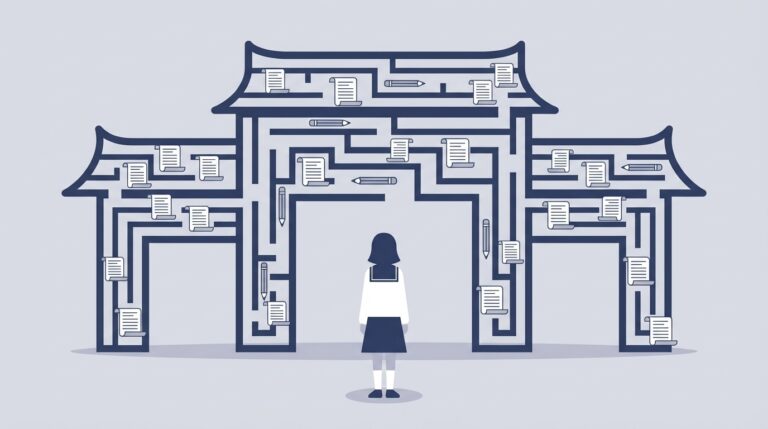
Phase 1: Immersive Hook
안녕하세요! This is your Senior Editor at Daily Hangul.
Imagine this scene: It’s a crisp November morning. The streets of Seoul are eerily quiet. Police officers are escorting running students to school gates. Even airplanes are grounded for 35 minutes so their engine noise doesn’t disturb the listening comprehension test. This isn’t a scene from a dystopic movie; it’s Suneung (수능) day in Korea.
If you’ve watched dramas like SKY Castle or Crash Course in Romance, you know that college entrance exams in Korea are not just tests—they are a national event, a family project, and often, a battlefield. But recently, the news has been flooded with heated debates about “Education Reform” (교육 개혁). The government is changing the rules to make things “fairer,” but confusion reigns supreme.
To truly understand Korean news, society, and the mindset of your Korean friends, you need to look beyond the grammar books. Today, we are diving deep into the vocabulary of Education Policy and Entrance Exam Reforms. Let’s decode the headlines together.
Phase 2: Deep Dive into Key Expressions
Since you are C1 learners, we will move past basic school vocabulary like ‘학교’ (school) or ‘숙제’ (homework) and look at the socio-political terms used in news and intellectual debates.
1. 변별력 (Byeonbyeollyeok)
- Pronunciation: [byeon-byeol-lyeok] (Sounds like: byun + byul + yuck)
- Meaning: Discriminating power / The ability of a test to distinguish between levels of students.
- Context: In Western education, a test is often about checking what you know. In Korea, where everyone studies intensely, a test must rank students. If a test is too easy, news anchors will say, “이번 시험은 변별력이 없었습니다” (This exam lacked discriminating power), meaning it failed to rank the students effectively.
- Editor’s Insight: This word is the holy grail of Korean testing. If a test has high byeonbyeollyeok, it successfully separates the top 1% from the top 5%. It sounds technical, but parents use this word daily.
- Situation Spectrum:
[🚫 Casual Friends] ———— [✅ News/Debate] ———— [✅ Academic]- 🤔 Think About It: Why is “ranking” often prioritized over “mastery” in Korean education? How does the concept of byeonbyeollyeok reflect the competitive nature of modern Korean society?
2. 킬러 문항 (Killeo Munhang)
- Pronunciation: [kil-leo mun-hang]
- Meaning: Killer Questions (Extremely difficult questions designed to lower the average score).
- Context: These are questions so hard that you often can’t solve them without expensive private tutoring. Recently, the Korean government declared a war on these questions to reduce reliance on private education.
- K-Culture Moment: In Crash Course in Romance, the star tutor becomes famous because he can crack these specific “Killer Questions.” In real life, removing them is a massive political controversy.
- Editor’s Insight: Use this when discussing current affairs. “Is it fair to remove Killer Questions?” is a great debate starter.
- Situation Spectrum:
[✅ Casual Chat] ———— [✅ News/Debate] ———— [✅ Professional]- 🤔 Think About It: Does removing difficult questions really make an exam fairer, or does it just create a different kind of competition?
3. 사교육 카르텔 (Sagyo-yuk Kareutel)
- Pronunciation: [sa-gyo-yuk ka-reu-tel]
- Meaning: Private Education Cartel.
- Context: Sagyo-yuk means private education (tutoring, academies). Recently, the government has been using the strong word “Cartel” to describe the connection between exam setters and private academies.
- Editor’s Insight: This is a very loaded, aggressive term. Using this shows you are following the very latest political rhetoric in Korea.
- Situation Spectrum:
[⚠️ Sensitive] ———— [✅ News/Debate] ———— [✅ Political Discussion]
Phase 3: Textbook vs. Real Life
How does a news anchor speak versus a stressed-out high school student?
| Situation | 📖 Textbook / News Korean | 🗣️ Real Life (Students/Internet) | 💡 Why the difference? |
|---|---|---|---|
| Failing the exam | 시험을 잘 못 봤습니다. (I didn’t take the test well.) |
수능 망했다 / 말아먹었다. (I ruined/ate up the CSAT.) |
“말아먹다” (eating rice in soup) implies ruining something completely and irreversibly. |
| Retaking the exam | 재수생입니다. (I am a student studying again.) |
N수생이야. (I am an N-time retaker.) |
Many students retake the exam 3 or 4 times. “N” represents a variable number, acknowledging this reality. |
| Easy Exam | 난이도가 낮았습니다. (The difficulty level was low.) |
완전 물수능이었어. (It was a ‘Water CSAT’.) |
“Mul” (Water) implies it was bland, easy, and lacked byeonbyeollyeok. |
Phase 4: Cultural Deep Dive
4-1. Non-verbal Communication: The “Glance of Solidarity”
During the exam season (November), if you see high school students looking exhausted on the subway, the cultural norm is to offer silent support. You might see older people giving up their seats specifically to students. It’s a non-verbal way of saying, “I know what you are going through.”
4-2. K-Drama Connection: The “Ib-si Coordinator” (입시 코디)
In the drama SKY Castle, the character Kim Joo-young is an “Ib-si Coordinator.” She manages not just grades, but the student’s psychology, volunteer work, and entire life portfolio.
* Reality Check: While SKY Castle is dramatic, high-end consulting for university entrance is real. When discussing this, you can say: “현실은 드라마보다 더해요” (Reality is more intense than the drama).
Phase 5: Immersive Roleplay
Scenario A: The Debate on Reform
Setting: A cafe in Hongdae on a rainy afternoon. You are discussing the recent news with your Korean friend, Min-ho (29, works at a publishing company), who is critical of the education system.
Min-ho: 정부에서 킬러 문항을 없앤다는데, 그게 진짜 도움이 될까?
(Jeongbueseo killeo munhangeul eopsaendaneunde, geuge jinjja doumi doelkka?)
(The government says they are removing ‘Killer Questions’, but will that really help?)
(Min-ho sighs and stirs his iced Americano)
YOU: 글쎄요. 의도는 좋지만…
(Geulsseyo. Uidoneun jojiman…)
(Well. The intention is good, but…)
Min-ho: 내 생각엔 변별력이 떨어져서 더 혼란스러울 것 같아. 쉬운 시험이 공정한 건 아니잖아?
(Nae saenggagen byeonbyeollyeogi tteoreojyeoseo deo hollanseureoul geot gata. Swiun siheomi gongjeonghan geon anijana?)
(I think it will just cause more chaos because the discriminating power will drop. An easy test isn’t necessarily fair, right?)
🔀 Your Turn! How do you respond to this complex social issue?
- A) “맞아요. 사교육비가 줄어들지는 의문이에요.” (Agreeing critically regarding private costs.)
- B) “그래도 학생들 스트레스는 좀 줄지 않을까요?” (Focusing on student welfare.)
- C) “한국 교육은 정말 답이 없네요.” (Too cynical/negative.)
✅ Best Choice: A
– Reasoning: This is a C1 level response. It acknowledges the complexity. Changing the exam (removing killer questions) doesn’t automatically solve the cost of private education (sagyo-yuk), which is the root problem.
– Why not C? As a foreigner, criticizing the host culture too harshly (
Frequently Asked Questions (FAQ)
Q: What does "변별력 (Byeonbyeollyeok)" mean in Korean and how do you pronounce it?
A: In Korean, "변별력 (Byeonbyeollyeok)" is pronounced [byeon-byeol-lyeok] and means: Discriminating power / The ability of a test to distinguish between levels of students.
Q: What does "킬러 문항 (Killeo Munhang)" mean in Korean and how do you pronounce it?
A: In Korean, "킬러 문항 (Killeo Munhang)" is pronounced [kil-leo mun-hang] and means: Killer Questions (Extremely difficult questions designed to lower the average score).
Q: What does "사교육 카르텔 (Sagyo-yuk Kareutel)" mean in Korean and how do you pronounce it?
A: In Korean, "사교육 카르텔 (Sagyo-yuk Kareutel)" is pronounced [sa-gyo-yuk ka-reu-tel] and means: Private Education Cartel.







