

Phase 1: Immersive Hook
👋 Hello, Daily Hangul family!
Welcome back! This is your Senior Editor. So, you’ve finally done it. You signed the papers, you ate the obligatory Jajangmyeon (black bean noodles) on the floor of your new empty apartment just like in a K-Drama, and you’ve unpacked your boxes. 🎉
But wait! In K-Dramas, the scene usually cuts to the romance or the housewarming party. In real life? You have one more critical mission.
If you don’t do this one specific thing within 14 days, you might face a fine, or worse—lose your huge housing deposit (Bojeung-geum) if the landlord goes bankrupt! 😱
Today, we are going to the Community Service Center (Jumin Center) to officially register your address. It sounds scary, but think of it as your initiation ceremony to becoming a true local. Let’s get you registered!
Phase 2: Deep Dive into Core Expressions
Here are the 3 golden sentences you need to survive the government office.
1. 전입신고 하러 왔어요.
- Pronunciation: [Jeon-ip-sin-go ha-reo wa-sseo-yo]
- Sound-alike: “John-ip-shin-go” (Imagine John goes in to shine) + “ha-ruh” + “wah-sso-yo”
- Meaning: (Literal) I came to do the move-in report. / (Real Nuance) “I’m here to register my address.”
- K-Culture Moment: You know those scenes in thrillers where the detective asks, “Is he a registered resident here?” This is that registration. It’s the most important legal step for a tenant.
- Editor’s Insight: Jeonib Singo is a fixed legal term. Don’t try to translate “change address” literally. Just use this magic word.
- Situation Spectrum:
[🚫 Casual] ———— [⚠️ Polite] ———— [✅ Formal]
(Use this with the clerk behind the glass window!)- 🤔 Think About It: Why does Korea have a specific term for “Move-in Report” rather than just “Address Change”? It’s linked to the Jeonse (large deposit) system. The government needs to track exactly when you moved in to protect your money order.
2. 번호표를 뽑아야 해요?
- Pronunciation: [Beon-ho-pyo-reul ppo-ba-ya hae-yo?]
- Sound-alike: “Bun-ho-pyo” (Bun like bread) + “ppo-ba-ya” (Pop a ya) + “hae-yo”
- Meaning: “Do I need to take a number ticket?”
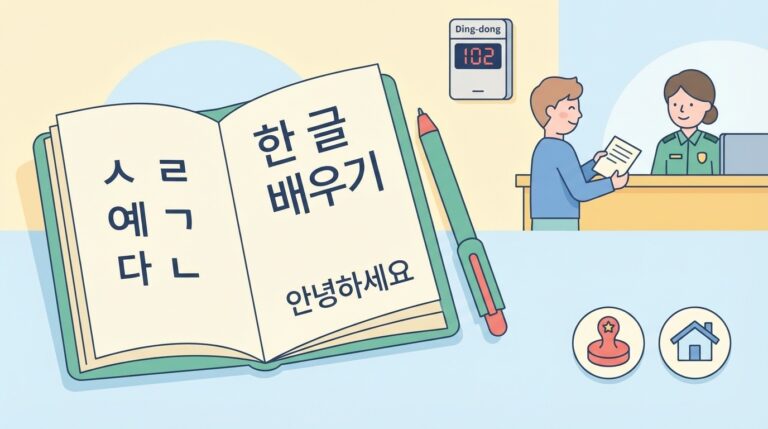
- K-Culture Moment: Every Korean bank, hospital, or government office runs on the “Ding-dong!” sound. If you stand in line without a ticket, the Ajumma (middle-aged lady) behind you will definitely scold you!
- Editor’s Insight: Ppopda (뽑다) means to pull or pluck. You are “plucking” a ticket from the machine.
- Situation Spectrum:
[🚫 Casual] ———— [✅ Polite] ———— [✅ Formal]3. 얼마나 걸려요?
- Pronunciation: [Eol-ma-na geol-ryeo-yo?]
- Sound-alike: “All-mana” + “girl-ryeo-yo”
- Meaning: “How long will it take?”
- K-Culture Moment: Koreans live by “Palli Palli” (Hurry Hurry) culture. Asking about time is not rude; it’s expected! In a busy Seoul office, they might say “10 minutes.” In a quiet countryside town? Maybe instant.
- Editor’s Insight: Use this anywhere—at a restaurant waiting for food, at a hair salon, or here at the office.
- Situation Spectrum:
[🚫 Casual] ———— [✅ Polite] ———— [⚠️ Formal]
(Safe for most service interactions)
Phase 3: Textbook vs. Real Life
| Situation | 📖 Textbook Korean | 🗣️ Real Korean (Survival) | 💡 Why the difference? |
|---|---|---|---|
| Stating Purpose | 주소를 변경하고 싶습니다. (I would like to change my address.) |
전입신고 하러 왔는데요. (I’m here for the move-in report…) |
“-nundeyo” softens the sentence and invites the listener to take the lead. It’s less robotic! |
| Giving ID | 제 신분증이 여기 있습니다. (Here is my ID card.) |
여기요. / 여기 있습니다. (Here.) |
Efficiency! In a fast-paced office, short and clear is better than a full sentence. |
| Asking for Form | 신청서는 어디에 있습니까? (Where is the application form?) |
서류 어디 있어요? (Where are the docs?) |
Koreans often drop particles (like -neun/eun) in spoken language for speed. |
💡 Bottom Note: Use the “Real Korean” version to sound like a local, but keep your tone polite (ends in -yo)!
Phase 4: Cultural Deep Dive — K-Culture Connection
4-1. Non-verbal: The Art of the “Two Hands”
Even though the government worker is a public servant, handing over your ID card (ARC) with one hand can look arrogant. Always use two hands, or support your right elbow with your left hand when passing your ID through the glass window. It shows you are a “well-mannered” resident.
4-2. K-Drama Trope: The Rooftop House (Oktapbang)
In dramas like Rooftop Prince or Fight for My Way, characters often live in rooftop houses. If you move into one of these, or a Goshiwon (study room), the process is the same! The “Community Center” (Dong-jumin-center) is often depicted as a place where the neighborhood gossip happens. In reality, it’s very quiet and fast!
Phase 5: Immersive Roleplay Scenario
Setting: It’s 2:00 PM on a Tuesday. The Dong-jumin-center (Community Center) is air-conditioned and quiet. You hear a “Ding-dong!” and your number, 104, flashes on the screen.
Characters:
– YOU: A foreign resident who just moved to Mapo-gu.
– Officer Kim: A efficient civil servant who types very fast.
Start Roleplay!
Officer Kim: 104번 고객님, 오세요. 무슨 일로 오셨어요?
(104-beon gogaeknim, oseyo. Museun illo osyeosseoyo?)
(Number 104, please come here. What brings you here?)
YOU: 안녕하세요. [ 1. 전입신고 하러 왔어요 ].
(Annyeonghaseyo. Jeonib-singo ha-reo wa-sseo-yo.)
(Hello. I came to do the move-in report.)
Officer Kim: 네, 신분증이랑 계약서 주시겠어요?
(Ne, sinbunjeung-irang gyeyakseo jusigesseoyo?)
(Okay, can you give me your ID and the contract?)
YOU: 네, [ 2. 여기 있습니다 ].
(Ne, yeogi isseumnida.)
(Yes, here it is.)
(🎭 Stage Direction: Officer Kim types furiously for 30 seconds.)
Officer Kim: 여기에 서명해 주세요. (Point at a pad)
(Yeogi-e seomyeong-hae juseyo.)
(Please sign here.)
🔀 Decision Point! The officer asks: “확정일자도 받으실 건가요?” (Do you want the ‘Fixed Date’ stamp too?)
- A) “아니요, 괜찮아요.” (No, I’m fine.)
- B) “네, 해주세요!” (Yes, please do it!)
✅ Best Choice: B
Why? “확정일자” (Hwak-jeong-il-ja) is the legal timestamp that protects your deposit money if the landlord goes broke. ALWAYS SAY YES! It usually costs just 600 won (about 50 cents).
Phase 6: 10-Second Shadowing Drill
Let’s practice! Listen to the rhythm. The slash / means a short pause.
- 😊 (Polite & Clear)
전입신고 / 하러 왔어요!
(Jeonib-singo / ha-reo wa-sseo-yo!) -
🤔 (Wondering)
번호표를 / 뽑아야 해요?
(Beon-ho-pyo-reul / ppo-ba-ya hae-yo?) -
😤 (Serious – Handing over documents)
신분증이랑 / 계약서 / 여기 있어요.
(Sinbunjeung-irang / gyeyakseo / yeogi isseoyo.)
Phase 7: K-Culture Mini Glossary
| Korean | Romanization | Meaning | Context |
|---|---|---|---|
| 동주민센터 | Dong-jumin-center | Community Service Center | The local gov office where you do address changes. Often just called “Dong-sa-mu-so” (old term). |
| 보증금 | Bojeung-geum | Security Deposit | The large sum of money you pay to rent a house. Protecting this is why we do Jeonib Singo! |
| 확정일자 | Hwak-jeong-il-ja | Fixed Date Stamp | A stamp on your contract proving when you moved in. Crucial for legal protection. |
| 외국인등록증 | Oegukin-deungnok-jeung | ARC (Alien Registration Card) | Your ID card. You must update the address on the back of this card here. |
Phase 8: Traveler’s Survival Kit (Expats Edition)
Since you are “traveling” through Korean bureaucracy, here is your kit:
🆘 Survival Phrases for the Office
– 🇰🇷 “작성해 주세요.” (Jak-seong-hae ju-se-yo)
– Meaning: “Please fill this out.” (You will hear this a lot!)
– 🇰🇷 “체류지 변경” (Che-ryu-ji byeon-gyeong)
– Meaning: Change of place of stay. (Formal term for address change for foreigners).
– 💡 Pro Tip: If your Korean is weak, just hand over your Passport, ARC, and Housing Contract. The officer will know exactly what to do without you saying a word!
Phase 9: Think Deeper — “Why is it so strict?”
🧠 System vs. Privacy
In many Western countries, changing your address is a simple mail forwarding process. In Korea, it is a strict legal requirement reported to the government database. Why?Korea has a resident registration number system (Jumin-beonho) that tracks everyone’s location for taxes, social services, and security. While it might seem like less privacy, it allows for incredible convenience—like instant banking, digital healthcare integration, and very safe streets. Does your country prioritize administrative efficiency or individual privacy? How does that affect how you move houses?
Phase 10: FAQ & Troubleshooting
Q: Can I do this online?
A: Yes, via the “Government24” or “Hikorea” website. BUT, Korean government websites often require many security plugins and digital certificates. For a beginner (A2), going to the office (offline) is actually faster and less frustrating!
Q: When is the deadline?
A: You must report your address change within 14 days of moving. If you are late, you will be fined (usually up to 100,000 KRW, but it varies).
❌ Common Mistake:
Going to the wrong community center. You must go to the center specifically for your neighborhood (Dong). If you live in Sinchon-dong, you cannot register in Hongdae-dong!
Phase 11: Wrap-up & Mission
One-Liner: To protect your deposit and stay legal, visit your local Dong-jumin-center and say “Jeonib Singo ha-reo wa-sseo-yo!”
🚀 Action Mission
- 🥉 Bronze: Look at your ID card (ARC). Is your current address printed on the back? If not, practice the phrase!
- 🥈 Silver: Find the nearest “Dong-jumin-center” to your house on Naver Maps.
- 🥇 Gold: Actually go there and register! (Or ask for a map of the neighborhood if you are already registered).
K-Culture Mission: Watch a clip of the variety show I Live Alone (Na Honja Sanda). Watch a celebrity moving house and see if they mention paperwork or eating Jajangmyeon!
Phase 12: Interactive Quiz
- Situation Judgment: You walk into the office, and it’s crowded. What is the FIRST thing you do?
- A) Yell “Jeonib Singo!!”
- B) Look for the number ticket machine (Beon-ho-pyo).
- C) Sit on the floor and cry.
- True or False: You should say “No” when the officer asks about “Hwak-jeong-il-ja” (Fixed Date) to save money.
- (True / False)
- Fill in the Blank:
“__________ 하러 왔어요.” (I came to do the move-in report.)
Answers:
1. B) Always get the ticket first! Silence is golden.
2. False! Always get the stamp to protect your thousands of dollars of deposit.
3. 전입신고 (Jeonib Singo)
Frequently Asked Questions (FAQ)
Q: What does "전입신고 하러 왔어요." mean in Korean and how do you pronounce it?
A: In Korean, "전입신고 하러 왔어요." is pronounced [Jeon-ip-sin-go ha-reo wa-sseo-yo] and means: (Literal) I came to do the move-in report. / (Real Nuance) "I'm here to register my address."
Q: What does "번호표를 뽑아야 해요?" mean in Korean and how do you pronounce it?
A: In Korean, "번호표를 뽑아야 해요?" is pronounced [Beon-ho-pyo-reul ppo-ba-ya hae-yo?] and means: "Do I need to take a number ticket?"
Q: What does "얼마나 걸려요?" mean in Korean and how do you pronounce it?
A: In Korean, "얼마나 걸려요?" is pronounced [Eol-ma-na geol-ryeo-yo?] and means: "How long will it take?"







