

Phase 1: Immersive Hook
Greeting: 안녕하세요! Hello, Daily Hangul family! It’s your editor, checking in from a busy cafe in Gwanghwamun, the heart of Seoul’s business district.
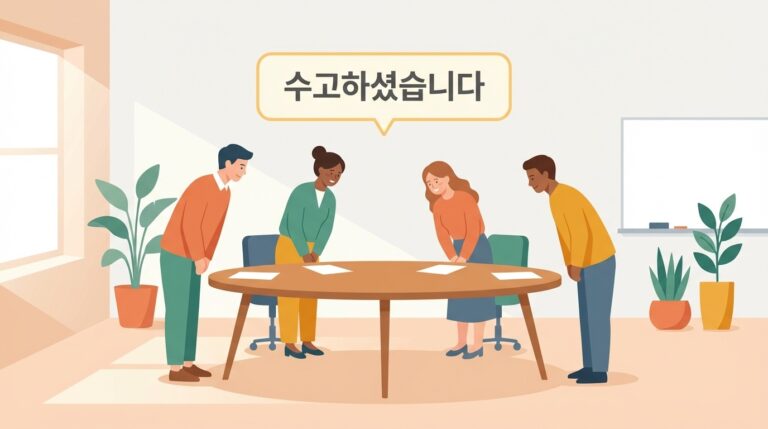
The K-Drama Moment: Picture this. You’re watching your favorite office K-Drama (maybe Misaeng or Start-Up). The intense meeting ends. Suddenly, everyone stands up in unison, performs a synchronized bow, and mutters a magical phrase that sounds like a hive of bees buzzing. “Su-go-ha-syeot-seum-ni-da…”
The subtitles just say “Good job,” but the vibe is so much more. It’s a ritual. It’s the bell that signals “School’s out!”
The ‘Why’: If you just silently pack your laptop and walk out of a meeting in Korea, the room will freeze. You might be seen as cold or rude. But master this one closing ritual, and you become the “Sense-jaeng-i” (a person with great social sense) that everyone wants on their team.
Transparency: This guide is built on real mistakes my students made—like the time one of them told their CEO “Good job” casually and the room went silent. Let’s make sure that doesn’t happen to you!
Phase 2: Deep Dive
Here are the top 3 expressions you need to survive the end of a meeting.
1. 수고하셨습니다 (Sugohasyeotseumnida)
- Pronunciation: [Su-go-ha-syeot-seum-ni-da] -> Sounds like: “Sue-go-ha-shot-sum-knee-da”
- Meaning: (Literal) You exerted a lot of effort. / (Real Nuance) “Thank you for your hard work, let’s wrap up!”
- K-Culture Moment: This is the period at the end of every Korean work sentence. You say it when a meeting ends, when you leave the office, or even when you finish a phone call.
- Editor’s Insight: It’s not just about the work. It’s about acknowledging the shared suffering of the meeting. It builds camaraderie.
- Situation Spectrum:
[🚫 CEO/President] ———— [⚠️ Senior Boss] ———— [✅ Peers/Team Leader]
(Note: While commonly used, strict etiquette says you shouldn’t comment on a superior’s “effort.” But in modern offices, it’s the standard goodbye.)- 🤔 Think About It: Why does Korean culture focus so much on “effort” (Sugo) rather than just the “result”? What does this say about the process vs. the outcome?
2. 이상입니다 (Isangimnida)
- Pronunciation: [I-sang-im-ni-da] -> Sounds like: “Ee-sang-im-knee-da”
- Meaning: (Literal) That is all. / (Real Nuance) “I’m done talking.”
- K-Drama Moment: In a presentation scene, after the hero delivers a passionate speech, they bow sharply and say this. It signals the applause to start.
- Editor’s Insight: Use this when you finish your own report or presentation in the meeting. It prevents that awkward silence where people wonder, “Is he done?”
- Situation Spectrum:
[✅ Formal Presentation] ———— [✅ Reporting to Boss] ———— [🚫 Casual Chat]3. 질문 있으신가요? (Jilmun isseusingayo?)
- Pronunciation: [Jil-mun i-sseu-sin-ga-yo?]
- Meaning: Do you have any questions?
- Editor’s Insight: Be careful with this one! (See the Roleplay section below).
- Situation Spectrum:
[✅ Meeting Host] ———— [✅ Presenter] ———— [🚫 Junior Listener]
Phase 3: Textbook vs. Real Life
| Situation | 📖 Textbook Korean | 🗣️ Real Korean | 💡 Why different? |
|---|---|---|---|
| Ending the meeting | 회의를 마치겠습니다. (We will end the meeting.) | 자, 오늘은 여기까지 하시죠. (Okay, let’s stop here for today.) | “Here” implies a boundary. It’s softer and suggests “we did enough.” |
| Praising the team | 모두 훌륭했습니다. (Everyone was excellent.) | 다들 고생 많으셨어요. (Everyone suffered/worked hard.) | Koreans bond over shared hardship (Gosaeng). It feels warmer. |
| Leaving the room | 안녕히 계세요. (Goodbye.) | 먼저 들어가 보겠습니다. (I will go in [to my desk/home] first.) | Leaving “first” requires polite excuse-making logic. |
Bottom Note: In a casual team meeting, simply clapping your hands once and saying “Ja!” (Okay!) often signals the start of the wrap-up.
Phase 4: Cultural Context — K-Culture Deep Dive
4-1. Non-verbal: The “Nunchi” Pack-up
In the West, when the meeting time is up, you might close your laptop immediately. In Korea, this shows a lack of Nunchi (awareness). Even if the clock says 5:00 PM, you wait for the senior person to close their notebook or stand up first. That is the true signal that the meeting is over.
4-2. K-Food Connection: The “Hoesik” Trap
Often, a meeting ending at 6 PM on a Friday isn’t really the end. It’s the prequel to Hoesik (Company Dinner).
* The Phrase: “끝나고 삼겹살 콜?” (Pork belly after this, call?)
* The Context: Business decisions are often finalized not in the meeting room, but over the grilling of meat and pouring of Soju. If you skip this, you might miss the real meeting.
Phase 5: Immersive Roleplay
Scenario: It is 5:50 PM on a Friday. You are in a conference room in Gangnam. The team leader, Min-su, looks tired. You really want to go home.
Min-su (Team Leader): 자, 오늘 회의는 이걸로 정리하죠. (Okay, let’s wrap up the meeting with this.)
YOU: (Following the others, you start organizing your papers slowly)
Min-su: 다들 이번 주 프로젝트 하느라 고생 많았어요.
(Da-deul ibeon ju project ha-neu-ra gosaeng man-a-sseo-yo.)
(Translation: You all suffered a lot doing the project this week.)
🔀 Decision Point: Min-su looks at the team and asks: “혹시 더 할 말 있는 사람?” (Anyone have anything else to say?)
- Option A: Raise your hand. “Yes! I have a question about the budget for next year.”
- Option B: Smile, shake your head slightly, and start standing up.
- Option C: Say “Thank you!” loudly.
✅ Best Choice: Option B
Analysis: asking a complex question at 5:55 PM on a Friday is considered a “social crime” in Korea! Read the room (Nunchi). If it’s not urgent, save it for Monday.
Min-su: 그래, 그럼 마칩시다! 수고하셨습니다!
(Geu-rae, geu-reom ma-chip-si-da! Su-go-ha-syeot-seum-ni-da!)
YOU: ____________________!
(Hint: Use the magic phrase from Phase 2!)
Phase 6: 10-Second Shadowing Drill
Listen to the rhythm. Korean is not robotic; it has waves.
- Emotion: 😊 Relieved & Grateful (Say it with a sigh of relief)
- Drill: 오늘 / 회의도 / 수고하셨습니다!
- Pronunciation: Oneul / hoe-ui-do / su-go-ha-syeot-seum-ni-da!
- Meaning: Great work on today’s meeting, too!
Phase 7: K-Culture Mini Glossary
| Korean | Romanization | Meaning | Context |
|---|---|---|---|
| 눈치 | Nunchi | Eye-measure / Intuition | The art of sensing the mood. Essential for knowing when to leave. |
| 칼퇴 | Kkal-toe | Knife-leave | Leaving work exactly on time (like cutting with a knife). The dream of every office worker. |
| 막내 | Maknae | The youngest | The person usually responsible for organizing the chairs after the meeting. |
Phase 8: Traveler’s Survival Kit
Even if you aren’t working in Korea, “wrapping up” happens everywhere.
🆘 Survival Expression: Checking Out / Leaving a Tour
– 🇰🇷 “수고하세요!” (Su-go-ha-se-yo!)
– Meaning: Keep up the good work! / Goodbye.
– Where to use: When leaving a convenience store, getting out of a taxi, or checking out of a hotel.
– Why: It acknowledges the staff’s ongoing work while you leave.
– 💡 Pro Tip: Don’t say this to someone older than you who isn’t providing a service. To an elder on the street, just bow and say “An-nyeong-hi gye-se-yo.”
Phase 9: Think Deeper — “Why so much suffering?”
Language & Culture:
Did you notice how often the words 수고 (Sugo – effort) and 고생 (Gosaeng – suffering) appear in Korean greetings? Unlike English, which focuses on the result (“Good job,” “Well done”), Korean etiquette focuses on the hardship you endured.
It reflects a high-context culture where validating someone’s pain is the highest form of empathy. By saying “You suffered,” you are telling them, “I see your struggle, and I appreciate it.”
💬 Your Turn: In your culture, do you praise the effort or the result? Tell me in the comments!
Phase 10: FAQ & Troubleshooting
Q: Can I say “수고하셨습니다” to the big boss (CEO/President)?
A: Strictly speaking? No. Traditionally, evaluating a superior’s effort is rude. K-Etiquette experts recommend “감사합니다” (Thank you) or “먼저 들어가 보겠습니다” (I’ll be leaving first). However, in young startups, “Sugo” is becoming acceptable for everyone. When in doubt? Just bow deeper!
❌ Common Mistake: Saying “Good job” (Cheer up/Keep going) literally as “수고해!” to a boss.
✅ Fix: “Su-go-hae” is Banmal (casual). Only use it with close friends or much younger juniors. Always add “-yo” or “-syeot-seum-ni-da” for work.
Phase 11: Wrap-up & Action Mission
One-Liner: Ending a meeting is about reading the air (Nunchi) and acknowledging everyone’s shared effort with “Sugohasyeotseumnida.”
🚀 Action Missions:
– 🥉 Bronze: Look in the mirror and practice bowing while saying “Su-go-ha-syeot-seum-ni-da” smoothly.
– 🥈 Silver: Watch a K-Drama episode involving an office scene. Count how many times they say “Sugo.”
– 🥇 Gold: Next time you visit a Korean restaurant or shop, say “Sugohaseyo!” to the staff as you leave. Watch their face light up!
Phase 12: Interactive Quiz
Scenario: The meeting ended. Your boss is packing his bag. What is the WORST thing to say?
- (Bow) 수고하셨습니다!
- (Silence) Just walk out while looking at your phone.
- 감사합니다. 내일 뵙겠습니다!
Answer: 2.
Why? Silence is cold. In Korea, greeting is the glue of social life. Even a slightly wrong greeting (1) is better than no greeting (2).
See you in the next lesson! 안녕! 👋
Frequently Asked Questions (FAQ)
Q: What does "수고하셨습니다 (Sugohasyeotseumnida)" mean in Korean and how do you pronounce it?
A: In Korean, "수고하셨습니다 (Sugohasyeotseumnida)" is pronounced [Su-go-ha-syeot-seum-ni-da] and means: (Literal) You exerted a lot of effort. / (Real Nuance) "Thank you for your hard work, let's wrap up!"
Q: What does "이상입니다 (Isangimnida)" mean in Korean and how do you pronounce it?
A: In Korean, "이상입니다 (Isangimnida)" is pronounced [I-sang-im-ni-da] and means: (Literal) That is all. / (Real Nuance) "I’m done talking."
Q: What does "질문 있으신가요? (Jilmun isseusingayo?)" mean in Korean and how do you pronounce it?
A: In Korean, "질문 있으신가요? (Jilmun isseusingayo?)" is pronounced [Jil-mun i-sseu-sin-ga-yo?] and means: Do you have any questions?







