

Phase 1: The Immersive Hook
Hello! This is your Daily Hangul Editor. 👋
Picture this: You’ve just finished a delicious meal of Dakgalbi (spicy stir-fried chicken) at your Korean friend’s house. The conversation was great, the food was spicy, and your stomach is full. Then, the host stands up and starts stacking plates.
Cue the panic. 🚨
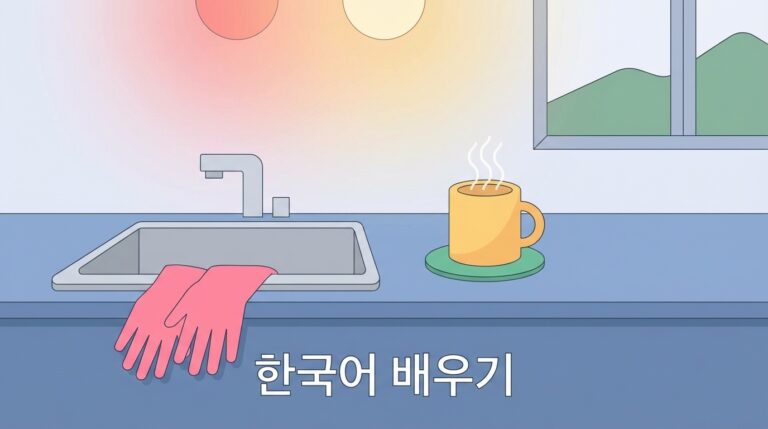
In many Western cultures, the guest stays seated to be polite, letting the host handle the hosting. But in a K-Drama? You’ve seen the scene. The main character practically wrestles the rubber gloves away from the host’s mother, shouting, “No, I’ll do it!”
So, what do you do? Do you sit still (and risk looking lazy)? Or do you rush to the sink (and risk overstepping)?
Welcome to the art of the “Dishwashing Dance.” It’s not just about cleaning; it’s about showing Jeong (affection/connection). Today, we’re going to learn how to offer help without making it awkward.
Phase 2: Deep Dive into Core Expressions
Here are the three phrases you need to survive the post-meal moment.
1. 제가 할게요 (Jega halgeyo)
- Pronunciation: [Je-ga hal-ge-yo] Sounds like ‘Jay-ga hal-g-yo’
- Meaning: Literal: “I will do it.” / Real Nuance: “Let me handle this (so you can rest).”
- K-Culture Moment: Think of a rookie employee in a drama jumping up to pour water for the CEO. It shows readiness and initiative.
- Editor’s Insight: This is your “First Strike.” As soon as the host touches a plate, you say this. It’s polite, proactive, and safe for B1 levels.
- Situation Spectrum:
[🚫 Boss/Elders (Too direct)] ———— [⚠️ Colleagues] ———— [✅ Friends/Hosts]- 🤔 Think About It: In English, we ask “Can I help?” (asking permission). In Korean, we say “I will do it” (declaring action). Why do you think Korean favors the proactive declaration over the question?
2. 좀 거들게요 (Jom geodeulgeyo)
- Pronunciation: [Jom geo-deul-ge-yo]
- Meaning: Literal: “I will help out a bit.” / Real Nuance: “I won’t take over your kitchen, but let me contribute my labor.”
- Editor’s Insight: Geodeulda (to help/assist) is a beautiful verb. It implies you are supporting the main actor (the host), not replacing them. It sounds very sophisticated and humble.
- Situation Spectrum:
[🚫 Kids] ———— [⚠️ Close Friends] ———— [✅ Parents-in-law/Older Hosts]3. 그냥 두세요 / 놔두세요 (Geunyang duseyo / Nwaduseyo)
- Pronunciation: [Geun-yang du-se-yo]
- Meaning: “Just leave it.” / “Let it be.”
- K-Drama Moment: This is what the host will scream at you while blocking the sink with their body.
- Editor’s Insight: You need to know this listening skill. If they say this firmly, you stop. If they say it softly, you offer one more time.
Phase 3: Textbook vs. Real Life
| Situation | 📖 Textbook Korean | 🗣️ Real Korean (Insa Style) | 💡 Why the difference? |
|---|---|---|---|
| Offering Help | 설거지를 도와 드릴까요? (Shall I help you with dishes?) | 에이, 제가 할게요! 앉아 계세요. (Ey, I’ll do it! You stay seated.) | Questions feel distant. Commands (kind ones) feel like family. |
| Host Refusing | 아니요, 괜찮습니다. (No, it is okay.) | 아유, 됐어 됐어! (Ayu, done done! / Forget it!) | “Ayu” is the universal sound of deflection in Korea. |
| Giving Up | 알겠습니다. (I understand.) | 그럼… 잘 먹었습니다! (Then… I ate well!) | Acknowledging the meal is the best way to say “Okay, I accept your refusal.” |
Bottom Note: Don’t be a robot. If you ask “Shall I…?” it sounds like you are a waiter. Jump in with “I will…!”
Phase 4: Cultural Deep Dive — The Art of Nunchi
4-1. Non-verbal Communication: The “Fake” Fight
Offering to do the dishes in Korea is often a ritual.
1. The Offer: You offer to wash.
2. The Refusal: The host says no.
3. The Nunchi:
* If the host is your close friend and looks tired: Push them aside and wash.
* If the host is an older person or someone you don’t know well: Offer once, maybe twice, then obey their refusal. Entering another person’s kitchen can be seen as invading their private territory.
4-2. K-Food Context
Korean meals involve many side dishes (Banchan). That means a mountain of small plates. The sheer volume of dishes is why offering help is considered such a high-class manner. It shows you understand the labor that went into the meal.
Phase 5: Immersive Roleplay Scenario
Setting: Friday night at your Korean friend Min-ji’s apartment. You just finished a heavy meal of Samgyeopsal. There are greasy plates everywhere.
Characters:
* YOU: A polite guest who wants to show appreciation.
* Min-ji (30): Your close friend, currently stacking plates.
Dialogue:
Min-ji: 아, 배부르다. 이제 좀 치워야겠다.
(Ah, baebureuda. Ije jom chiwoyagetta.)
(Ah, I’m full. I should clean up now.)
YOU: (Standing up immediately)
Min-ji야, 앉아 있어. 설거지는 제가 할게요.
(Min-ji-ya, anja isseo. Seolgeojineun jega halgeyo.)
(Min-ji, stay seated. I’ll do the dishes.)
Min-ji: (Waving hands) 아니야! 손님한테 어떻게 시켜. 내가 하면 돼.
(Aniya! Sonnim-hante eotteoke sikyeo. Naega hamyeon dwae.)
(No! How can I make a guest do work? I’ll do it.)
🔀 Decision Point: What is your next move?
- A) “네, 알겠습니다.” (Sit down immediately)
- B) “에이, 맛있는 거 얻어먹었는데 이 정도는 해야죠!” (Grab a plate gently)
- C) “비켜! 내가 한다고!” (Physically push her)
✅ Best Choice: B — “Ey, I ate such good food, I should at least do this!” This is the perfect ‘Insa’ response. It creates a warm back-and-forth.
⚠️ Choice A Analysis: A bit too cold. You gave up too easily!
🚫 Choice C Analysis: Too aggressive! Unless you are best friends since childhood, don’t push the host.
YOU (Option B):
에이, 맛있는 거 얻어먹었는데 이 정도는 해야죠!
(Ey, masinneun geo eodeomeogeonneunde i jeongdoneun haeyajyo!)
(Come on, I got a free delicious meal, I should at least do this!)
Min-ji: (Laughing) 진짜 괜찮아. 그럼 그 접시만 식탁으로 좀 옮겨 줄래?
(Jinjja gwaenchana. Geureom geu jeopsiman siktageuro jom olmgyeo jullae?)
(Really, it’s okay. Then can you just move that plate to the table?)
YOU:
그럼요!
(Geureomyo!)
(Of course!)
Phase 6: 10-Second Shadowing Drill
Practice this sentence to sound like a natural Korean guest. Focus on the rising, cheerful intonation at the start.
“Ey~ / Since I ate well / I should do this much!”
😊 에이~ / 잘 먹었는데 / 이 정도는 해야죠!
(Ey~ / jal meogeonneunde / i jeongdoneun haeyajyo!)
- Ey~ (에이~): Make this sound friendly and playful.
- Haeyajyo (해야죠): End with a confident downward pitch, showing determination.
Phase 7: K-Culture Mini Glossary
| Korean | Romanization | Meaning | Context |
|---|---|---|---|
| 손님 | Sonnim | Guest | In Korea, a guest is treated like a king, which is why they rarely let you work. |
| 정 | Jeong | Affection/Bond | The invisible string connecting people. Fighting over the dishes increases Jeong. |
| 잘 먹었습니다 | Jal meogeo-sseumnida | I ate well | The ultimate phrase of gratitude. Say this if they refuse your help. |
| 집들이 | Jip-deul-i | Housewarming | A party where these dishwashing battles happen most often. |
Phase 8: Traveler’s Survival Kit (Home Visit Edition)
Since this is a home-visit scenario, here is your etiquette survival kit.
🆘 Survival Expressions
1. “초대해 주셔서 감사합니다.” (Cho-dae-hae ju-syeo-seo gam-sa-ham-ni-da)
* Thank you for inviting me.
2. “신발은 어디에 두나요?” (Sin-bal-eun eo-di-e du-na-yo?)
* Where should I put my shoes? (Vital first step!)
3. “빈손으로 오기 뭐해서…” (Bin-son-eu-ro o-gi mwo-hae-seo…)
* I felt awkward coming empty-handed so… (Say this when handing a gift).📌 Editor’s Pro Tip: The Fruit Fork
After dinner, if the host brings out cut fruit, do not wash the fork immediately after eating. Wait until the whole session is over. Rushing to clean can signal “I want to leave now.”
Phase 9: Think Deeper — “Why do we fight?”
Topic: Food and Collectivism
In many individualistic cultures, a dinner party is “Host provides, Guest enjoys.” It’s a transaction of hospitality. In Korea, a meal is a shared communal event. By offering to wash dishes (or fighting to pay the bill at a restaurant), you are trying to erase the line between “Host” and “Guest.” You are saying, “We are one team; we share the labor and the cost.”
🧠 Think Deeper:
Does offering to clean up at a friend’s house in your country feel polite, or does it feel like you are saying the host is messy? How does the boundary of the “Kitchen” differ?
Phase 10: FAQ & Troubleshooting
Q: Can I actually just start washing without asking?
A: No. Unless it’s your sibling or best friend. The kitchen is a private space. Just walking in can be rude. Always announce your intent: “제가 할게요!”
Q: What if they say no 3 times?
A: Then stop! If you persist after 3 refusals, you become annoying. Just say “잘 먹었습니다” and sit down.
❌ Common Mistake #1: Sitting on the sofa immediately after eating.
✅ Fix: At least pretend to move dishes to the kitchen sink. This “performative helpfulness” is key.
Phase 11: Wrap-up & Mission
One-Liner: Helping with dishes isn’t about the dishes; it’s about showing you care enough to get your hands wet.
🎬 Action Mission:
* 🥉 Bronze: Say “설거지는 제가 할게요” 3 times in front of a mirror with a confident smile.
* 🥈 Silver: Watch a K-Drama scene with a family dinner. Spot the moment someone tries to help clean up.
* 🥇 Gold: Next time you eat at a friend’s place (even non-Korean), say “Let me do the dishes” and insist once.
💬 Your Turn: Have you ever experienced a “fight” over chores or the bill? Tell us your story in the comments!
Phase 12: Interactive Quiz
- Situation: You are at your boss’s house for the first time. The boss’s husband starts cleaning. What do you say?
- A) “비키세요!” (Move!)
- B) “제가 돕겠습니다.” (I will help / assist.)
- C) Stay silent and look at your phone.
- True or False?
- In Korea, if a host says “No, don’t help,” they always mean it 100%. (T/F)
Answers:
1. B) With a superior, “helping” (돕다/거들다) is better than taking over. Never do C!
2. False. It is often politeness. You should offer at least one more time to check their true feeling (Nunchi).
Frequently Asked Questions (FAQ)
Q: What does "제가 할게요 (Jega halgeyo)" mean in Korean and how do you pronounce it?
A: In Korean, "제가 할게요 (Jega halgeyo)" is pronounced [Je-ga hal-ge-yo] and means: Literal: "I will do it." / Real Nuance: "Let me handle this (so you can rest)."
Q: What does "좀 거들게요 (Jom geodeulgeyo)" mean in Korean and how do you pronounce it?
A: In Korean, "좀 거들게요 (Jom geodeulgeyo)" is pronounced [Jom geo-deul-ge-yo] and means: Literal: "I will help out a bit." / Real Nuance: "I won't take over your kitchen, but let me contribute my labor."
Q: What does "그냥 두세요 / 놔두세요 (Geunyang duseyo / Nwaduseyo)" mean in Korean and how do you pronounce it?
A: In Korean, "그냥 두세요 / 놔두세요 (Geunyang duseyo / Nwaduseyo)" is pronounced [Geun-yang du-se-yo] and means: "Just leave it." / "Let it be."







