

Phase 1: The Immersive Hook
Greeting: 안녕하세요! This is your Daily Hangul Chief Editor.
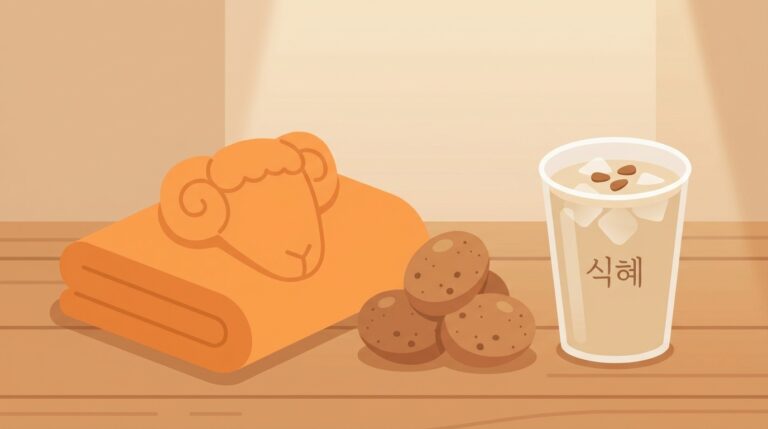
Picture this: You are watching a K-Drama. The lead couple has just escaped a stressful situation. Cut to the next scene—they are sitting in a room that looks like a giant kiln, wearing orange t-shirts and shorts. On their heads? Towels folded into bizarrely cute sheep shapes. In their hands? Brown, roasted eggs and a cup of icy, cloudy drink.
Suddenly, the guy grabs an egg and—crack!—smashes it on his own forehead. Or worse, on the girl’s head.
Wait, is that assault? No, that’s Jjimjilbang (찜질방) culture.
If you visit Korea and don’t experience the Yangmeori (Sheep Head) and Maekbanseok Gyeran (Stone-baked Eggs), have you really been to Korea? Today, we are going beyond the “I’m hot” phrases. We are diving into the C1-level nuances of Korean relaxation, where burning heat feels “cool,” and cracking eggs is a love language.
Phase 2: Deep Dive into Core Expressions
Since you are aiming for C1, let’s skip the basics and get into the expressions that make you sound like a local Seoulite.
1. 양머리 (Yangmeori)
- Pronunciation: [Yang-meo-ri] Sounds like ‘Young’ + ‘Murray’
- Meaning: Literal: Sheep Head / Real: The specific towel folding technique used in saunas.
- K-Culture Moment: From the classic drama My Name is Kim Sam-soon to modern variety shows like Running Man, this look is iconic. It’s not just for cuteness; it keeps the sweat out of your eyes and the towel secure.
- Editor’s Insight: You don’t ask the staff for a “Yangmeori.” You have to make it yourself. It’s a rite of passage.
- Situation Spectrum:
[🚫 Formal Meetings] ———— [⚠️ Street] ———— [✅ Jjimjilbang Only] - 🤔 Think About It: Why does a culture that values conformity and saving face (Chemyon) suddenly allow everyone to look silly with sheep towels in public? Is the Jjimjilbang a “judgment-free zone” in Korean society?
2. 시원하다 (Siwonhada)
- Pronunciation: [Si-won-ha-da]
- Meaning: Literal: To be cool (temperature) / Real: To be refreshing, relieving, or satisfying (even when it’s hot).
- K-Culture Moment: You enter a 40°C hot tub or a 80°C clay sauna. An older Korean man sighs deeply, “아~ 시원하다!” (Ah, it’s cool!).
- Editor’s Insight: This is the ultimate linguistic paradox. When your muscles relax and the tension melts due to heat or a massage, Koreans say it is Siwonhada. If you say “It’s hot” (뜨거워요), you are describing the temperature. If you say “Siwonhada,” you are describing the sensation of relief.
- Situation Spectrum:
[✅ Casual] ———— [✅ Polished] ———— [✅ Formal]
3. 몸을 지지다 (Momeul Jijida)
- Pronunciation: [Mo-meul Ji-ji-da]
- Meaning: Literal: To sear/fry one’s body / Real: To let your body soak in intense heat to soothe aches.
- Editor’s Insight: This is a very native phrasing. “Let’s go to the sauna” is boring. “Let’s go sear our bodies (sweat it out)” implies you are tired, your bones ache, and you need therapeutic heat. It’s a favorite phrase of tired office workers.
Phase 3: Textbook vs. Real Life
| Situation | 📖 Textbook Korean | 🗣️ Real Korean (Insa Style) | 💡 Why the difference? |
|---|---|---|---|
| Suggesting Sauna | 찜질방에 갈까요? (Shall we go to the Jjimjilbang?) | 땀 좀 뺄까? (Shall we drain some sweat?) | Focuses on the detox effect rather than the location. |
| Feeling Good | 기분이 좋아요. (I feel good.) | 아, 피로가 싹 풀린다. (Ah, fatigue is completely unraveling.) | Specifically targets the release of physical stress. |
| Eating Eggs | 계란 먹을래? (Want to eat eggs?) | 계란 내기 콜? (Call for an egg bet?) | At saunas, food is often the prize of a game (Rock-Paper-Scissors). |
Bottom Note: Using “몸 좀 지지자” (Let’s sear our bodies) instantly raises your level perception. It shows you understand the physicality of Korean relaxation.
Phase 4: Cultural Deep Dive
4-1. The “Head Smash” Ritual (Non-verbal)
In dramas, you see people cracking hard-boiled eggs on heads. Warning: Maekbanseok eggs (brown, sauna-baked) are harder than regular boiled eggs.
* The Rule: You usually play Rock-Paper-Scissors (가위바위보 – Ga-wi-ba-wi-bo). The winner gets to crack the egg on the loser’s head.
* Nunchi Check: Do NOT do this to strangers or elders. Only close friends. And don’t hit too hard, or the “fun” ends in a fight.
4-2. The Holy Trinity of Jjimjilbang Snacks
- Gu-un Gyeran (Roasted Eggs): Chewy, smoky flavor. Dip in salt.
- Sikhye (Sweet Rice Punch): The icy sweetness balances the hot sauna air. It aids digestion.
- Miyeok-guk (Seaweed Soup): Surprisingly common in saunas. It replenishes minerals lost through sweat.
🤔 Critical Perspective: Why is eating on the floor communal? Unlike Western spas which are often solitary and quiet, Korean Jjimjilbangs are loud, communal living rooms. Families sprawl on mats, eating and sleeping together. It is an extension of the Bang (Room) culture—private comfort in a public space.
Phase 5: Immersive Roleplay Scenario
Setting: Saturday night at a large Jjimjilbang in Yongsan. The floor is heated (Ondol). You are wearing the standard issue orange shorts and t-shirt.
Characters:
* YOU: Exhausted from a week of travel.
* Minji (30, Korean friend): energetic, loves saunas.
(Dialogue Start)
Minji: 와, 사람 진짜 많다. 우리 저기 구석에 자리 잡자.
(Wa, saram jinjja manta. Uri jeogi guseoge jari japja.)
(Wow, so many people. Let’s grab a spot in that corner.)
YOU: (Looking at the clay kiln)
저기 불가마는 너무 뜨겁지 않을까?
(Jeogi bulgamaneun neomu tteugeopji aneulkka?)
(Isn’t that fire kiln too hot?)
Minji: 에이, 들어가서 몸 좀 지져야 피로가 풀리지! 그 전에 매점부터 갈까?
(Ei, deureogaseo mom jom jijyeoya piroga pulliji! Geu jeone maejeombuteo galkka?)
(Ey, we need to sear our bodies inside to release the fatigue! Should we hit the snack bar first?)
🔀 Decision Point: Minji suggests buying snacks. How do you respond?
A) “Yes, I want eggs.” (Grammatically correct, but boring)
B) “Okay! Rock-Paper-Scissors for the eggs?” (Shows you know the culture)
C) “I don’t have my wallet.” (Rookie mistake—you have your locker key!)
✅ Best Choice: B.
YOU: 좋아! 계란 내기 콜? 진 사람이 머리에 계란 깨기!
(Joa! Gyeran naegi call? Jin sarami meorie gyeran kkaegi!)
(Good! Call for an egg bet? Loser gets the egg cracked on their head!)
Minji: (Laughing) 오~ 자신 있는데? 가위, 바위, 보!
(Oh~ You seem confident? Rock, Paper, Scissors!)
(Minji loses. She offers her forehead)
Minji: 아, 졌다… 살살 해라.
(Ah, jyeotda… Salsal haera.)
(Ah, I lost… Do it gently.)
YOU: (Cracking the egg) 팍!
Phase 6: 10-Second Shadowing Drill
Let’s practice the sentence you say after taking a sip of ice-cold Sikhye after sweating for 20 minutes.
😊 Emotion: Pure bliss and relief.
🇰🇷 땀 빼고 먹으니까 / 식혜가 / 완전 꿀맛이네!
[Ttam ppaego meogeunikka / sikhye-ga / wanjeon kkul-masine!]
(Eating this after sweating / the Sikhye / tastes like total honey!)
Phase 7: K-Culture Mini Glossary
| Korean | Rom. | Meaning | Context |
|---|---|---|---|
| 찜질방 | Jjimjilbang | Korean Sauna | A 24-hour sauna/spa with heated rooms, baths, and sleeping areas. |
| 불가마 | Bulgama | Fire Kiln | The very hot, dome-shaped sauna rooms. |
| 식혜 | Sikhye | Rice Punch | Traditional sweet drink made of malt and rice. |
| 맥반석 계란 | Maekbanseok | Baked Eggs | Eggs slow-baked on Elvan stones; brown and chewy. |
| 세신 | Seshin | Body Scrub | Professional exfoliation service (aka “Italian Towel” scrub). |
Phase 8: Traveler’s Survival Kit
Context: How do I pay if I’m naked or in shorts?
🆘 Survival Expression #1
* 🇰🇷 “락커 키로 결제할게요.” (Rak-keo ki-ro gyeol-je-hal-ge-yo.)
* 🗣️ Pronunciation: [Locker key-ro gyul-jay-hal-ge-yo]
* Where: Snack bar, massage chair, restaurant inside the sauna.
* 💡 Pro Tip: In 99% of Jjimjilbangs, your locker key (bracelet) is your credit card. You tap it to buy everything and pay the total bill at the exit. Don’t lose it!📌 Editor’s Travel Note: The Taboos
* Tattoos: If you have large tattoos, some traditional saunas may deny entry or ask you to cover them (due to old gang associations). Check beforehand.
* Swimsuits: In the gender-segregated bath areas, you must be completely naked. Wearing a swimsuit there is seen as dirty/rude. In the mixed-gender common areas (Jjimjilbang), you wear the provided uniform.
Phase 9: Think Deeper — “Communal Vulnerability”
Topic: Nakedness and Bonding (Jeong)
In Western culture, nudity is often sexualized or strictly private. In Korea, Mogyoktang (Bathhouse) culture is about shedding social ranks. When everyone is naked, the CEO and the student are equals. Scrubbing each other’s backs (among family or close friends) is a supreme act of intimacy and care, known as Jeong (deep affection/bond).
🧠 Think Deeper:
Does your culture have a space where social masks are removed? Why do you think Korean business deals or honest talks often happen in these hot, vulnerable spaces?
Phase 10: FAQ & Troubleshooting
Q: Can I really sleep there overnight?
A: Yes! Many travelers use Jjimjilbangs as cheap accommodation. There are sleeping mats and caves. Just beware of the snorers.
Q: Is it okay to make the Sheep Head (Yangmeori) anywhere?
A: It’s cute in the Jjimjilbang or a funny photo op at home. Do not wear it in a regular cafe or street; people will think you escaped from the sauna.
❌ Common Mistake: Bringing your phone into the high-heat Bulgama.
✅ Fix: Leave your phone in the locker or outside the hot room. The heat can destroy your battery or shut down the device.
Phase 11: Wrap-up & Action Mission
One-Liner Summary: To enjoy a Korean sauna, you must “sear” your body (Jijida), wear a sheep head, and bet on eggs with friends.
Action Missions:
* 🥉 Bronze: Search “How to make Yangmeori” on YouTube and fold a towel at home.
* 🥈 Silver: Watch a clip of Running Man or a K-Drama sauna scene and identify “Sikhye” and “Eggs.”
* 🥇 Gold: Visit a local Korean spa (or one in Korea), order Sikhye using the “Locker Key” phrase, and crack an egg (gently)!
💬 Your Turn: Have you ever experienced a public bath culture? How does it compare to Korea’s communal living room vibe?
Phase 12: Quiz — The Sauna Master Challenge
- Situation: You step into a boiling hot tub. What is the most natural “Korean Old Soul” reaction?
- a) It’s too hot! (너무 뜨거워!)
- b) Ah, Siwonhada! (아, 시원하다!)
- c) It’s cold. (추워요.)
- Culture: You want to buy an egg. You are wearing your sauna shorts. What do you use to pay?
- a) Cash hidden in your sock.
- b) Credit card.
- c) Your electronic locker key bracelet.
- True or False: You should wear a swimsuit inside the gender-segregated bathwater area.
- (True / False)
(Answers: 1-b, 2-c, 3-False [You must be naked!])
Frequently Asked Questions (FAQ)
Q: What does "양머리 (Yangmeori)" mean in Korean and how do you pronounce it?
A: In Korean, "양머리 (Yangmeori)" is pronounced [Yang-meo-ri] and means: Literal: Sheep Head / Real: The specific towel folding technique used in saunas.
Q: What does "시원하다 (Siwonhada)" mean in Korean and how do you pronounce it?
A: In Korean, "시원하다 (Siwonhada)" is pronounced [Si-won-ha-da] and means: Literal: To be cool (temperature) / Real: To be refreshing, relieving, or satisfying (even when it's hot).
Q: What does "몸을 지지다 (Momeul Jijida)" mean in Korean and how do you pronounce it?
A: In Korean, "몸을 지지다 (Momeul Jijida)" is pronounced [Mo-meul Ji-ji-da] and means: Literal: To sear/fry one's body / Real: To let your body soak in intense heat to soothe aches.







