

Unlocking the Code of “Gamseong”: Inside Korea’s Trendy Cafe Culture
Phase 1: The Vibe Check (Immersive Hook)
안녕하세요! This is your Daily Hangul Editor.
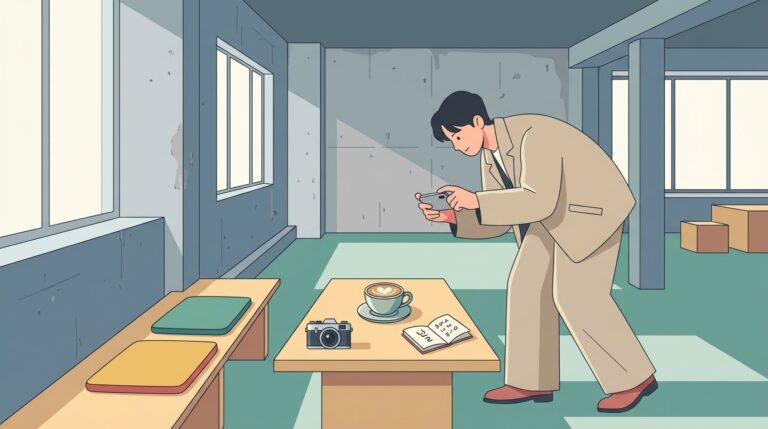
Picture this: You are walking through the back alleys of Seongsu-dong or Yeonnam-dong. There’s a crumbling brick building with no signboard, just a tiny poster taped to a steel door. Is it a construction site? An abandoned factory?
No, it’s the hottest cafe in Seoul right now.
If you’ve watched K-Dramas like Start-Up or Itaewon Class, you know that cafes in Korea aren’t just places to drink caffeine; they are stages. They are battlegrounds for aesthetics. In K-Pop fandom culture, they transform into shrines for birthday events.
But here is the C2-level reality check: In these “Insta-worthy” spots, the menu is cryptic, the tables are often lower than your knees (we’ll talk about why later), and everyone is taking photos of their latte instead of drinking it.
Today, we are going beyond “Iced Americano, please.” We are deconstructing the marketing psychology of Korean cafes and learning the sophisticated vocabulary to critique, appreciate, and navigate them like a local trendsetter.
Phase 2: Deep Dive into Key Expressions
Since we are aiming for C2 (Advanced), we will focus on concepts that describe the experience and value, not just the product.
1. 감성 (Gamseong)
- Pronunciation: [Gam-seong] (Think of it as ‘Emotional Vibe’ or ‘Sentimentality’)
- Meaning: While literally “emotion” or “sensibility,” in marketing, it refers to a specific, trendy, often melancholic or vintage aesthetic. It is the core product these cafes sell.
- K-Culture Moment: When a K-Drama protagonist sits by a window with rain falling, holding a mug with both hands—that atmosphere is Gamseong.
- Editor’s Insight: If a cafe has unfinished concrete walls and dim lighting, we call it a “감성 카페 (Gamseong Cafe).” It implies you are paying for the mood, not just the beans.
- Situation Spectrum:
[🚫 Formal Report] ———— [⚠️ Gentle Critique] ———— [✅ Social Media/Casual]
(Use freely when describing places, photos, or music.) - 🤔 Think About It: Why does modern Korean youth culture value this vague “feeling” over traditional luxury? Is it a reaction to the hyper-competitive, fast-paced society?
2. 가심비 (Gasimbi)
- Pronunciation: [Ga-sim-bi]
- Meaning: A portmanteau of 가격 (Price), 심리 (Psychology), and 비율 (Ratio). It means “psychological satisfaction for the price.”
- K-Culture Moment: You pay 9,000 KRW ($7) for a latte because it has a cute bear-shaped ice cube. It’s not cost-effective (가성비), but it makes you happy. That is Gasimbi.
- Editor’s Insight: This is a crucial economic term in Korea’s consumption trend. It explains why people queue for hours for a bagel.
- Situation Spectrum:
[🚫 Funeral] ———— [⚠️ Business Meeting] ———— [✅ Everyday Conversation]
3. 인증샷 (Injeung-shot)
- Pronunciation: [In-jeung-shot]
- Meaning: Proof Shot.
- Editor’s Insight: In Korea, “If you didn’t take a picture, it didn’t happen.” The food must be photographed before it is eaten. This is the engine of viral marketing.
- 🤔 Think About It: How does the pressure to provide “proof” of one’s lifestyle affect mental health in digital societies?
Phase 3: Textbook vs. Real Life (C2 Edition)
| Situation | 📖 Textbook Korean | 🗣️ Real Korean (Trendsetter) | 💡 Why the difference? |
|---|---|---|---|
| Complimenting the decor | 인테리어가 아름답네요. (The interior is beautiful.) | 여기 완전 사진 맛집이네. (This place is a total “photo restaurant”.) | Koreans use “Restaurant (맛집)” as a suffix for anything excellent (Photo-Matjib, View-Matjib). |
| Asking about popularity | 이 카페는 인기가 많습니까? (Is this cafe popular?) | 여기 요새 핫플이라면서요? (I heard this is a “Hot-ple” these days?) | “Hot-ple” (Hot Place) is the standard term for trendy spots. |
| Commenting on price | 가격이 조금 비싸네요. (The price is a bit expensive.) | 솔직히 자리값이지 뭐. (Honestly, it’s just the “seat rental fee”.) | A cynical but common way to justify high prices for the ambiance. |
💡 Editor’s Note: At a C2 level, you shouldn’t just say “It’s pretty.” You should analyze why it’s popular. Using words like “공간감” (sense of space) or “채광” (natural lighting) makes you sound like a connoisseur.
Phase 4: Cultural Deep Dive
4-1. Non-verbal: The “Silent Shutter” Etiquette
In a Gamseong Cafe, you will hear a symphony of shutter sounds. However, there is an unwritten rule: Do not disturb others’ frames. If someone is taking an Injeung-shot at the entrance, you stop and wait. Also, moving your drink to a different table just for better lighting? Totally acceptable, as long as you put it back.
4-2. K-Culture Connection: The “Cupholder” Event
If you are a K-Pop fan, you know the “Birthday Cafe” (생카 – Saeng-ka) culture. Fans rent out cafes to celebrate an idol’s birthday, decorating the entire space with the idol’s face. The cafe owner gets a surge in sales (marketing strategy), and fans get a communal space. It is a unique symbiosis of fandom and small business.
Phase 5: Immersive Roleplay (The “Hip” Cafe)
Setting: A renovated warehouse cafe in Seongsu-dong. Exposed concrete, uncomfortable low tables, jazz playing. It is Saturday afternoon.
Characters:
– YOU: A seasoned expat who appreciates good coffee but hates uncomfortable seats.
– Soyeon: Your Korean friend (28) who loves Instagram.
Dialogue:
Soyeon: (Taking 50 photos of her cake) 와, 여기 채광 미쳤다. 사진 진짜 잘 나와! ✨
(Wa, yeogi chaegwang michyeotda. Sajin jinjja jal nawa!)
(English) “Wow, the natural light here is insane. Photos come out so well!”
YOU: (Looking at the tiny chair) 분위기는 좋은데, 오래 있기는 힘들겠어.
(Bunwigi-neun joeunde, orae itgi-neun himdeulgesseo.)
(English) “The vibe is good, but it looks hard to stay for long.”
Soyeon: 요즘 핫플은 다 회전율 때문에 테이블을 낮게 둔대. 불편해야 빨리 나가니까.
(Yojeum hot-ple-eun da hoejeonyul ttaemune teibeul-eul natge dundae. Bulpyeonhaeya ppalli naganikka.)
(English) “They say hot places these days keep tables low for the turnover rate. People leave faster if it’s uncomfortable.”
🔀 Decision Point: How do you respond to this marketing tactic?
- A) “아, 정말 똑똑하네! 장사는 그렇게 해야지.” (Ah, so smart! That’s how business should be done.)
- B) “그래도 커피값 8천 원은 좀 심한데? 가심비가 떨어져.” (Still, 8,000 won for coffee is harsh. The ‘Gasimbi’ is low.)
- C) “사진 다 찍었으면 다른 데 갈까?” (If you’re done with photos, shall we go somewhere else?)
✅ Best Choice: B. This shows high-level vocabulary usage (Gasimbi) and critical thinking about the consumer experience. It engages in a deeper cultural discussion.
Phase 6: 10-Second Shadowing Drill
Let’s practice a sentence you can use when debating where to go.
😤 Nuance: Analytical & Sophisticated
“거기는 / 커피 맛보다는 / 감성으로 가는 / 공간이죠.”
(Geogi-neun / keopi mat-bodaneun / gamseong-euro ganeun / gonggan-ijyo.)Meaning: “That place is a space we go to for the vibe, rather than the taste of the coffee.”
Phase 7: K-Culture Mini Glossary
| Korean | Romanization | English | Context |
|---|---|---|---|
| 오픈런 | Open Run | Queueing before opening | Sprinting to a store/cafe the moment it opens to get in. |
| 노키즈존 | No Kids Zone | No Children Allowed | A controversial policy in many “Gamseong” cafes to maintain a quiet atmosphere. |
| 시그니처 | Signature | Signature Menu | The one drink you must order (usually sweet, visually complex) to take a photo. |
| 웨이팅 | Waiting | Waiting/Queue | “Wait” is used as a noun. “웨이팅 있어요?” (Is there a line?) |
Phase 8: Traveler’s Survival Kit (Cafe Edition)
Finding these hidden gems is half the battle. They rarely have big signs.
🆘 Survival Phrases
– 🇰🇷 “여기 시그니처 메뉴가 뭐예요?” (Yeogi signature menu-ga mwoyeyo?)
– “What is the signature menu here?” (Skip the Americano, ask for their specialty.)
– 🇰🇷 “혹시 콘센트 사용할 수 있나요?” (Hoksi consent sayonghal su innayo?)
– “Can I use a power outlet?” (Many trendy cafes cover them up to discourage studying.)📌 Editor’s Pro Tip:
Search on Instagram using hashtags like #성수카페 (Seongsu Cafe) or #연남동핫플 (Yeonnam-dong Hot Place). Look for the photos with the most likes—that’s where the crowd is. Don’t trust Google Maps ratings alone; locals use Naver Maps (Smart Place reviews).
Phase 9: Think Deeper — “Space vs. Comfort”
Architecture as Marketing:
Why do modern Korean cafes often look like construction sites (Industrial Interior)?
- Cost: It’s cheaper to leave walls bare than to finish them.
- Turnover Rate (회전율): As Soyeon mentioned in the roleplay, low tables and uncomfortable chairs are a calculated design choice. They want you to take the photo, drink quickly, and leave so the next customer can come in. It is the capitalist reality behind the “chill” aesthetic.
🧠 Think Deeper: In your country, is a cafe considered a “third place” to stay for hours (like a library), or a commercial space to consume quickly? How does this reflect the pace of life?
Phase 10: FAQ & Troubleshooting
Q: Can I study or work in these “Gamseong” cafes?
A: Maybe, but read the room. If the music is loud, the tables are low, and there’s a line outside, it is rude to open a laptop. These are “experience” spaces, not libraries. Go to a franchise (Starbucks, Twosome Place) for studying (often called “Ca-gong” or Cafe-Studying).
❌ Common Mistake:
Walking in and sitting at a 4-person table when you are alone.
✅ Fix: In popular spots, staff will ask you to move. Look for 2-person tables or bar seats first.
Phase 11: Wrap-up & Action Mission
One-Liner: Korean cafes sell “Gamseong” (Vibe) and “Injeung-shot” (Photos) first, coffee second.
Action Missions:
– 🥉 Bronze: Search #서울카페 on Instagram and save 3 places that look “Hip.”
– 🥈 Silver: Practice the “Shadowing Drill” sentence until you can say it with a cynical, sophisticated tone.
– 🥇 Gold: Visit a local cafe, order their signature drink, take an Injeung-shot, and post it with the caption: “가심비 최고! (Best Gasimbi!)”
💬 Your Turn: Have you ever been to a cafe that was beautiful but terribly uncomfortable? Tell me about it in the comments!
See you at the next Hot-ple!
Phase 12: Quiz — The Trendsetter Challenge
Q1. You enter a cafe. The tables are knee-high, the music is hip-hop, and there is no Wi-Fi. What kind of cafe is this likely to be?
1. A “Ca-gong” (Study) Cafe
2. A traditional Tea House
3. A “Gamseong” Cafe designed for high turnover
Q2. Your friend says, “This coffee is expensive, but the view is amazing.” Which word best describes this satisfaction?
1. 가성비 (Cost-effectiveness)
2. 가심비 (Psychological satisfaction)
3. 눈치 (Nunchi)
(Answers: 1->3, 2->2)
Frequently Asked Questions (FAQ)
Q: What does "감성 (Gamseong)" mean in Korean and how do you pronounce it?
A: In Korean, "감성 (Gamseong)" is pronounced [Gam-seong] and means: While literally "emotion" or "sensibility," in marketing, it refers to a specific, trendy, often melancholic or vintage aesthetic. It is the core product these cafes sell.
Q: What does "가심비 (Gasimbi)" mean in Korean and how do you pronounce it?
A: In Korean, "가심비 (Gasimbi)" is pronounced [Ga-sim-bi] and means: A portmanteau of 가격 (Price), 심리 (Psychology), and 비율 (Ratio). It means "psychological satisfaction for the price."
Q: What does "인증샷 (Injeung-shot)" mean in Korean and how do you pronounce it?
A: In Korean, "인증샷 (Injeung-shot)" is pronounced [In-jeung-shot] and means: Proof Shot.







