

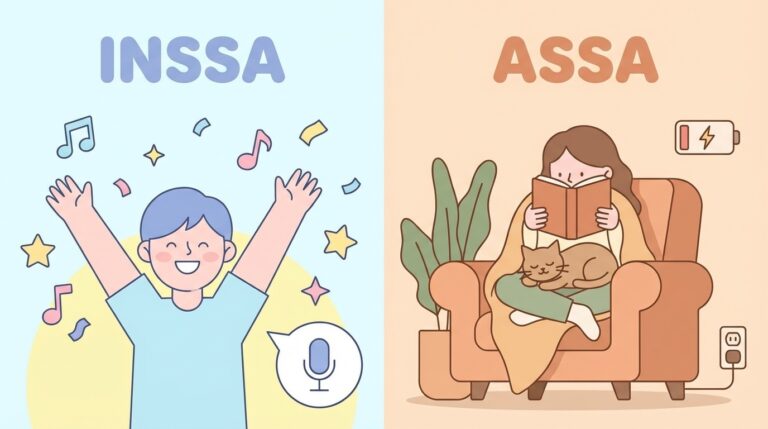
Phase 1: The Hook — “Wait, You Don’t Know Your Type?”
Hello! This is your Daily Hangul Editor. 👋
Picture this: You’ve just met a new group of Korean friends at a hip cafe in Hongdae. You’ve exchanged names, maybe asked about ages (the classic Korean hierarchy ritual), and then, barely 5 minutes into the conversation, someone leans in with intense curiosity and asks:
“So, is your MBTI E or I?”
If you hesitate or say “I don’t believe in that,” the air might freeze for a second. In modern Korea, MBTI isn’t just a personality test; it’s a social survival tool. It’s the new “What’s your blood type?” but on steroids. K-Pop idols wear their types on t-shirts, and variety shows group people by ‘E’ (Extrovert) and ‘I’ (Introvert) to create drama.
Being able to navigate this conversation is your ticket to being an ‘In-ssa’ (Insider). Today, we aren’t just learning adjectives like “shy” or “active.” We are diving into the B2-level slang and nuances that define the E vs. I dynamic in Korea.
Phase 2: Deep Dive — Core Expressions 🧠
Here are the three expressions that will make you sound like a local when discussing personality.
1. 기 빨려요 (Gi ppal-lyeo-yo)
- Pronunciation: [Gi ppal-lyeo-yo] + Sounds like ‘Key’ + ‘Pal’ (friend) + ‘Yoyo’
- Meaning:
- Literal: My energy is being sucked out.
- Real Nuance: “My social battery is dead.” / “This situation is draining me.”
- K-Culture Moment: An ‘I’ (Introvert) K-Pop idol at a chaotic after-party sits in the corner, staring into space. A caption appears: “기 빨리는 중…” (Energy draining in progress…)
- Editor’s Insight: This is the anthem of the Korean Introvert. It’s not necessarily negative; it just means you need to go home and recharge.
- Situation Spectrum:
[🚫 Formal Boss] ———— [⚠️ Colleagues] ———— [✅ Friends]- 🤔 Think About It: Why does Korean use the word ‘Gi’ (Energy/Qi) here? It reflects the cultural belief that social interaction is an exchange of vital energy.
2. 낯을 가리다 (Nacheul garida)
- Pronunciation: [Na-cheul ga-ri-da]
- Meaning:
- Literal: To screen/cover one’s face.
- Real Nuance: To be shy around strangers; to take time to warm up to new people.
- K-Culture Moment: A variety show guest introduces themselves: “I look like an ‘E’, but I actually na-cheul garyeoyo (am shy with strangers).”
- Editor’s Insight: This is a B2/C1 level phrase. Instead of saying the simple “Sukkki-ga eopseo” (I have no bashfulness/spirit), saying you “cover your face” sounds much more sophisticated and specific to the initial meeting phase.
- Situation Spectrum:
[✅ Formal Boss] ———— [✅ Colleagues] ———— [✅ Friends]3. 분위기 메이커 (Bunwigi Meikeo)
- Pronunciation: [Bun-wi-gi May-kuh]
- Meaning: Mood Maker / Life of the party.
- Editor’s Insight: This is the ultimate compliment for an ‘E’. In a collective society like Korea, someone who lifts the group’s energy (Bunwigi) is highly valued during Hoesik (company dinners).
- Situation Spectrum:
[✅ Formal Boss] ———— [✅ Colleagues] ———— [✅ Friends]
Phase 3: Textbook vs. Real Life 📖 vs 🗣️
| Situation | 📖 Textbook Korean | 🗣️ Real Korean (Slang/Trend) | 💡 Why the difference? |
|---|---|---|---|
| Asking Personality | 성격이 어때요? (Seonggyeogi eottaeyo?) |
너 MBTI 뭐야? E야 I야? (Neo MBTI mwoya? E-ya I-ya?) |
MBTI has become the standard shorthand for personality traits in 2020s Korea. |
| Being an Extrovert | 저는 외향적이에요. (Jeoneun oehyangjeogieyo.) |
저 완전 ‘인싸’ 재질이에요. (Jeo wanjeon ‘Inssa’ jaejirieyo.) |
‘Inssa’ (Insider) implies social competence and popularity, not just extroversion. |
| Staying Home | 집에 있는 걸 좋아해요. (Jibe inneun geol joahaeyo.) |
저는 ‘집순이/집돌이’예요. (Jeoneun Jipsuni/Jipdori-yeyo.) |
Creates a cute identity around being a homebody. |
💡 Editor’s Note: Jaejil (Material/Texture) is a trendy suffix meaning “I have the quality of…” e.g., “Boyfriend material” (Namchin jaejil).
Phase 4: Cultural Deep Dive — The ‘Nunchi’ Factor 👀
4-1. Non-verbal: The Silence of the ‘I’s
In Western culture, silence can be awkward. In Korea, if you are an ‘I’, silence is acceptable, provided you are still reading the room (Nunchi). If you are quiet but smiling and nodding, you are “observant.” If you are quiet and looking at your phone, you are “rude.”
4-2. K-Drama Connection: The ‘Tsundere’ Lead
Many K-Drama leads are classic ‘I’s who seem cold but are warm inside. They often claim, “I hate loud places,” yet end up at the pojangmacha (street food tent) protecting the ‘E’ lead who drank too much soju.
– Think: The rich CEO who hates people vs. the bubbling, optimistic part-timer. This clash of ‘E’ and ‘I’ is the backbone of Korean romance tropes.
Phase 5: Immersive Roleplay 🎭
Setting: A Friday night at a noisy Chicken & Beer (Chimaek) restaurant in Gangnam. You are with Minji (Korean friend, extreme ‘E’) and waiting for others.
Characters:
– YOU: An ‘I’ (Introvert) trying to survive the loud night.
– Minji: An ‘E’ (Extrovert) who wants to invite the table next to you to join.
Dialogue:
Minji: (Clapping hands) 와, 오늘 분위기 미쳤다! 우리 옆 테이블이랑 합석할까?
(Wa, oneul bunwigi michyeotda! Uri yeop teibeul-irang hapseok-halkka?)
(Wow, the vibe is crazy today! Should we join tables with the people next to us?)
YOU: (Looking slightly terrified)
…
🔀 Your Turn! How do you respond?
- A) “좋아요! 재미있겠네요!” (Pretend to be ‘E’)
- B) “아… 저는 좀 기 빨릴 것 같아요. 우리끼리 마셔요.” (Honest ‘I’ response)
- C) “낯을 좀 가려서요…” (Polite refusal)
✅ Best Choice: B or C
– Analysis: Unless you really want to party, honesty is better here.
– Option B uses the slang Gi ppal-lyeo (energy drained), which Minji will immediately understand and respect with a laugh.
– Option C (Nacheul garyeoyo) is a polite way to say “I’m shy with strangers” without ruining the mood.
Phase 6: 10-Second Shadowing Drill 🗣️
Try to mimic the exhaustion or excitement!
- (😓 Exhausted ‘I’ vibe)
사람이 / 너무 많아서 / 기 빨려요…
(Sarami / neomu manaseo / gi ppal-lyeo-yo…)
“There are too many people, my energy is draining…” -
(🤩 Excited ‘E’ vibe)
저는 / 새로운 사람 만나는 게 / 너~무 좋아요!
(Jeoneun / saeroun saram mannaneun ge / neo~mu joayo!)
“I lo~ve meeting new people!”
Phase 7: K-Culture Mini Glossary 📚
| Korean | Romanization | Meaning | Context |
|---|---|---|---|
| 인싸 / 아싸 | Inssa / Assa | Insider / Outsider | Inssa is popular/social; Assa is a loner (but can be a ‘voluntary Assa’ – Jabaljeok Assa). |
| 집순이 / 집돌이 | Jipsuni (F) / Jipdori (M) | Homebody | Someone who loves staying home. Often associated with ‘I’ types. |
| 극 E / 극 I | Geuk E / Geuk I | Extreme E / Extreme I | “Geuk” means extreme. Used to describe someone who is 100% one type. |
Phase 8: Traveler’s Survival Kit 🎒
Even if you aren’t living in Korea, you will meet Koreans in hostels or guesthouses who WILL ask your MBTI.
🆘 Survival Expression #1
– 🇰🇷 “저 MBTI 검사 안 해봤어요.” (Jeo MBTI geomsa an haebwasseoyo.)
– Meaning: “I haven’t taken the MBTI test.”
– 💡 Pro Tip: This might shock them. Be prepared for them to try to guess your type immediately!🆘 Survival Expression #2
– 🇰🇷 “저는 I 성향이 강해요.” (Jeoneun I seonghyang-i ganghaeyo.)
– Meaning: “I have strong ‘I’ tendencies.”
– 📍 Use when: You want to politely decline a loud party invitation.
Phase 9: Think Deeper — “Labeling Culture” 🧠
Why is Korea so obsessed with MBTI?
Korea is a “high-context” society where understanding your relationship relative to others is crucial. In the past, people used age, hometown, and blood type to quickly categorize and understand how to treat someone. MBTI has replaced blood types as a more “scientific” (though debatable) way to efficiently scan a person. It saves time in getting to know someone in the fast-paced Ppalli-Ppalli (Hurry-Hurry) culture.
💬 Your Turn: Does your country have a quick way to categorize personality? Zodiac signs? Hogwarts Houses? Tell me in the comments!
Phase 10: FAQ & Troubleshooting 🛠️
Q: Can I tell my boss “Gi ppal-lyeo-yo” (My energy is draining)?
A: 🚫 NO. That implies your boss or the work is annoying you. Only use it with friends. With a boss, just say “조금 피곤하네요” (I’m a little tired).
Q: Is being an ‘Assa’ (Outsider) an insult?
A: Not anymore. While Wang-tta (outcast) is bullying and negative, Assa is often reclaimed by introverts who enjoy their own company (My Way). You can proudly say, “I’m a joyful Assa!”
❌ Common Mistake:
Don’t say “I am boring” just because you are an Introvert. Koreans respect the “Quiet but thoughtful” type. Instead of “Jaemi eopseoyo” (I’m not fun), say “Jeoneun jo-yong-han pyeon-i-e-yo” (I’m on the quiet side).
Phase 11: Wrap-up & Action Mission 🎬
Summary: Today we learned that being an Inssa or Assa isn’t good or bad—it’s just a flavor! Use Gi ppal-lyeo when you’re tired of people, and check your Nunchi always.
🚀 Action Missions:
– 🥉 Bronze: Look in the mirror and define yourself: “Jeoneun [E/I] imnida.”
– 🥈 Silver: Watch a K-Drama interview on YouTube and listen for “MBTI.”
– 🥇 Gold: Ask a Korean friend (or language exchange partner): “MBTIga eotteoke doeseyo?” (What is your MBTI?)
Phase 12: Quiz — Are You Ready to Socialize? 📝
- Situation: Your friend wants to go to a club, but you want to go home and read. What do you say?
- A) 나 오늘 완전 인싸야! (I’m a total Inssa today!)
- B) 나 오늘 기 빨려서 쉬고 싶어. (My energy is drained, I want to rest.)
- C) 분위기 메이커네! (You are a mood maker!)
- True or False (K-Culture):
- In Korea, it is considered very rude to ask someone’s MBTI on the first meeting.
- (True / False)
Answers:
1. B (A is for when you have energy, C is a compliment to the friend).
2. False! It is actually a very common icebreaker in modern Korea to avoid awkwardness.
Frequently Asked Questions (FAQ)
Q: What does "기 빨려요 (Gi ppal-lyeo-yo)" mean in Korean and how do you pronounce it?
A: In Korean, "기 빨려요 (Gi ppal-lyeo-yo)" is pronounced [Gi ppal-lyeo-yo] and means: Literal: My energy is being sucked out.
Q: What does "낯을 가리다 (Nacheul garida)" mean in Korean and how do you pronounce it?
A: In Korean, "낯을 가리다 (Nacheul garida)" is pronounced [Na-cheul ga-ri-da] and means: Literal: To screen/cover one's face.
Q: What does "분위기 메이커 (Bunwigi Meikeo)" mean in Korean and how do you pronounce it?
A: In Korean, "분위기 메이커 (Bunwigi Meikeo)" is pronounced [Bun-wi-gi May-kuh] and means: Mood Maker / Life of the party.







