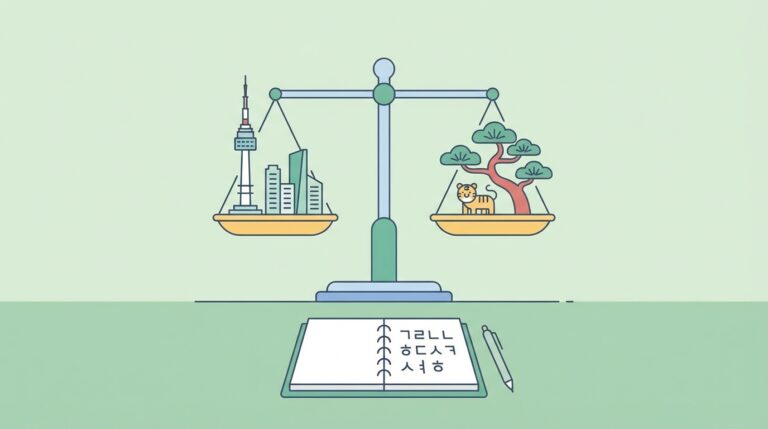
Phase 1: The Hook — More Than Just “It’s Hot Today”
Greeting: 안녕하세요! This is your Daily Hangul Editor, back with a topic that’s heating up—literally.
K-Culture Cold Open: You’ve seen it in K-Dramas like Extraordinary Attorney Woo (이상한 변호사 우영우). The protagonist obsesses over the Indo-Pacific Bottlenose Dolphins (남방큰돌고래). It wasn’t just a quirky character trait; it sparked a nationwide conversation about marine life conservation in Jeju. Or maybe you’ve noticed K-Pop idols like BTS RM posting about nature and art, or Blackpink acting as ambassadors for climate change conferences.
The ‘Why’: At the C1 level, you need to move beyond saying “날씨가 더워요” (It’s hot). You need to be able to discuss why the seasons are changing, why the bees are disappearing, and why that matters to our dinner tables. In Korea, where recycling is a competitive sport and fine dust (미세먼지) is a daily enemy, talking about the environment is talking about daily survival.
Transparency: This guide digs deep into the vocabulary of “Biodiversity (생물 다양성).” It’s tough, it’s necessary, and it’s how you sound like an intellectual in Seoul.
Phase 2: Deep Dive — 3 Key Expressions
1. 생태계 (Saeng-tae-gye)
- Pronunciation: [Saeng-tae-gye] + (Sounds like “Sang-tay-gyeh”)
- Meaning: Ecosystem (Literal & Metaphorical)
- K-Culture Moment: You will hear this in news about nature, but also in business news: “K-Pop 생태계” (The K-Pop ecosystem) or “스타트업 생태계” (Startup ecosystem). It implies a complex web of survival.
- Editor’s Insight: Use this word to sound analytical. It shows you see the big picture, not just individual elements.
- Situation Spectrum:
[🚫 Casual Slang] ———— [✅ Intellectual Conv/News] ———— [✅ Formal]- 🤔 Think About It: Why do Koreans often apply biological terms like “ecosystem” to business and culture? Does this reflect a view of society as an organic, living thing?
2. 공존하다 (Gong-jon-ha-da)
- Pronunciation: [Gong-jon-ha-da] + (Think “Gong” as in a bell + “Jon” as in John)
- Meaning: To coexist
- K-Culture Moment: Often used in documentaries about the DMZ (Demilitarized Zone), describing it as a place where tragedy and nature coexist. Also used when discussing urban development vs. green belts.
- Editor’s Insight: This is a “heavy” word. You wouldn’t use it to say “I coexist with my roommate.” You use it for nature, nations, or opposing ideologies.
- Situation Spectrum:
[🚫 Friends joking] ———— [⚠️ Serious Talk] ———— [✅ Debate/Presentation]- 🤔 Think About It: In a densely populated country like Korea, gongjon is a constant struggle. How does the Korean concept of “harmony” play into this?
3. 멸종 위기 (Myeol-jong wi-gi)
- Pronunciation: [Myeol-jong wi-gi]
- Meaning: Endangered crisis (Threat of extinction)
- K-Culture Moment: Variety shows like Law of the Jungle often mention animals in myeol-jong wi-gi. Also, when a favorite limited-edition snack disappears, Koreans jokingly say, “Is this snack in myeol-jong wi-gi?”
- Editor’s Insight: The word wi-gi (crisis) adds urgency. It’s not just “endangered”; it’s a “crisis of extinction.”
- Situation Spectrum:
[✅ Metaphorical Humor] ———— [✅ Environmental Discussion]- 🤔 Think About It: Korea has lost many native species (like the tiger) due to colonization and industrialization. How does this historical trauma affect the way Koreans view conservation today?
Phase 3: Textbook vs. Real Life
| Situation | 📖 Textbook Korean | 🗣️ Real Korean (C1 Level) | 💡 Why the difference? |
|---|---|---|---|
| Complaining about weather changes | 환경 오염 때문에 날씨가 이상해요. (The weather is strange because of pollution.) | 기후 위기라더니, 봄이 그냥 사라진 것 같아. (They said it’s a climate crisis, and it feels like spring just vanished.) | Real Koreans link the abstract “crisis” to the tangible loss of “seasons” (a huge cultural sentiment). |
| Discussing animals | 동물들을 보호해야 합니다. (We must protect animals.) | 생물 다양성이 무너지면 우리 식탁도 위험해져. (If biodiversity collapses, our dinner tables are in danger too.) | Koreans often link environmental issues to food security and daily life impact. |
| Recycling | 분리수거를 잘 합시다. (Let’s recycle well.) | 야, 이거 라벨 떼고 버려야지! (Hey, you gotta rip the label off before throwing it!) | Real life is about the specific rules of recycling etiquette (Nunchi). |
Phase 4: Cultural Deep Dive — The “Nunchi” of Recycling
4-1. The Silent Pressure of “Bunli-sugu” (Recycling)
In Korea, preserving the environment starts at the trash can. If you throw a plastic bottle with the label still on into the generic bin, you might get a side-eye (and in some apartments, a fine). This is Environmental Nunchi. You are expected to know that biodiversity protection starts with resource circulation.
4-2. K-Culture Connection: The DMZ Paradox
Let’s talk about the DMZ (Demilitarized Zone). It’s the most heavily fortified border in the world, yet it’s an accidental sanctuary for biodiversity.
– K-Drama Trope: In Crash Landing on You, the paragliding accident happens in a storm, but notice the lush, untouched forests? That’s the visual of the DMZ’s biodiversity.
– Critical View: It’s ironic that the safest place for Korean wildlife is a place where humans cannot go due to war. Is this true “preservation,” or just nature thriving in our absence?
Phase 5: Immersive Roleplay — The Climate Debate
Setting: A hip “Zero Waste” cafe in Mangwon-dong (Seoul). You are talking to Ji-eun, an eco-conscious friend who volunteers at an animal shelter.
Dialogue:
Ji-eun: 뉴스 봤어? 꿀벌이 사라져서 과일 값이 또 오른대. 🐝
(Nyuseu bwasseo? Kkulbeoli sarajyeoseo gwail gapsi tto oreundae.)
(English: Did you see the news? Fruit prices are going up again because the honeybees are disappearing.)
YOU:
(Choose your response!)
🔀 Your Turn! How do you respond?
– A) “정말 걱정이야. 생태계가 무너지면 인간도 공존할 수 없잖아.” (Really worried. If the ecosystem collapses, humans can’t coexist either.)
– B) “아, 그래서 딸기 값이 비쌌구나.” (Ah, so that’s why strawberries were expensive.)
– C) “벌이 없으면 꿀 못 먹어서 어떡해?” (What do we do if we can’t eat honey without bees?)✅ Best Choice: A
Analysis: Choice A uses C1 vocabulary (생태계, 공존) and shows deep critical thinking. Choice B is natural but a bit simple. Choice C sounds a bit too naive for this serious context.
Ji-eun: 맞아. 단순히 먹거리 문제가 아니라, 생물 다양성 전체가 위협받는 신호니까.
(Maja. Dan-sun-hi meok-geo-ri mun-je-ga a-ni-ra, saeng-mul da-yang-seong jeon-che-ga wi-hyeop-bat-neun sin-ho-ni-kka.)
(Exactly. It’s not just a food issue; it’s a signal that the entire biodiversity is threatened.)
YOU (Challenge):
“그런데 한국은 도시 개발이랑 환경 보존 사이에서 균형 잡기가 참 힘든 것 같아.”
(Geu-reon-de Han-guk-eun do-si gae-bal-i-rang hwan-gyeong bo-jon sa-i-e-seo gyun-hyeong jap-gi-ga cham him-deun geot ga-ta.)
(But it seems really hard for Korea to find a balance between urban development and environmental conservation.)
Phase 6: 10-Second Shadowing Drill
Read this aloud with a serious, contemplative tone.
😤 인간과 자연은 / 정복의 대상이 아니라 / 공존해야 할 파트너입니다.
(In-gan-gwa ja-yeon-eun / jeong-bok-ui dae-sang-i a-ni-ra / gong-jon-hae-ya hal pa-teu-neo-im-ni-da.)
Translation: Humans and nature are not subjects of conquest, but partners that must coexist.
Phase 7: K-Culture Mini Glossary
| Korean | Romanization | English | Context |
|---|---|---|---|
| 줍깅 | Jup-ging | Plogging | “Jup-da” (pick up) + Jogging. A trendy activity among young Koreans to pick up trash while jogging. |
| 비건 | Bi-geon | Vegan | Rapidly growing trend in Seoul. Not just diet, but “Vegan Beauty” is huge. |
| 가치 소비 | Ga-chi so-bi | Value Consumption | Spending money on brands that align with your values (ESG). |
| 제로 웨이스트 | Je-ro we-i-seu-teu | Zero Waste | Very popular hashtag in Korean social media. |
Phase 8: Traveler’s Survival Kit — Eco-Friendly Edition
Even travelers generate trash. Here is how to handle it without panicking.
🆘 Survival Expression #1: The Tumbler Discount
– 🇰🇷 “텀블러 가져왔는데 할인 되나요?” (Teom-beul-leo ga-jyeo-wat-neun-de ha-rin doe-na-yo?)
– 🗣️ Sounds like: Tum-bluh ga-juh-what-neun-day ha-rin day-na-yo?
– 📍 Where: Starbucks, Mega Coffee, most cafes.
– 💡 Pro Tip: Many cafes in Korea offer a discount (300-500 KRW) if you use your own cup. It’s a great way to save money and the planet.📌 Editor’s Note: The “Ice Cup” Dilemma
In Korean convenience stores, you buy an “Ice Cup” (plastic) for coffee. If you want to be eco-friendly, buy the pouch drink but pour it into your own reusable bottle!
Phase 9: Think Deeper — Nature as a Companion
Topic: Feng Shui (Pung-su) vs. Modernity
Traditionally, Koreans viewed nature through Pung-su (Feng Shui), believing mountains and rivers hold energy (Gi). A house should have a mountain behind it and water in front (Baesanimsu). Today, high-rise apartments often block these flows.
🧠 Think Deeper:
As Korea rapidly modernized, did the traditional respect for “nature’s flow” get lost, or is it returning through concepts like “Urban Forests” and “Cheonggyecheon Stream restoration”? How does your country balance ancient beliefs about nature with modern needs?
Phase 10: FAQ & Troubleshooting
Q: Can I use the word ‘짐승’ (Jim-seung) for animals?
A: ⚠️ Careful! Jim-seung means “beast” or “brute.” It’s often used as an insult for a human behaving badly. When talking about biodiversity, use 동물 (Dong-mul – Animals) or 생물 (Saeng-mul – Living things).
Q: Is it rude to ask for a paper straw?
A: No, but in Korea, many places are legally required to strictly limit disposable plastics. If they give you a soggy paper straw, just accept it as the taste of Gongjon (coexistence).
❌ Common Mistake:
Thinking “Food Waste” (음식물 쓰레기) includes chicken bones.
✅ Correction: Chicken bones, eggshells, and fruit pits are General Waste (일반 쓰레기) because animals cannot eat them (recycled food waste usually becomes animal feed).
Phase 11: Wrap-up & Action Mission
One-Liner: Biodiversity isn’t just science; in Korea, it’s about coexistence (공존) and responsible consumption (가치 소비).
Action Missions:
– 🥉 Bronze: Say “공존해야 합니다” (We must coexist) three times while looking at a plant.
– 🥈 Silver: Go to a Korean cafe Instagram account and comment using the hashtag #제로웨이스트 (Zero Waste).
– 🥇 Gold: Visit a “Refill Station” (like Almeng Shop in Seoul) or a Zero Waste shop in your city and ask about their products using today’s vocabulary.
K-Culture Mission: Watch an episode of Extraordinary Attorney Woo (specifically the Jeju dolphin episode) and listen for the word 방생 (releasing back to nature).
Phase 12: Interactive Quiz
1. Situational Judgment:
You are at a business meeting. Your boss asks for your opinion on the new eco-friendly project. What is the most C1-level professional response?
– A) “동물들이 좋아할 것 같아요.” (Animals will like it.)
– B) “우리 회사의 생태계를 확장하는 좋은 기회입니다.” (It’s a good opportunity to expand our company’s ecosystem.)
– C) “쓰레기를 줄여야죠.” (We should reduce trash.)
2. True or False – K-Culture Edition:
– In Seoul, you can throw banana peels in the “General Waste” bag. (T/F)
Answers:
1. B) (Uses ‘Ecosystem’ metaphorically and professionally.)
2. False! Banana peels are soft and animals can eat them, so they are Food Waste.
Frequently Asked Questions (FAQ)
Q: What does "생태계 (Saeng-tae-gye)" mean in Korean and how do you pronounce it?
A: In Korean, "생태계 (Saeng-tae-gye)" is pronounced [Saeng-tae-gye] and means: Ecosystem (Literal & Metaphorical)
Q: What does "공존하다 (Gong-jon-ha-da)" mean in Korean and how do you pronounce it?
A: In Korean, "공존하다 (Gong-jon-ha-da)" is pronounced [Gong-jon-ha-da] and means: To coexist
Q: What does "멸종 위기 (Myeol-jong wi-gi)" mean in Korean and how do you pronounce it?
A: In Korean, "멸종 위기 (Myeol-jong wi-gi)" is pronounced [Myeol-jong wi-gi] and means: Endangered crisis (Threat of extinction)