

Phase 1: The ‘Oops!’ Moment (Immersive Hook)
Greeting: 안녕하세요! (Hello!) This is your Daily Hangul Editor.
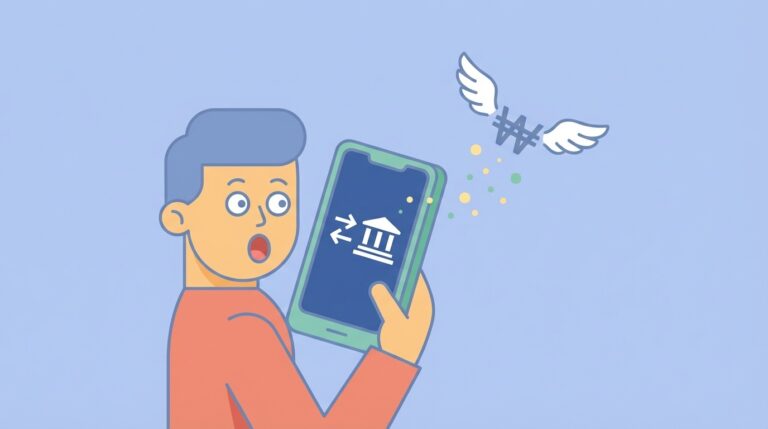
Scene: Picture this K-Drama moment. The protagonist is frantic. They just transferred their entire savings to pay for the villain’s blackmail… or so they thought. Suddenly, the camera zooms in on their shaking hand holding the phone. The name on the screen isn’t the villain. It’s their mom. 😱
The Reality: Okay, maybe your life isn’t that dramatic. But in Korea, where mobile banking is faster than a K-Pop idol’s rap verse, mistakes happen. You meant to send lunch money to your friend ‘Min-ji’, but you sent it to ‘Min-su’ (your boss).
Why this matters: If you don’t act fast, getting your money back can be a headache. Knowing exactly what to say can turn a “Disaster” into a simple “fixable error.”
Let’s learn how to handle this panic moment like a local!
Phase 2: Core Expressions (Deep Dive)
1. 잘못 보냈어요 (Jalmot bonaesseoyo)
- Pronunciation: [Jal-mot bo-nae-sseo-yo] + Sounds like ‘Jal’ (like jail) + ‘Mot’ (like moat) + ‘Bo-nae-sseo-yo’
- Meaning: I sent it wrongly / I made a mistake in sending it.
- K-Culture Moment: You’ll hear “jalmot” (wrongly/mistake) all the time in K-Dramas when a character kneels to apologize. “Joega jalmot haesseoyo!” (I made a mistake!). Here, we use it for money.
- Editor’s Insight: This is the magic phrase. It clarifies that it wasn’t a gift, but an accident. Say this immediately!
- Situation Spectrum:
[✅ Friends] — [✅ Bank Teller] — [✅ Boss]- 🤔 Think About It: In English, we focus on the object (“wrong person”). In Korean, we focus on the action (“wrongly sent”). Why do you think Korean emphasizes the action over the result?
2. 다시 보내주세요 (Dasi bonae-juseyo)
- Pronunciation: [Da-shi bo-nae-ju-se-yo]
- Meaning: Please send it back (again).
- K-Culture Moment: Think of a variety show game where someone fails, and they shout “Da-shi! Da-shi!” (Again! Again!). Here, you are asking them to perform the action of sending again.
- Editor’s Insight: It’s polite but firm. You add ‘juseyo’ (please give/do) to make it soft.
- Situation Spectrum:
[⚠️ Close Friends (Too formal)] — [✅ Strangers/Acquaintances]3. 계좌번호가 틀렸어요 (Gyejwabeonho-ga teullyeosseoyo)
- Pronunciation: [Gye-jwa-beon-ho-ga teul-lyeo-sseo-yo]
- Meaning: The account number is incorrect.
- Editor’s Insight: ‘Gye-jwa-beon-ho’ is a long word, but it’s essential for survival. It means Account Number.
- Situation Spectrum:
[✅ Calling the Bank] — [✅ Explaining to a friend]
Phase 3: Textbook vs. Real Life
| Situation | 📖 Textbook Korean | 🗣️ Real Korean | 💡 Why is it different? |
|---|---|---|---|
| Realizing the mistake | 송금을 잘못하였습니다. (I made an incorrect remittance.) | 아! 잘못 보냈다! (Ah! Sent it wrong!) | In panic mode, nobody uses formal words like ‘remittance’. Short & emotional is key! |
| Asking for money back | 반환해 주시겠습니까? (Would you please refund it?) | 다시 보내줄 수 있어? (Can you send it back?) | Using ‘refund’ sounds like you are a robot. We use ‘send back’ among friends. |
Bottom Note: If you are talking to a bank employee, stick to the Textbook/Polite versions. If it’s a friend, use the Real Life version!
Phase 4: Cultural Context — K-Culture Deep Dive
4-1. The “8282” (Hurry Hurry) Culture
Korean banking is instant. In many countries, transfers take days. In Korea, it takes seconds. This is part of the ‘Pali-pali’ (Fast-fast) culture.
- The Risk: Because it’s so fast, once you hit ‘Send’, the money is gone instantly. There is no “undo” button.
- The Nunchi (Eye-measure): If you send money to a friend by mistake, call them immediately. But if you sent it to a stranger, you must call your bank first, not the stranger (privacy laws make it hard to get their number).
4-2. The ‘Dutch Pay’ (N-bbang) Connection
Why do foreigners make this mistake often? Because of Group Orders (Gong-gu) or Dutch Pay.
* After lunch, one person pays, and everyone transfers their share instantly via apps like KakaoPay or Toss.
* Drama Trope: A character tries to look cool paying for everyone, then secretly texts friends: “Send me your share, 1/N.” This is when mistakes happen!
Phase 5: Immersive Roleplay Scenario
Setting: A chaotic Friday night at a Chicken & Beer (Chimaek) restaurant. You just tried to send 20,000 KRW to the restaurant owner for your takeout, but… oops.
Characters:
* YOU: A hungry student.
* Min-su: Your Korean friend (who is currently sitting at home playing games).
(You look at your phone. You sent the money to Min-su, NOT the owner!)
YOU: (Calling Min-su) 민수야, 큰일 났어! 😨
(Min-su-ya, keunil nasseo!)
(Min-su, big trouble!)
Min-su: 왜 그래? 무슨 일이야? 🎮
(Wae geurae? Museun iriya?)
(What’s wrong? What happened?)
🔀 Decision Point: How do you explain?
A) “돈을 잘못 보냈어. 다시 보내줘.” (I sent money wrongly. Send it back.)
B) “너한테 치킨 사줬어. 고맙지?” (I bought you chicken. Thank me, right?)
C) “계좌 이체 취소해 주세요.” (Please cancel the account transfer.)✅ Best Choice: A — Simple and clear. Min-su will understand immediately and send it back.
⚠️ Choice B Analysis: This is a funny joke! If Min-su is a close friend, he will laugh. But you might lose 20,000 won if he takes it seriously!
❌ Choice C Analysis: Too formal. You sound like you are talking to a bank teller, not a friend.
Min-su: 아, 진짜? 알았어. 바로 보낼게! 💸
(Ah, jinjja? Arasseo. Baro bonaelge!)
(Ah, really? Okay. I’ll send it right away!)
Phase 6: 10-Second Shadowing Drill
Let’s practice the panic! Repeat after me with emotion.
- 😨 Panic Mode:
아! / 잘못 / 보냈어요!
(Ah! / jal-mot / bo-nae-sseo-yo!) -
🙏 Polite Request:
돈을 / 다시 / 보내주세요.
(Do-neul / da-shi / bo-nae-ju-se-yo.)
Phase 7: K-Culture Mini Glossary
| Korean | Romanization | Meaning | Context |
|---|---|---|---|
| 계좌 이체 | Gye-jwa I-che | Bank Transfer | The most common way to pay friends in Korea. |
| 1/N (엔빵) | N-bbang | Split the bill | Koreans often say “Let’s do N-bbang” instead of “Dutch Pay”. |
| 토스 / 카카오페이 | Toss / KakaoPay | Finance Apps | The Venmo or CashApp equivalents of Korea. Everyone uses these. |
| 송금 | Song-geum | Remittance | The formal word on the button in the banking app. |
Phase 8: Traveler’s Survival Kit
Even if you are just traveling, you might need to visit a bank or exchange money.
🆘 Survival Phrases for Money
1. 🇰🇷 카드 돼요? (Ka-deu dwae-yo?)
* English: Do you accept cards?
* Use: Everywhere. Taxis, restaurants, convenience stores.
2. 🇰🇷 현금 영수증 해 주세요. (Hyeon-geum yeong-su-jeung hae ju-se-yo.)
* English: Please give me a cash receipt.
* Use: If you pay huge cash (unlikely for tourists, but good to know).📌 Editor’s Travel Note:
Korean ATMs often close around 11 PM or 12 AM (unless they are 24-hour convenience store ATMs). Always carry a little cash (KRW) for street food, but 99% of places take cards!
Phase 9: Think Deeper — “Trust in Numbers”
Topic: Why is banking so open?
In Korea, you will see people’s bank account numbers printed on wedding invitations, business cards, and even Instagram profiles for donations.
🧠 Think About It: Why are Koreans comfortable sharing sensitive data like account numbers? It reflects a high-trust society and the necessity of the “Pali-pali” (Hurry-hurry) lifestyle. Speed is valued over extreme privacy in daily transactions. Does this shock you compared to your home country?
Phase 10: FAQ & Troubleshooting
Q: I sent money to a stranger’s account. Can I call them?
A: No. You probably don’t have their number. Due to privacy laws, the bank cannot give you their number. You must call your bank and ask for a “Return Request” (Chako Song-geum Ban-hwan).
Q: Can I use ‘Cancel’ (Jwiso) after sending?
A: Usually, no. Korean transfers are instant. Once it’s gone, it’s gone. Double-check the name before hitting send!
❌ Common Mistake #1: Saying “Sorry” (믴안해요/Mianhaeyo) to the bank teller.
✅ Fix: Use “Jalmot bonaesseoyo” (I sent it wrong). The teller needs facts, not an apology!
Phase 11: Wrap-up & Action Items
One-Liner: When you send money to the wrong person, don’t panic—just say “Jalmot bonaesseoyo!”
🚀 Action Mission:
* 🥉 Bronze: Look at your banking app. Find the word “Transfer” or “Confirm”. (It might say 이체 or 확인).
* 🥈 Silver: Practice saying “Account number” (Gye-jwa-beon-ho) 5 times fast. It’s a tongue twister!
* 🥇 Gold: Watch a K-Drama scene where someone pays for a meal. Do they use a card or phone? Observe!
💬 Your Turn: Have you ever made a mistake with money in a foreign country? Tell me your horror story in the comments!
Phase 12: Quiz — Survival Challenge
Scenario: You are at a cafe. You accidentally transferred the coffee money to your ex-boyfriend instead of the cafe owner. What do you say to the cafe owner (not the ex)?
- “사랑해요.” (I love you.)
- “잠시만요, 잘못 보냈어요.” (Wait a moment, I sent it wrongly.)
- “맛있게 드세요.” (Enjoy your meal.)
- “깎아주세요.” (Please give me a discount.)
🔽 Answer & Explanation:
Correct: 2. You need to explain why payment is delayed.
* 1 is… awkward.
* 3 is polite but weird here.
* 4 might work at a market, but not after a mistake!
Frequently Asked Questions (FAQ)
Q: What does "잘못 보냈어요 (Jalmot bonaesseoyo)" mean in Korean and how do you pronounce it?
A: In Korean, "잘못 보냈어요 (Jalmot bonaesseoyo)" is pronounced [Jal-mot bo-nae-sseo-yo] and means: I sent it wrongly / I made a mistake in sending it.
Q: What does "다시 보내주세요 (Dasi bonae-juseyo)" mean in Korean and how do you pronounce it?
A: In Korean, "다시 보내주세요 (Dasi bonae-juseyo)" is pronounced [Da-shi bo-nae-ju-se-yo] and means: Please send it back (again).
Q: What does "계좌번호가 틀렸어요 (Gyejwabeonho-ga teullyeosseoyo)" mean in Korean and how do you pronounce it?
A: In Korean, "계좌번호가 틀렸어요 (Gyejwabeonho-ga teullyeosseoyo)" is pronounced [Gye-jwa-beon-ho-ga teul-lyeo-sseo-yo] and means: The account number is incorrect.







