

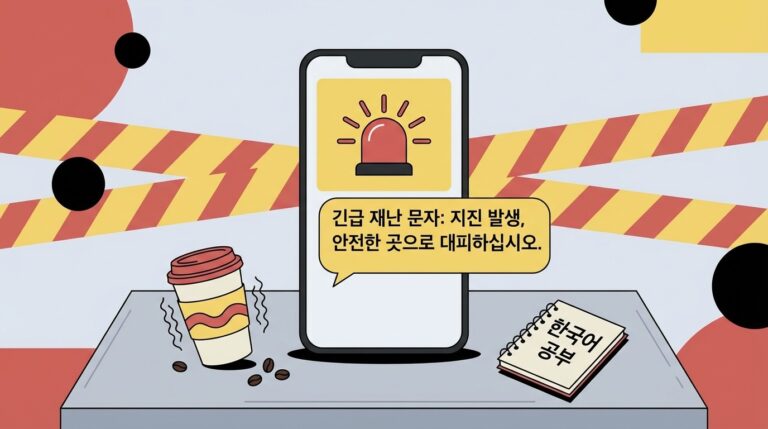
Phase 1: The Alarm That Stops Seoul 🚨
Greeting: 안녕하세요! It’s your Daily Hangul editor.
Imagine this: You are in a trendy cafe in Hongdae, sipping an Iced Americano. Suddenly, every single phone in the cafe starts screaming at the exact same time. WEEE-WEEE-WEEE! 📲🔊
If you’ve watched Korean disaster movies like Tunnel or Ashfall, your heart might skip a beat. Is it a zombie apocalypse? An alien invasion?
Usually, it’s a “Safety Disaster Alert” (재난 문자). While Korea is relatively safe from massive earthquakes compared to its neighbors, tremors do happen, and the government sends alerts instantly.
In that split second of confusion, knowing just three words can save you from freezing in panic. Today, we aren’t just learning words; we are learning survival instincts.
Let’s get safe.
Phase 2: Deep Dive — 3 Words to Save Your Life
Since this is an emergency, we are skipping the fancy grammar. We need short, punchy, survival commands.
1. 지진이에요! (Ji-jin-i-e-yo!)
- Pronunciation:
Jee-jin-ee-eh-yo- Ji (지): Sounds like the “G” in Gee whiz.
- Jin (진): Sounds like the alcohol Gin.
- Meaning: “It’s an earthquake!”
- K-Culture Moment: In dramas, this is the line shouted by the observant character right before the lights start flickering. It breaks the denial phase.
- Editor’s Insight: Even if you aren’t sure, saying this alerts others. In an emergency, being loud is better than being polite.
- Situation Spectrum:
[🚫 Formal Speech] ———— [⚠️ Polite] ———— [✅ Urgent/Loud]- Note: In a real emergency, you might just scream “지진!” (Ji-jin!) dropping the polite ending. That is totally acceptable.
- 🤔 Think About It: Why does Korean have a specific word for earthquake (
Ji-jin) derived from Chinese characters (Earth + Shake), while English uses a compound word? It shows how information was historically categorized in East Asia.
2. 숨으세요! (Su-meu-se-yo!)
- Pronunciation:
Soo-meu-seh-yo- Sum (숨): Sounds like Zoom but with an ‘S’.
- Eu (으): Make the sound you make when you see something gross, “Eww” (but pull your lips back).
- Meaning: “Please hide!” / “Take cover!”
- K-Culture Moment: You’ll hear this in thriller movies when the protagonist pushes a child under a desk. It’s a protective command.
- Editor’s Insight: This is technically polite (
-seyo), but it functions as a strong command. Use this to tell your friends to get under the table.
3. 나가요! (Na-ga-yo!)
- Pronunciation:
Na-ga-yo- Na (나): Like Nachos.
- Ga (가): Like Garden.
- Meaning: “Let’s go out!” / “Get out!”
- Situation Spectrum:
[🚫 To Boss] ———— [⚠️ To Stranger] ———— [✅ To Group]- Used when the shaking stops and you need to evacuate.
Phase 3: Textbook vs. Real Life Survival
When the ground shakes, grammar books go out the window.
| Situation | 📖 Textbook Korean | 🗣️ Real Survival Korean | 💡 Why different? |
|---|---|---|---|
| Identifying | 지진이 발생했습니다. (An earthquake has occurred.) | 지진이야!! (Earthquake!!) | No time for subjects and polite endings. Short = Fast. |
| Commanding | 책상 밑으로 들어가십시오. (Please enter under the desk.) | 숙여! / 숨어! (Get down! / Hide!) | Survival instinct takes over social hierarchy. |
| Evacuating | 밖으로 대피합시다. (Let us evacuate outside.) | 나가! 빨리! (Out! Hurry!) | Adrenaline removes the “Let us” suggestion nuance. |
Bottom Note for A1: In a real emergency, if you shout “STOP!” or “GO!” in English, people will understand the urgency. But knowing “지진” (Earthquake) helps you understand why everyone is running.
Phase 4: Cultural Context — The “Safety Korea” Vibe
4-1. The “Alert” Culture (Non-verbal)
In Korea, phones are capable of making a sound louder than a rock concert. When the Emergency Alert (Jae-nan Mun-ja) goes off, don’t be the only one looking around confused.
* Nunchi Tip: If everyone looks at their phone and goes back to drinking coffee, it’s just a COVID update or a heatwave warning. If everyone looks up with wide eyes… follow them.
4-2. K-Drama Connection: The Hero Trope
In dramas like Descendants of the Sun, disaster scenes are often where romance blooms. The lead character always protects the other’s head with their hand.
* Reality Check: In real life, don’t wait for a handsome captain to save you. Grab your bag, cover your head, and get under a table. K-Dramas romanticize the chaos; reality requires speed.
Phase 5: Immersive Roleplay 🎭
Setting: You are in a crowded underground shopping mall (COEX) in Seoul. It’s Saturday afternoon. Suddenly, the floor vibrates and signs start shaking.
Characters:
* YOU: A tourist shopping for souvenirs.
* Min-su: A shop staff member next to you.
Dialogue:
Min-su: (Eyes wide open, holding a shelf) 어? 지진이에요?
(Eo? Ji-jin-i-e-yo?)
(English: Huh? Is it an earthquake?)
YOU: (Noticing the lights swaying) 네, 지진이에요!
(Ne, Ji-jin-i-e-yo!)
(English: Yes, it’s an earthquake!)
Min-su: (Pointing under the display table) 여기! 숨으세요!
(Yeo-gi! Su-meu-se-yo!)
(English: Here! Hide!)
(Stage Direction: The shaking stops after 10 seconds.)
Min-su: 괜찮아요? 이제 나가요.
(Gwaen-chan-a-yo? I-je na-ga-yo.)
(English: Are you okay? Let’s go out now.)
🔀 Decision Point! How do you respond?
* A) “가방을 챙겨야 해요!” (I need to grab my bag!)
* B) “네, 빨리 나가요!” (Yes, let’s go out quickly!)✅ Best Choice: B. In Korean safety culture, speed is key. Don’t worry about the bag.
⚠️ Choice A Analysis: While human, holding up an evacuation to pack items is a huge “No-No” in Korean safety protocols.
Phase 6: 10-Second Shadowing Drill 🗣️
Practice this until it’s muscle memory.
Emotion: 😨 Urgent & Loud
지진이에요! / 머리 조심하세요!
(Ji-jin-i-e-yo! / Meo-ri / jo-sim-ha-se-yo!)
“It’s an earthquake! / Watch your head!”
Phase 7: K-Culture Mini Glossary 📘
| Korean | Romanization | Meaning | Context |
|---|---|---|---|
| 재난 문자 | Jae-nan Mun-ja | Disaster Text | The loud alert sent by the gov. to all phones. |
| 대피소 | Dae-pi-so | Shelter | Usually schools or parks designated for safety. |
| 비상구 | Bi-sang-gu | Emergency Exit | Look for the green running man sign! |
| 119 | Il-il-gu | 911 (Emergency) | The number for Fire & Rescue in Korea. |
Phase 8: Traveler’s Survival Kit 🆘
If you are traveling in Korea, you must know these.
🆘 Survival Card #1: The Magic Number
* 🇰🇷 “일일구 (119)”
* 🗣️ Pronunciation:Il-Il-Goo
* 📍 Usage: Fire, Rescue, Ambulance. (For Police, it’s 112).
* 💡 Pro Tip: Korean 119 has interpretation services. Just say “English please.”📌 Editor’s Travel Note
* App to Download: “Emergency Ready App” (Provided by Korean Gov for foreigners).
* Subway Safety: Every subway station has gas masks in cabinets. Look for “구호용품” (Relief Goods).
Phase 9: Think Deeper — “Why so loud?”
Topic: The Culture of Shared Responsibility
Have you noticed how Koreans often shout commands to everyone in a crisis, not just their family? “Everyone, get down!” or “Everyone, move!”
In Western individualism, the focus might be on personal safety first. In Korean collectivism, there is a strong sense of shared fate. The loud alerts and shouting are annoying to some, but they reflect a society that values collective synchronization in the face of danger. If one person survives but the group fails, it is seen as a tragedy.
💬 Your Turn: Does your country have a national alarm system for phones? How do people react to it? Ignore it or panic?
Phase 10: FAQ & Troubleshooting
Q: Can I use Banmal (casual speech) to an older person during an earthquake?
A: YES! 100% Yes. If a chandelier is falling, shouting “비켜!” (Move!) is not rude; it’s lifesaving. Safety overrides Confucian hierarchy in immediate danger.
Q: What if I don’t understand the Disaster Text (Korean only)?
A: Translate apps like Papago allow you to take a screenshot and translate the image. Also, most urgent alerts (Level 1) are now being broadcast in English too, but local ones might still be Korean.
❌ Common Mistake:
* Running to the elevator.
* ✅ Correction: Korea has many high-rises. Never use the elevator (Ell-li-bei-teo) during a quake or fire. Use the stairs (Gye-dan).
Phase 11: Wrap-up & Mission
One-Liner: When the ground shakes, shout “Ji-jin!” and hide under the table.
🚀 Action Missions:
* 🥉 Bronze: Say “지진이에요!” (It’s an earthquake!) out loud 3 times with urgency.
* 🥈 Silver: Find the “Emergency Ready App” on your app store and download it.
* 🥇 Gold: Next time you are in a building (office, hotel), find the green 비상구 (Exit) sign and point to it saying “Na-ga-yo!”
🎬 K-Culture Mission: Watch the trailer for the Korean movie “Tunnel” (터널) on YouTube. Can you spot the moment the character realizes something is wrong?
Phase 12: Quiz — Will You Survive? 🧩
- Situation: You feel the ground shaking. What do you shout to warn others?
- A) 안녕하세요! (Hello!)
- B) 지진이에요! (It’s an earthquake!)
- C) 얼마예요? (How much is it?)
- Culture Check: True or False?
- “In an emergency, you must still use the highest honorifics to elders in Korea.”
- (Answer: False! Safety first!)
- Survival: Which number do you call for rescue in Korea?
- A) 911
- B) 119
- C) 8282
(Scroll down for answers)
.
.
.
Answers: 1-(B), 2-(False), 3-(B)
Frequently Asked Questions (FAQ)
Q: What does "지진이에요! (Ji-jin-i-e-yo!)" mean in Korean and how do you pronounce it?
A: In Korean, "지진이에요! (Ji-jin-i-e-yo!)" is pronounced [Jee-jin-ee-eh-yo] and means: a key conversational Korean expression covered in this lesson.
Q: What does "숨으세요! (Su-meu-se-yo!)" mean in Korean and how do you pronounce it?
A: In Korean, "숨으세요! (Su-meu-se-yo!)" is pronounced [Soo-meu-seh-yo] and means: a key conversational Korean expression covered in this lesson.
Q: What does "나가요! (Na-ga-yo!)" mean in Korean and how do you pronounce it?
A: In Korean, "나가요! (Na-ga-yo!)" is pronounced [Na-ga-yo] and means: a key conversational Korean expression covered in this lesson.







