

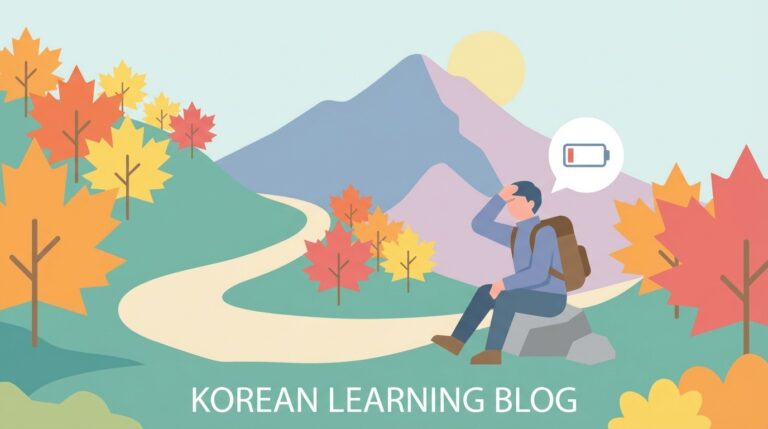
Phase 1: The ‘My Legs Are Jelly’ Moment ⛰️
Hello, Daily Hangul family! It’s your editor here.
Picture this: You are watching a K-Drama. The couple is hiking up a beautiful mountain (probably Namsan or Bukhansan). The girl trips, or stops breathing heavily, and the guy immediately offers a piggyback ride. Romantic, right?
But in reality? You are halfway up a steep trail in Seoul, your legs are shaking like noodles, and the Korean Ajummas (middle-aged ladies) and Ajusshis (middle-aged men) are zooming past you in professional gear, not even breaking a sweat.
If you don’t speak up now, your energetic Korean friends might march you all the way to the peak without stopping! Today, we learn the survival phrase to save your legs (and your dignity).
Phase 2: Deep Dive — Key Expressions 🧠
Here are the three phrases you need when gravity becomes your enemy.
1. 다리 아파요 (Dari apayo)
- Pronunciation: [Da-ri a-pa-yo]
- Da sounds like the start of ‘Dad’.
- Ri sounds like ‘Ree’ in ‘Read’.
- A like ‘Ah’ (doctor says open wide).
- Pa like ‘Part’.
- Meaning: “My legs hurt.” (Literal: Leg hurts).
- K-Culture Moment: Think of a reality show where idols have to do extreme training. You’ll hear them whining, “Ah, dari apayo~” to the camera.
- Editor’s Insight: This is a direct statement. It doesn’t explicitly ask to stop, but any Korean with Nunchi (social sense) will understand you need a break.
- Situation Spectrum:
[🚫 Formal Speech] ——— [⚠️ Colleagues (Use with polite tone)] ——— [✅ Friends]- 🤔 Think About It: In English, we say “My legs hurt.” In Korean, we often drop “my” (jeo-ui). Why? Because it’s obvious whose legs are hurting! Korean loves efficiency.
2. 좀 쉴까요? (Jom swilkkayo?)
- Pronunciation: [Jom swil-kka-yo?]
- Jom rhymes with ‘Home’ but shorter.
- Swil sounds like ‘Sh’ + ‘Wheel’.
- Meaning: “Shall we rest a bit?”
- Editor’s Insight: This is the magic phrase. Instead of saying “I want to stop” (which sounds selfish), you propose a shared activity: “Shall we rest?” It’s polite and considerate.
- Situation Spectrum:
[🚫 Army General] ——— [⚠️ Boss] ——— [✅ Anyone else]3. 힘들어요 (Himdeureoyo)
- Pronunciation: [Him-deu-reo-yo]
- Him like ‘Him’.
- Deu like the French ‘De’ or the sound you make when disgusted ‘Eugh’.
- Meaning: “It is hard/tough/tiring.”
- K-Culture Moment: You will hear this 100 times in any K-Drama where the main character works part-time jobs all night. “Working is hard” = “il-i himdeureoyo.”
Phase 3: Textbook vs. Real Life 🗣️
| Situation | 📖 Textbook Korean | 🗣️ Real Korean | 💡 Why is it different? |
|---|---|---|---|
| Your legs really hurt | 다리가 아픕니다. (Dariga apeumnida) | 아, 다리 아파… (Ah, dari apa…) | Nobody uses the formal robot-style speech while sweating on a mountain! Self-talk is usually casual. |
| Asking for a break | 우리 휴식할까요? (Uri hyusikhalkkayo?) | 좀 쉬었다 가요! (Jom swieotda gayo!) | ‘Hyusik’ is too formal (like ‘recess’). ‘Swieotda gayo’ (Let’s rest then go) implies we aren’t quitting, just pausing. |
Phase 4: Cultural Deep Dive — The ‘Hiking Lie’ 🤥
4-1. Non-verbal Cue: The Heavy Breathing
Koreans are masters of non-verbal cues. Before you even say “My legs hurt,” try stopping, putting your hands on your hips or knees, and exhaling loudly (“Huuuh~”). Your Korean friend will likely notice instantly.
4-2. K-Culture: The Great “Almost There” Lie
If you hike in Korea, you will meet an older hiker coming down while you go up. If you ask “Is it far?”, they will 100% say:
“Almost there! Just 5 more minutes!” (Da wasseo! O-bun man!)”
Do not trust this. It is a white lie to give you hope. It usually means 20-30 minutes left. It represents the Korean spirit of Jeong (encouragement/affection) — they want you to succeed, not give up!
Phase 5: Immersive Roleplay — The Never-ending Staircase 🎭
Setting: A sunny Saturday morning at Bukhansan National Park. The trail is endless stairs. You are sweating buckets.
Characters:
* YOU: A beginner hiker who regrets skipping leg day.
* Min-su (30): Your energetic Korean friend who hikes every weekend.
Dialogue:
Min-su: 야, 날씨 진짜 좋다! 빨리 와! ☀️
(Ya, nalssi jinjja jota! Ppalli wa!)
(Hey, the weather is so good! Come on quickly!)
YOU: (Panting heavily) 민수 씨, 잠깐만요… 다리 아파요. 😫
(Minsu-ssi, jamkkanmanyo… Dari apayo.)
(Min-su, wait a second… My legs hurt.)
Min-su: 에이, 벌써? 거의 다 왔어! 조금만 힘내! 💪
(Ei, beolsseo? Geoui da wasseo! Jogeumman himnae!)
(Eh, already? We’re almost there! Cheer up a little!)
🔀 Your Turn! How do you respond?
- A) “거짓말 하지 마세요!” (Don’t lie to me!) — Direct & slightly aggressive.
- B) “네, 가요…” (Okay, let’s go…) — The submissive sufferer.
- C) “진짜 못 가요. 좀 쉴까요?” (I really can’t go. Shall we rest a bit?) — Assertive but polite.
✅ Best Choice: C. You need to be clear about your limits, or Min-su will drag you to the top without water! Using “Shall we?” keeps the mood friendly.
Phase 6: 10-Second Shadowing Drill 🎤
Repeat after the guide. Pay attention to the emotion!
- 😢 Whining tone: 아… / 다리 / 너무 / 아파요. (Ah… / dari / neomu / apayo.)
- Translation: Ah… my legs hurt so much.
- 🥵 Out of breath: 우리 / 여기서 / 좀 / 쉴까요? (Uri / yeogiseo / jom / swilkkayo?)
- Translation: Shall we rest a bit here?
- 😤 Determined (Self-talk): 할 수 있어! (Hal su isseo!)
- Translation: I can do it!
Phase 7: K-Culture Mini Glossary 📚
| Korean | Romanization | Meaning | Context |
|---|---|---|---|
| 등산 | Deungsan | Hiking | The national pastime of Korea. |
| 정상 | Jeongsang | Peak/Summit | The goal. Everyone takes a photo here. |
| 막걸리 | Makgeolli | Rice Wine | The mandatory reward AFTER the hike. |
| 파전 | Pajeon | Green onion pancake | Makgeolli’s best friend. |
| 야호 | Yaho | Yaho | The sound people shout at the summit (less common now due to noise pollution rules). |
Phase 8: Traveler’s Survival Kit (Hiking Edition) 🆘
If you are hiking in a Korean National Park, memorize these survival cards.
🆘 Survival Expression #1
– 🇰🇷 “얼마나 더 가야 해요?” (Eolmana deo gaya haeyo?)
– 🗣️ Sounds like: [Ol-ma-na duh ga-ya hey-yo]
– Meaning: How much further do we have to go?
– Use when: You think you might die if you take one more step.🆘 Survival Expression #2
– 🇰🇷 “화장실 어디예요?” (Hwajangsil eodiyeyo?)
– Meaning: Where is the restroom?
– Pro Tip: Bathrooms are usually at the entrance or major rest stops, rarely near the peak!
Phase 9: Think Deeper — Food & Identity 🧠
Why do Koreans hike to eat?
In many Western cultures, hiking is about solitude, nature, and a protein bar. In Korea, hiking is often a social event that ends with a feast. You will often see hikers sharing kimbap, cucumbers, and fruits on the trail, and then heading straight to a restaurant for Makgeolli (rice wine) and Pajeon (pancakes) afterwards. The suffering of the climb makes the food taste better. It reflects the Korean culture of “working hard, playing hard” together.
💬 Your Turn: Does your culture have a specific food you eat after exercise? Tell us in the comments!
Phase 10: FAQ & Troubleshooting 🛠️
- Q: Can I say “힘들어” (Himdeureo) to my boss?
- A: No! That is casual language (Banmal). You must add “-yo” at the end: “힘들어요” (Himdeureoyo). Even better, try not to complain too much to your boss unless you are really fainting!
- Q: People keep offering me cucumbers. Why?
- A: Cucumbers represent hydration in Korean hiking culture. It is polite to accept one, say “Thank you” (Gamsahamnida), and eat it!
❌ Common Mistake:
Sitting down in the middle of a narrow trail to rest.
✅ Do this: Move to the side (designated rest areas or flat rocks) so you don’t block the “pali-pali” (hurry-hurry) hikers behind you.
Phase 11: Wrap-up & Mission 🚀
Summary: Today we learned how to say your legs hurt (dari apayo), suggest a break (jom swilkkayo?), and that “we are almost there” is usually a lie.
Your Mission:
* 🥉 Bronze: Say “Ah, dari apayo” out loud next time you walk up some stairs.
* 🥈 Silver: Watch a hiking scene in a K-Variety show (like 2 Days 1 Night) and listen for “Himdeureo!”
* 🥇 Gold: Go for a walk with a friend and suggest a break in Korean: “Jom swilkkayo?”
K-Culture Mission: Search for “Korean Hiking Food” on Instagram. Warning: It will make you hungry!
Phase 12: Quiz — Interactive Challenge 📝
- Situation: Your friend Min-su is running up the mountain. You need water and a break. What is the BEST thing to say?
- A) 너 미쳤어? (Are you crazy?)
- B) 좀 쉴까요? (Shall we rest a bit?)
- C) 안녕히 계세요. (Goodbye.)
- True or False: If an Ajusshi says “Just 5 more minutes” to the peak, it means exactly 300 seconds.
- (True / False)
- Fill in the blank: To say “My legs hurt” politely, you say: “Dari ______.”
- A) apayo
- B) apa
- C) happy-yo
(Scroll down for answers)
.
.
.
Answers: 1. (B), 2. (False – it’s a trap!), 3. (A)
Frequently Asked Questions (FAQ)
Q: What does "다리 아파요 (Dari apayo)" mean in Korean and how do you pronounce it?
A: In Korean, "다리 아파요 (Dari apayo)" is pronounced [Da-ri a-pa-yo] and means: a key conversational Korean expression covered in this lesson.
Q: What does "좀 쉴까요? (Jom swilkkayo?)" mean in Korean and how do you pronounce it?
A: In Korean, "좀 쉴까요? (Jom swilkkayo?)" is pronounced [Jom swil-kka-yo?] and means: a key conversational Korean expression covered in this lesson.
Q: What does "힘들어요 (Himdeureoyo)" mean in Korean and how do you pronounce it?
A: In Korean, "힘들어요 (Himdeureoyo)" is pronounced [Him-deu-reo-yo] and means: a key conversational Korean expression covered in this lesson.







